Editorial
Select search scope: search across all journals or within the current journal


Total thyroidectomy (TT) and hemithyroidectomy (HT) are acceptable surgical options for the treatment of low-risk differentiated thyroid cancer (DTC). While previous data suggest similar disease-free and disease-specific survival regardless of initial surgical treatment, the effect of the extent of surgery on health-related quality of life (HRQOL) is less clear. This systematic review aimed to examine HRQOL in low-risk DTC survivors after TT compared with HT.
A search of PubMed, CINAHL, Cochrane, PsycINFO, and Scopus databases was conducted to identify studies published between January 1, 2011, and December 31, 2022, that assessed HRQOL predominantly in patients with low-risk DTC who underwent open thyroid surgery. Covidence™ software was used to apply the inclusion criteria, and a validated instrument was used to assess study quality.
Sixteen of the 1402 identified studies were included: 5 prospective and 11 retrospective cohort studies. The majority of included studies were of good quality (
Differences in HRQOL after HT and TT tended to favor HT particularly when measured <6 months after surgery or when compared with TT with CND. Additional prospective and ideally randomized data are needed to fully determine the impact of the extent of surgery on HRQOL in patients with low-risk thyroid cancer.
Rearranged during transfection (
Adult patients with advanced/metastatic
As of October 18, 2021, the measurable disease population comprised of 61 patients with
In this updated analysis of the ARROW study, pralsetinib continued to show deep and durable clinical activity and a manageable safety profile in patients with advanced/metastatic
An accurate preoperative workup of cytologically indeterminate thyroid nodules (ITN) may rule out malignancy and avoid diagnostic surgery for benign nodules. This study assessed the performance of molecular diagnostics (MD) and 2-[18F]fluoro-2-deoxy-
Adult, euthyroid patients with a Bethesda III or IV thyroid nodule were prospectively included in this multicenter study. They all underwent MD and an [18F]FDG-PET/CT scan of the neck. MD was performed using custom next-generation sequencing panels for somatic mutations, gene fusions, and copy number alterations and loss of heterozygosity. Sensitivity, specificity, negative and positive predictive value (NPV, PPV), and benign call rate (BCR) were assessed for MD and [18F]FDG-PET/CT separately and for a combined approach using both techniques.
In 115 of the 132 (87%) included patients, MD yielded a diagnostic result on cytology. Sensitivity, specificity, NPV, PPV, and BCR were 80%, 69%, 91%, 48%, and 57% for MD, and 93%, 41%, 95%, 36%, and 32% for [18F]FDG-PET/CT, respectively. When combined, sensitivity and specificity were 95% and 44% for a double-negative test (i.e., negative MD plus negative [18F]FDG-PET/CT) and 68% and 86% for a double-positive test, respectively. Concordance was 63% (82/130) between MD and [18F]FDG-PET/CT. There were more MD-positive nodules among the [18F]FDG-positive benign nodules (25/59, 42%, including 11 (44%) isolated RAS mutations) than among the [18F]FDG-negative benign nodules (7/30, 19%,
MD and [18F]FDG-PET/CT are both accurate rule-out tests when unresected nodules that remain unchanged on ultrasound follow-up are considered benign. It may vary worldwide which test is considered most suitable, depending on local availability of diagnostics, expertise, and cost-effectiveness considerations. Although complementary, the benefits of their combined use may be confined when therapeutic consequences are considered, and should therefore not routinely be recommended. In nononcocytic ITN, sequential testing may be considered in case of a first-step MD negative test to confirm that withholding diagnostic surgery is oncologically safe. In oncocytic ITN, after further validation studies, MD might be considered.
This trial is registered with
The criteria for determining technical efficacy of thermal ablation for papillary thyroid carcinoma (PTC) are not clearly defined. We analyzed the involution process of the ablation zone with clear pathologic results on core-needle biopsy (CNB) to clarify the relationship between sonographic changes and pathologic findings.
This retrospective cohort study included 382 patients with unifocal T1N0M0 PTC who underwent radiofrequency ablation (RFA) between May 2014 and August 2021. Patients with a single ablation zone biopsy (recommended at 3 or 6 months for T1a and 6 or 12 months for T1b) and regular neck ultrasound (US)/contrast-enhanced ultrasound imaging follow-up at 1, 3, 6, and 12 months and every 6–12 months thereafter after RFA were included. Patients also underwent yearly chest computed tomography. CNB was performed in the target lesion ablation zone's central, peripheral, and surrounding thyroid parenchyma to detect the presence of tumor cells. If the thyrotropin (TSH) was >2 mU/L, levothyroxine was prescribed with the intention of keeping the TSH 0.5–2 mU/L. Technical efficacy was defined as tumor disappearance by imaging follow-up together with the pathologically confirmed absence of tumor cells in the ablation zone.
During the mean follow-up period of 67.8 ± 18.2 months (22–110 months), the overall incidence of persistent disease and the technical efficacy rate were 3.9% (15/382; 2.9% of T1a, and 12.2% of T1b) and 96.1%, respectively. Tumor size (
US-guided RFA is an effective treatment for small low-risk PTC. Tumor disappearance on US after RFA may suggest an excellent prognosis and confirm complete ablation of the macroscopic tumor, but this sonographic finding is generally late and requires histological confirmation.
The impact of near-infrared autofluorescence (NIRAF) imaging on postthyroidectomy hypocalcemia is controversial. As patients with Graves' disease are at increased risk, our aim was to compare postoperative parathyroid function in these patients undergoing total thyroidectomy (TT) with or without NIRAF imaging.
This was a retrospective “before and after” study, comparing outcomes of patients who underwent TT without or with NIRAF imaging at a single center. Primary outcome was the incidence of temporary hypocalcemia and secondary outcomes, rates of incidental parathyroidectomy on final specimens and permanent hypocalcemia. Analyses were performed using Mann-Whitney U and chi-Square tests. Continuous data are expressed as median (interquartile range).
There were 85 patients in NIRAF and 100 patients in non-NIRAF group. Groups were comparable regarding age, gender, body-mass index, and thyroid weight. Number of parathyroid glands identified intraoperatively was 3 in both groups (
To our knowledge, this is the first comparative study investigating the impact of NIRAF on postoperative parathyroid function after thyroidectomy for Graves' disease. The rate of incidental parathyroidectomy on final pathology was lower with use of NIRAF, without an impact on temporary or permanent hypocalcemia rates compared to conventional technique.
Redifferentiation therapy (RDT) can restore radioactive iodine (RAI) uptake in differentiated thyroid cancer (DTC) cells to enable salvage 131I therapy for previously RAI refractory (RAIR) disease. This study evaluated the clinical outcomes of patients who underwent RDT and identified clinicopathologic characteristics predictive of RAI restoration following RDT.
This is a retrospective case series of 33 patients with response evaluation criteria in solid tumors (RECIST)-progressive metastatic RAIR-DTC who underwent RDT between 2017 and 2022 at the Mayo Clinic (Rochester, MN). All patients underwent genomic profiling and received MEK,
Of the 33 patients, 57.6% had restored RAI uptake following RDT (Redifferentiated subgroup). 42.1% (8/19) with papillary thyroid cancers (PTC), 100% (4/4) with invasive encapsulated follicular variant PTCs (IEFV-PTCs), and 100% (7/7) with follicular thyroid cancers (FTC) redifferentiated. All (11/11)
RDT has the potential to restore RAI avidity and induce RECIST responses following 131I therapy in select patients with RAIR-DTC, particularly those with
Nasolacrimal duct obstruction (NLDO) is an adverse effect of high dose radioactive iodine (RAI) therapy for thyroid carcinoma. There are currently no established preventive measures. This study assesses whether preservative free artificial tears (PFATs) can decrease the 131I sodium iodide (131I) activity in the tears of patients following RAI therapy for thyroid carcinoma, and potentially serve as a preventive measure for RAI-associated NLDO.
This non-randomized prospective pilot clinical trial recruited contact-lens wearing patients undergoing RAI therapy for thyroid cancer to self-administer PFATs into the right eye for four days starting on the day of RAI ingestion. Left eyes were the controls. While wearing contacts, patients self-administered PFATs per the following—Day 1: every 15 minutes for 2 hours, then every 30 minutes until bedtime, day 2: every hour for at least 12 hours, day 3: four times a day, and day 4: two times a day. Contact lenses were changed daily, and all lenses were collected one week later. Levels of 131I activity were measured by a well counter, decay-corrected, and converted to units of becquerel. Statistical analyses were performed to compare the 131I activities of the experimental and control eyes.
Sixteen eyes of eight patients treated with an average of 145.7 mCi (range 108–159) of 131I for papillary thyroid cancer were included. On day 1, artificial tears decreased the geometric mean 131I activity by 26% in the experimental eyes (
131I is present in the tears following RAI therapy for thyroid carcinoma. Frequent PFATs starting on the day of RAI ingestion may decrease the level of 131I in the tears. This finding could have implications for lowering the risk of NLDO. Future multi-center clinical trials are needed to determine whether the use of artificial tears after RAI therapy may decrease the risk of NLDO.
NCT04327999
Risk stratification systems for thyroid nodules are limited by low specificity. The fine-needle aspiration (FNA) biopsy size thresholds and stratification criteria are based on evidence from the literature and expert consensus. Our aims were to investigate the optimal FNA biopsy size thresholds in the American College of Radiology (ACR) Thyroid Imaging Reporting and Data System (TI-RADS) and artificial intelligence (AI) TI-RADS and to revise the stratification criteria in AI TI-RADS.
A total of 2596 thyroid nodules (in 2511 patients) on ultrasound examination with definite pathological diagnoses were retrospectively identified from January 2017 to September 2021 in 6 participating Chinese hospitals. The modified criteria for ACR TI-RADS were as follows: (1) no FNA for TR3; (2) FNA threshold for TR4 increased to 2.5 cm. The modified criteria for AI TI-RADS were as follows: (1) 6-point nodules upgraded to TR5; (2) no FNA for TR3; (3) FNA threshold for TR4 increased to 2.5 cm. The diagnostic performance and the unnecessary FNA rate (UFR) of modified versions were compared with the original ACR TI-RADS.
Compared with the original ACR TI-RADS, the modified ACR (mACR) TI-RADS yielded higher specificity (73% vs. 46%), accuracy (74% vs. 51%), area under the receiver operating characteristic curve (AUC; 0.80 vs. 0.70), and lower UFR (25% vs. 48%; all
The revised FNA thresholds and the stratification criteria of the mACR TI-RADS and mAI TI-RADS may be associated with improvements in specificity and accuracy, without significantly sacrificing sensitivity for malignancy detection.
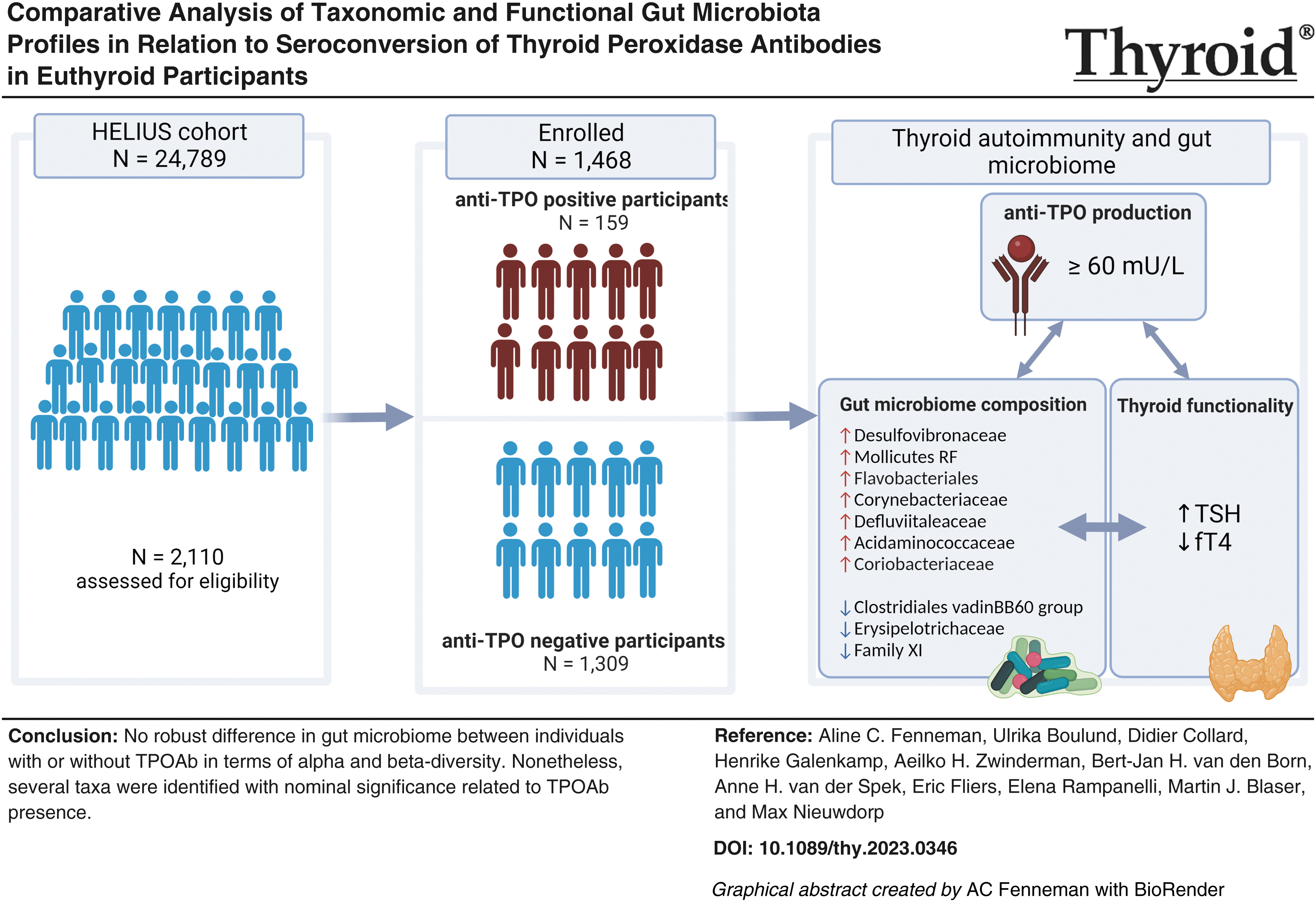
Previous studies have reported gut microbiome alterations in Hashimoto's autoimmune thyroiditis (HT) patients. Yet, it is unknown whether an aberrant microbiome is present before clinical disease onset in participants susceptible to HT or whether it reflects the effects of the disease itself. In this study, we report for the first time a comprehensive characterization of the taxonomic and functional profiles of the gut microbiota in euthyroid seropositive and seronegative participants. Our primary goal was to determine taxonomic and functional signatures of the intestinal microbiota associated with serum thyroid peroxidase antibodies (TPOAb). A secondary aim was to determine whether different ethnicities warrant distinct reference intervals for accurate interpretation of serum thyroid biomarkers.
In this cross-sectional study, euthyroid participants with (
Overall composition showed a substantial overlap between the two groups (
These findings suggest that there is no robust difference in gut microbiome between individuals with or without TPOAb in terms of alpha and beta-diversity. Nonetheless, several taxa were identified with nominal significance related to TPOAb presence. Further research is required to determine whether these changes indeed imply a higher risk of overt HT.
Although recent studies have introduced antibiotics as a potential risk factor for thyroid cancer, further studies are necessary. We examined the association between long-term antibiotic usage and thyroid cancer risk.
This nationwide cohort study investigated 9,804,481 individuals aged 20 years or older who participated in health screening (2005–2006) with follow-up ending on December 31, 2019, using the Korean National Health Insurance Service database. Multivariable Cox proportional hazards regression was used to estimate adjusted hazard ratios (aHRs) and 95% confidence intervals (CIs) for thyroid cancer risk according to the cumulative days of antibiotic prescription and the number of antibiotic classes, respectively. A 1:1 propensity score (PS) matching was also performed for analysis.
Compared with nonusers of antibiotics, participants prescribed ≥365 days of antibiotics showed an increased risk of thyroid cancer (aHR, 1.71; CI, 1.66–1.78) after adjusting for covariates including age, smoking status, comorbidities including thyroid-related diseases, and the number of head and neck computed tomography scans. Participants prescribed ≥365 days of antibiotics also had a significantly increased risk of thyroid cancer (aHR, 1.37; CI, 1.34–1.40) compared with participants prescribed 1–14 days of antibiotics. Association remained significant in the 1:1 PS-matched cohort. Moreover, compared with nonusers of antibiotics, the 5 or more antibiotic class user group had a higher thyroid cancer risk (aHR, 1.71; CI, 1.65–1.78).
Long-term antibiotic prescriptions and an increasing number of antibiotic classes may be associated with a higher risk of thyroid cancer in a duration-dependent manner. The effects of long-term antibiotic exposure on thyroid cancer should be further investigated.
Graves' disease has been associated with adverse pregnancy, labor and delivery, and neonatal outcomes. Thyroid function levels, assessed during newborn screening (NBS), can serve as indicators of the adaptation in the hypothalamic–pituitary–thyroid axis. We utilized data from the national thyroid NBS program to investigate the characteristics of the mother–infant dyad of term infants born to mothers with past or active Graves' disease.
The dataset of the Israeli NBS for thyroid function was linked with the electronic records of a tertiary medical center to generate a unified database of mothers and their term infants born between 2011 and 2021. The MDClone big data platform extracted maternal, pregnancy, disease course, labor and delivery, and neonatal characteristics of the mother-infant dyads.
Out of 103,899 registered mother–infant dyads, 292 (0.3%) mothers had past or active Graves' disease. A forward multivariate linear regression demonstrated that Graves' disease did not significantly affect NBS total thyroxine (tT4) levels (
Neonatal thyroid function levels were affected by maternal Graves' disease only when the disease was active during gestation. Moreover, maternal Graves' disease was also associated with an increased risk of adverse outcomes for the mother–infant dyad.