Announcement
Select search scope: search across all journals or within the current journal


Multidrug resistant infections are a challenge in the health care setting and a cause of patient morbidity and mortality. Bacteriophages (phages) are viruses that target and kill bacteria and have been used in patients to treat bacterial infections. We present a case of disseminated
Phages are known as a promising method to combat antimicrobial resistance (AMR) in the human and veterinary sector. Use of phage aerosols enormously increases the application field, although the impact on the infectivity of phages during nebulization needs to be evaluated. In this study
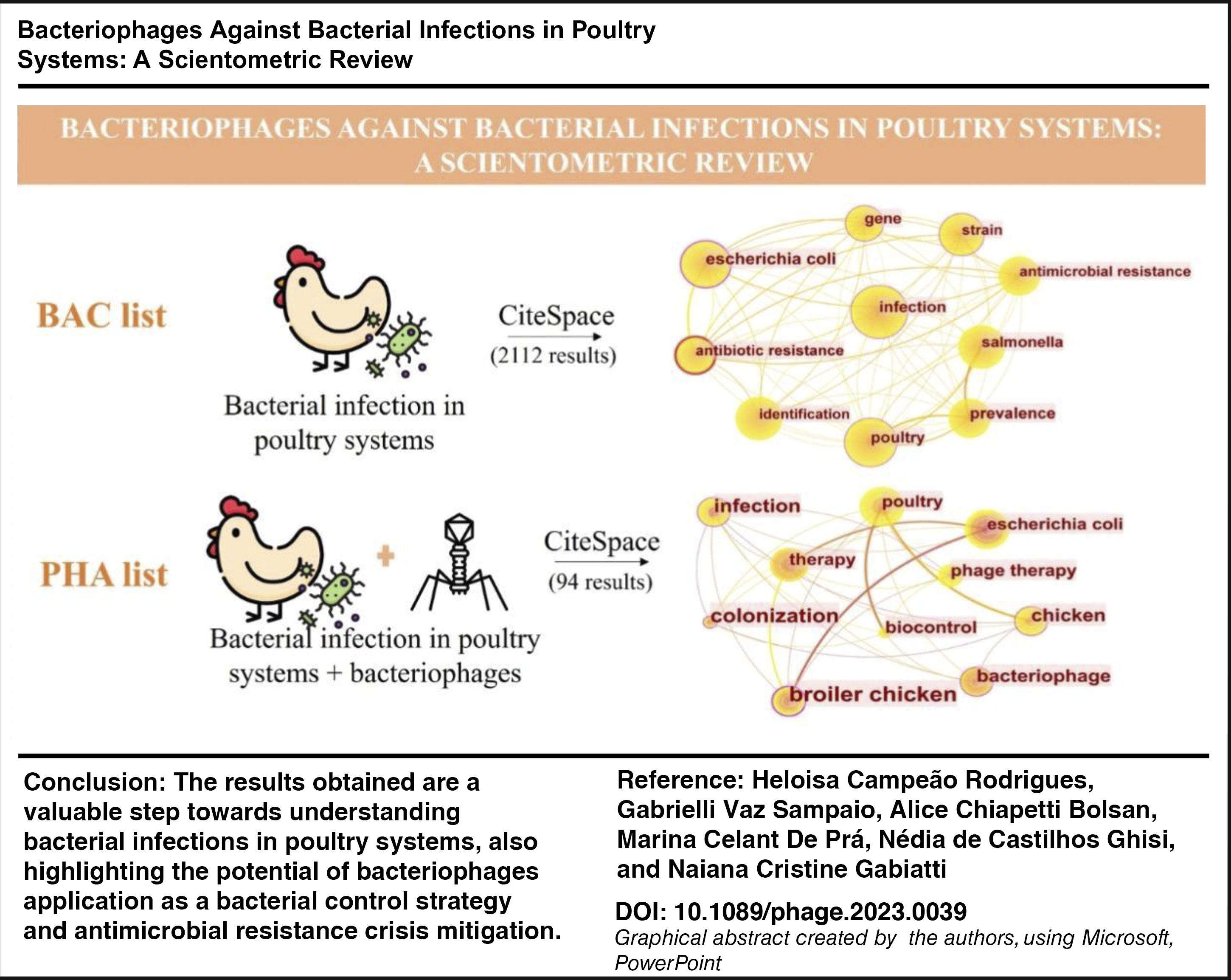
Poultry production faces challenges from bacterial infections, aggravated by antibiotic resistance, affecting bird welfare and the industry’s economy. Bacteriophages show promise as a solution, but their use in poultry systems is still limited. This study uses scientometric analysis to investigate the incidence of bacterial infections in poultry systems and bacteriophage application trends. The Web of Science database was used, and the articles were refined by searching for keywords that included the most reported bacteria in the different phases of poultry farming and the application of phages. The articles were analyzed using the CiteSpace and Excel software, allowing the evaluation of publication trends, influential countries, and correlations with antimicrobial resistance and the use of bacteriophages. Results highlight
The avian pathogen
This study evaluated the safety of SalmoFree®, a bacteriophage cocktail, administered to 276 laying hens from the first week of age until the 28th week. The hens were divided into two groups: a control group (138 birds) and a treatment group (138 birds). Over the 28-week period, eight doses of SalmoFree® (∼1010 UFP per bird) were administered via drinking water in a controlled environment.
The results indicate that the consumption of SalmoFree® has no adverse effects on bird health or zootechnical parameters. Additionally, there is a trend toward improving weight homogeneity (up to 19%), feed conversion (up to 68%), and egg weight (up to 2.7%). The detection of phages by PCR in cloacal swabs suggests that they persist in birds for 2 to 8 weeks post-ingestion. Furthermore, phages were detected in organs and eggshells, indicating that they provide protection beyond the gut.
The study demonstrates that SalmoFree® is safe for use in laying hens and may offer additional benefits, such as improved zootechnical parameters and extended protection against S. Gallinarum through the persistence of bacteriophages in the birds.
Key features of the actinobacterial genus
As part of a public outreach program within the priority program SPP 2330, involving local schools, we describe the isolation and characterization of five novel
All isolates are virulent members of two existing genera and, additionally, establish a new genus in the
Taken together, phages Ankus, Byblos, DekoNeimoidia, Mandalore, and Naboo expand the phage diversity and contribute to ongoing research in the field of
The emergence of antibiotic-resistant
Two new phages, P2 and vB_AhydM-H1, targeting pathogenic
Phage P2, a member of genus
Safe for environmental and clinical use because of their lytic nature, and lack of virulence and resistance genes, these newly isolated phages expand the arsenal against antibiotic-resistant
TLS is a virulent bacteriophage of
The genome was reannotated using the latest online resources and compared to other T1-like phages.
The TLS genome consists of 49,902 base pairs, encoding 86 coding sequences that display considerable sequence similarity with the T1 phage genome. It also contains 18 intergenic 21-base long repeats, each of them upstream of a predicted start codon and in the direction of transcription. Data revealed that DNA packaging occurs through the
Based on sequence analysis of its genome, TLS belongs to the