




Abstract
This paper provides a comprehensive literature review of mathematical models in cross docking planning. From the reviews, the models are classified in three different levels regarding its decisions level which are operational, tactical, and strategic level. The researches in operational level are mainly related to develop model in scheduling, dock door assignment, transhipment problem, vehicle routing, and product allocation. For tactical and strategic level, the researches are mainly proposing model to design the layout and the network of cross docking respectively. The contribution of this paper is to realize the gaps of knowledge in strategic, tactical and operational levels and point out the future research directions in cross docking.
Keywords
1. Introduction
Cross docking has been known as the strategy of logistic in which the products from several suppliers can be consolidated become a single shipment. The cross docking makes possible to ship product in Truck Load (TL) rather than Less Than Truck Load (LTL). The cross docking also can minimize (eliminate) order picking and storage activity, since the receiving product will be load immediately within 24 hours to the outbound dock door. Thus only receiving and shipping activity occur in the cross docking. Compare with traditional warehouse, in this warehouse the receiving products will be put in the storage area and stored it. When the customer order comes, the products will be picked and shipped to the customer. In addition, because of its nature the cross docking is best suitable for products that have stable demand and fast moving items, such as perishable products and agricultural products (Apte and Viswanathan, 2000).
Therefore, the cross docking offers many benefits than the traditional warehouse. Applying cross docking in the distribution network can reduce the transportation cost and the inventory holding cost and increase cycle time and customer satisfaction. It has been reported some success application using cross docking strategy, such as Wal-Mart and Toyota (Apte and Viswanathan, 2000).
In order to obtain such benefits, the company should be able to operate the cross docking effectively and efficiently. The cross docking can only provide a great advantageous if it applied in a good manner. The researches in cross docking planning models are driven by this motivation, to improve and make the operation in the cross docking becomes more efficient and effective.
To the best of our knowledge, there is little number of papers that reviewed the cross docking planning model from operational to strategic aspect. One work in the reviewing the cross docking models was done by Boysen and Fliedner (2009) but their review was limited in the cross docking scheduling problem.
Objective of this paper is to present a general picture of the mathematical models in the cross docking planning model. The paper reviews what are the previous researches have been done in improving the cross docking operation from operationally to strategically aspect. Therefore the contribution of this paper is providing a comprehensive literature review of the mathematical models in the cross docking planning. Then the models are classified and some future researches are identified.
2. Review Methodology
The literatures has been searched using keywords “cross docking” and “crossdocking” and using several academic search engines, these are Engineering Village, Science Direct, Academic Search Premier, Taylor and France, Elsevier, International Journal of Business Logistic, OR Practices, IIE Transactions, Omega, and IEEE Explorer. This study only reviewed journals or proceedings published in international journals and conferences in English language.
From the selected papers, it was collected about 50 (fifty) papers related with cross docking planning models and be reviewed. The review adopted some methodology done by Mula, et al. (2009) in reviewing the mathematical programming models for supply chain production and transport planning and Boysen and Fliedner (2009) in reviewing the cross docking scheduling model.
3. Classification
The criteria used to classify the models are consists of several criteria. These are shown in Figure 1:
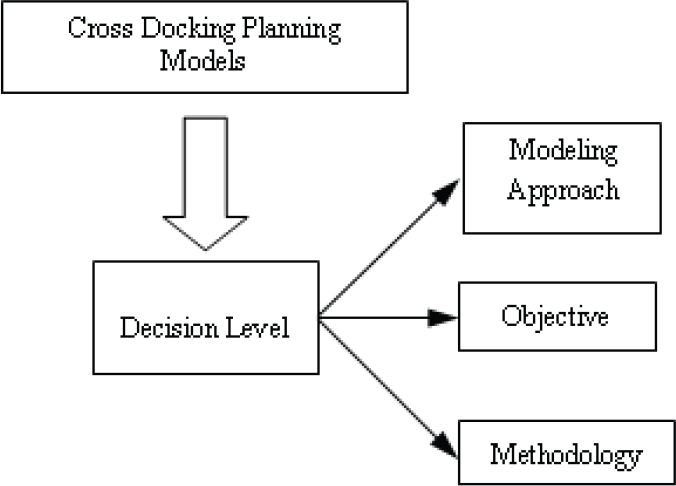
Criteria of the classification
Referring to the figure above, the classification of the models are based on its decision levels, which are operational, tactical, and strategic level. From its decision levels, the models will be further studied regarding three factors, which are its objective, modelling approach, and methodology.
3.1 Operational Level
In order to operate and manage the cross docking efficiently, it is required some decisions in the operational level. Operational decision level involves decisions in the short term planning horizon (i.e. daily, weekly). Some works have been done in the operational level to improve the efficiency of its operation. These researches are grouping in five problems area. These are scheduling problem, transhipment problem, dock door assignment problem, vehicle routing problem, and product allocation problem. Among these problems, not much researches done in the vehicle routing and product allocation problem. The review found that Lee, et al. (2006) and Wen, et al. (2009) studied the vehicle routing problem and Li, et al. (2008, 2009) studied the product allocation problem in the cross docking. Therefore, in this level, further review will be done only for the scheduling, transhipment, and dock door assignment problems.
3.1.1 Scheduling Problem
The truck (or some models using trailer) scheduling is important decision in the cross docking operation, since it manages the cross docking operation daily. The smoothness of operation inside the cross docking is related with its good scheduling. It determines the sequences of inbound and outbound trucks. The poor truck scheduling can affect congestion, poor product flow, long processing times (makespan) which in turn create higher cost than saving for money. Therefore, the objective of some proposed models for the scheduling problem is minimizing the makespan in order to minimize the cost. The models in the cross docking scheduling problem are reviewed below.
Li, et al. (2004) proposed a model based on Just In Time (JIT) scheduling to minimize the storage time and order picking activity. They developed Integer Programming (IP) model that objective is to minimize the total penalty of earliness and tardiness in incoming and outgoing container. They proposed meta-heuristic procedure to solve the problem. These are Squeaky Wheel Optimization embedded in a Genetic Algorithm and Linear Programming within a Genetic Algorithm.
The work of Li, et al. (2004) has been extended by Alvarez-P'erez, et al. (2009). Using the same model, Alvarez-P'erez, et al. (2009) developed different meta-heuristic procedure, entitled Reactive GRASP and Tabu Search (RGTS) that works more efficient and effective than in the Li, et al. (2004).
McWilliams, et al. (2005) studied the parcel hub scheduling problem. The problem is modelled as Linear Programming model which the objective is to minimize the time span of transfer operation. The model determines the schedule of trailer in the unload dock. Then simulation-based scheduling algorithm using Genetic Algorithm (GA) is proposed.
Larbi, et al. (2007) studied the scheduling of transhipment operation inside the cross docking to minimize the total cost of inventory holding cost and truck replacement cost. The model consist of one stack and one strip door (one inbound and one outbound door). The problem is modelled as graph based model and solution using shortest path methodology is proposed. Then their work is extended by Larbi, et al. (2009). In this research, they considered the multiple inbound and outbound doors and modelled it as a dynamic programming model. The heuristic methods are proposed to solve the model.
Ley and Elfayoumy (2007) developed a scheduling model of inbound and outbound truck to minimize the distances. They proposed Genetic Algorithm (GA) to solve the problem. In the same year, Song and Chen (2007) studied two stages cross docking model which is the model consists of multiple inbound vehicles and one outbound vehicle. The objective of the model is to minimize the makespan and then heuristic methods based on Johnson's rule are proposed.
Yu and Egbelu (2008) developed a scheduling model for single truck in inbound and outbound dock and combine it with the assignment of the products. The model can determine the truck schedule and product allocation simultaneously. The objective of the model is to minimize the total operation time when a temporary storage buffer to hold items temporarily is located at the shipping dock. Their work has been continued by Vahdani and Zandieh (2010) through proposing five meta-heuristic methods to solve and improve the solution obtained from heuristic approach in Yu and Egbelu (2008). These five methods are Genetic Algorithm (GA), Tabu Search (TS), Simulated Annealing (SA), Electromagnetism-like Algorithm (EMA) and Variable Neighbourhood Search (VNS). These methods are proven can solve the problem faster and better than in Yu and Egbelu (2008).
Shakeri, et al. (2008) combined the truck scheduling problem with the dock door assignment problem together. They developed a generic model for truck scheduling and truck to dock door assignment problem and modelled it as MIP model.
The model developed by Chen and Lee (2009) is related with the model of Song and Chen (2007). In Chen and Lee (2009), the model consists of one inbound and one outbound trailer, in which in Song and Chen (2007) the model consists of multiple inbound vehicles and one outbound vehicle. The objective of Chen and Lee (2009) model is to minimize the makespan. The problem is modelled as a two-machine flow shop problem and the Branch and Bound algorithm is used to solve the model. They work then has been extended by Chen and Song (2009), through modifying the model in which at least one stage has parallel machine, entitled hybrid cross-docking scheduling problem. In this model, the inbound and outbound trailers can be more than one. The problem is modelled as Mixed Integer Programming (MIP) model and solved by heuristic method based on Johnson's rule.
Chen, et al. (2009) studied two-stage scheduling problem and proposed several heuristic algorithms to address the scheduling problems with performance analysis. There are three types of machines (parallel, uniform, and open-shop) that are considered in the scheduling problem. In each case, besides heuristic algorithms and approximation ratio analysis, some special polynomially solvable cases are introduced.
Boysen and Fliedner (2009) contributed in presenting a comprehensive literature review in the cross docking scheduling model. Then some classifications and future research in the truck scheduling models are identified.
Wei, et al. (2009) proposed the best rule of dispatching the truck. The parameter used is the throughput and the system is assisted by RFID technology. The studied found that the best strategy of dispatching is SRT (Shortest remaining production time) rule.
Maknoon and Baptiste (2009) proposed a truck scheduling model for the inbound and outbound semitrailer. The difference of this model from the others is the objective of the model. This objective is to minimize the moving path for products rather than the travel distance or congestion. The model is limited to single incoming and outgoing door. Dynamic programming and heuristic approach are proposed for solving the model.
Work of McWilliams (2009) is related with the previous one (McWilliams, et al., 2005). In this work, he proposed a dynamic load-balancing algorithm to solve the parcel hub scheduling problem and modeled it as linier binary model.
Boysen, et al. (2010) studied the truck scheduling problem in which one inbound door serves one outbound door. This work is similar with the work of McWilliams, et al. (2005) and Yu and Egbelu (2008). The problem is modelled as Mixed Integer Programming model and the objective is to minimize the makespan. The model is solved using decomposition approach.
Boysen (2010) proposed a truck scheduling model in food industry context, in which forbid any storage. The products that already came in the receiving dock are loaded immediately to the outbound truck then ship to the customer because of strict cooling requirement. The objective of the model is to minimize the flow time, processing time, and tardiness of outbound trucks. Dynamic programming and Simulated Annealing are proposed to solve the model.
3.1.2 Transhipment Problem
The transhipment model is related with answering of four questions these are how much to ship, between which locations, on which routes, and at what times (Lim, et al., 2005). Some works have been done in the transhipment problem since operation inside the cross docking can be modelled as transhipping from inbound to outbound dock. It determines the product flow allocation to the outbound dock for fulfilling customer demand.
The transhipment model in cross docking, firstly studied by Lim, et al. (2005). They extended the traditional transhipment model through considering the inventory, capacity of cross docking, and time window constraint in the model. The study developed some variant models combining of fixed/flexible scheduling, multiple/single shipping, and multiple/single delivery.
The work of Miao, et al. (2008) is related with Lim, et al. (2005). They studied the transhipment problem where the transportations have fixed schedule and shipping and delivery only execute within time windows. The model's objective is minimizing the shipping and inventory holding cost and solved by Genetic Algorithm.
Related with two previous studies, Miao, et al. (2009) developed one model in Lim, et al. (2005). They formulated an Integer Programming model for the fixed schedule and single shipping and delivery. The objective is to minimize the transportation cost, holding penalty cost, and holding inventory cost and methodology based on Genetic Algorithm is proposed.
3.1.3 Assignment Problem
Many researches have studied the dock door assignment problem. It is a critical issue since it determines the short and mid term planning in the cross docking operation. The good assignment of dock doors will effect the operation in it become more efficient. Some works in the dock door assignment problems are presented below.
First study in dock door assignment was done by Tsui and Chang (1990). They developed a model to determine the assignment of receiving doors to the origins and shipping doors to the destinations. The objective of the model is to minimize the travel distance of the forklifts. A microcomputer based tool based on bilinier programming is proposed to solve the model. The work is extended by Tsui and Chang (1992). In this paper, Tsui and Chang (1992) proposed a solution for the bilinier programming model using branch and bound algorithm.
Oh, et al. (2006) developed a model for assigning the destinations to the shipping doors in cross-docking system of mail distribution centre. The problem is modelled as non-linear mathematical model with the objective is minimizing the travel distance of the pallets in the centre. Two solution methods are developed these are three-phase heuristic procedure and Genetic Algorithm.
Lim, et al. (2006a) modelled the truck dock assignment problem as Integer Programming model. The model considered the capacity of cross dock and time window constraint. Thus the model assigns the truck to dock door between its time window. The objective of the model is to minimize the total shipping distance of transferring cargo from inbound to outbound dock. Tabu Search and Genetic Algorithm are proposed to solve the model.
In the second paper, Lim, et al. (2006b) modified the objective of the model to minimize the total cost that consist of operation cost and penalty cost of unfulfilled demand. The problem is modelled as IP model and GA is used to solve the model. They work then continued by Miao, et al. (2009) through proposing Tabu search combined with Genetic Algorithm to solve the model.
Bozer and Carlo (2008) studied the assignment of trailer to dock door. The problem is modelled as Mixed Integer Programming model. The objective of the model is to minimize the material handling workload in rectangular cross dock. Simulated Annealing is used to solve the model.
Ko, et al. (2008) presented an approach for assigning destinations to shipping dock doors. The objective of the model is to minimize both the number of workers engaged in loading operation and the imbalance ratio among the workers. Then, Genetic Algorithm approach is proposed with a line balancing heuristic.
3.2 Tactical Level: Cross docking Layout Design
In tactical decision level, the planning horizon of the decision is in the mid term horizon. Research in tactical level mainly addresses determination of the best layout in the cross docking. Having a good layout is very important since it will significantly affect the effectiveness and efficiency of the operation inside the cross docking.
Some works in the cross docking layout design are related with dock door assignment problem. It is because dock doors assignment affect the material flow inside the cross dock. Thus, the dock door assignment is considered when designing the layout. Such works are done by Gue (1999) and Bartholdi and Gue (2000). In Gue (1999), he developed a material flow model to minimize the flow inside the cross dock. In the study he found that using ‘look ahead scheduling’ combined with the model to determine the dock door assignment resulted layout that provide much saving than without the model or if using First come first served policy. They modelled it as Linier programming model and using simulation to execute the model.
Bartholdi and Gue (2000) also proposed the layout design model that considering the dock door assignment problem. The idea is to make a good layout through well assignment of the dock doors. The model is formulated to minimize a cost model, resulted from minimizing the travel time, material handling and congestion. Simulated Annealing was used to solve the model. Using this model, reducing the labour load and labour cost through efficient layout of cross docking can be obtained.
In 2004, Bartholdi and Gue (2004) investigated the various shapes in the cross docking to determine the best shape for it. The study found that the best shape is determined by the number of facility and the freight flow pattern. As the size of cross dock (number of dock doors) increases, the best shape are I, T, and X, successively.
Heragu, et al. (2005) proposed a linier programming model to jointly determine the functional area sizes in warehouse (storage, forward, and cross docking area) and the product allocation such that the total material handling cost is minimized. The model is solved using heuristic algorithm. In 2006, Hauser and Chung (2006) studied the cross docking in manufacturing industry context (Toyota Motor Manufacturing plant, USA). They proposed an algorithm using Genetic Algorithm to rearrange the layout. The objective of the model is to minimize the labour workload and lead time. The study found that V layout performs best than the current layout, I, and T shape.
Vis and Roodbergen (2008) developed a cross docking layout model to determine the temporary storage location for incoming unit loads. The objective is to minimize the travel distances of forklift trucks with these unit loads. They model it as minimum cost flow problem and proposed “row-based storage assignment algorithm” to solve the model.
Yanchang and Min (2009) compared the performances of three cross dock designs these are rectangular with conveyor, rectangular without conveyor and cross shape with conveyor. An Integer programming model is proposed to assign the truck to dock doors such that the total distance of indoor freights are minimized. Using Genetic Algorithm, the study found that rectangular shape with conveyor is the most efficient strategy.
3.3 Strategic Level: Cross docking Network Design
Mathematical models in the strategic level make decisions that effect in the long term horizon. This level addresses decision such as determination of the number and location of cross dock and the number of vehicles in the network. Thus, the problems arise in this level are related with the cross docking network design. Some researches in this problem are discussed below.
Ratliff, et al. (1998) modelled a load driven network system design in railroad network context to determine the number and location of the mixing centre in the automotive delivery system. The objective of the model is to minimize the total delay, consist of transportation delay (i.e. travel time) and loading delay. The model is formulated as Mixed-Integer Linier Programming model and use the Branch and Bound and Linier Programming relaxation methods to solve the model. As oppose, Donaldson et al. (1998) developed a model in a schedule driven cross docking network context. The model determines the number of vehicles and its route and flow for the first class mail service in United Stated Post Services. The objective of the model is to minimize the transportation cost. The model is formulated as integer programming model and solved using Branch and Bound method and relaxation of the model.
In 2002, Syarif, et al. (2002) presented a mixed integer linier programming model to determine the plants and distribution centre should be opened in order to minimize the cost. A spanning tree based Genetic Algorithm is proposed to solve the model. In 2003, Jayaraman and Ross (2003) proposed a two phase model to determine the Production Logistic Outbound and Transportation (PLOT) design system. This model determines which warehouse and cross docking are opened and its product allocation, to minimize the total cost. They presented the model as Mixed Integer programming model and proposed a meta-heuristic procedure based on Simulated Annealing to solve the model.
The works of Jayaraman and Ross (2003) is extended in 2007 (Ross and Jayaraman, 2007). The model in Ross and Jayaraman (2007) is the similar as their work in 2003, but it is proposed other heuristic method to solve the model, these are GABU-SA (combination of Genetic Algorithm-Tabu Search-Simulated Annealing) and RESCALE-SA. This extended study contributed in providing better heuristic method to solve their previous model.
Sung and Song (2003) proposed an integer programming model to determine the location of cross docking and allocating vehicles for the associated direct services in the context of service network. The objective of the model is to minimize the cost of locating cross docking and the cost of allocating vehicles. Tabu search algorithm is proposed for the model. Their work is extended in 2008 by Sung and Yang (2008). Sung and Yang (2008) proposed a branch-and-price algorithm as an exact algorithm to solve the model in Sung and Song (2003). The new approach provides more efficient solution then then Tabu search algorithm.
Gümüs and Bookbinder (2004) proposed a linear programming model to determine the cross docking network design that minimizes the cost. In 2006, Chen, et al. (2006) proposed a model to design the cross docking network that consider delivery and pick up time windows, warehouse capacities, and inventory handling cost. The model is formulated as linier programming model to minimize the transportation and inventory cost. They proposed Tabu Search and Simulated Annealing to solve the model.
Bachlaus, et al. (2008) proposed a novel algorithm entitled Hybrid Taguchi-Particle Swarm Optimization (HTPSO) to design the network consist of suppliers, plants, distribution centres, cross docks, and customer zones. The problem has been formulated as a multi-objective optimization model that aims to minimize the cost (fixed and variable) and maximizes the plant flexibility and volume flexibility.
Kreng and Chen (2008) developed a model to determine a production-distribution strategy such that the total cost percentage saving is minimized. This model can determine in selecting the best approach of distribution for the manufacturer's production process, whether using cross docking or traditional distribution centre.
4. Conclusion and Future Research
The cross docking planning models can be classified based on its decision levels these are operational, tactical, and strategic level. In the operational level, the models address issue such as determination of truck scheduling, dock door assignment, transhipment problem, vehicle routing, and product allocation.
Various models have been developed in the scheduling problems. Some works have made scheduling model in the context where there is a temporary storage area available in front of the shipping dock. As opposite a model is also developed in the context where there is no temporary storage area in between. This different context is driven by the process in the cross docking and the product characteristics and requirement. In the first context, the products can be put in the temporary storage area before shipping, because it will affect nothing to the products (i.e. product will not become damage). But in the second context, because the products have strict cooling requirement (i.e. frozen food industry), it is required for the received products to be loaded immediately to the outbound truck for shipment. Otherwise, the products will be damaged. Then, in this context there is no need any temporary storage area. In addition, some works have developed the scheduling model in different application area, such as transportation industry (i.e. LTL terminal), parcel hub industry, distribution (retail) industry, and specifically food industry. Thus, it can be a future research, to develop a cross docking scheduling model in the different context. Developing a scheduling model in the retail industry context that having various product characteristics and requirements (perishable items, frozen item, fragile item, etc) can be a future research agenda.
Besides developing a new model based on the context, it is also a challenging research to develop a better and novel methodology in the scheduling models. Since real time (online) scheduling is a demand for the effective and efficient operation in the cross docking, finding a novel and more accurate scheduling methodology (approach) become a challenge. Another interesting issue is to develop a model that jointly determine two problems together such as scheduling and dock door assignment problem or scheduling with product allocation problem, and there is limited research done on these area.
In the tactical level, the models have been developed to solve the cross docking layout design. Some works relate the layout problem with the dock door assignment, since the dock door assignment affect the travelling distance, the material flow, and the design of layout. The existing models designed the layout through considering the assignment of the dock doors only. However, these models do not consider the layout inside the cross dock, such as sorting area, temporary storage area (if any), the material handling used, and the product characteristic. In the reality, cross docking does not just consist of inbound and outbound dock doors. Thus developing a layout design model that considers the dock doors, the material handling used (i.e. the conveyor, forklift), the area inside the cross dock, and the product characteristics (i.e. the dimension, the batch size) simultaneously is a challenging study.
The models reviewed in the strategic level mainly concentrate on determination of the number and location of cross docks which the objective is to minimize the cost in the networks. The review found that there is a lack of model that can help manager to decide the best strategy for the distribution network planning, in term of business strategy (i.e. profit, service level, market share, competitors, and expansion planning). It can be a challenge future research to develop a model that can investigate and determine what is the best strategy for the distribution planning, whether using cross dock or traditional warehouse, open new cross dock, close it, or do nothing, in term of business strategy. The new model will also consider the effect of each strategy such as investment cost of opening new cross dock, penalty cost of closing the cross dock, expansion planning, the market share target, service level target, and the profit obtained regarding each strategy. Through developing such a model, it can give a valuable insight to the company about what and which strategy should be selected in their cross docking distribution network to win the market competition.