Abstract
One key objective of good plant asset management is to prevent undesirable failure that may cause loss of life, destruction of asset, loss of economic benefit or damage to the environment. In order to deploy strategies that prevent failure, one needs to first understand the processes leading to failure, and definitions used for describing the failure of physical assets. A number of different definitions for the same terms related to equipment failure can be found in the literature. The looseness of terminology and often overlapping shades of meaning lead to ambiguity and confusion. This paper aims to offer clearer definitions derived from examining a generic failure development process exhibited by physical assets (herein referred to as “equipment”).
Keywords
1. Introduction
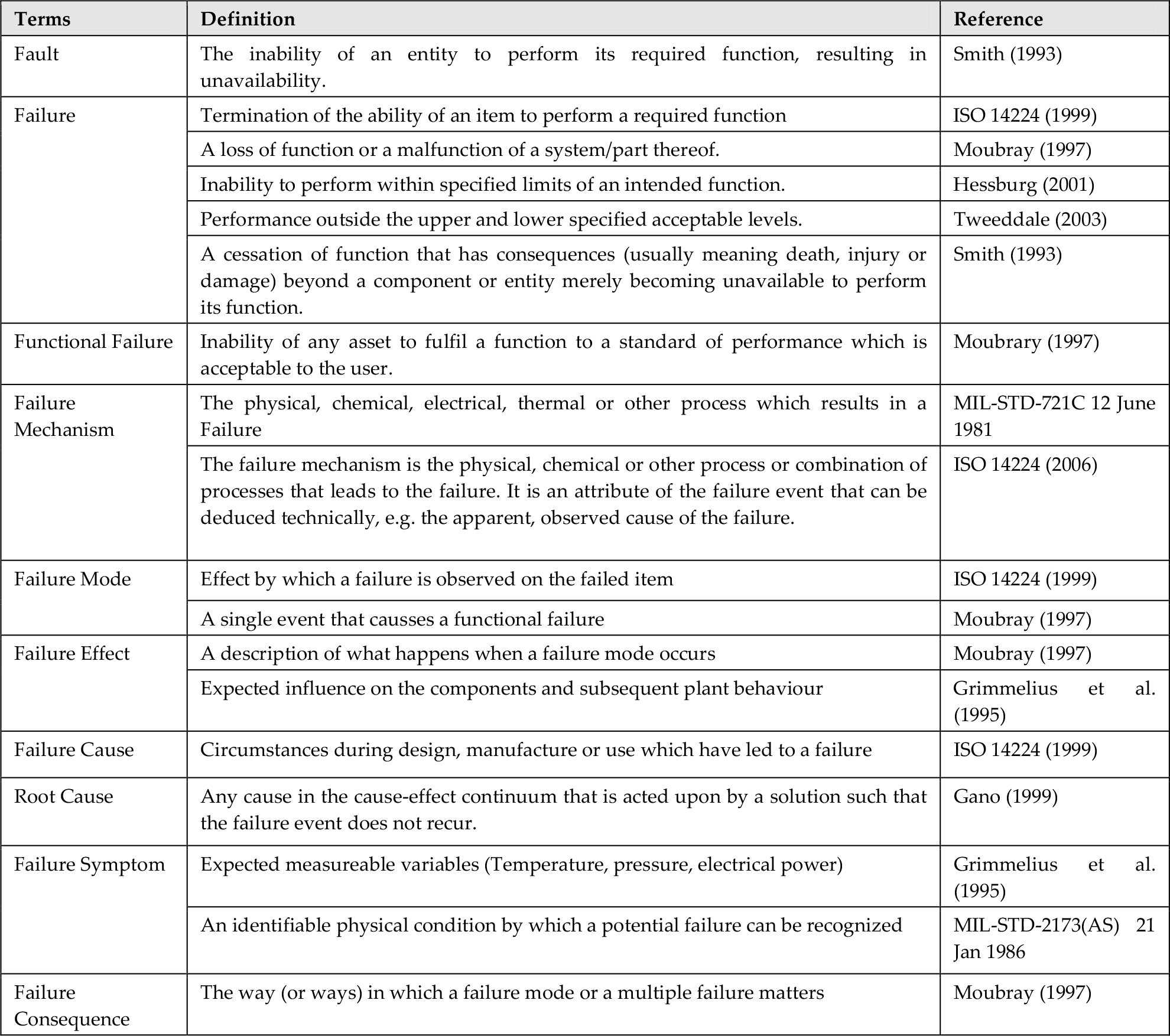
Plant Assets are defined as the fixtures, implements, machinery and apparatus that have the purpose of providing an economic and/or social benefit. Failure (of plant assets) is generally understood as the termination of the ability of equipment to perform to its designed capacity. Terms related to failure like failure mode, failure causes, failure effects and failure symptoms, are given different definitions in the plant asset management world. Some definitions of terms found in literature are given in appendix A.
These terms are often used in various ways, leading to confusion and ambiguity in the asset management community. One possible reason for this confusion is that these terms are used in different contexts and times within the failure development process.
2. Background to Risk Management Methodologies
To provide clearer definitions of terms, it is useful to look generically at how an equipment failure develops over a time period. A model for failure terminology within this context is presented in this paper.
2.1. Failure Event
The cause and effect approach is found to be useful. For every effect, there is always at least two causes: at least one action and at least one condition [2]. Conditions change over time and the actions are momentary. For example, to start a fire, the conditions needed are heat, fuel and oxygen. The momentary action required is the action of ignition (such as striking a match).
In the cause and effect chain, the effect is a failure event if the termination of the ability of the equipment to perform its designed capacity occurs at that instant.
In terms of equipment failure, deteriorated physical condition(s) and the action of starting up equipment under these conditions may result in equipment failure. Another example is where the equipment may be in good condition but it is operated beyond its design capacity (e.g. overstress). In other words, a failure event is the result of:
deteriorated equipment conditions and a triggering action, or
good equipment conditions and inappropriate triggering actions
2.2. Failure Symptoms
Failure symptoms are indicators or signs of a failure event. These indicators or signs may manifest before the event occurs (as a “failure warning”), or after the event occurs (as a “failure effect”).
2.2.1. Before a failure event
A failure event is the result of a chain of cause and effect relationships. As discussed above, a failure event can be the result of either:
deteriorated equipment conditions and a triggering action, or
good equipment conditions and inappropriate triggering actions
The deteriorating conditions are often observable via human senses or detectable via instrumentation. The equipment may send out signals or symptoms that it is not ‘feeling too well’ prior to actual failure. These ‘symptoms’ may be referred to as failure warnings, and are opportunities for detecting changes and/or abnormality in equipment operations.
A new and generic term introduced here is “
2.2.2. After a failure event
After a failure event, a term loosely used to describe the impact or influence the failure has on the equipment is “failure effect”. Unfortunately, the term “failure effect” has been used in the literature in diverse ways. In this paper, we suggest the following delineation of terminology that more precisely defines the aspects of failure after a failure event has occurred.
In essence, failure effect refers to the impact of a failure to the equipment function, whereas failure consequence refers to the impact upon the external world.
2.2.3. Failure development process model
The failure development process model is illustrated in Figure 1.

A Model for the Failure Development Process
The blue boxes refer to the physical equipment and a possible failure event.
The green boxes refer to processes of investigation after a failure event.
The pink boxes refer to the application of a strategy to mitigate a future failure event.
Before a failure event, symptoms of failure may be observable or measureable as failure warnings as conditions deteriorate, or as the equipment is subject to adverse treatment.
After the failure event, the symptoms are observable or recognizable as failure effects. Failure effects may be classified and recorded over time to provide a history of equipment behaviour and a source of information for historical and/or statistical analysis.
A good investigation of the failure will take into account both failure warnings and failure effects and attempt to ascertain:
how the failure occurred – the failure mechanisms
why the failure occurred – the failure causes
Given the results of the investigation, a strategy may then be developed to protect against future failure. The strategy will consist of the following generic features: Preventive Actions – tasks designed to maintain the condition of equipment and its environment within desired specifications, and to prevent abnormal usage or abuse.
Proactive Actions – the installation and monitoring of measures that are capable of detecting the failure warnings. Health Indicators are the instruments of strategy selected to monitor and act upon the available warnings of failure.
An Example of the application of this terminology is provided in Table 1.
3. Conclusion
A number of different definitions for the same terms related to equipment failure are found in literature. The looseness of terminology leads to ambiguity and confusion. This paper offers a reconciled list of definitions by examining the equipment failure development process. The proposed definitions for equipment failure to be used are listed in Table 2.
The “What, How and Why” related to Equipment Failure

Proposed Definitions for Equipment Failure

Appendix A