




Abstract
In today's rapidly changing and globally volatile world, manufacturers pay strong efforts on conducting lean production, outsourcing their components, and management on the complex supply chain. Warehouse management plays a vital role to be a successful player in the any kinds of industry which put-away process is a key activity that brings significant influence and challenges to warehouse performance. In this dynamic operating environment, minimizing the operation mistakes and providing accurate real time inventory information to stakeholder become the basic requirements to be an order qualifier. An OLAP based intelligent system called Fuzzy Storage Assignment System (FSAS) is proposed to increase availability of decision support data and convert the human knowledge into system for tackling the storage location assignment problem (SLAP). To validate the feasibility of this proposed system, a prototype will be worked out for a third party logistics company.
1. Introduction
Warehouse storage decisions influence almost all key performance indicators of a warehouse such as order picking time and cost, productivity, shipping and inventory accuracy and storage density (Frazelle, 2002). As a warehousing service player, all the customers are looking for more comprehensive services and shorter response time under today's competitive environment. The storage location assignment problem (SLAP) is to assign incoming products to storage locations in storage departments/zones in order to reduce material handling cost and improve space utilization (Gu et al. 2007).
Storage location process is a very data intensive process, which requires the relevant for making such decision. There are only few warehouse management systems (WMS)s and warehouses have the data allowing alone the warehouse operators and computer support intelligent slotting (storage location selection) to ensure that the quality information is available at the time to make storage location decision. Besides there is often insufficient required data for put-away process while the existing WMS lacks customization for supporting the put-away process in the warehouse which has given specific operation characteristics while the put-away decisions are made based on human knowledge that unavoidably lead to inaccuracy and long order time which brings negative impacts on customer satisfaction.
This paper is divided into five main sections. Section 2 reviews the studies related to the put-away operations. Section 3 describes the infrastructure of the proposed OLAP based intelligent Fuzzy Storage Assignment System (FSAS). A case study on a third party logistics company is carried out in section 4. The discussion and overall conclusion about the use of the proposed FSAS are made in the final section.
2. Literature Review
Warehouse is used to stored inventories during all phases of the logistics process (James et al., 2001). The five key operations in warehouse are receiving, put-away, storage, order picking as well as utilizing and shipping (Frazelle, 2002). Hausman et al. (1976) suggested that warehouse storage planning involves the decisions on storage policy and specific location assignment. In general, there are a wide variety of storage policies such as random storage, zoning, shortest driveway / closest - open - location etc (Michael et al., 2006). As each of the storage strategy with its own characteristics, there are different ways to solve the storage assignment location assignment problem. Brynzer and Johansson (1996) concerned the stock location assignment problem (SLAP) and described a strategy for pre-structuring components and information for the picking work in storehouses based on the product structure to reduce order picking times. Pan and Wu (2009) developed an analytical model for the pick-and-pass system and proposed three algorithms that optimally allocate items to storages for the cases of a single picking zone, a picking line with unequal-sized zones, and a picking line with equal-sized zones in a pick-and-pass system A nonlinear integer programming model and branch and bound algorithm are developed for making class-based storage implementation decisions considering the storage space, handling costs and area reduction (Muppani and Adil, 2008a).
In order to collect and provide quality data for the decision making process, the use of decision support system (DSS) consists of comprehensive computer systems and related tools with an aim at assisting managers in making decisions and solving problems by offering management relevant specific information (Dunham, 2002). Online analytical process (OLAP) is a decision support system (DSS) tool which allows accessing and analyzing the data in a flexible and timely basis. OLAP allows analyst to explore, create and manage enterprise data in multidimensional ways for analysis (Peterson, 2000). The decision maker, therefore, is able to measure the business data in deeper levels and aggregated levels (Giovinazzo, 2002). According to Dayal and Chaudhuri (1997), the typical operations performed by OLAP software can be divided into four aspects: (i) roll up, (ii) drill down, (iii) slice and dice and (iv) pivot. With the use of OLAP, the data can be viewed and analyzed in a real time and efficient way.
Artificial Intelligence (AI) is one of the techniques that support comprehensive knowledge representations and practical manipulation strategy (Robert, 1990). By the use of AI, the system is able to learn from the past experiences and handle uncertain and imprecise environment (Pham et al., 1996). According to Chen and Pham (2006), fuzzy logic controller system comprises 3 main processes; they are a) fuzzification, b) rule base reasoniong and c) defuzzification. Petrovic et al. (2006) mentioned that fuzzy logic is capable to handle decision-making problems with the aim of optimizing more than one objective, which proved that fuzzy logic could be adopted to meet the multi-put-away objective operation in the warehouse industry. Lau et al. (2008) proposed a stochastic search technique called fuzzy logic guided genetic algorithms (FLGA) to assign items to suitable locations such that the required sum of the total traveling time of the workers to complete all orders is minimized.
With the advantages of OLAP and AI techniques in supporting decision making, an intelligent put-away system – namely Fuzzy Storage Assignment System (FSAS) for the novel real world warehouse operation is proposed to enhance the WMS system. Two key elements would be embraced, that are Online Analytical Processing (OLAP) in the Data Capture and Analysis Module (DCAM) and a fuzzy system in the Storage Location Assignment Module (SLAM), with objective to achieve the optimal put-away decision minimizing the order cycle time, material handling cost and damage of items.
3. Methodology
The Fuzzy Storage Assignment System (FSAS) is designed to capture the distributed items' data from different departments or organizations along the supply chain and data on warehouse status, converting the data into information, and then suggest the correct put-away decision for SLAP. This will have significant influence on the warehouse performance. In fact, it also allows warehouse worker generate a report to show the status and information of SKUs, no matter they are coming to or holding inside the warehouse. The generic architecture of the FSAS is illustrated in the Figure 1. Generally, FSAS consists of 2 modules namely, Data capture and analysis Module (DCAM) and Storage location assignment module (SLAM). These 2 main modules are used to achieve the research objectives via enhancement of data availability, fully analyzing available data and converting expert's knowledge into the system with the aim to automatically recommend storage for put-away solution.

The architecture of the FSAS
3.1. Data capture and analysis Module (DCAM)
There are three major components of Data capture and analysis Module (DCAM) is central data warehouse, OLAP and data mart. DCAM is used for connecting various systems with different data sources, including the WMS, ERP and VMI which are independent system but may hold valuable data of the storage SKUs to a central data warehouse in order to fulfill SLAP, it ensures the availability of required data for further analysis.
DCAM plays as decision support system which offers warehouse engineer or manager relevant specific information, including the item's activities information, demand correlation and warehouse information. OLAP provides calculation and multi-dimension structure of data, Warehouse management bases on these information in SKUs and the warehouse to make strategic decision formulating the Fuzzy rules for SLAP. Through holistic manipulation of quality information, the warehouse engineers are able to develop a set of specific rules or algorithms to fit their unique daily operations, warehouse configuration and their operational objective.
DCAM offers the refined parameter of SKUs and warehouse that act as the input of the next module-SLAM for generating the automatic recommendation for SLAP. The data mart is developed to store the refined parameter and fuzzy rules (as a fuzzy rule repository), directly and specifically support the SLAP.
3.2. Storage location assignment module (SLAP)
Storage location assignment module is used to decide the correct storage location for arrival SKUs based on the analyzed information and the fuzzy rules set from DCAM. The major component of SLAM is the fuzzy system that consists of a fuzzy set, a fuzzy rule and fuzzy inference. The fuzzy rules is a set of rules that integrate the elements of the selected storage strategies, experience and knowledge of expert, and regulations; which has If (condition) Then (action) structure. The set of rules is to determine each item storage location; the system will match the characteristics of the SKU and current warehouse (conditions) with the fuzzy rule and then find out the action (where it should be shored). Finally the automatic put-away solution is generated.
The SLAM start from the data mart in the former DCAM, it provides the parameters that are format compatible to the fuzzy system, than the parameters will be the input into the fuzzy system that is specifically developed to support the SLAP. The output of fuzzy system will be explained as the recommendation of final storage location for the inbound cargo, than the warehouse workers will store the inbound cargo as the recommendation, finally the storage information will be updated to the WMS system.
4. Case Study
In today's rapidly changing and globally volatile world, industries daily operations are very complicated. As a Third Party Logistics Company, SJY Logistics Co. (Alias)'s business is to provide comprehensive logistics services, specialize in warehouse services, to the target customers. Currently, all decisions for the SLAP within the warehouse are go through by the warehouse manager decisions according to the operational needs and routine practise. When the storage location is found out, the next is to put the item to the decisded location, store it and finially update the information to the WMS.
The warehouse consists of four main storage departments including Bulky Cargo Storage Department, Shelve Bin Storage Department with, and two departments for Pallet Storage with the 4-tiers height pallet racks (Figure 2) that one Pallet Storage Department is temperature and humidity controlled while another does not. For the operation purpose, the warehouse management divides storage location into 9 classes according to the accessibility of the location in each storage department. They are golden zone (the most accessible), silver zone (middle accessible) and bronze zone (the least accessible). And there are 3 subzones inside each of storage zone, they are zone A, B and C in the sequence of the accessibility in which zone A with the highest accessibility.

Four tiers height pallet rack
4.1. Problem definition
Generally, the SJY Logistics Co. requires handle large amount of requests in warehouse operation. Efficient storage location assignment may result in minimizing the cost as well as the damage rate so as to increase the customer satisfaction. However, the current practice of SLAP in deciding storage department, location and the suitable tier relies on the warehouse manager based on his knowledge. Problems may be raised as the wrong storage environment offers the storage item resulting in deterioration of item quality, and the long storage location process resulted in longer inbound shipment processing cycle. This is caused by the insufficient data availability and lacks of systematic decision support system in the decision process. According to the past experience, cargo storing in high tier of a pallet rack or the item with higher loading weigh is easier getting damage or higher loading height because of the difficulty to control the pallet truck well. The more expensive cargo, the higher loss the warehouse suffers from the damage.
To ensure the accurate and real-time data can be used, the proposed FSAS for integrating data, extracting quality data from different data source and assigning appropriate storage location for the inbound items to minimize the risk of getting damage and the loss from it during the put-away and storage process.
4.2. Deployment of Online Analytical Processing in DCAM
After the SKU data and warehouse data are captured and transferred into the centralized data warehouse from the data source systems. Through the application of the OLAP, a multidimensional data model called a star schema could be built up. It is composed of a central fact table and a set of surrounding dimension tables. Each of the tables has its own attributes in variety of data type. The users are able to view the data in different levels of detail; this means the warehouse engineer can generate real-time report for decision making. The OLAP function allows finding out the statistics of SKUs activities for a specific period of time, representing the SKUs dimension, storage environment and information of warehouse etc., so the critical decision support data could be mastered by the warehouse operator. To ensure the OLAP approach functions properly, the OLAP data cube have to be built in the OLAP sever in advance. The cube is developed in star schema (Figure 3) consisting of the dimensions, measures and calculated members.

The relational database structure of DCAM
Dimensions
In “SKU” dimension, the “SKU _ID”, and “Product _Type” fields are used to find the SKU's dimensions and other characteristics for storage department selection.
In the “Invoice” dimension, the “Invoice ID”, and “SKU_ID” and “Invoice _Type” fields are used to find the activity patterns of SKU's for deciding the location inside the department for the SKU.
In the “Time” dimension, the “Delivery Date” and “Arrival Date” field is used to find the expected storage time for the SKU and the number of transaction during the specific period.
Measures
The “Loading Item Height”, “Loading Item Width”, “Unit Cost” and “Unit _Cube” etc. are used to provide critical information for the warehouse manager to do fuzzy rule composition and perform as a fuzzy input for implication process.
Calculated Member
The calculated member is to calculate the mean of “Popularity”, “Turnover”, “Cube _Movement” and “Pick _density” etc., this is also for fuzzy rule composition and implication process
4.3. Deployment of fuzzy system in SLAM
The fuzzy rules and membership function of each parameter in the company have to be first formulated in the fuzzy system. The parameters (Table 1) and the fuzzy rules of others rule sets are specifically set by the warehouse manager in order to truly reflect the operational conditions of such product families. The formulation is worked out by knowledge of experts with the revision on the past experience on the warehouse daily operation; the historical revision could be achieved by the help of the OLAP report in the former module-DCAM. Different set of fuzzy rule with particular parameters specifically make the decision to determine the storage zone/department, storage location and tier level for the item storage. The fuzzy rules are stored in the knowledge database and defined as a conditional statement in IF-THEN form. Some examples of fuzzy rules are shown in Figure 4. The membership function of each parameter is determined by the warehouse manager ranged from 0–1. There is more than one type of membership functions existing, these include Gaussian distribution function, the sigmoid curve, and quadratic and cubic polynomial curves. For this case study, as trapezoid and triangular membership functions are able to appropriately demonstrate the manager's knowledge, it is employed to represent the SLAP parameters, the graphic formats of the membership functions of the example parameters are demonstrated as the Figure 5.
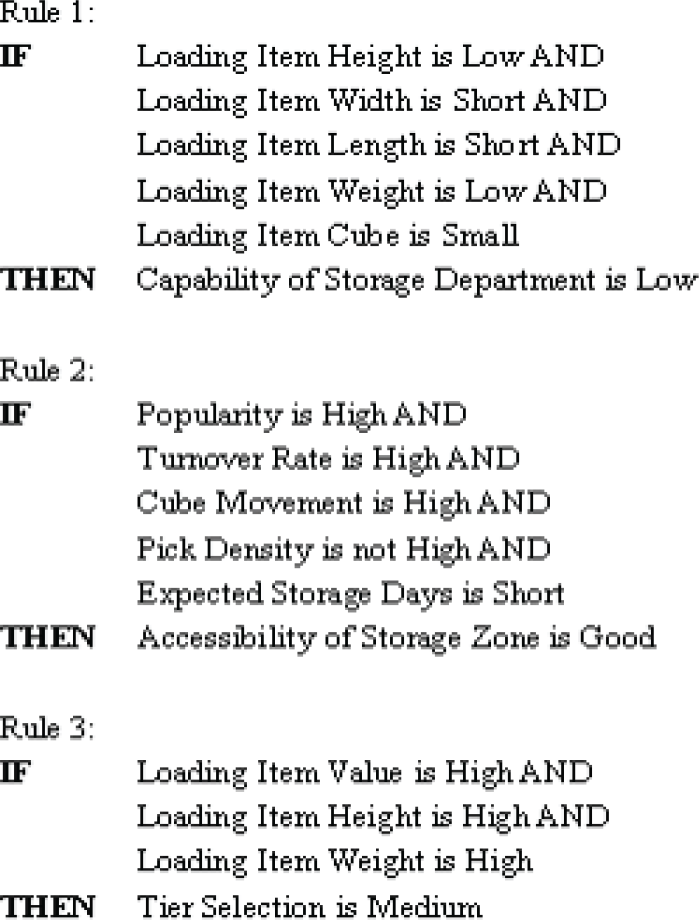
Fuzzy rule Examples in the knowledge database

Graphic format of membership function of the parameters
The range of decision making parameters

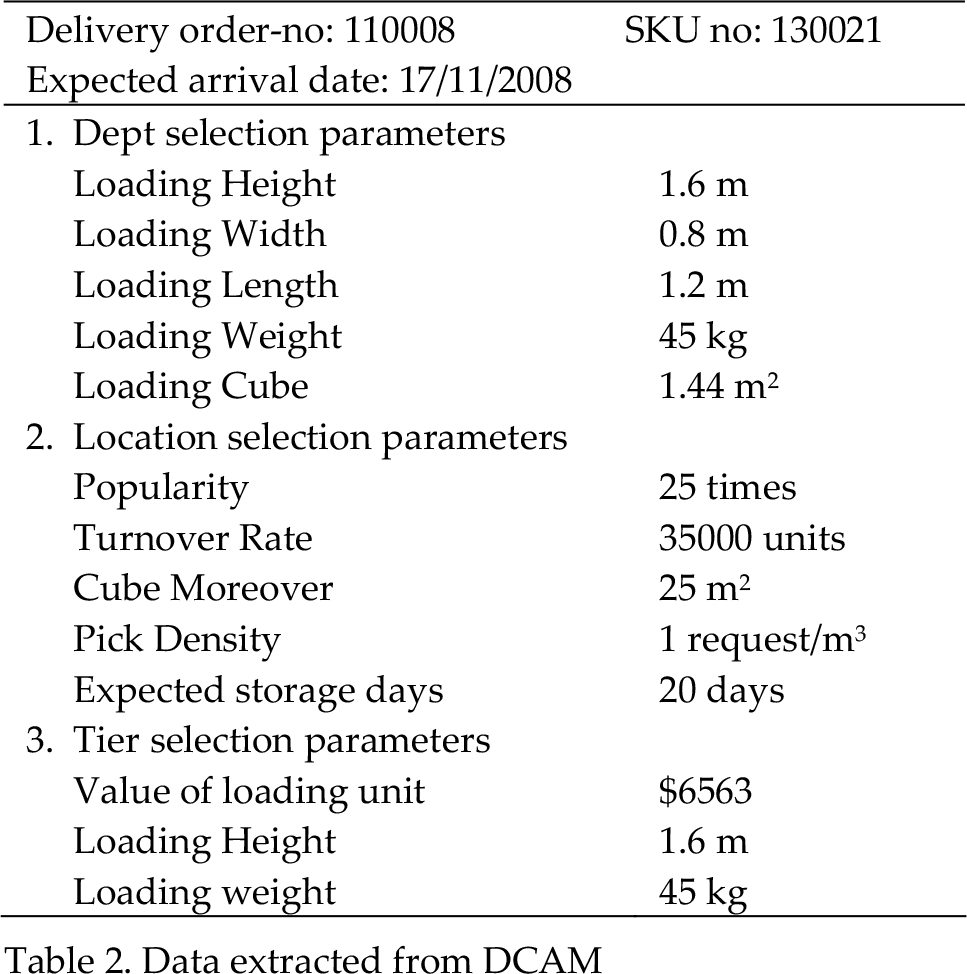
To execute the fuzzy system, the MATLAB-Fuzzy Logic Toolbox is employed to create and execute fuzzy inference systems. With the above fuzzy rules and required data, the final storage location for the incoming item would be generated from the Fuzzy Toolbox automatically for SLAP. In order to demonstrate the feasibility of the system, one supplier delivery order is selected and input into the proposed system FSAS. Assume the market operating department receives the delivery order from the supplier; the delivery invoice no. is 110008. After the market operating department enters the relevant data into the ERP, the data will be extracted by central data warehouse and then go to the OLAP module while the detailed data extracted through DCAM are shown in Table 2. At the same time, the warehouse department is informed and started to go through their slotting decision tree.
Data extracted from DCAM
In the fuzzy inference diagram as shown in Figure 6, the storage location assignment for the case delivery order-order-no: 110008, the inbound item should be stored in high capacity of storage department, very good accessibility of location and relative high tier. The warehouse operator can find the finally storage location for this order that is highlighted in the explanation table. The explanation tables are adopted to turn the fuzzy output to be compliable for real operation. The incoming item should be stored in the pallet storage department (medium capability), golden zone B of storage location (very good accessibility) and the tier level 3 (relative high tier).
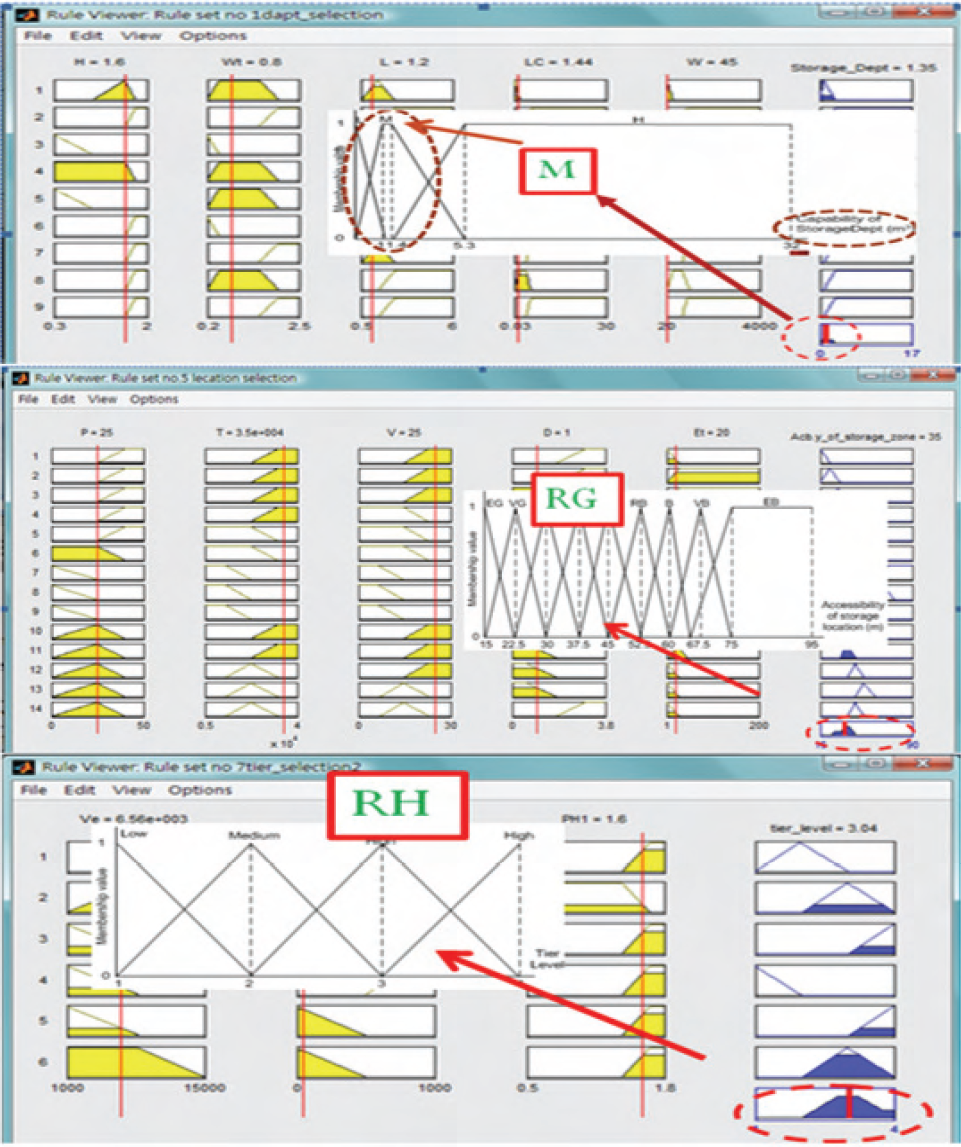
The fuzzy inference diagram obtained with the MATLAB Fuzzy Logic Toolbox
5. Discussion and Conclusion
As increasing numbers of manufacturers and retailers emphasize the just-in-time inventory strategy, the delivery orders will become more frequent with smaller lot size. This directly creates considerable demand for put-away processes in warehouses. Put-away process is to match the characteristics of the storage item and the storage location. To do so, the warehouse operators first need to master the characteristics of the incoming items and storage location, and then correctly match the storage location to the item with the objective to minimize the material handling cost, product damage and order cycle. An OLAP based intelligent system - Fuzzy Storage Assignment System (FSAS) with two modules DCAM and SLAM is proposed that can enhance the required data availability and integrate day to day operational knowledge from human's mind supporting a key operation in warehouse - put-away process in order to achieve the overall operation objectives which are shortening order cycle time, minimizing product damage and material handling cost. FSAS enables the warehouse operators to perform put-way decision: (i) real-time decision support data with different query dimensions (ii) mimicking the warehouse manager to provide recommendation for SLAP.
Further research on enhancing the fuzzy rules generation is considered to improve the accuracy in assignment suitable storage location. The generation of fuzzy rules and the membership functions is currently defined by the experts. As the database is well developed for the put-away process in the DCAM, this is eligible to provide overview on the past performance of the warehouse. A scientific way like association rule could be employed to discover the hidden knowledge from the database for SLAP instead of only converting the knowledge into the system from human.