




Abstract
Graphite was exfoliated to graphene by tip sonic using sodium cholate as a surfactant in the presence of Millipore water as a medium. The use of water as a solvent for exfoliation purposes is very important due to its environmentally friendly nature and almost no cost, contrary to organic media. Two different concentration ratios of surfactants are used in the present work. As a result, graphene dispersions with two different concentrations of 5 mg/ml and about 7 mg/ml respectively were obtained in aqueous media. It was observed that the optimum concentration of surfactant has an effective role in the exfoliation of graphite to graphene. Concentrations of graphene dispersions were studied through UV spectroscopy, while Raman spectroscopy, Scanning Electron Microscopy (SEM) and Transmission Electron Microscopy (TEM) were used to study the quality of the exfoliated graphene flakes.
1. Introduction
Graphene is a nearly transparent, two-dimensional semimetal consisting of a single atomic lattice of hexagonally arranged sp2 hybridized carbon atoms [1]. Since the isolation of graphene and the discovery of its unique properties, there have been unprecedented levels of research into this remarkable material. The work carried out by Geim and Novoselov in 2004 was a simple exfoliation method in which protrusions of highly oriented pyrolytic graphite (HOPG) were embedded in photoresist and adhesive tape was used to successively peel off layers of graphene [2]. Although this method is tedious and cannot be scaled up to industrial level, nevertheless it opened up new horizons of research in this specific field. This so-called Scotch tape method is simple and does not require any modification for environmental parameters such as temperature and pressure. In addition, this method provides high quality (high mobility and low defect) single- and few-layer graphene sheets with large areas as big as 100 μm [3]. Usually strong acids are used for the oxidation of graphite to graphene oxide (GO), which results in a stable aqueous solution of GO [4]. This dispersion of GO can then be reduced by aqueous hydrazine as reducing agent [5, 6], or by thermal reduction under a reducing atmosphere [7-9]. Graphene growth by chemical vapour deposition (CVD) is typically carried out under ultra-high vacuum and at high temperatures [10]. In this process, volatile or gas phase carbon precursor is flowed over a metallic substrate, which acts as a catalyst and nucleation site for graphene growth [11]. Graphene produced by CVD was first reported by Somani and colleagues in 2006, using nickel foil and camphor for the metallic substrate and carbon precursor respectively [12].
Liquid exfoliation of graphite to graphene, also referred to as solution-based graphene exfoliation, was first carried out by the Coleman group [13] in 2008, via sonication of graphite flakes in organic solvents such as N-methyl-Pyrrolidinone (NMP) and dimethyl formamide (DMF). Coleman's work stemmed from previous research involving dispersion of carbon nanotubes (CNTs) in organic solvents, which was concerned with matching the surface energies associated with CNTs and the solvent [14]. The use of surfactants in liquid exfoliation is also carried out to create aqueous dispersion of graphene, to help mitigate colloidal aggregation of graphene in solution [15]. In some studies, aqueous/low boiling point organic solvents system have been used for exfoliation. Likewise, various surfactant systems have also been used for exfoliation of graphite to graphene [16-20]. A kitchen blender has also been utilized for exfoliation and 0.22 mg/ml concentration in about eight hours has been reported [21].
Other less common but noteworthy liquid exfoliation methods include intercalation of graphite with alkaline [22] or halogen salts [23] to form graphite intercalation compounds (GICs). The GICs can be either directly dispersed or exfoliated in solution by sonication [22]. Furthermore, these can also be thermally expanded at high temperatures in which the intercalating compounds volatilize to form expanded graphite (EG) [24]. In the next step this expanded graphite is subsequently exfoliated in solution via sonication [23].
Liquid exfoliation of graphite to graphene is an advantageous method compared with other methods such as CVD growth and mechanical exfoliation, due to the simplicity of the process. It does not require high vacuum and high temperatures and the cost of the starting materials is low. There are presently a number of commercially available surfactants that have been used in the literature for solution processing of graphene by various methods and solvents [22, 23]. Surfactant-assisted exfoliation has permitted the use of water as a solvent for solution processing, which is attractive from an environmental standpoint as well as for applications that cannot tolerate organic solvents. The three main classes of surfactants are cationic, anionic and non-ionic surfactants. These also include small molecular surfactants such as sodium dodecyl sulphate (SDS) and sodium cholate, which consist of a hydrophobic tail and a polar head group. Similarly, cationic, anionic and non-ionic Pluronic and Tetronic block copolymer surfactants have been used to form aqueous dispersions of graphene [25]. Likewise, it has been shown that graphene oxide can be dispersed in some organic solvents at concentrations of up to 1 mg/ml [6, 26-28] and in water this concentration raised to 7 mg/ml [29]. Similarly, graphene concentration increased to about 1 mg/ml in organic solvents [30]. Surfactant-based graphene dispersion in aqueous medium above 1 mg/ml has not been reported [31-33]. A method is also presented for producing graphene using sodium cholate as surfactant and 0.3 mg/ml concentration of graphene is obtained via bath sonication in about 400 hrs [31]; likewise, in one paper six kinds of surfactants were used to probe the concentration of surfactant as a function of graphene concentration. Two models were introduced to explain the difference between ionic and non-ionic surfactant [34].
In this work we used two different concentrations of surfactants in order to study their effects on exfoliation of graphite to graphene. Very reasonable concentrations (5 and 7 mg/ml) of graphene dispersions in water are obtained, which has not been previously reported. Moreover, it is very interesting to see that a low concentration of sodium cholate as surfactant has a very promising role in exfoliation and achieved a high concentration of graphene dispersion in water.
2. Experimental Procedure
Graphite powder and Sodium cholate (surfactant) were purchased from Sigma–Aldrich and were used as supplied. Sonication was performed by using sonic tip (GEX600, 48W, 24kHz, flat head probe) running at 25% of maximum power and sonic bath (Branson 1510E-MT). Centrifugation was performed using a Hettich Mikro 22R, typically at 500 rpm for 45 minutes. After centrifugation the 70% of the top portion of the dispersed solution was removed and concentration was determined by UV-Vis-IR absorption spectroscopy Varian Cary 6000i (with 1 mm cuvettes). TEM was done using a Joel 2100 and holey carbon grids (400 mesh). Thin film was made using porous alumina membrane (Whatman Anodisc 47 mm, pore size = 0.02 micron). Raman spectra (633 nm) were recorded on a Horiba Jobin Yvon LabRAM-HR. Scanning Electron Microscopy (SEM) was performed in a Hitachi S-4300 field emission.
3. Results and Discussion
Graphite was exfoliated to graphene by using sonic tip and Millipore water was used as solvent. During exfoliation sodium cholate was used as surfactant to ease the exfoliation of graphite to graphene. We used two different concentrations of the surfactant, i.e., 5 mg/ml and 10 mg/ml (concentration of surfactant CS=5 mg/ml and CS=10 mg/ml) Initially 10 grams of graphite were added to Millipore water. Surfactant was then added in different amounts to the graphite dispersions. Both of these dispersions were sonicated under the same conditions and small samples were taken from these dispersions hourly. The samples were bath sonicated for 15 minutes using a sonic bath. Finally, these bath sonicated samples were centrifuged at 500 rpm for 45 minutes. The top 70% portion of the centrifuged sample was taken for absorbance study using a UV spectrophotometer, to check the concentration of graphene in these samples. This process was continued for 96 hours and samples were taken after the required time intervals. The concentration was studied through UV spectroscopy using Beer-Lambert law, Eq. (1) [30]:

Where the absorption coefficient “α” is related to the absorbance “A”, “C” is concentration and “l” is the path length. We have selected “α” value equal to 3.62 ml/mg/m [30]. The concentration was measured by recording the absorbance at 660 nm and transforming this into the concentration using Eq. (1) [30]. It is reported that the exfoliation was conducted using organic solvent N-Methyl Pyrrolidinone (NMP). In previous studies, the NMP has been known to spoil after six hours, which might be due to oxidative degradation [35]. However, this phenomenon was not observed in our study and graphene concentration tended to rise after every hour. Although the rate of exfoliation was not as fast and high as was observed in NMP [35], nevertheless after 96 hours we achieved 5 mg/ml and 7 mg/ml concentrations of graphene for CS=10 mg/ml and CS=5 mg/ml of surfactant respectively.
In this work it has been observed that the optimum concentration of surfactant has an effective role in the exfoliation of graphite to graphene. After 96 hours the concentration of graphene exfoliated was 5 mg/ml in the presence of CS=10 mg/ml of surfactant, while in the case of CS=5 mg/ml (concentration of sodium cholate) the graphite was exfoliated to 7 mg/ml under the same conditions and time. It is very clear from the UV graph (Figures 1 and 2) that there is a rapid increase in graphene concentration at low concentration of surfactant (CS=5 mg/ml) compared with high concentration (CS=10 mg/ml). Latoya et al. exfoliated graphite to graphene and obtained very low concentration in the presence of surfactant in aqueous medium [36].
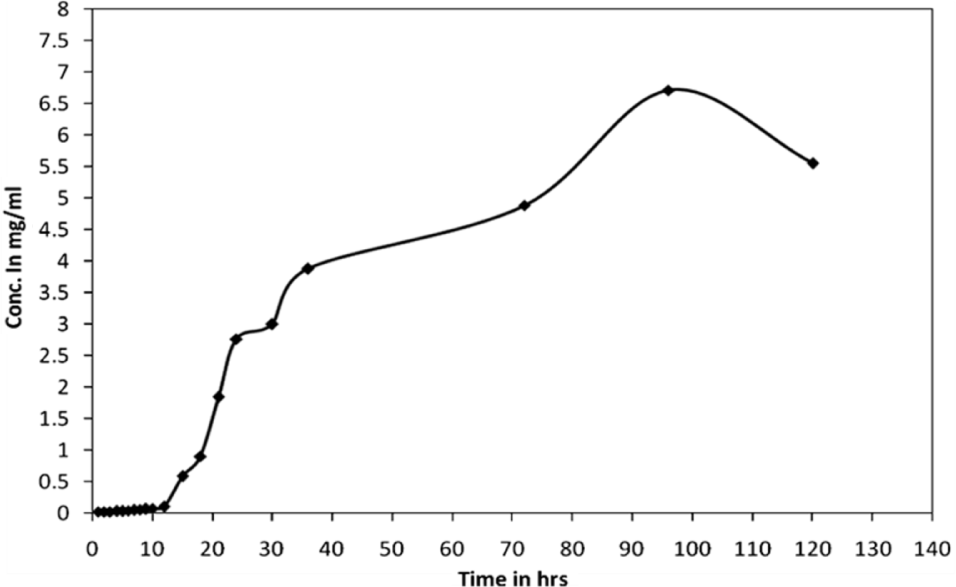
Concentration of graphene after centrifugation (500/45) as a function of sonication time (Cs=5 mg/ml). Concentration was calculated using absorption coefficient “α” value equal to 3.62 mL mg−1m−1

Concentration of graphene after centrifugation (500/45) as a function of sonication time (CSs=10 mg/ml). Concentration was calculated using absorption coefficient “α” value equal to 3.62 mL mg−1m−1
The TEM analysis was performed on flakes of graphene obtained after 96 hours of sonication using surfactant with the concentration value CS=5 mg/ml deposited on holey carbon grid. It is apparent that the exfoliated graphene flakes were found in a few layers of graphene.
It was revealed that a large number of graphene flakes of various types with different sizes are present, as shown in Figure 3. These data are also presented in Figure 4 in histogram format in order to show the number of layers of graphene after 96 hours of sonication, along with their length and thickness.

TEM images of graphene flakes deposited from sample with concentration of 7 mg/ml
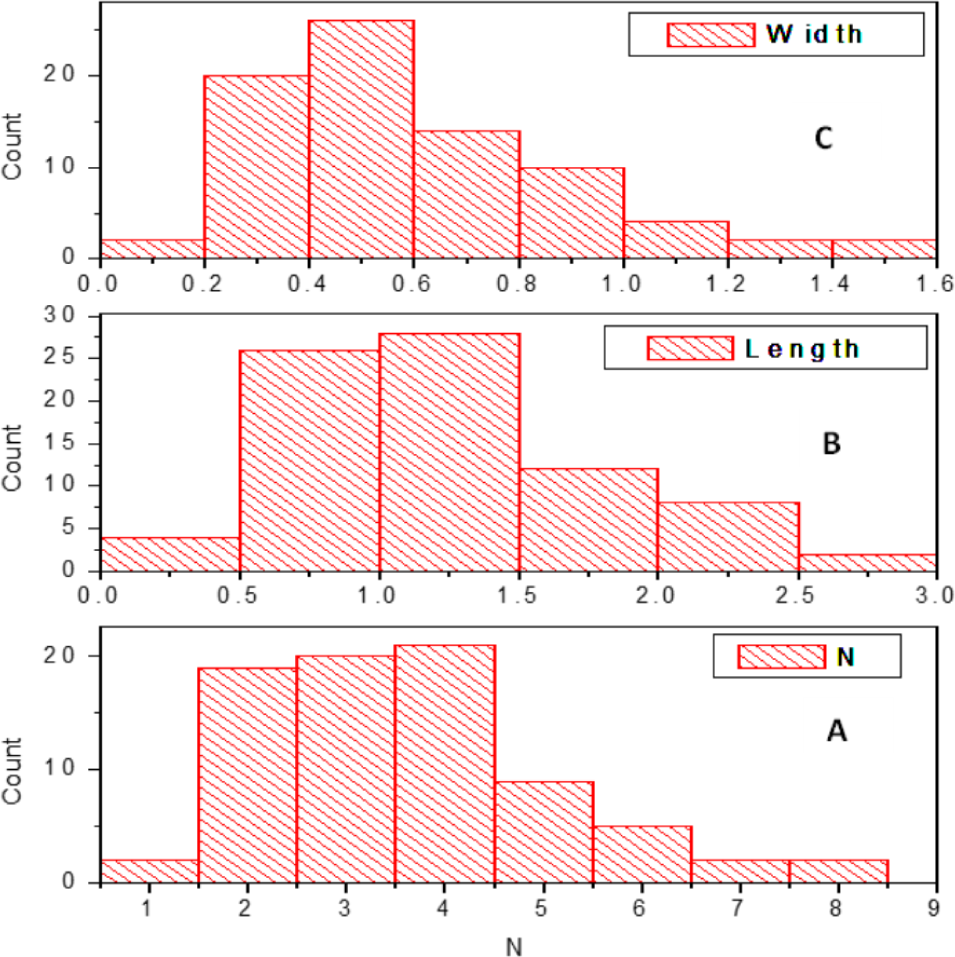
(A) Histogram showing the number of layers per flake (N) measured for 96 hours sonication time (B) average length of flakes and (C) the average width of flakes
It is very clear from this histogram that most of the population consists of few-layer graphene (fewer than five layers) and the length of flake is about 1.0 micron, while the width of the maximum population of graphene flakes is about 0.6 micron. This confirms that the graphite is fully exfoliated. Likewise, Scanning Electron Microscopy (SEM) of thin film (the segment of the film used for SEM was coated with 10–20 nm of gold/palladium) also reveals that the exfoliated graphene consists of a few layers, as shown in Figure 5.

SEM images of the flakes present on the interface of the freestanding films
This study revealed information about the size of graphene flakes and defects in them. The spectrum of graphite materials can be characterized by certain specific bands such as D-band (1,350cm−1), G-band (1,582cm−1) and 2D band (2,700cm−1) [37]. D-band shows the evidence of the presence of topological defects in sheets or the edges of nanosheets [38].
A typical Raman spectrum was measured on film prepared from the sample with 7 mg/ml concentration. The film was deposited on alumina membrane by filtering the aqueous graphene dispersion under vacuum. This film was thoroughly washed with plenty of de-ionized water to make it free from surfactant. For solvent-exfoliated graphene the D-band is associated with the presence of flake edges and can be related to flake length by relation in Eq. (2):

Where k is constant; hence an increase in the ID/IG value shows a decrease in flake size and vice versa. The value of k is reported to be 0.26; this also gave (ID/IG) powder = 0.037 [30, 39].
It is clear from Figure 6 that the ID/IG value of exfoliated graphene increases as a function of sonication time. The ID/IG of graphene sonicated for 30 hours has a low value of ID/IG, while as sonication proceeds the ID/IG increases and reaches its maximum value at 96 hours.

Increase in Defect peak (D-band) of normalized Raman spectra as a function of sonication time
These data are also presented in Figure 7 to show the values of ID/IG with the passage of time. The ID/IG value continuously increases from 0.113 at 30 hrs to 0.317 at 96 hrs, while (ID/IG) powder for graphite powder is 0.037 [30, 39]. This suggests that with sonication time there is an increase in ID/IG value, suggesting a decrease in flake size. This suggests that sonication creates a number of defects in graphene flakes by cutting the size of graphite, creating new edges [40]. Equation (2) can be used to estimate the flake length. By putting the obtained different values of ID/IG into Eq. (2), it has been shown in Figure 8 that flake length decreases from 3.42 micron to about 1 micron after sonicating for 96 hours. Similarly, the Raman data of estimated flake length of graphene nanosheets on the basis of ID/IG value are in close agreement with the TEM study. The histogram shown in Figure 4 indicates that most of the flakes consist of fewer than five layers and have flake length of 1–1.5 microns with average width of 0.6 micron.

Change in ID/IG as a function of sonication time

Estimated length of graphene flake with D/G values
4. Conclusion
Although, as discussed earlier, a high concentration of exfoliated graphene is reported in organic solvent, environmental issues can be raised with regard to the use of organic solvent. Therefore, in this work, water was used as solvent. It has been observed that a reasonable concentration of graphene in aqueous media in a short time can also be obtained by using sonic tip in the presence of surfactant. The flake length obtained through this procedure is about one micron with low layer thickness. Furthermore, the remaining part of the graphite crystallites/unexfoliated graphite can be used for further exfoliation after filtration for better results in terms of high concentration. The concentration of graphene dispersion could be increased from 7 mg/ml by finding another suitable surfactant for this purpose.
Footnotes
5. Acknowledgements
We strongly appreciate the financial support of the Higher Education Commission of Pakistan through the International Research Support Initiative Program (IRSIP). We are very grateful to the School of Physics at Trinity College Dublin (TCD), Dublin 2, Republic of Ireland, for providing the opportunity to complete this research work there.