




Abstract
To gain a competitive advantage on industrial markets, suppliers need to understand what motivates their customers to collaborate in long-term buyer-supplier relationships. Therefore, this paper presents (i) a literature-based model of a 12-part industrial customers' motivation profile, and (ii) empirical findings from an explorative survey of 118 decision makers in the purchasing departments of firms in the technology sector. The results indicate that, “the optimum value for money”, “the holistic problem-solving capability of the suppliers and their high degree of performance” and “the good assistance in economically hard times in the past, which has led to a feeling of gratefulness” are all of great importance to industrial customers for building and maintaining relationships.
1. Introduction
The competitiveness of firms that supply technological components on innovation-driven industrial markets depends on their ability to provide innovative and customer-specific solutions, in combination with stable prices [1, 2, 3]. In order to enhance their capability to provide their customers with innovative and tailor-made products and services, they need to know and to understand their customers' needs [4, 5, 6, 7, 8, 9, 10, 11]. This could lead to a goal-oriented allocation of scarce marketing resources, which again has great potential to help consolidate the competitive position of firms [12].
According to the experience of practitioners in the sales departments of supplying technology firms, the understanding of customer needs increases when suppliers collaborate closely and therefore become reasonably familiar with their industrial customers, e.g., by organizing their own business together with those of their customers in a cluster, or by teaming up in research and development (R&D) projects [13, 14, 15, 16, 17, 18]. In practice, however, this is not always the case; only a minority of supplying firms' business relationships are at a mature enough stage to enable them to gain an in-depth knowledge of their customers' motivation to collaborate closely. It has also been shown that the use of e-procurement and other ancillary initiatives fails to deepen industrial buyer-supplier relationships [19]. Hence, the following research question arises:
What are the factors that motivate customers to establish and collaborate in long-term buyer-supplier relationships on industrial markets?
To explain the phenomenon of close collaboration, social exchange theory (SET) and social capital theory (SCT) are widely used and accepted in the literature [20, 21]. However, to address the problem stated in the research question, some authors have claimed the need for empirical research by employing customer satisfaction approaches [22]. Although there has been some theoretical work on the personal satisfaction of customers in different contexts [23], the mechanism behind customer satisfaction on industrial markets remains inadequately explored. To tackle this problem in industrial and inter-firm settings, this paper analyses the motivation of industrial customers with regard to the factors that explain the personal motivation structure of decision makers in the purchasing departments of buying firms. Therefore, we assume that the personal motivation of purchasing managers reflects the motivation of the buying firm. As a result, this study introduces a motivation model consisting of 12 single motivation factors in an inter-firm as well as an industrial context. The model was developed on the basis of a literature review and data analysis deploying SPSS for data originating from a survey among Austrian technology firms.
The structure of this paper is as follows: Section 2 gives a brief overview of the literature; Section 3 focuses on the development and identification of the literature-based motivation profile of customers in industrial inter-firm settings; Section 4 outlines the explorative research approach and the selection of the applied method; Section 5 presents the key results of the data analysis and the empirically aligned 12-part motivation profile of industrial customers; and finally, Section 6 concludes the paper by discussing its contribution to the literature and the practical benefits it provides for decision makers in the customer relationship and sales management (CRM) departments of supplying firms.
2. Literature Overview
There is a large body of literature about SET and SCT that tries to explain the motivations behind collaboration in industrial and inter-firm settings [24, 25, 26, 27, 28, 29]. On the one hand, SET is generally used to investigate the social processes that control the collaboration between groups or individuals. Close collaborations in long-term business relationships develop over time through the interactions of the exchange partners within firms [24, 25]. The general assumption of SET is that individuals within firms that act on industrial markets form different social exchange relationships, e.g., with customers or suppliers [26, 27]. These different social exchange relationships have an impact on the behaviour of the individuals who work in purchasing departments, for example. Individuals who enjoy a satisfying social exchange relationship return the benefits to their cooperation partners [30, 31]. On the other hand, SCT focuses on social ties forged between corporate actors or individuals in order to achieve certain benefits from these ties, such as a long-term business relationship [28, 29]. It is trust that strengthens such a relationship and encourages the exchange of resources [21, 32, 33]. Trust, in turn, is based on a high degree of mutual understanding of needs between firms [34, 35]. SET and SCT literature thus helps to improve understanding of the motivation to collaborate in a long-term business relationship on industrial markets [36]. Nevertheless, as already mentioned in the introduction, there is a need for additional research in the area of customer satisfaction [22]. However, the majority of researchers working on customer satisfaction as a precondition for customer motivation have focused on the consumption of goods and services from an individual consumer [37] and personal motivation point of view [38, 39], rather than from an industrial or inter-firm perspective. The literature-based and empirically aligned research model presented in this paper is founded on (a) organizational behaviour theory [40], (b) Maslow's hierarchy of needs framework [38], (c) the existential fundamental motivations framework developed by Reiss [39], and (d) Heinrich's motivation model for firms [41].
3. Literature-based Motivation Profile
Based on a literature review that considered the above-mentioned theoretical background, a research model consisting of 12 single motivation factors of industrial customers [41] was developed (Figure 1).

Furthermore, the 12 single motivation factors shown in Figure 1 were divided into two main factor groups within a continuum of diverse needs: “fundamental motivation factors” and the “higher level motivation factors”.
4. Applied Method
Recent literature [46, 47, 48, 49] has suggested various comparison methods for understanding the complex problems as described in the Section 1. When it comes to analysing hierarchical and complex problems, the analytic hierarchy process (AHP) developed by Saaty [53, 54] is an approach that is often applied in different practical and theoretical contexts [50, 51, 52]. The literature shows that, using the AHP, feedback networks and hierarchies can be built in order to make, e.g., judgements and performance measurements [55]. The goal of the present study is not to build a hierarchical motivation model. Instead, it focuses on an empirically based expansion of the existing knowledge base of customer motivation in an industrial context. Furthermore, since this study is not rooted in theory, it follows the tradition of exploratory motivation factor research, which has been the dominant research paradigm for more than 60 years [38, 39]. Consequently, to assess the validity as well as the information value of the theoretical framework (presented in Figure 1) in an industrial context, a survey instrument was developed and pre-tested with five practitioners from the purchasing departments of technology firms and five academic experts. Following the pre-test, 329 potential participants holding executive positions in purchasing departments were invited to participate in the survey via telephone, before the paper-based questionnaire was sent to 287 procurement managers of Austrian technology firms. Of these, 118 completed the questionnaire, which corresponds to a response rate of 41%. A descriptive data analysis using SPSS was conducted with the collected data in order to identify the most important single motivation factors for industrial customers in technology firms.
5. Results
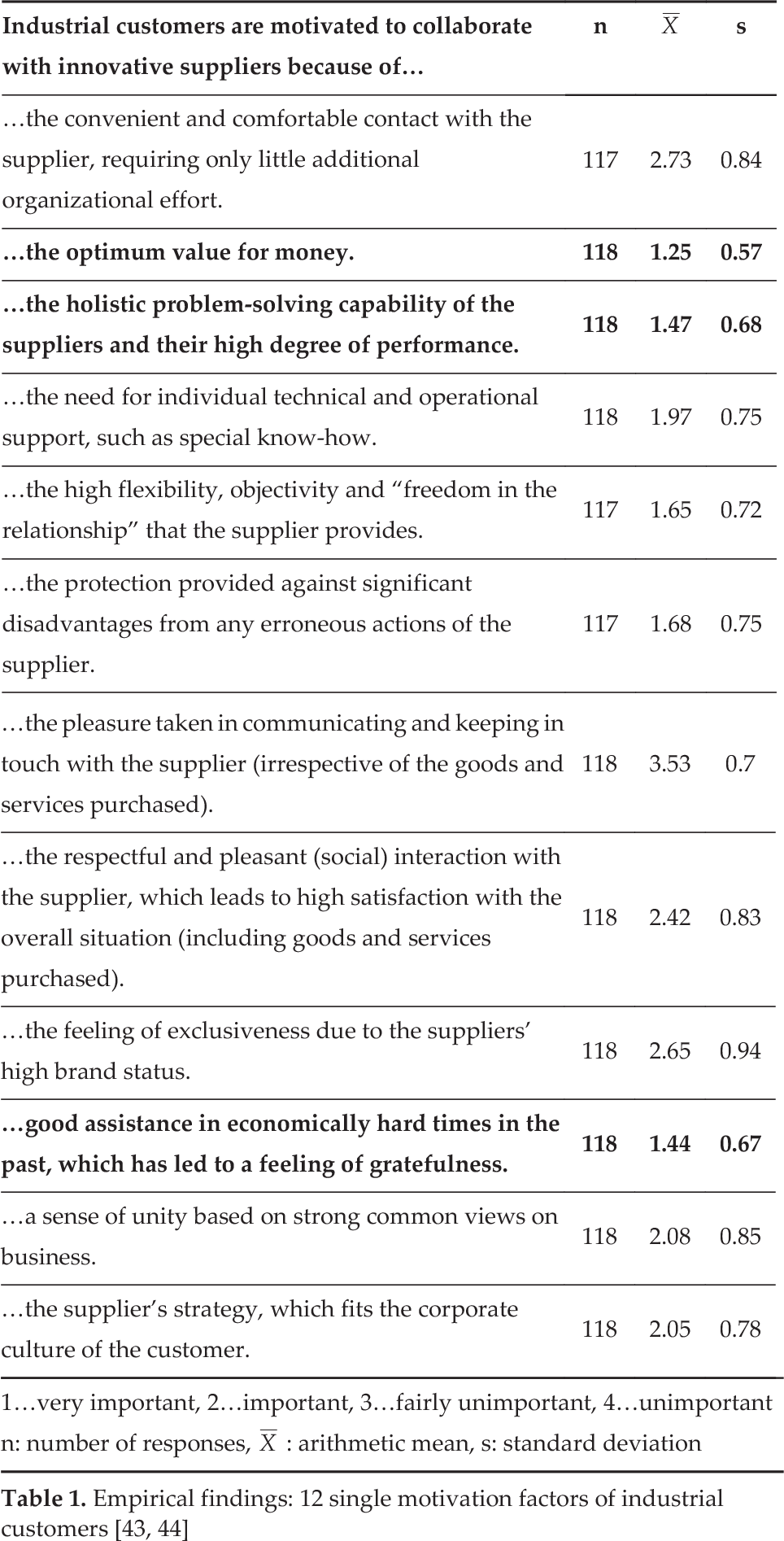
Table 1 shows the results of the survey in which the responding procurement managers were asked to rank the 12 different motivation factors shown in Figure 1 “very important”, “important”, “fairly unimportant” or “unimportant”. The descriptive statistics presented in Table 1 show that — according to firms collaborating with innovative suppliers in the Austrian technology sector — the three most important motivation factors are “optimum value for money” (arithmetic mean 1.25), “good assistance in economically hard times in the past, which has led to a feeling of gratefulness” (arithmetic mean 1.44) and the “holistic problem-solving capability of the supplier, as well as a high degree of performance” (arithmetic mean 1.47). In the first step of the data analysis, the results were also controlled for corporate growth, procurement volumes, share of purchased services in the total turnover, and professional experience of the procurement managers, as well as inter-industry differences, but no significant differences were detected.
6. Discussion and Conclusion
The presented results of the study demonstrate that “optimum value for money”, “good assistance in economically hard times in the past”, and “the holistic problem-solving capability of the supplier and their high degree of performance” are all of great importance for industrial customers.
Furthermore, the results suggest that “the need for individual technical and operational support, such as special know-how”, “the high flexibility, objectivity and ‘freedom in the relationship’ that the supplier provides”, and “the protection provided against significant disadvantages from any erroneous actions of the supplier” should also be considered by innovative suppliers when managing business relationships with industrial customers.
These findings could contribute to the literature through extending the individual consumer motivation profile [39] by integrating an industrial customer view based on a quantitative research approach. This research thus provides an empirically supported blueprint for customer relationship managers to address the needs of their industrial customers who work in the procurement departments of technology firms. This could help them achieve a better balance in buyer-supplier relationships in supply chains, through a better integration of all supply chain actors [45].
To sum up, practitioners in innovative supplying firms' CRM departments can benefit from the knowledge about industrial customers' motivations to collaborate in various ways. The results show that, besides providing innovative products and services, an improvement in buyer-supplier collaboration can be achieved if customer relationship managers…
…keep in mind the price sensitivity of industrial customers by offering the optimum value for money;
…demonstrate a holistic problem-solving capability;
…provide special know-how, even in the early stages of the selling process;
…allow a high degree of flexibility and objectivity (e.g., through transparent and alterable contractual terms); and
…alleviate industrial customers' fears of being cheated or of having to pay extortionate prices.
Finally, some limitations have to be considered. Firstly, the study must be considered exploratory, due to its small sample size (118 participants). Secondly, the study lacks generalizability because of its restriction to the technology sector. Thirdly, possible cultural differences could not be considered as all respondents belong to the same cultural area. Fourthly, this study only focuses on executives from purchasing departments, even though research and development departments (as well as management accountants) [42] are also involved in the purchasing process, especially in large firms on technology-driven markets.
Footnotes
7. Acknowledgements
The author wishes to acknowledge the helpful comments of the reviewers of earlier versions of this paper, written in different contexts, which were submitted to the 22nd International Purchasing and Supply Education and Research Association (IPSERA) Conference [43] at the Audencia Nantes School of Management in France, 24th–27th March 2013, and to the XXIV International Society for Professional Innovation Management (ISPIM) Conference [ ], hosted by the Aalto University School of Business, in partnership with Lappeenranta University of Technology in Finland, 16th–19th June 2013.