




Abstract
Innovation activities are a critical factor in national and regional development. The innovative behaviour of companies is one of the main sources of competitiveness, business survival, economic growth and employment in a territory. It is therefore important to identify and understand the factors that determine innovation behaviour among enterprises. In line with this, the aim of this study is to analyse the relations between innovation-related variables and the impact that they have on company performance. The research model proposed is applied to two high-tech sectors of the Italian region of Lazio to verify its validity. The examination concerns the aerospace and biotech sectors, which are characterized by strong innovative activity.
Keywords
1. Introduction
The globalization of markets and the development of information technologies has led to a shift in enterprise business from a form of competition based on physical assets to one based on intangible assets and knowledge [1–2]. In this complex context, innovative behaviour becomes a fundamental requisite for companies to remain competitive in the market.
Innovatory activity is also a critical factor in territorial economic development and, thus, in a country's economic growth [3–4], particularly considering that an important part of productive growth in advanced nations (in terms of GDP) depends on innovation [5]. Therefore, the innovation activity that derives from specific innovative behaviour in a company should be considered as one of the key factors of competitiveness, business survival, growth and employment [6–7]. It is thus crucial to identify which factors determine innovative behaviour and understand the relationship between innovation processes and company performance, in terms of competitiveness, economic output and productivity trends.
In the current paper, we begin by identifying the innovation drivers that characterize the innovative behaviour of companies through a review of the relevant literature. The aim of the study is then to analyse how innovative behaviour, and in particular the various innovation-related variables, influences company performance.
The high-tech sectors of biotechnology and aerospace are the object of the analysis. More specifically, the research is conducted in the Italian region of Lazio, which historically presents an industrial fabric featuring the strong presence of these two sectors. In fact, for the number of companies and employees in the Italian biotech sector, Lazio is second only to the Italian region of Lombardy, and it ranks first for total incidence of industrial output. The most important national and multinational companies active in this sector are concentred in the Lazio provinces of Rome and Latina. The aerospace sector in Lazio is also characterized by the presence of large companies that operate at the global level, with a strong concentration in the area of Rome [8].
The next section of the paper consists of a brief overview of the relevant literature, identifying the innovation-related variables. Section 3 explains the research model. Section 4 describes the characteristics of the sample analysed, while Section 5 presents the results of the analysis. The final section briefly summarizes this research and its findings and offers considerations for policy implications.
2. Literature Overview
The strategic importance of innovation for contemporary firms justifies the continually increasing researches in this area [9]. However, in spite of an exponential multiplication of papers over recent decades, there is still no precise prescription for successful innovation [10].
Several authors have studied the effect of a large number of innovation-related variables. In this section, we focus on the main variables relating to innovative behaviour and culture in firms, as listed below. We do not consider contextual variables that are external to the company and which do not have a direct effect on its performance.
Intellectual capital
One of the important drivers of innovation is highly educated, technically qualified and experienced personnel [11–17]. Various authors have studied the link between intellectual capital management and enterprise performance. For example, Calabrese et al. [1] assess the comparative importance of intellectual capital components in terms of their contribution to company value creation. Audretsch et al. [18] study the relations existing between intellectual capital, economic performance and benefits to the regional economy, revealing a virtuous cycle involving regional innovation efforts and regional knowledge-based entrepreneurial activity [19]. Costa [2] identifies the relationships between intellectual capital components (e.g., human capital) and company economic performance. Grimaldi and Rippa analyse the relationship between knowledge assets and innovation processes [20]. Mura et al. [21] investigate the role of intellectual capital in promoting innovative behaviours within the health sector. Grimaldi and Hanandi [22] analyse the interdependences among intellectual capital elements in order to determine the impact of core competencies on organizational performances.
Knowledge of grants and funding opportunities
Overall, government policies aimed at financial support in the area of the innovative process (subsidies, grants, awards, loans, etc.) have a significant positive effect on innovation [23–25]. Some authors have focused on the importance of knowledge of grants. For example, Greiger and Cashen [26] suggest that knowledge of grants and funds availability are key determinants of innovation, although an excessive level of funds availability may generate a relaxed environment favouring a tendency on the part of managers to neglect innovation efforts. Van der Wijst [27] emphasises the weight of information costs in the area of funding opportunities for small and young firms.
Technological knowledge
The main literature states that technological knowledge within a company and in-house R&D are crucial determinants of innovation [28–30]. The roles that technological knowledge and internal R&D play as innovation determinants are various [9]. Technological knowledge allows companies to create, develop and transform new knowledge into new products and/or processes [31–35]. Furthermore, technological knowledge within the enterprise helps firms to seize (i.e., acquire, assimilate, transform and exploit) new technologies developed by other innovation actors (competitors, research centres, universities, etc.) [36–37]. The development of technological knowledge is closely correlated to a company's financial autonomy and profitability, which increase the launch of new investments and the possibility of generating innovations internally rather than importing them [17, 38–41].
Innovation efforts
Innovation efforts should be finalized to new product and/or services creation, since the optimal use of innovation resources drives the profitability of a firm [42–44]. On the other hand, innovation efforts may be highly challenging, altering organizational hierarchies and relationships and requiring changes to the organizational structure and climate [45–47]. An important line of the literature studies the link between company innovation efforts and regional economic growth [48–50]. For example, Audretsch et al. [18] show that innovation efforts have both a direct and an indirect effect on regional economic performance. Buesa et al. [3] and Griliches [51] also show that the flow of new knowledge depends, on the one hand, upon the company's innovatory effort and, on the other hand, upon a set of characteristics of the region in which the innovation is developed.
Risk propensity
Francois et al. and Veugelers and Cassiman [52–53] show a significant positive association between innovation and managers' risk propensity. Given this, perceived high risks and costs of innovation do not deter companies from innovating. Moreover, the managers' perceptions of the positive effects of innovation (increased profits, improvement of the firm's competitive position, etc.) are a powerful factor stimulating companies to innovate [17, 22]. Following this lead, some authors propose models to reduce the risk of strategic investment in innovation, pointing out the hidden value drivers of innovative managerial decisions [54].
Network
In the main literature, there are numerous studies on network effects in the innovation process. All these authors agree in showing that there is a positive correlation between innovation and interaction with universities, research centres and other actors in a firm's environment [17, 22, 31, 55–57]. These interactions help the company to overcome gaps in its information, scientific knowledge, resources and competencies [9].
Innovation Protection
A critical issue related to the innovation process is that of protection mechanisms, which can be legal (patents, brand and copyright registrations, etc.) or derive from protection strategies, such as secrecy over product or process design and the maintenance of lead times over competitors [53]. Some studies show the significant positive effect of protection mechanisms on innovation [52]. The protection mechanisms allow firms to appropriate the benefits of innovation [53], which in turn leads them to invest the necessary will and resources for greater innovation [58]. Gangopadhyay and Mondal [59] provide a counterintuitive model, showing that stronger protection mechanisms may not always stimulate innovation: on the one hand, granting intellectual property rights increases the expected benefits from innovations; on the other hand, it makes future innovation more difficult by limiting the knowledge spill-over.
The aim of the current article is to evaluate the impact of the above innovation-related variables on company performances. In the scientific literature, numerous methodologies are applied for the assessment of company performance. Many authors choose to examine economic and financial returns derived from financial statements, investigating various industrial sectors [60–63]. Other researchers focus on competitiveness indices, such as market share [64–65]. A third strand of the literature examines three different measures of performance (profit, productivity and price differential), considered simultaneously in order to obtain an overall picture of a company performance [66–68]. Further studies are based on social issues regarding the satisfaction level of employees, customers and stakeholders in general [69–72]. Finally, a company's performance can be evaluated on the basis of the user-perceived quality, considering it as a driver for the company success [73–74].
3. The Research Model
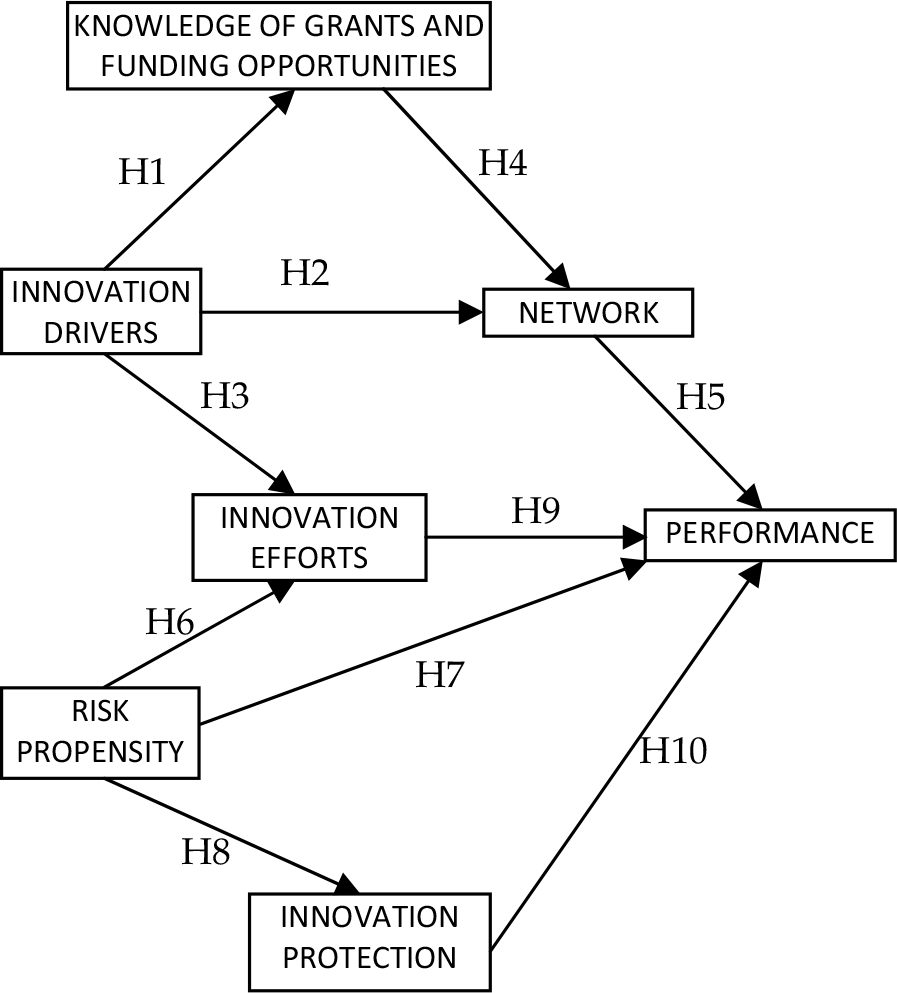
The principal objective of the paper is to create a model capable of explaining the effects on company performance of specific company characteristics and behaviours in the area of innovation (i.e., company “risk prowess”) (Figure 1).
The research model.
The behaviours and company characteristics useful for the application of our model are those inherent to innovation activity, R&D and technological transfer. From the analysis of the scientific literature, summarized above, we select seven innovation-related variables to analyse the relation between company performance and innovation:
“Innovation drivers” takes into account factors enabling innovation, such as technological knowledge and a skilled workforce, R&D investments, organizational culture and a climate for creativity and innovation [32, 75]. “Network” considers the network of company relationships with universities, research centres, partners, clients and suppliers, etc. [2, 54]. “Knowledge of grants and funding opportunities” describes the company's capacity to exploit public innovation funding [26]. “Innovation efforts” describes the company commitment to innovation, regardless of its economic resources [44]. “Risk propensity” indicates company risk-taking as an innovative behaviour [52]. “Innovation protection” takes into account the company's protection mechanisms and strategies [52–53]. “Performance” describes the company outcomes in terms of competitiveness, i.e., revenue, market share, efficiency and productivity trends [2, 76–77].
The data concerning innovation-related variables is gathered by means of surveys conducted with companies belonging to high-tech sectors that are characterized by high levels of innovation.
In the current study, the purpose of the research model is to verify the following hypotheses:
H1: A greater presence of ‘innovation drivers’ in a company leads to greater knowledge of ‘grants and funding opportunities’. H2: ‘Innovation drivers’ stimulate a company to grow their ‘network’. H3: ‘Innovation drivers’ favour greater ‘innovation efforts’ in companies. H4: Greater ‘knowledge of grants and funding opportunities’ pushes a company to enlarge its ‘network’, favouring the activity of technological transfer and incentivizing the company to search partnerships for R&D activity. H5: Companies that increase technological transfer activity through their ‘network’ obtain better ‘performance’. H6: A greater ‘risk propensity’ in a company increases its ‘innovation efforts’. H7: The ‘risk propensity’ of a company has a positive effect on its ‘performance’. H8: A greater ‘risk propensity’ in a company pushes it to increase the use of ‘mechanisms for innovation protection’. H9: A company's ‘innovation efforts’ have a positive impact on its ‘performance’. H10: The use of mechanisms for ‘innovation protection’ by a company has a positive effect on its ‘performance’.
4. The Sample
Given national aims of acquiring a competitive advantage and promoting territorial development, the contributions of companies characterized by high innovative content are becoming ever more important. The territory that is the object of analysis for the current article is the Italian region of Lazio. This region offers notable potential, both because it hosts the metropolis of Rome, being capable of attracting multiple investors and resources, and in terms of economic growth. To comprehend the weight of Lazio in economic terms, we can compare the GDP of the region to that of entire European nations: Lazio's GDP is 169 billion euros [78], slightly below that of countries such as Greece and Portugal (206.4 and 170.1 billion euros) and much higher than that of Hungary (98.2 billion euros).
The Lazio industrial fabric involves a number of sectors characterized by high innovative content: among these, our study concentrates on the biotechnology and aerospace sectors.
The sample selected consists of a total of 47 companies, of which 20 operate in the aerospace sector and 27 in biotechnology. The information concerning company characteristics was obtained by submitting a questionnaire to the enterprises. The component questions were posed in such a manner as to quantify certain characteristics of the companies (by employing a Likert scale with scores from 1 to 5). The questionnaire included four questions concerning each of the innovation-related variables, and the same number for performance. It also requested information concerning the characteristics of the company's innovation (e.g., type of innovation, sources of financing for R&D activities, etc.). The questionnaire was administered during the first three months of 2013 and refers to the 2010-2012 triennium.
The Lazio aerospace industry is fundamentally centred on two sub-sectors, civil and military, which are interdependent. In fact, the presence of these two sub-sectors permits the greater integration of competencies and technologies, as well as the exploitation of economies of scale and scope. The core business of enterprises that concentrate on the military sector is the production of military aircraft, structural components and vehicles, etc.
Many of the companies operating in the civil sector constitute part of the supply chain for the military sector, producing services, consultancies and electronic, computing and telecommunications products. The companies belonging to the military sector are large but few in number, while those in the civil sector are more numerous but generally smaller (SMEs), characterized by greater specialization [79].
The sample analysed reflects the composition of the sector. In terms of the number of employees and revenues, the companies in the sample are primarily small- and medium-sized. The sample includes only four large-sized companies, although these are enterprises of major, national importance. A substantial circuit of small and medium companies of a high technological and innovative level has consolidated around these large companies. These are SMEs characterized by strong entrepreneurial character, which provide significant support to the aerospace sector.
The biotechnology sector of the region of Lazio focuses primarily on pharmaceutical activities. Thus, in the sample interviewed, the percentage of pharmaceutical companies (88%) is notably higher than for any other sector of activity. The remaining companies in the sample operate in the agri-foods, chemical-rubber, biomedical engineering and energy and environment sectors, with each of these sectors represented in quite a small percentage (3%).
Concerning the subdivision of the companies by dimension [80], roughly 75% of the total sample can be classified as small- to medium-sized companies, while the large-sized companies (some of which are multinationals) are in reality some of the most important at the national level.
From a first analysis of the questionnaires, we immediately detect several differences between the two sectors. For example, there are inherent differences in the type of innovation developed over the past triennium. Observing Figure 2, the large part of the aerospace companies (40%) has introduced new technological products onto the market (not including the simple resale of new products from other companies or product changes of a cosmetic nature). In the biotech sector, the principle type of new innovation developed is also the new technological product, although in this case the percentage share of total innovation is less (37%). A more significant difference appears for innovations in service. In fact, in the aerospace sector, 20% of companies developed such innovation in service, while the biotech sector produces barely half this level of service innovation (11.1% of the total). Concerning innovation in production processes, there is little difference between the percentages of the two sectors: 20% in the aerospace sector and 22.2% in the biotech sector. A group of other innovations produced in the two sectors include purchase management and maintenance and support activities. In this case, the percentages are again close: 15% for the aerospace sector and 14.8% for the biotech sector.

Typology of innovative activity.
Only 5% of aerospace companies and 7.4% of biotech companies carried out innovations in relation to logistics systems or distribution methods.
A final, notable point concerns the percentage of companies that did not develop any innovation over the past triennium. While in the aerospace sector all companies produced at least one innovation, in the biotech sector 7.4% of companies did not develop any. This data is probably influenced by the crisis that has affected the pharmaceutical sector in recent years, which has led some companies to disinvest in R&D departments.
Figure 3 presents the average values attributed to the importance of the different means of financing in the biotech and aerospace sectors. In general, the enterprises attribute little importance to external financing. This result is due to the fact that the sample consists primarily of SMEs, which are companies that experience greater difficulty in gaining access to credit and, thus, do not have confidence in future potential financing. The exception to this trend is presented by the companies in the aerospace sector, for which the most important means of financing is seen as public funding, from the national level and - above all - from the European Community level.

Financing of innovative activity.
The companies in the biotechnology sector generally attribute little importance to the potential financing methods for innovation activity. The highest average value for a particular method is still less than 3, corresponding to a judgment of “average importance”. Concerning the means “other forms of financing”, the companies had considered practices of co-design and co-creation for the development of new solutions.
Another important aspect that differentiates the two sectors is the use of innovation (Figure 4). In fact, for companies in the biotech sector, innovation is primarily used (63%) within the company itself, while 29.6% of companies use innovation with other companies and/or research institutions, and only a small percentage (7.4%) cede the innovation to third parties. The behaviour of the aerospace companies is significantly different: here, a large part of the companies (46%) use innovation together with other companies and/or research institutes. This fact seems to indicate behaviour characterized by greater cooperation. In reality, the Lazio industrial aerospace sector features the presence of several large enterprises that attract a truly linked industry, composed of surrounding small- and medium-sized companies. The presence of this network of companies, involving complex relationships of supply and sub-supply, explains the high percentage of enterprises that utilise innovation with other enterprises.

Utilization of innovation.
5. An Application to the Biotech and Aerospace Industries
Figure 5 shows that all of the hypotheses presented in Figure 1 are verified for the high-tech sectors analysed. It is important to note that the correlations are high and strongly significant, confirming the importance of innovation in these high-tech sectors, both as a condition necessary for competitiveness in these markets and in order to achieve elevated levels of performance.

The estimated model: total sample (**p<0.01; *p<0.05).
In particular, ‘innovation drivers’ have a strong influence: on the search for understanding of the regulatory framework (‘knowledge of grants and funding opportunities’), on ‘innovation efforts’, and on the construction of a network of contacts in the spheres of public and private research (‘network’) (H1, H2, H3). Knowledge of the regulatory environment (‘knowledge of grants and funding opportunities’) permits the companies to obtain greater contacts in the public and private research spheres (‘network’), favouring the activity of technological transfer and incentivizing the enterprises towards innovation (H4).
In addition, ‘risk propensity’ is a characteristic of companies that engage in innovation (‘innovation efforts’), and that reach positive innovative results that are then justly protected (‘innovation protection’) (H6, H8). Finally, in the high-tech sectors analysed, company competitiveness and ‘performance’ are incremented primarily through the company's ‘innovation efforts’, but also through ‘risk propensity’, by the ability to create an adequate network favouring technological transfer and R&D partnerships (‘network’), as well as the capacity to protect the results of their innovative activity (‘innovation activity‘) (H5, H7, H9, H10).
6. Comparison between the Biotech and Aerospace Samples
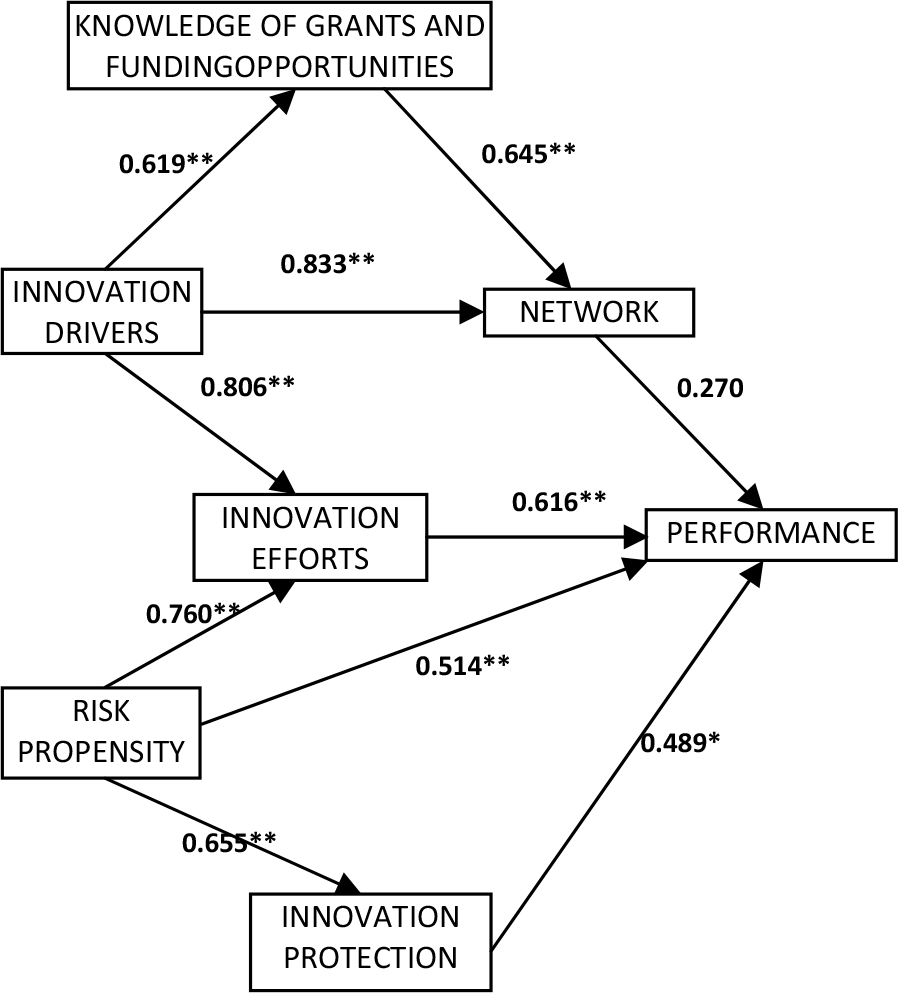
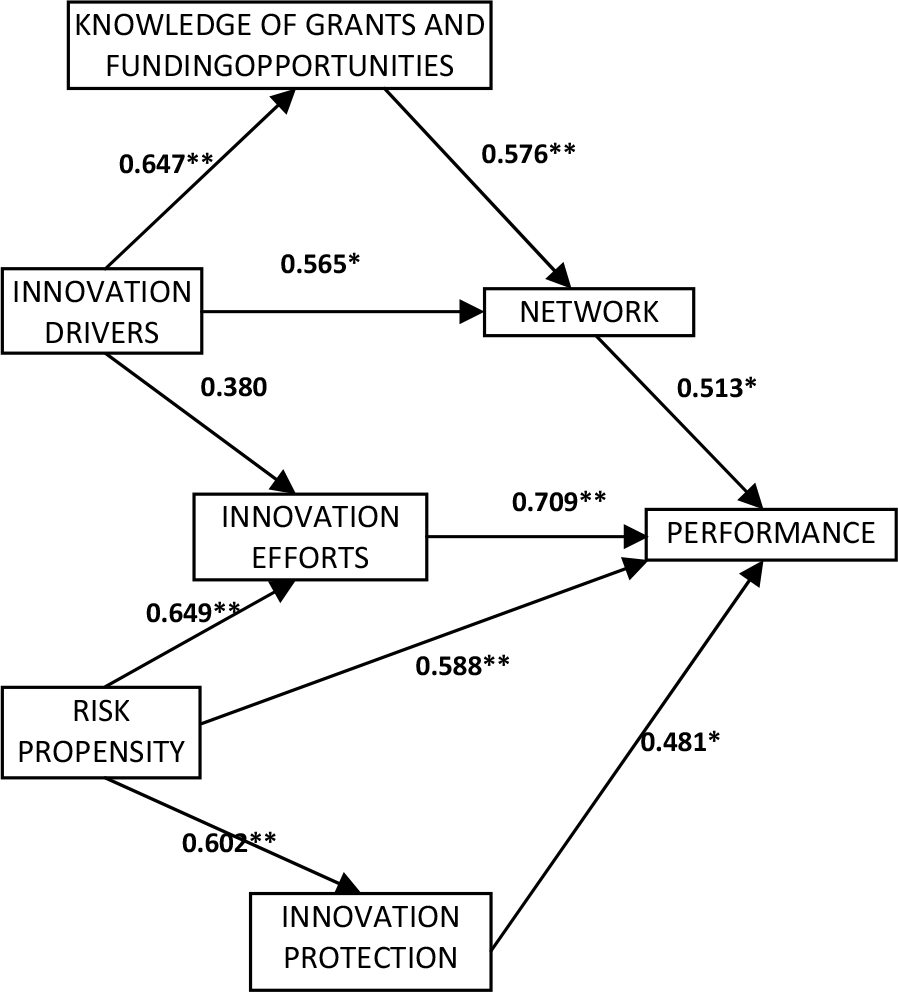
The application of the research model to the individual sectors (Biotechnology – Figure 6; Aerospace – Figure 7) exhibits results very similar to those observed for the entire sample.
The estimated model: biotechnology sector (**p<0.01; *p<0.05).
The estimated model: aerospace sector (**p<0.01; *p<0.05).
In the comparison between the two sectors, two significant differences emerge:
‘Network’ has a positive and significant influence on the ‘performance’ of the enterprises (H5) only in the aerospace sector, while in the biotechnology sector the correlation is not significant. ‘Innovation drivers’ are fundamental in developing enterprise engagement in innovation (‘innovation efforts’) only for the biotechnology sector but not for the aerospace sector.
The most significant difference concerns the role of the ‘network’. In fact, both the questionnaire and the statistical analyses show that biotech enterprises tend less towards cooperation than those enterprises in the aerospace sector. In fact, it emerges that the largest part of biotech enterprises utilise their innovation in their own company, while the aerospace sector uses innovation primarily with other enterprises (Figure 4). This result is in part due to the composition of the aerospace sector, which is characterized by the presence of a small number of very large enterprises operating primarily in the military sector and supported by a network of small- and medium-sized local suppliers operating in a linked industry. The statistical analysis confirms that the network has a highly positive influence on performance in the aerospace sector, while in the biotech sector the correlation is not significant.
The other difference concerns the absence of a significant correlation between ‘innovation drivers’ and ‘innovation efforts’ in the aerospace sector, while this correlation is highly positive and significant in the biotech sector (Figure 6). This result is due to the fact that SMEs in the aerospace sector (80% of the total sample) comprise the linked industry of the large enterprises of the sector (20%). In this situation, the innovations are introduced by the large enterprises and do not serve as innovation drivers to stimulate SMEs towards further innovation.
The correlation between the efforts undertaken by the enterprises to innovate and the enterprise performances is positive and highly significant in both the aerospace and biotechnology sectors (H9), confirming the findings from the analysis of the combined sectors (Figure 5).
Another important characteristic for enterprises that wish innovationg is the propensity to risk of the organization (‘risk propensity’). In all three analyses (Figures 5, 6, 7), this variable has a strong influence on the efforts undertaken by the company to innovate (innovation efforts) (H6).
7. Conclusions
Italy's slow pace in innovative activity compared with other industrialized nations reflects the fragmentation of the productive system among many small enterprises that have difficulty in sustaining the high costs of R&D and in assuming risk [81]. Lazio is only one among several national regions where innovative processes struggle to take hold. Current expenditures in R&D are still very low (3 billion euros in Lazio versus 16 billion euros for the region of Paris, 3.8 billion for Madrid, 3.4 billion for London, 3.3 billion for Berlin). This pattern also holds for patents, calculated per million inhabitants (11.2 for Lazio, 76.5 for the region of Berlin, 95.9 for Paris, 35.7 for Amsterdam).
The current work analysed the innovative behaviour of a sample of 47 enterprises in the biotech and aerospace sectors of the Region of Lazio. The model developed has permitted the illustration of the relations between the innovation-related variables and the impact that these have on company performance.
The analyses conducted reveal high and strongly significant correlations, both between the innovation-related variables and the variables that directly influence performance, with the exception of the network in the biotech sector. Thus, ‘innovation efforts’, ‘innovation protection’ and ‘risk propensity’ have positive effects on the economic performances of such enterprises. In particular, the variable ‘risk propensity’ takes on a central role, exercising a high level of influence on both ‘innovation efforts’ and ‘innovation protection’, as well as directly on company performances. The differences observed between the two sectors reiterate that in the aerospace sector, a small number of large enterprises dominate the innovative process, guiding the linked industry (SMEs) and creating a strong network for innovation. In contrast, the biotech enterprises lack sufficient connections with research centres and other potential partners in technology transfer.
Thus, in the biotech sector, policy makers should plan measures that are useful in stimulating technology transfer and the development of public-private R&D partnerships. Such initiatives would not only to promote innovation in the individual enterprises, but also serve in launching regional economic development.