




Abstract
Parallel trade (PT) is a practice related to arbitrage operations in international trade. We provide a rationale for PT as an opportunistic behaviour by an international wholesaler who is privately informed about market demands in two countries where a multinational firm operates. This alternative theory of PT contributes to an explanation of why PT has gained considerable importance in various industries, and why it has not yet resulted in price convergence across relevant countries. Indeed, we find that asymmetric information enlarges the scope for PT, relative to complete information, and possibly increases crosscountry differences in prices. The European Commission supports PT as a means to achieve the integration of national markets, to the benefit of all citizens. However, under asymmetric information, consumers benefit from PT only with a high volume of parallel imports (e.g., when arbitrage costs are low); otherwise competition among wholesalers can be an effective substitute for PT. Furthermore, an important implication of PT is the transfer of profits from the manufacturer to the wholesaler. Therefore, in R&D-intensive industries, such as pharmaceuticals, policy makers should anticipate the likely consequences of PT under asymmetric information on the long-run incentives to innovate.
1. Introduction
Parallel trade (PT) is a practice related to arbitrage operations in international trade. It consists in importing goods into a country without the authorization of the intellectual property rights (IPR) owner, after those goods have been produced and distributed legally in another market by the rights-holder, or an authorized distributor.
The legitimacy of PT in a given area depends upon the policy makers' decision concerning the regime of territorial exhaustion of IPR. For instance, the EU has adopted a regime of regional exhaustion where IPR are ended upon first sale in Member States (thus allowing free trade among them), but still hold outside the region. Thus, the EU supports PT as a means to achieve the integration of national markets, to the benefit of all citizens. On the other hand, United States have chosen national exhaustion, where IPR owners may prevent imports. Generally, developing countries have chosen international exhaustion, with complete trade liberalization.
The main reason for PT is the existence of price differentials across countries. These in turn have been explained in terms of retail price discrimination [1, 2], vertical pricing [3, 4], or national differences in government price controls [5, 6].
In this paper, we provide a complementary explanation for PT, which is based on asymmetric information about market demand between upstream manufacturers and wholesalers or distributors. This alternative theory of PT may contribute to explain why PT has gained considerable importance in various industries, and why it has not yet resulted in price convergence across relevant countries.
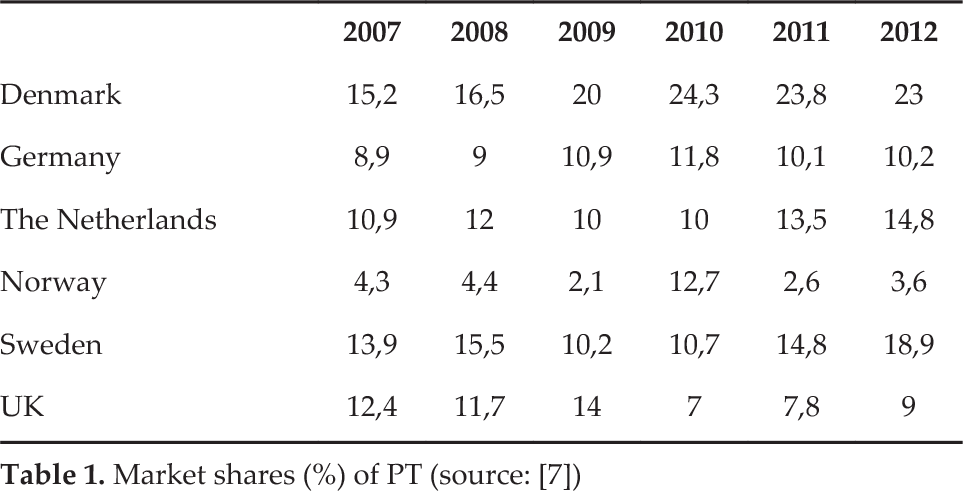
Empirical evidence shows that PT plays a significant role in a number of industries. In pharmaceuticals, PT in the EU was estimated to amount to € 5,465 million at ex-factory prices in 2012 [7]. In the UK, the market share of PT is 9%, while, in Germany, it is 10.2%. In the Netherlands, parallel imports have reached about 15% of the ethical-drug market, and concern nine out of the top ten firms.
Table 1 displays the time trend of market shares attributable to PT in some relevant destination markets in the EU.
Market shares (%) of PT (source: [7])
The motivating example for our model concerns Bayer group, a major multinational firm in the pharmaceutical industry. In particular, it regards Adalat, a drug designed to treat cardiovascular illness that, in a few years after the launch, reached around 8% of the relevant EU market [8].
Adalat provides a clear example of how the same prescription drug manufactured in different countries by the same multinational firm can be affected by PT due to price differentials between countries. Actually, prices in Spain and France were initially, on average, 40% lower than prices in the UK. Because of these price differentials, wholesalers in Spain and France exported Adalat to the UK. Adalat represents a large percentage of total turnover of Bayer UK, figures such as 56% having been quoted in the past years. On account of parallel imports, sales of Adalat by Bayer UK fell by almost half in a few years, thereby causing a loss of revenue of 160 million US dollars for the British subsidiary and a loss of 70 million US dollars to Bayer group as a whole [8]. Figure 1 provides a stylized representation of how PT works in this example, where ‘Market A’ is Spain or France, and ‘Market B’ is the UK.
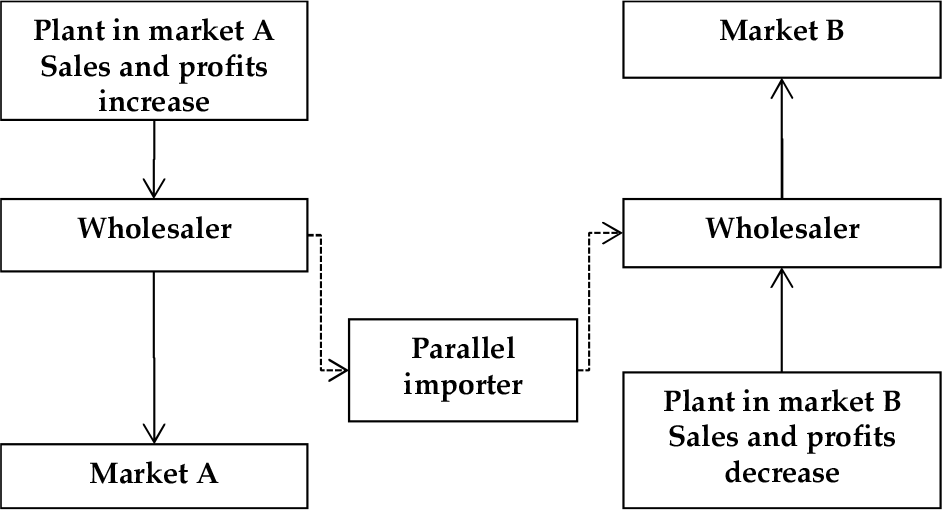
The working mechanism of PT
The main problem manufacturers have regarding the limitation of exports is that, as soon as they have sold their products to the wholesalers, they have no further direct control over the product final destination. In many industries (such as pharmaceuticals), the reciprocal flows of orders and deliveries between wholesalers and retailers enable wholesalers to have a precise knowledge of local markets and forecast demand sizes more thoroughly than manufacturers. Hence, to gather information about market demand and possibly reduce the scope for arbitrage, manufacturing firms may set up monitoring systems on distribution channels.
Indeed, faced with PT, Bayer decided that the subsidiaries in Spain and France would no longer fulfil all orders placed by wholesalers in their respective countries. In addition, Bayer set up a monitoring system based on the recording of supplies in a given period (reference quantity). Then, on a yearly basis, Bayer decided unilaterally the quantity amount to be sold to each wholesaler. In so doing, Bayer stopped responding to orders for supplies from certain wholesalers identified by the system as those who had increased their orders by inordinate proportions over the past years. The aim behind this practice was to target the main export suppliers in order to reduce the volumes of product channelled into the parallel import market. 1
Similarly, GlaxoSmithKline (GSK) also introduced an agency distribution scheme in the UK, in an attempt to gain more control over the distribution of its products. As part of the agreement, each wholesaler had to supply GSK with detailed sales data on the destination and volumes of some GSK's products sold. This ‘transparency obligation’ was primarily intended to curtail PT. Following the same line, Pfizer and other multinational firms later introduced similar agency models in the UK [9].
The central argument of this paper claims that the scope for PT is related to the wholesalers having private information about consumer demand in national markets. Thus, we model strategic interaction by defining a game where a multinational firm offers a menu of contracts to a privately informed international wholesaler in order to infer its type (that is associated with market sizes) and, possibly, limit PT. On the other hand, the wholesaler aims at obtaining product quantities larger than the actual demand in the low-price market, and lower than the actual demand in the high-price market, so as to rearrange the quantities sold at its own benefit.
We find that asymmetric information enlarges the scope for PT compared with the case of complete information, since PT becomes profitable for substantially lower intermediate price differentials. We show that one of the main implications of PT is transferring profits from the manufacturer to the wholesaler. On the other hand, consumers really take advantage of PT only in the presence of a high volume of parallel imports (e.g. when arbitrage costs are low), otherwise competition among wholesalers can be an effective substitute for PT. 2
The relevant literature rules out the typical problems arising from a principal-agent context with a privately informed wholesaler. To our knowledge, all of the relevant papers assume that the manufacturer is completely informed. Therefore, the manufacturer is able, first, to perfectly control the quantities sold in each country (thus governing the extent of PT) and, second, to extract the wholesaler's profit.
This assumption seems to be at odds with the trend towards concentration and internationalisation in wholesaling and distribution, which has produced pan-European chains. In the past years, the three biggest wholesalers in Europe (Phoenix, Celesio and Alliance UniChem) have acquired smaller firms locally and across national borders, and now are dominant firms in several EU markets. Indeed, their combined shares reached, in 2007, 100% in Denmark and Norway, 92% in the UK, 70% in France, and 63% in Germany [10, 11]. Table 2 shows the high degree of concentration in distribution in a number of national EU markets.

This trend towards concentration in the distribution segment, producing pan-European chains, improves wholesalers' and distributors' bargaining position in front of manufacturers. This bargaining power is strengthened by the fact that wholesalers and distributors are often better informed on actual market demands than upstream producers are.
The remainder of this paper is organised as follows. Section 2 defines the theoretical model and identifies the agents' strategies. Section 3 analyses the effect of competition in the distribution segment. Section 4 analyses welfare implications, while Section 5 contains some concluding remarks.
2. The model
We analyse formally the scope for PT in a vertical relationship between a multinational manufacturer and an international wholesaler. For this purpose, we assume that the manufacturer (M) has two plants producing the same good located in two different countries (A and B), and that the wholesaler (W) deals with the sales of the good in both retail markets. Let the inverse demand curves take the linear form. For simplicity, we assume that in each country the manufacturer has zero marginal costs, while the only cost incurred by the wholesaler is that of purchasing the good at the intermediate price.
The information structure is such that the wholesaler has private information about market sizes, as measured by the demand intercept parameters aA, aB in markets A and B respectively. However, it is common knowledge that demand in each country may be high (so that aA=HA and/or aB=HB) or low (so that aA=LA and/or aB=LB), where LA<HA<LB<HB. The manufacturer's prior beliefs about the sizes of the two markets can be expressed according to a probability distribution Pij, with Pij≥ 0 ∀i, jε{H, L} and σijPij = 1 (where subscript i refers to the size of market A and subscript j to the size of market B), which is also common knowledge. Let the four possible market configurations be assimilated to the wholesaler's types ij, ∀i, jε{H, L}.
In this framework, we model strategic interaction between the manufacturer and the wholesaler through the following two-stage game. At the first stage of the game, the manufacturer offers a menu of contracts to the wholesaler. At the second stage of the game, the wholesaler makes a selection from the menu that is observed by the multinational. Each contract in the menu specifies the quantity amount to be purchased by each wholesaler's type in each country, and the related intermediate prices. On the basis of the wholesaler's choice, the manufacturer updates its prior beliefs about the sizes of the two markets.
The manufacturer may be interested in discerning the wholesaler's type (that is, market sizes) and, consequently, limit the extent of PT. The menu approach allows the proposed contract to be conditional on the wholesaler's type. Hence, to induce self-selection, the menu of contracts should properly take into account the constraints arising from incentive compatibility and participation. If the menu induces separation, the manufacturer correctly infers the wholesaler's type. In the opposite case, the posterior beliefs are the same as the priors.
2.1 Complete information – segmented markets
In this section, we consider the benchmark case for our results. First, we assume that there is complete information. Thus, both the manufacturer and the wholesaler are perfectly aware of the actual market sizes. Moreover, we assume that markets are segmented, namely, PT is not allowed legally. Clearly, this is the most profitable case to the manufacturer under complete information.
Let pA=aA-bqA and pB=aB-bqB be the inverse demand curves, where pA, pB are the retail prices and qA, qB are the quantities sold in the two markets. Let wA, wB denote the intermediate prices of the good in countries A and B, respectively. Under market segmentation, the wholesaler's optimal strategy is determined by solving:

Thus, the wholesaler chooses the quantities to be sold in each market (that are respectively equal to those purchased from each of the manufacturer's plants) so that the joint profit is maximized. On the other hand, the manufacturer's optimal strategy is determined by solving:

Thus, the multinational firm chooses the intermediate prices that maximize the joint profit, thereby practicing third-degree price discrimination. The optimal intermediate prices and (both intermediate and final) quantities can be easily derived, and are as follows:
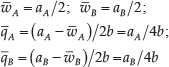
The results obtained directly extend to the case of two markets the classical double-marginalization model, involving two vertically-related monopolies.
In what follows, we will refer to this benchmark case as the ‘segmented market’ (SM) case. The focus of our paper is in fact on PT specifically deriving from the assumed information structure of the game, that is, from the wholesaler having private information about market demands. This structure may provide a rationale for PT as an opportunistic behaviour by the wholesaler, in the sense that it has the possibility to purchase quantities that differ from those it resells in the retail markets. In particular, the wholesaler may find it profitable to modify the required quantities in such a way that is functional to international arbitrage. Thus, the wholesaler would like to induce the manufacturer to produce quantities in excess with respect to the real low-price market size, on the one side, and less than the real high-price market size, on the other side. Therefore, the manufacturer is not able to identify a simple direct relationship between the quantities purchased upstream, those resold downstream and the actual market sizes. In the next sections, we will focus on the case where, due to the intermediate price differential, PT reduces the multinational firm's joint profit.
2.2 Incomplete information – parallel trade
Now, assume that PT is not legally restricted. Let s be the unit cost of transporting the good from country A to B (including not merely the cost of physical transportation, but also repackaging and other possible distribution costs). Let d denote the transported quantity. It follows from the assumption on market sizes that PT can only flow from country A to B. For simplicity, we assume that the wholesaler cannot create inventories nor can it buys quantities of the good that it does not resell. This implies that the sum of the purchased quantities from M coincide with the total quantities sold by W in the two countries.
Under asymmetric information, the manufacturer may wish to infer market sizes from the wholesaler's purchased quantities. As a response to the chance of PT, the manufacturer may decide to restrict the quantities it sells to the wholesaler to a discrete and finite set, including exactly the quantities the wholesaler would ask in the segmented market case. In other words, the manufacturer may offer the wholesaler a menu of contracts, where quantities and wholesale prices are specified as in (1). To simplify the analysis, in the remainder of the paper we assume that this is actually the case. We can prove that, under certain conditions, selecting this menu of contracts is the manufacturer's equilibrium strategy under incomplete information.
Let t={ tij }, i, jε{H, L }, represent a contract menu, where ij denotes the wholesaler's type. Each contract in the menu consists of a pair of quantities (qA,qB)
ij
and the associated intermediate (linear) prices (wA,wB)
ij
, that is,
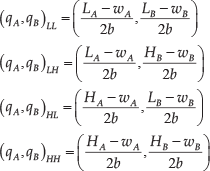
Now, let


for i, j, h,
Condition (3) is the self-selection constraint, while condition (4) is the participation constraint. If the menu induces separation, both players act as if they have complete information in the second-stage of the game. This happens when, for each possible demand configuration, W chooses the related contract, thus adopting a separating strategy. In the opposite case, a specific contract is selected by a multiplicity of types. When the same contract is profitable to all the wholesaler's types, irrespective of the actual demand levels, W is said to adopt a pooling strategy. Hence, M cannot infer the real market sizes, so that it supplies quantities of the good different from those it would have supplied under complete information. In the case where W adopts a pooling strategy for a subset of configurations, and a separating strategy for the remaining subset, W is playing a hybrid strategy (i.e., a partially-pooling or a semi***separating strategy). Figure 2 displays the wholesaler's strategies, on the basis of market sizes.

Wholesaler's strategy definition
The appropriate solution concept for this game is the perfect Bayesian equilibrium (PBE). The definition of a PBE consists of a set of strategies and beliefs such that, at each stage of the game, strategies are optimal given beliefs, and the beliefs are obtained from equilibrium strategies and observed actions using Bayes' rule (see [12]). A PBE of the described game is separating if the wholesaler adopts a separating strategy, while it is pooling (partially-pooling) if the wholesaler adopts a pooling (partially-pooling) strategy.
2.3 Equilibrium analysis
In the described framework, it is of primary interest to us to analyse PT as deriving from the existence of partially-pooling equilibria of the game. These equilibria result from the profitability to any wholesaler's type ij to mimic any other type hk in the choice of a specific contract from the menu. Given the discrete and finite set of proposed contracts, the number of possible partially-pooling equilibria is also finite.
Table 3 displays the imitation strategies (on the table columns) that are available to each wholesaler's type (on the rows), where + (respectively, -) indicates that the imitation strategy may be profitable (is unprofitable).
Imitation strategies
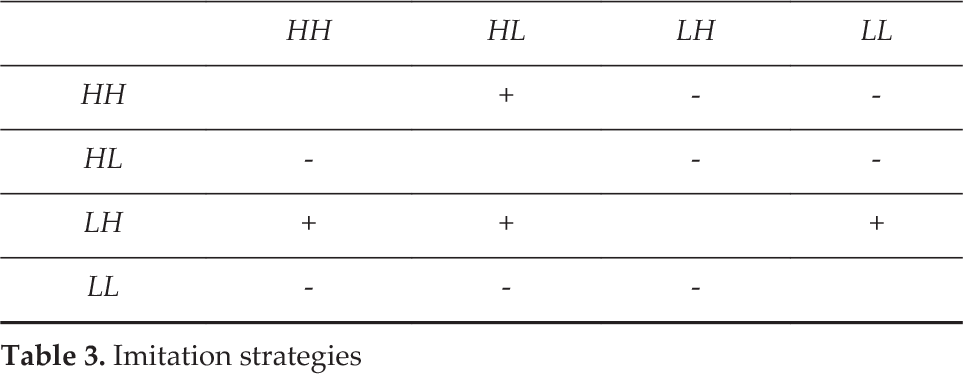
Clearly, the profitability of any imitation strategy depends on arbitrage costs. Nonetheless, a number of imitation strategies are in sharp contrast with the assumed direction of arbitrage flow. Actually, to be effectively able to engage in PT, the wholesaler should purchase in country A a quantity amount in excess relative to the actual market size.
This, in turn, implies that a number of possible pooling strategies are indeed prevented from occurring.
On the basis of the foregoing statements, the most interesting case for the analysis occurs when type LH mimics type HL. Actually, this represents the partially-pooling strategy that maximizes the scope for PT, in the sense that the transported quantity amount is the highest possible. Therefore, it is potentially the imitation strategy with the most significant impact on firms' profits and consumer surplus. For these reasons, in the remainder of the paper, we will focus on this case. To keep things interesting, let us make the following assumption.
It follows from Assumption 1 that, in the considered case, PT has detrimental effects on the manufacturer's profit. Let us now determine the precise quantity amount that is functional to international arbitrage.

Proof The incentive compatibility constraint for type LH to mimic type HL can be written as:
When the wholesaler's type LH imitates type HL, the manufacturer cannot discriminate between the two types. Hence, it sells as if demand in country A is high whereas it is low, and as if demand in country B is low whereas it is high, thus losing (under Assumption 1) part of the profit it would have obtained in the segmented market case.
Computation yields that the following result holds.

An interesting remark should be made at this point. Under complete information, the necessary condition for PT to be profitable is clearly wA + s<wB. Under incomplete information, the value of δMAX can be rewritten as an explicit function of the intermediate prices wA=HA/2 and wB=LB/2. By substituting these values into the expression of δMAX' it can be obtained that:
As expected, the transported quantity is directly proportional to the intermediate price differential between the two countries (including the cost of arbitrage). However, an additional impact on the transported quantity emerges that can be uniquely attributed to the presence of asymmetric information, namely, the term ((HB−L B) + (HA−L A)). This term identifies the scope for PT as a function of the difference between the real market sizes (respectively, L A and HB) and the signalled dimensions, namely, the quantities purchased through the selected contract (respectively, HA and L B). The wholesaler's strategy enables it to incur lower intermediate costs compared to complete information, and to recoup arbitrage costs by setting proper retail prices. Indeed, much of the quantity purchased by W in country A at a cost wA<wB is resold in B at a price pB > pA.
The main implication is that, under incomplete information, PT may persist in the case where the transport cost is higher than the intermediate price differential (to the extreme case, even setting equal intermediate prices could not be enough to deter PT).
Let us now examine the effect of PT on both ex-factory and retail price differentials. Under market segmentation, when actual market sizes are those related to type LH, the ex-factory price differential can be expressed as:
As regards retail prices, these can be written as a function of the quantity imported in B from A, that is,
The foregoing statements can be summarized in the following proposition.
3. Downstream competition
Let us now assume that there are n symmetric international wholesalers for the homogenous good produced by M. The linear inverse demand curve in country m can be written as:

On the other hand, the manufacturer's problem is:

We can easily find that:

Note that the optimal intermediate prices are independent of the number of wholesalers:
If the n wholesalers operating in both markets have private information about market sizes, the manufacturer proposes a contract menu where the supplied quantities are determined on the basis of the number of competing wholesalers, while intermediate prices, being independent of their number, are not affected. The possible PBE of the game are the same as those discussed in subsection 2.3, in the sense that there are partially-pooling and separating equilibria. Let us focus on the partially-pooling equilibrium where type LH imitates type HL.

Proof. We omit the proof, since it follows the same steps as the proof of Proposition 1. QED
Downstream competition reduces the scope for PT to each single wholesaler. This effect can be explained on the following grounds. First, there is a fall in each wholesaler's margin, due to the reduction of retail prices, while intermediate prices are not affected by competition. Second, there is also a fall in the amount of quantities that each wholesaler can distribute. A further implication is that the transported quantity from market A to B in the case of a single wholesaler is higher than the overall transported quantity with n competing wholesalers.
Proof. The total transported quantity in an environment with n symmetric competing wholesalers is simply given by the sum of the δl transported by each wholesaler l:

It is easy to see that:

being
Similar to the case of a single wholesaler, we can find the following result.

Easy computation yields that sn<s 1 holds for n>1.
4. Welfare implications
We evaluate here the effects of PT on both upstream and downstream firms' profits, as well as on consumer surplus in the considered countries. Note that we assess welfare implications of PT only in terms of static efficiency, namely, the real resources used in arbitrage are weighted against the involved parties' costs and benefits.
First, we compare the amount of consumer surplus under PT, that is,
if transport costs are relatively low, the combined effect of PT and downstream competition raises consumer surplus; that is, if
if transport costs are high, PT reduces consumer surplus when downstream competition is sufficiently intense; that is, there exists a critical value n̂ such that, if s' <s <sn, then
Proof We can find that CSnPT –CSnSM is a quadratic function in s:

Solving
Computation yields that
we have that
Let us now compare sn and s’. Computation yields that:
Solving sn=s’ in n yields two roots: n = 0 and

We can find that i), ii), iii) and iv) imply that n̂ >0 and that sn crosses s' from below in n̂. It follows that s’ <sn holds for n>n̂. This proves that, if n>n̂ and s‘<s<sn, then
Figure 3 shows the effects of PT on total wholesalers' profit

The effects of PT on aggregate consumer surplus and on wholesalers' profit, depending on the arbitrage cost and on downstream competition.
From Proposition 6, the critical value sn identifies the maximum value of s for which the partially-pooling equilibrium exists, that is, for which PT is profitable. From Proposition 7, we have that, when s<s', CSnPT-CSnSM is positive, that is, consumers benefit from PT. Finally, we find the critical value s” by imposing condition
Figure 3 shows that consumers as a whole really benefit from PT only in the presence of a high volume of parallel imports. Recall, from Proposition 5, that downstream competition reduces the scope for PT. Thus, the volume of parallel imports is sufficiently high in two alternative circumstances (see Figure 3): i) given that downstream competition is intense (n>n̂≈3), if the transport cost is sufficiently low (s<s'), namely, in the relevant portion of area (2); ii) with a small number of wholesalers (n<n̂), for any feasible value of the transport cost (s<sn), namely, in the remaining portion of area (2) and in area (1).
Conversely, in area (3), the volume of parallel imports is relatively small, since the transport cost is high (s'<s<sn) and the number of wholesalers is high (n>n̂). Consequently, we find that CSnPT-CSnSM is negative, that is, PT reduces consumer surplus.
Finally, we are able to assess how wholesalers and consumers share the benefits of PT, if any. In area (1), where the transport cost is sufficiently high (s”<s<sn), we have that
It is worth noting that, in all areas in Figure 3, PT is transferring profits from innovating firms (i.e., manufacturers) to non-innovating firms (i.e., wholesalers). Therefore, in the long run, PT may have negative social effects, when these are evaluated in terms of dynamic efficiency. Actually, one should ascertain whether the manufacturers' profit loss reflects into a reduction in R&D investment, which in turn may cause a loss of competitiveness in the relevant industry.
5. Concluding remarks
PT has gained considerable importance in several industries. It often stems from vertical relationships between multinational manufacturing firms and international wholesalers. We have analysed formally the practice of PT through a game between a multinational and a wholesaler operating in two markets. The wholesaler owns private information about market sizes, and exploits this information advantage so as to practice international arbitrage. We have shown that the scope for the wholesaler's opportunistic behaviour depends on the price differential between countries, on the amount of resources employed in arbitrage operations, and on the downstream market structure.
We have also shown that, depending on these factors, the welfare implications of PT are ambiguous. We have pointed out that one of the main effects of PT is transferring profits from multinational manufacturing firms to international wholesalers. On the other hand, consumers as a whole really benefit from PT only in the presence of a high volume of parallel imports. This occurs when downstream competition is not too intense, or transport costs are low.
If instead the volume of parallel imports is relatively small (because transport costs are high), then market segmentation with international price discrimination by the multinational firm could be the socially optimal solution, as far as downstream competition is sufficiently intense.
On the basis of the results obtained, we can draw a number of recommendations for policy makers. The EU has adopted a regime of regional exhaustion of IPR, which allows free circulation of goods within Member States. This policy choice is pursuant to the essential objective of achieving the European single market. Both the European Commission and the European Court of Justice have repeatedly supported PT as a means to achieve the full integration of national markets. Indeed, they believe that PT strengthens competition in retail markets, thereby inducing national retail prices to converge to a single price across Europe. In principle, the mere threat of PT should lead to global uniform pricing and thus eliminate any arbitrage opportunities.
It is however worth noting that empirical evidence shows that PT has gained large market shares, but has not yet resulted in price convergence across relevant countries (see e.g. [4]). Our vertical pricing model of PT attempts to provide this evidence with a theoretical underpinning, given that it exhibits both parallel imports and third-degree retail price discrimination at equilibrium.
We have stressed that, when wholesalers and distributors have private information on market demands, PT may even have the perverse effect of increasing, rather than reducing, cross-country differences in retail prices. It is therefore important that upstream manufacturers are aware of market demands. This condition could be achieved as long as manufacturers are able (and allowed) to design effective distribution monitoring schemes, or wholesalers are subject to transparency obligations.
As to the pharmaceutical industry, which is the leading example for this paper, the European Commission has noted that completion of the single market in pharmaceuticals, to be achieved through the fundamental support of PT, should serve two main purposes [13]:
to give patients access to the medicines they need at affordable prices;
to create incentives for innovation and industrial development.
Later on, the Commission has argued that the availability and affordability of medicines have a European dimension. Thus, the Commission's vision is to ensure that European citizens can increasingly benefit from a competitive industry that generates safe, innovative and accessible medicines [14].
Our results highlight that, in the short run, consumers do not necessarily benefit when PT stems from privately informed wholesalers and distributors. For instance, recent empirical evidence has shown that there has been a shortage of fundamental drugs in low-price EU countries, which are the main sources of PT within the region. 3 On the basis of time series of market demand data, future empirical work could thus attempt to determine in what measure this phenomenon is due to manufacturers' over-restrictions in supply, or rather to an increased amount of arbitrage operations. In the former case, shortage of medicines would be caused by the manufacturers' need to prevent the potential risk of PT, while, in the latter case, it would be the effect of parallel exports from low-price countries.
In the European pharmaceutical industry, the degree of concentration in the downstream segment has been increasing substantially in recent years. However, as long as this trend towards concentration is not due to substantial economies of scale in distribution, downstream competition can be considered as an effective substitute for PT. The rationale is that downstream competition may be able to provide economic benefits to consumers and manufacturers, while avoiding the waste of resources associated with arbitrage operations.
Moreover, under asymmetric information, policy makers should be very cautious on the long run consequences of PT in R&D intensive industries such as pharmaceuticals. Given that PT is responsible for transferring profits from innovating firms (namely, IPR owners) to non-innovating firms (namely, international wholesalers), policy makers should anticipate the possible consequences of PT on the amount of R&D effort, which is essential to ensure that new medicines continue to be introduced into the market.
The existing literature has provided mixed results on the effects of PT on investment incentives. Some papers have proved a stimulating effect of PT on investment [15, 16, 17], while other papers have shown that PT has an adverse effect on R&D investment [18, 19]. All of these papers have considered the case of complete information. In future work, we could thus investigate the impact of PT on R&D investment incentives, and, more generally, on social welfare, in the case where PT takes place in an environment of incomplete information.
Finally, future work could extend the analysis by introducing either behavioral or structural regulation. In the former case, national governments control (wholesale and/or retail) prices, while, in the latter case, they may influence the vertical structure of the supply chain, for example by imposing or supporting either vertical integration or vertical separation in the manufacturing-distribution chain (see e.g. [20, 21]).
A further extension could be considering the presence of a supra-national regulatory agency in the EU that, given the regime of regional exhaustion of IPR, controls pricing decisions in each Member State to improve global welfare (see e.g. [22]). This issue is particularly relevant for the EU pharmaceutical industry, where PT is allowed in a context where pricing policies are still the prerogative of national governments.
Footnotes
1
The European Court of Justice has sentenced in favour of quantity restrictions imposed by Bayer on Spanish and French distributors of Adalat, thereby reversing the initial Commission Decision (see [ ]). Interestingly, while the monitoring system allowed Bayer to identify those wholesalers that had parallel exported Adalat, supply restrictions did not alter the attitude of international agents, which reacted to such restrictions by spreading their orders through a number of small local wholesalers. In so doing, they were able to maintain a significant level of PT.
2
Our model focuses on the static efficiency of PT. Nonetheless, PT also influences dynamic efficiency, by affecting R&D firms' long run incentives to innovate (see the discussion in the concluding section, and the references reported therein).
3
See e.g.: CNN International, Sick man of Europe: Life-support drugs run short in Greece, March 12, 2013.