






Abstract
We study the value of information in a supply chain where the manufacturer introduces a direct‐selling channel to encroach in the retailer's market. Based on different information structures regarding the direct‐selling cost for the manufacturer, we analyze three models: incomplete information model, asymmetric information model, and full information model. By comparing the firms' profits in these models, we derive the value of the manufacturer's information acquisition and the value of sharing that information with the retailer. We find that the manufacturer's information acquisition may hurt the manufacturer but benefit the retailer simultaneously. However, we also find a win–win outcome for the manufacturer and the retailer due to the manufacturer's learning of its direct‐selling cost. Further, in expectation, the manufacturer always benefits from sharing its private cost information with the retailer, while the retailer does not. We also show that the direct‐selling channel is always valuable to the manufacturer, while the retailer's preference will depend on the information structure. Finally, we consider a supply competition model where the manufacturer competes with a spot supply source to sell to the retailer. In contrast to the case of no supply competition, the manufacturer sells less using direct selling. However, direct selling can become more valuable as it may contribute higher profit for the manufacturer due to the reduced wholesale price charged to the retailer. We find that supply competition can completely reverse the manufacturer's disincentive into incentive for information acquisition and facilitate information sharing with the retailer.
INTRODUCTION
In addition to partnering with retailers to channel products to consumers, manufacturers have the option of creating independent, direct access to the market. For example, Nike, Hewlett Packard, IBM, and Apple have built and operated their online stores for direct selling (Guan et al., 2019). With direct selling, manufacturers hope to augment the existing retail channel with additional benefits that were previously beyond reach, such as increasing sales, tightening control of flow of goods, direct marketing, and improving customer experience before and after sales.
Direct selling, however, complicates the manufacturer–retailer relationship. Retailers generally perceive manufacturers' direct selling as competition and may react aggressively in selling and contracting with manufacturers, causing reduced trust and cooperation. For example, Home Depot issued a letter to its suppliers to put forth a threat of cutting off suppliers that practiced direct selling online (Brooker, 1999). Heightened strain in the manufacturer–retailer relationship may cause excessive friction in the channel and erode any benefits of direct selling to the manufacturer. The problem is further exacerbated when different levels of information are available to the channel partners. The focus of our research is to examine these information issues and its resulting impact on the supply chain partners.
It is well‐known that manufacturers have to carefully balance between the dual roles they play with their retailers: being a supply chain partner and being a competitor for end‐market demand. The trade‐off critically hinges on manufacturers' efficiency in selling relative to that of the retailer. When the manufacturer is a new player selling direct in the market, they often experience a steep learning curve with high costs of direct selling, which puts them in a disadvantageous position in competition with retailers. In addition, direct selling often occurs via online stores, which have different cost structures from traditional brick‐and‐mortar retailers. Kapner (2014) finds that the operational fulfillment costs of online stores are generally higher than the fulfillment costs of bricks‐and‐mortar retailers and the fulfillment costs of online stores can run as high as 25% of their sales. In some cases, shipping expenses for some online orders can even exceed the price of the product (Whelan, 2016). High selling costs erode manufacturers' profit margins, compromise their competitiveness in the market, and lead to more reliance on retailers. When manufacturers' costs are moderately high, they may find it beneficial to complement the retail channel with direct selling, when “manufacturer encroachment” occurs as so perceived by the retailer. Striking an optimistic note, Arya et al. (2007) use a game‐theoretical model to show that if the manufacturer's selling cost is moderately higher than the retailer's, manufacturer encroachment may increase their profits simultaneously. In the extreme case, if manufacturers' costs are very high, they may choose not to engage with direct selling. Sony, for example, closed its retail stores in the United States in 2014 “to further streamline costs and continue focus on existing partner relations” (Welch, 2014).
Often, manufacturers closely guard their sensitive cost information for competitive reasons. Information asymmetry reduces the retailers' visibility of manufacturers' competitiveness and weakens the retailers' ability to respond. Consider, for example, a scenario where a manufacturer chooses a wholesale price for a retailer. The retailer may not be able to identify the manufacturer's motivation in price selection as it could be an attempt to undermine the retailer's competitiveness in protection of direct selling or it may be due to extracting higher profits from the retailer. As such, information asymmetry may cause unintended consequence, such as stirring up the retailer's aggressive moves in choosing its order quantity which can put extra stress on the manufacturer–retailer relationship.
We have four research objectives in this paper. First, we determine the value of information acquisition by the manufacturer. Specifically, when the manufacturer gains more accurate cost information, how does it affect profits for both players? Our second objective is to study the effect of information asymmetry regarding the manufacturer's direct‐selling cost. We analyze how information asymmetry affects the manufacturer's distribution strategy in terms of its use of direct‐selling channel versus selling through the retailer. Specifically, does information asymmetry intensify or mitigate competition between the manufacturer and the retailer? Also, would sharing its cost information with the retailer improve profits for the manufacturer and the retailer?
Our third objective is to understand the value of the direct‐selling channel in relation to information asymmetry in the supply chain. Specifically, does information asymmetry make the direct‐selling channel more or less valuable to the manufacturer and the retailer? Although previous research has examined the benefits of direct selling by the manufacturer, we contribute to the literature by studying the impact of different states of cost information (incomplete, asymmetric, and full) on the manufacturer's optimal distribution strategy and on profits for both players.
Finally, our fourth research objective is to study the effect of supply competition. We are interested in analyzing how supply competition affects the manufacturer's distribution strategy and the incentive of the manufacturer and the retailer for information acquisition. Previous research on multichannel distribution has focused on these issues with a single supplier. As such, our research contributes to the literature by studying the effect of supply competition on multichannel distribution and the value of information.
We model strategic interaction between the manufacturer and the retailer as a signaling game (i.e., the
To answer the research questions, we analyze why it is not evident that getting better (more precise) information on its direct‐selling costs would always benefit the manufacturer. To study this, we compare the outcome of the
Next, we study the effect of information sharing by comparing the outcome of the
Finally, we study the effect of supply competition by extending our model to include a spot supply market as a second source for the retailer. The retailer's sourcing decision is price‐driven, and the manufacturer sets the wholesale price to compete with the spot supply. We find that supply competition discourages the manufacturer's use of direct selling, that is, it would now sell a lower quantity in the direct channel. However, interestingly, the contribution to overall profits from direct selling may be even higher because the manufacturer charges the retailer a lower wholesale price due to competition from spot supply. We also analyze the effect of supply competition on the value of information, and show that it may change the manufacturer's disincentive to acquire information of the direct‐selling cost. Further, supply competition may also change the retailer's disincentive to get information on the manufacturer's cost information and, as a result, supply competition facilitates information sharing between the manufacturer and the retailer.
The rest of this paper is organized as follows. We review the relevant literatures in Section 2. In Section 3, we describe the model setting and present the result of two benchmark models: the
LITERATURE REVIEW
Our work falls in the literature on channel management that explores strategic interaction among the channel players—manufacturers and retailers—in the existence of multiple channels. Although a stream of work in this literature focuses on understanding competition between brands when they share the same retailer (see Zheng et al., 2020 for a recent paper), our paper explores interaction between the manufacturer and the retailer, when the manufacturer uses multiple retail channels at the same time. Specifically, our work is closely related to the stream of work on manufacturer encroachment. The literature on manufacturer encroachment mainly focuses on the situation when the manufacturer actually sells through the direct‐selling channel, (e.g., see Arya et al., 2007; Cao et al., 2013; Huang et al., 2018; Li et al., 2013). One exception is Chiang et al. (2003) who use a Bertrand competition model in which the manufacturer does not explicitly use the direct‐selling channel but can achieve higher profit by using it as a threat. In their paper, the manufacturer will never sell through the direct‐selling channel in the equilibrium. We extend this stream of literature on manufacturer encroachment by considering a Cournot competition model as in Arya et al. (2007) but without restricting the manufacturer's direct‐selling strategy. With asymmetric information, the manufacturer encroachment model has been considered in Cao et al. (2013), Li et al. (2013, 2015), and Gao et al. (2021). Li et al. (2013) consider the situation when the retailer will use the order quantity to signal its private demand information. Cao et al. (2013) use nonlinear price contracts to screen the retailer's private selling cost information. Li et al. (2015) also consider nonlinear price contracts, but to screen the retailer's private demand information. Our paper differs from these papers by considering the manufacturer's private information of its direct‐selling cost.
A relevant paper to ours is Gao et al. (2021), who also consider the situation when the manufacturer can use the wholesale price to signal its direct‐selling cost. Our paper differentiates from their paper in several aspects. First, the main analysis and results of Gao et al. (2021) are based on the “dual selling” case, in which the manufacturer always sells a nonzero quantity through the direct‐selling channel. In our paper, we allow the manufacturer to optimally choose the distribution strategy—the direct‐selling quantity can be zero or positive. Our analysis and results are built upon full characterization of the optimal decision of the manufacturer. Second, the main analysis and results of Gao et al. (2021) are based on the separating equilibrium of the signaling game in the asymmetric information model. In comparison, we provide a full characterization of both separating
Our paper is also related to the literature on upstream information sharing. This stream of literature focuses on the situation in which the manufacturer has more information about demand than the downstream partner (e.g., see Chu, 1992; Desai, 2000; Guo & Iyer, 2010; Jiang et al., 2016; Lariviere & Padmanabhan, 1997). In Guo and Iyer (2010), the manufacturer can acquire information on the consumers' preference. They find that the manufacturer may not prefer accurate information even if information acquisition is free. Regarding the manufacturer's incentive to share information, it depends on the market parameters. In their paper, however, the retailer cannot rationally infer information from the manufacturer's wholesale price. When wholesale price is treated as a signal of the manufacturer's demand information, Jiang et al. (2016) show that the manufacturer may downward distort the wholesale price to convey a low demand forecast to the retailer. This wholesale price distortion may result in the manufacturer having lower profit but the retailer having higher profit, compared to the full information case. Other researchers (Dukes et al., 2011, 2017; He et al., 2008) also consider the situation when both the manufacturer and the retailer have private demand information. He et al. (2008) show information sharing may not always increase the channel profit. As in Guo and Iyer (2010), they assume that the retailer cannot derive any information from the manufacturer's wholesale price. When the wholesale price is used as a signal, Dukes et al. (2017) find that the manufacturer may downward distort the wholesale price to transmit a low demand forecast to the retailer, which causes information sharing may only benefit the manufacturer at the expense of the retailer and consumers. Finally, Gal‐Or et al. (2008) consider two competing retailers and show that the more informed manufacturer may only share information with the less informed retailer.
Our paper differs from the aforementioned literature in the following important ways. First, our model focuses on the manufacturer's private information about its direct‐selling cost. Second, in our model because the manufacturer can sell to the end market by direct selling, the manufacturer competes with the retailer. With dual channel, the manufacturer signal its direct‐selling cost information to the retailer through the wholesale price.
MODEL PRELIMINARIES
Model setting
We consider a supply chain with a manufacturer (supplier) and a retailer (buyer). The manufacturer sells a product through a retailer to consumers, and, in addition, the manufacturer has a direct‐selling channel for access to consumers. We assume that the products distributed via these two channels are perfect substitutes from the consumer's perspective.
The sequence of events is as follows. In stage 1, the manufacturer quotes a take‐it‐or‐leave‐it wholesale price, 








In this research, we consider three information states with respect to the manufacturer's direct‐selling cost
In these models, an uninformed firm faces uncertainty about the manufacturer's direct‐selling cost. We assume that the direct‐selling cost is either high or low. We denote the high‐ and low‐cost type of the manufacturer with the subscript 


The timing of events is illustrated in Figure 1. To begin, nature reveals the direct‐selling cost to neither firm, the manufacturer only, or both firms, depending on the information state of the supply chain. Then, the manufacturer sets the wholesale price. In sequel, the retailer orders from the manufacturer. Finally, both firms sell to the market at the same time.
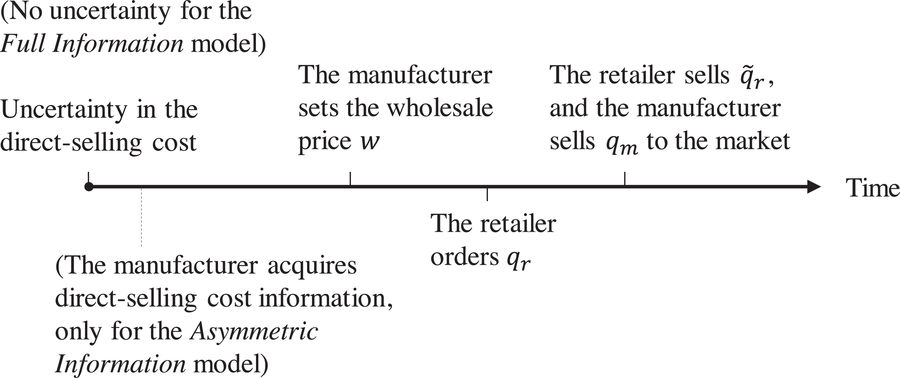
Timing of events
We analyze the
The full information model
In this section, we analyze the model in which the manufacturer's direct‐selling cost per unit 

We use backward induction to derive the sub‐game perfect Nash equilibrium for this perfect information model. The equilibrium results are presented in Proposition 1. All proofs are in EC.2.1 in the Supporting Information. In the full information model, in equilibrium the wholesale price, 


The equilibrium result for the


Proposition 1 shows that as the manufacturer's selling cost 


If 



In summary, the analysis of the
The incomplete information model
In the 

THE ASYMMETRIC INFORMATION MODEL
In this section, we first analyze the 


The essence of the signaling game is the low‐cost type manufacturer's incentive to mimic the high‐cost type. In general, the retailer tends to order more from the manufacturer with a higher selling cost, because the retailer sees less competition in the market. By mimicking the high‐cost type, the low‐cost type can earn extra profit from the supply contract while maintaining a strong direct presence in the market. Being unable to discern the true cost type of the manufacturer, the retailer may distort its order quantity which would lower profits for high‐cost type. As such, the high‐cost manufacturer has an incentive to credibly distinguish itself from the low‐cost type in contracting with the retailer. To do so, it downward‐distorts the wholesale price
In general, in a signaling game, multiple equilibria may co‐exist. To eliminate equilibria with unreasonable beliefs, we apply the refinement of “undefeated” equilibrium proposed by Mailath et al. (1993). This refinement stipulates that one should retain only the equilibrium that yields the highest profit for the type of the message sender that has incentive to signal its true type. In our setting, only the high‐cost manufacturer has such incentive, and so we select the equilibrium with highest profit for it as the unique equilibrium of the signaling game.
3
We present the equilibrium result in Proposition 2. In the asymmetric information model, the unique “undefeated” equilibrium is as follows. At each At each




To aid the understanding of the results in Proposition 2, we illustrate SE1, SE2, SE3, PE1, and PE2 in Figure 2.

Signaling equilibrium in the
As shown in Figure 2, in general the signaling game has pooling equilibrium only if the high type's cost 


When the high‐type manufacturer's cost is small or medium (i.e., 
When the high‐type manufacturer's cost is moderately large (i.e., 
MANUFACTURER'S ACQUISITION OF COST INFORMATION
When the manufacturer introduces direct selling as part of its distribution strategy, it may not have perfect information about its selling cost, and instead it relies on expected costs only. As the manufacturer acquires information about its selling costs, it could enable better informed decisions due to the informational advantage over the retailer. However, it is not evident whether this would necessarily benefit the manufacturer or the supply chain as a whole, depending on the retailer's response to it. To study this, we analyze the effect of the manufacturer's learning on the two firms' profits by comparing the equilibrium outcome of the The manufacturer's expected profit under asymmetric information may be greater or less than that under incomplete information. Specifically, only when 

In Figure 3, we illustrate the region where the manufacturer's expected profit is greater under incomplete information than under asymmetric information. In this region, where the expected direct‐selling cost 


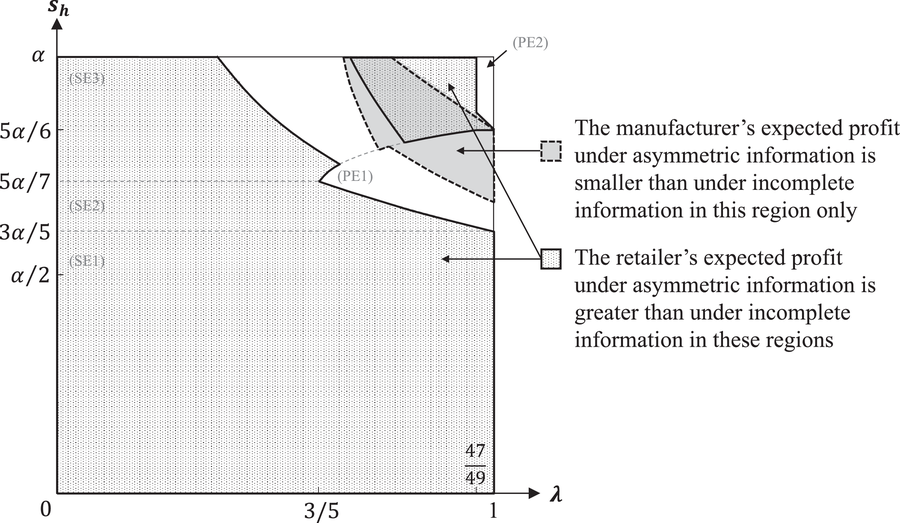
Effect of the manufacturer's learning on the two firms' expected profit
To understand this result, we break down the effect of the manufacturer's learning on its profit by cost type. We can show that, not surprisingly, when the direct‐selling cost is low type, the manufacturer always benefits from learning. 4 Knowing that its selling cost is as low as the retailer's, the manufacturer has the option of replacing the retailer with the direct‐selling channel and eliminate any inefficiency from double marginalization. When the direct‐selling cost is high type, however, the manufacturer may suffer from the learning when the expected cost of direct selling is moderately large or higher. By learning its cost to be high type, the manufacturer loses the power of exerting vertical control on the retailer and extracting its profit. With a sufficiently large probability of drawing the high‐cost type, in expectation, the benefit of learning for the low‐cost type manufacturer is outweighed by the loss of the high‐cost type.
We also find that the manufacturer's acquisition of cost information may or may not benefit the retailer. We present this finding in Proposition 4 and illustrate it in Figure 3. The retailer's expected profit under asymmetric information may be greater or less than that under incomplete information. Specifically, only when 

Interestingly, Proposition 4 shows that the retailer may also benefit from the manufacturer's learning. This result suggests that while the manufacturer's learning leads to relative information disadvantage for the retailer, such information disadvantage needs not translate into a lower profit for the retailer. From Figure 3, we further observe that the retailer benefits from learning mainly in regions where the manufacturer's learning leads to separating equilibrium (i.e., regions SE1, SE2, and left and right portions of SE3). To understand this result, we first note that if the uninformed manufacturer learns its cost type to be low (with 
There are also regions where the manufacturer's learning hurts the retailer. In the middle part of the separating equilibrium region SE3 where the expected direct‐selling cost is moderately large, the retailer suffers from the manufacturer's learning. This can be explained as follows. When the manufacturer is uninformed and sees a moderately large expected direct‐selling cost, the retailer enjoys the largest expected profit as the uninformed manufacturer decreases its wholesale price to boost the retailer's order. When the manufacturer learns its direct‐selling cost to be low type (with 
In addition, the retailer suffers from the manufacturer's learning of its cost in region PE1 and most of region PE2, where pooling equilibrium occurs. Because the retailer cannot resolve its information disadvantage in a pooling equilibrium, the retailer is vulnerable to exploitation by the informed manufacturer. More specifically, at pooling equilibrium the retailer remains uninformed and its order quantity is independent of the manufacturer's cost type. Both types of the informed manufacturer can choose their respective selling strategy to take advantage of the retailer's under‐order or over‐order, causing the retailer's profit to suffer.
Finally, Figure 3 suggests that there are regions in which both the manufacturer's and the retailer's expected profit are greater under asymmetric information than under incomplete information, that is, the manufacturer's learning of its direct‐selling cost is a win–win for both firms at the same time. We formalize this observation in Proposition 5 and delineate the win–win regions in Figure 4. When 
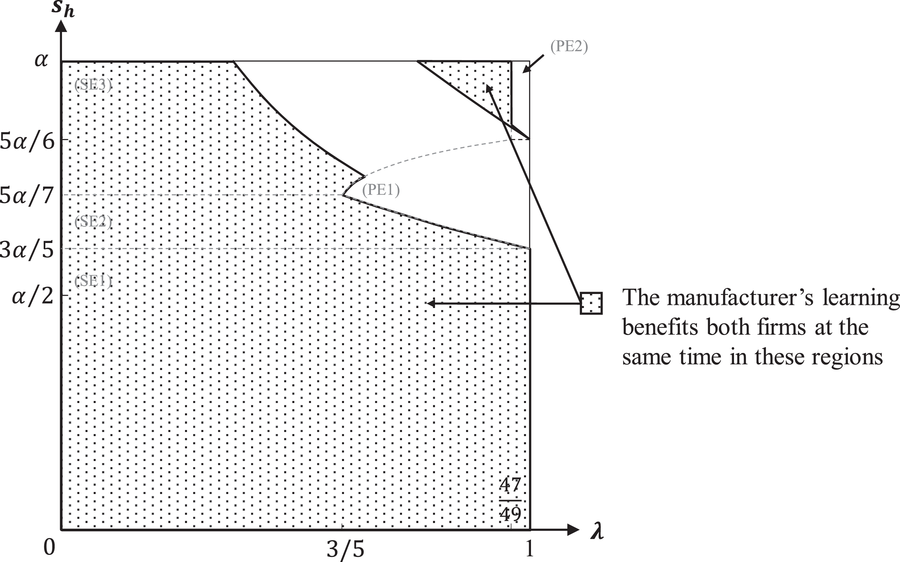
Simultaneous effect of the manufacturer's learning on both firms' expected profit
Proposition 5 and Figure 4 together show that the win–win outcome occurs mostly in regions where separating equilibrium occurs under asymmetric information. Because the informed manufacturer can credibly signal its true cost, the manufacturer benefits from tailoring its wholesale price and selling quantity to its cost type. The retailer benefits from loosened vertical control by the high‐type manufacturer, and from a reduction in the wholesale price due to the high‐type manufacturer's need to send a credible signal, as noted in the discussion following Proposition 4. This leads to a win–win outcome in expectation for both players.
INFORMATION SHARING
As we have shown in Sections 4 and 5, information asymmetry distorts the manufacturer's and the retailer's actions and affects their profits. In this section, we study information sharing by the manufacturer with the retailer which brings added visibility to the supply chain. The question then is whether the two firms can benefit from more visibility. We explore the effect of information asymmetry on the manufacturer's distribution strategy and discuss the value of information sharing for the two firms. To do this, we compare the equilibrium outcome of the
We compare the results in Propositions 1 and 2 to identify the directional changes in the manufacturer's and the retailer's selling qualities and profits caused by information asymmetry. Table 2 summarizes the directional changes in the selling quantities of the high‐ and low‐cost manufacturer, 


The directional changes in the manufacturer's and the retailer's selling quantities and profits caused by information asymmetry


Effect of information asymmetry on distribution strategy
We first study how information asymmetry affects the manufacturer's distribution strategy by examining the directional changes in the two firms' selling quantities (that is, 


When direct selling is of the high‐cost type, information asymmetry has no effect on the manufacturer's direct‐selling quantity 


When direct selling is of the low‐cost type, information asymmetry causes the manufacturer to cut back on its direct‐selling quantity in regions PE1 and PE2 in exchange for a larger order quantity of the retailer. Under full information, the retailer stops ordering from the manufacturer with low direct‐selling cost, leaving the manufacturer to be a monopolist in the market. However, under asymmetric information, pooling equilibrium occurs in regions PE1 and PE2, and the retailer orders from the manufacturer based on the expected costs regardless of the manufacturer's cost type. Facing competition, the low‐cost manufacturer sells less than a monopolist. As such, information asymmetry causes the manufacturer to cede some market share to the retailer.
Effect of information sharing on profits
The difference in a firm's profit in the
To shed light on the manufacturer's and the retailer's incentive for information sharing, we explain the effect of information sharing on the two firms' profits 


When the manufacturer's direct‐selling cost is of low type, we observe the opposite effect—the manufacturer's profit is lower under full information than under asymmetric information, and the retailer's profit is larger under full information. In other words, information sharing benefits the retailer but not the manufacturer. Note that this result occurs only in regions PE1 and PE2, in which pooling equilibrium occurs under asymmetric information. In the pooling equilibrium, the retailer cannot distinguish between the cost type of the manufacturer and orders in expectation. The manufacturer with low direct‐selling cost enjoys higher profit from the retailer's supply contract under asymmetric information, which is forgone under full information.
In short, when the direct‐selling cost is high type, only the manufacturer has an incentive to share information resulting in a loss for the retailer. Conversely, when the direct‐selling cost is low type, only the retailer has an incentive to get information. This conflict of interest may possibly be overcome with an ex ante commitment by both firms to information sharing. To understand the two firms' incentive for such commitment, we analyze the effect of information sharing on their expected profits. Table 2 shows that information sharing increases the manufacturer's expected profit 

The analysis above suggests that without additional arrangement, the manufacturer and the retailer may not form a consensus on committing to information sharing, because the retailer could be worse off. Such an arrangement can take the form of an enforceable transfer payment between the manufacturer and the retailer, for example. Table 2 shows that information sharing increases total channel profits 

Value of the direct‐selling channel
Finally, we discuss the value of the direct‐selling channel when perfect information on selling cost may not be available to the players. In the full information model, Arya et al. (2007) highlight the possibility of a win–win outcome when the manufacturer encroaches into the retailer's market under certain conditions. We now explore if a win–win outcome can still occur under asymmetric information. We measure the value of the direct‐selling channel for the firms as the difference in their expected profit with and without the direct‐selling channel. The results are summarized in Proposition 6. Under asymmetric information, the manufacturer's value of the direct‐selling channel is positive for all 



It follows from Proposition 6 that the creation of the direct‐selling channel is a win–win for both firms under asymmetric information whenever the retailer's value is positive. More interestingly, under asymmetric information the direct‐selling channel is more likely to be a win–win outcome than under full information. We illustrate, respectively, the set of 

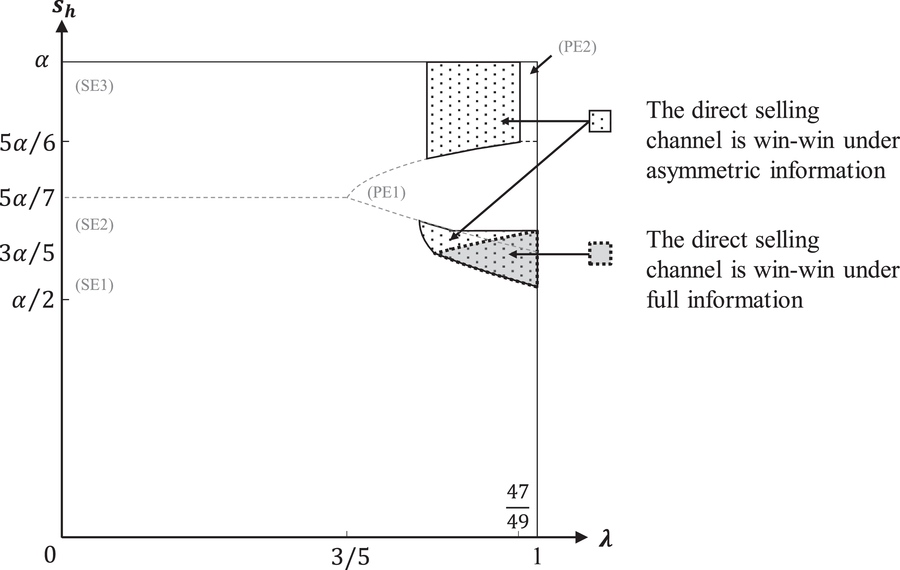
The regions in which the direct‐selling channel is win–win under asymmetric information and full information
SUPPLY COMPETITION
The manufacturer faces supply competition when the retailer has the option to order from multiple sources. In this section, we explore how supply competition affects the manufacturer's channel and selling decisions and the firms' incentive of learning and information sharing.
To model supply competition, we focus on the outcome of supply competition—downward distortion of the manufacturer's wholesale price, but not strategic interactions between the competitors that shape the wholesale price decision. Specifically, we model a scenario in which the retailer can source from a spot supply market as well as the manufacturer. We assume that the products from the manufacturer and the spot market are perfect substitutes in the end market, and so the retailer's sourcing decision is purely price‐driven. We assume the unit price of the spot supply is constant, denoted by 


We fully characterize the equilibrium of the model with supply competition for all 


Effect of supply competition on channel strategy
In this section, we examine how supply competition affects the manufacturer's channel decision. Generally speaking, the retailer's access to a second source would reduce the retailer's propensity of sourcing from the manufacturer. For this reason, one may expect that the presence of the spot supply market pushes the manufacturer to be more aggressive with direct selling to the end‐market. We compare the equilibrium results of the models with and without supply competition under all three information structures, and surprisingly show that while the manufacturer sells a lower quantity through the direct channel, the contribution of direct selling to the manufacturer's total profit may be even higher. This is due to the need to reduce the wholesale price to sell to the retailer (due to competition from the spot supply), which in turn could lead to higher profit contribution from direct selling. We present these findings in Propositions 7 and 8. Under all three information structures, the manufacturer direct‐sells a smaller quantity under supply competition than under no supply competition.
Proposition 7 shows that supply competition discourages the manufacturer from direct selling. To explain this result, note that the spot price caps the manufacturer's wholesale price. This enables the retailer to order more from the manufacturer, which reduces the incentive for the manufacturer to use direct selling.
Reduced direct selling due to supply competition suggests that the manufacturer becomes more reliant on, and less competitive toward, the retailer for reaching the end market. In other words, supply competition mitigates demand competition between the retailer and the manufacturer. The manufacturer's use of direct selling in the end‐market promotes the retailer to source from the spot market, which can push the manufacturer out of the end‐market. To preempt this, the manufacturer appeases the retailer by imposing self‐restraint on direct selling.
The preceding discussion may suggest that supply competition diminishes the value of the direct‐selling channel for the manufacturer. We evaluate this conjecture with the Under full information, there exists a nonempty set of 


Proposition 8 shows that when the direct‐selling cost is low, supply competition may enhance the manufacturer's incentive to create a direct‐selling channel, even if supply competition discourages the manufacturer's use of direct selling. With an efficient direct‐selling channel, the manufacturer encroaches into the retailer's market share. Although the manufacturer enjoys an extra stream of profit from direct selling, it comes with a downside—the manufacturer has to set a high wholesale price to restrict the retailer's order quantity. Under supply competition, the spot price automatically caps the manufacturer's wholesale price and thus mitigates the downside of direct selling. As a result, the net benefit of direct selling may become larger. In other words, profit contribution from direct selling may become more valuable for the manufacturer due to the reduced wholesale price in selling to the retailer (due to competition from spot supply).
Effect of supply competition on the value of information
In this section, we explore how supply competition affects the manufacturer's and the retailer's incentive to acquire information of the manufacturer's direct‐selling cost. We use the equilibrium outcome in EC.1.2 in the Supporting Information to compute the expected benefit of information acquisition for the manufacturer and the retailer under supply competition and compare the benefit with that under no supply competition.
The manufacturer's information acquisition
We first analyze how supply competition affects the manufacturer's incentive of information acquisition. Recall that Proposition 3 shows that in the absence of supply competition, the manufacturer's acquisition of private information of direct‐selling cost may increase or, interestingly, decrease its expected profit. In Proposition 7, we show that supply competition reduces the manufacturer's use of direct selling. From this, it appears to be reasonable to infer that supply competition discourages the manufacturer's incentive of information acquisition and exacerbates the manufacturer's disincentive for information acquisition. To investigate this conjecture, we compare the expected benefit for the manufacturer from its information acquisition under supply competition with that under no supply competition and summarize the finding as follows: Supply competition may increase or decrease the manufacturer's expected benefit from learning its direct‐selling cost. Moreover, when 
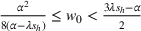


Proposition 9 shows that supply competition may strengthen or weaken the manufacturer's incentive to learn its direct‐selling cost. Interestingly, supply competition can completely reverse the manufacturer's disincentive into incentive for information acquisition. As such, supply competition can reinforce the manufacturer's incentive to acquire its direct‐selling cost information, even though supply competition discourages the manufacturer's use of direct selling.
To understand the incentive‐strengthening effect of supply competition, note that the manufacturer's information acquisition causes information asymmetry and signaling—the high‐cost type downward distorts its wholesale price to prevent the low type from mimicking. Supply competition with a reasonably small spot price 
Information sharing
We next analyze how supply competition affects information sharing between the two firms. In Subsection 6.2, we discovered that without supply competition the retailer does not have incentive to share the manufacturer's private information of its direct‐selling cost; so, information sharing is infeasible without additional arrangement. It is unclear a priori whether or not this conclusion remains valid if the manufacturer faces supply competition. To answer this question, we compare the benefit of information sharing for the manufacturer and the retailer with versus without supply competition. We summarize the finding in Proposition 10: When (1) 
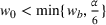

We find that supply competition can reverse the retailer's disincentive to learn the manufacturer's private cost information. Better yet, supply competition may enable information sharing between the manufacturer and the retailer without the aid of other arrangements such as a transfer payment, and so on. These findings are in contrast to the findings in the absence of supply competition in Subsection 6.2. As such, our finding contributes a new perspective on facilitating information sharing in distribution channels.
We now explain why the retailer can benefit from information sharing under supply competition. Recall that without supply competition, information sharing frees the manufacturer from the signaling burden of downward price distortion and affords the manufacturer freedom of exploiting the retailer by charging a high wholesale price. So, the retailer's profit can suffer from information sharing. With supply competition, the spot market price caps the manufacturer's wholesale price and limits the manufacturer's ability to exploit the retailer. This protects the retailer's profit margin and enables the retailer to earn more profit than without supply competition.
In summary, we find that supply competition mitigates the wholesale price distortion for the retailer. As a result, supply competition may strength the manufacturer's incentive for creating the direct‐selling channel. Moreover, supply competition relieves the manufacturer's signaling burden, and, as a result, it may strengthen the manufacturer's incentive for acquiring private information and facilitate information sharing between the players.
CONCLUSION
In this paper, we study a distribution channel where the manufacturer introduces a direct‐selling channel to encroach into the retailer's market. The manufacturer's cost of direct selling may be known (or unknown) to both players, or may be private information for the manufacturer. As such, a number of different informational structures are analyzed, and a number of interesting results are derived. First, we show that the manufacturer may prefer not to have private information on its selling cost, as the resulting profit loss due to a downward distortion in the wholesale price may make it worse off. However, we show that the manufacturer always benefits from sharing its cost information with the retailer, who may interestingly be worse off with more information. Finally, we show that the region where the bright side of encroachment, that is, where both players benefit from direct selling by the manufacturer, is enlarged when there is information asymmetry between the players in comparison to the full information case.
We also extend the models to include supply competition. We assume that the retailer can also source from a spot supply market for a perfectly substitutable product. As such, the manufacturer faces competition with the spot supply. Comparing this model with the standard single‐supplier model, we analyze the effect of supply competition on the manufacturer's distribution strategy and on the value of information. Our analysis there yields a number of interesting findings. First, we find that supply competition may make the direct‐selling channel even more valuable for the manufacturer, even though supply competition always discourages the manufacturer's use of direct selling. Second, supply competition may fully reverse the manufacturer's disincentive into incentive to acquire information. Finally, supply competition facilitates information sharing between the two firms.
The paper can be extended in several directions. One may consider variant information structures in the supply chain. In general, both supply chain players may have private information of different variables of the supply chain at the same time. For example, the retailer may have private information of the market demand potential and the manufacturer may have information about its direct‐selling cost. Depending on which player makes the first move and has more contracting power, the issue of double signaling or informed principle may arise. It remains to be explored how an additional layer of information asymmetry may alter the findings in this paper.
The paper can also be extended by considering a more complicated supply chain structure. The issue of common retailer arises when a retailer sells substitutable products of multiple manufacturers. In such setting, a manufacturer's direct selling not only introduces competition with the retailer, but also aggravates its competition with the other manufacturers. It is interesting to study how direct selling of a manufacturer reshapes the other manufacturers' distribution decisions and their interaction with the retailer.
In our model, we assumed that 

Footnotes
ACKNOWLEDGMENTS
We thank the Department Editor Asoo Vakharia, Senior Editor, and two anonymous reviewers for their constructive comments and suggestions that have improved the paper. Huiqi Guan's research is supported in part by the National Natural Science Foundation of China (Grant Numbers: 72102048, 72131004, and 71971065). Haresh Gurnani's research is partially supported by the Thomas H. Davis Endowed Chair at Wake Forest University.
1
The analysis can be extended to the case when the low‐cost manufacturer's cost is greater than zero. Details are in the EC.3 in the Supporting Information.
2
Arya et al. (2007) assume that the retailer will sell all supply to the market, which in our notation is  ) for examples.
3
In case of a tie between two equilibria, we select the equilibrium with the highest profit for the low‐cost type.
4
The details of the proof are in EC.2.4 in the Supporting Information.
5
The details of the proof are in EC.2.4 in the Supporting Information.
6
The value of direct selling for the manufacturer is computed without accounting for the fixed costs of creating the direct‐selling channel. Strictly positive fixed costs will reduce the value of direct selling for the manufacturer and negatively affect its decision to open the direct‐selling channel. As a result, the win–win region will reduce or may even vanish. However, as long as the fixed costs are not prohibitively high, the win–win regions persist.
7
The result thereof can be qualitatively extended to the
8
References
Supplementary Material
Please find the following supplemental material available below.
For Open Access articles published under a Creative Commons License, all supplemental material carries the same license as the article it is associated with.
For non-Open Access articles published, all supplemental material carries a non-exclusive license, and permission requests for re-use of supplemental material or any part of supplemental material shall be sent directly to the copyright owner as specified in the copyright notice associated with the article.
