




Abstract
This research develops and tests a model of the effects of resources bundling on third-party logistics (3PL) providers' performance. Based on data from a survey of Malaysian 3PLs, basic and advanced technology and equipment resources, knowledge and relational resources, and demand management interfaces are identified. The bundling of advanced technology, knowledge resources, and demand management interface capability are found to enhance 3PLs' customer service innovation. Similar resource bundling (excluding advanced technology) is required to achieve cost leadership. The effects of other resources on performance are mediated mainly by the demand management interface capability and knowledge resources. This is a novel attempt to justify the interaction and mediation effects of resources and capabilities on performance. The research highlights the needs for 3PL managers to focus on developing and bundling their demand management interface capability and knowledge resources in order to achieve cost leadership, and further combine advanced technology into such bundling of resources and capabilities to achieve innovation in customer service. It advances the application of resource-based view (RBV) theory in logistics research by identifying resources that play supporting roles and examining the capabilities for enhancing 3PLs' competitive performance.
1. Introduction
The recent global halal market has increased demand in the halal industry, which has brought new challenges to third-party logistics (3PLs) providers in Malaysia. 3PLs' clients expect new services called halal services whenever they need them, and which sometimes extend beyond 3PLs' capabilities. Consequently, 3PLs are facing a new dynamic situation: every client has unique and different halal requirements. This creates strategic challenges for 3PLs to exploit logistics resources more productively as a competitive resource in such a complex and unpredictable environment. Thus it is essential for 3PLs to not just gain access to the right resources and capabilities but to innovate and improve their resource position by practicing proactive innovation in bundling resource and capability so that their resources are better than those of their competitors.
Interest in logistics resources and capabilities was begun in research by Chiu [1], followed by Sink et al. [2], Myers et al. [3], Larson and Kulchitsky [4], Alshawi [5], Stank et al., [6] and Knemeyer and Murphy [7], but their work ignored the logistics service provider perspective [8]. Some work focuses on the service capabilities of 3PLs [9, 10]. To date, studies from the 3PL perspective undertaken by Panayides and So [11], Panayides [12], Brah and Lim [13], Ellinger et al. [14], Yang et al., [15], Karia et al. [8], and Karia and Wong [16] were the most relevant to this research and provide empirical evidence to support its theoretical underpinning that resource and capability will have a constructive impact on the performance of third-party logistics (3PL) providers. In an attempt to address deficiencies in the literature, this research aims to empirically assess 3PLs in terms of aggregate resources and capabilities, and to examine their potential bundling on performance.
There is evidence suggesting that the performance of 3PLs, e.g., delivery, service, and cost, can be explained by tangible and intangible resources such as physical resources and equipment [13, 17, 18], human resources [13, 14, 17–19] and corporate image [15]. Others suggest that 3PLs need capabilities such as information technology (IT) capability [15, 20], relational orientation [21, 22], and knowledge and managerial competences [23]. In the seminal work of Mentzer et al. [17], it is argued that certain unique capabilities are required to manage different resources so that 3PLs can achieve competitive advantages in terms of cost leadership and service differentiation.
Exactly how 3PLs can effectively manage different resources and capabilities remains an intriguing question. Attempting to answer this crucial question, there are some clues suggesting that the combination or bundling of certain resources and capabilities could enhance 3PLs' performance. In particular, Huang et al. [21] discovered that bundles of IT-infrastructure, human IT-resources, and IT-enabled intangible resources (with an emphasis on customer orientation, better coordination, and responsiveness) were positively associated with the financial performance of Taiwanese logistics firms. It is also important to properly develop and implement different digitized logistics activities, since firms characterized with more extensive digitized logistics activities bundles and which utilize them more intensively tend to achieve better logistics performance [22]. Furthermore, the combination of technology orientation, resource commitment, and managerial involvement was found to have contributed to 3PLs' cost and service advantages [20]. In another logistics study, Yang et al. [15] reported that container-shipping firms bundled their information equipment, corporate image, and network resources together with a view to improve their performance. However, it still remains unclear what mechanisms and orders with different resources and capabilities can be bundled together to enhance 3LPs' competitive performance.
This research examines the combined (bundling) effects of 3PLs' resources and capabilities on their performance in terms of customer service innovation (CSI) and cost leadership (CL). This research provides unique contributions because it considers bundling of various resources and capabilities, unlike most previous research, which examined the relationship between individual resources and 3PL performance separately (e.g., [12, 15, 19, 20]). In addition, this study builds a resource bundling model for 3PLs. It advances the application of resource-based view (RBV) theory, which argues that resources have no real value to a firm when they act in isolation [24]. Furthermore, this research distinguishes resources from capabilities, following Mentzer et al. [17], and identifies which resources and capabilities need to be bundled together [25] to enhance 3PLs' performance. Various tangible and intangible resources can be acquired by 3PLs from their logistics networks. The orders in which such resources can be bundled together to perform logistics tasks cost-effectively are the unique capabilities this research seeks to reveal. Enhanced understanding of the effective management of 3PLs' resources and capabilities is required because there has been a lack of understanding regarding the performance impact of resources and capabilities from the perspective of 3PLs [8].
The RBV theorists argue that a firm's valuable, rare, and inimitable resources and capabilities are the determinants of its competitive advantage [26–28]. However, such 3PLs' performance can only be sustainable when specific resources and capabilities are combined in a specific manner so that it is very costly and difficult for competitors to imitate it, or for it to be substituted by other resources [28, 29]. Similarly, 3PLs constantly need to gain access to and combine certain resources and capabilities in order to provide novel logistics services and remain cost competitive. Thus, the RBV theory is an appropriate theoretical lens to advance the much needed understanding of the bundling effects of logistics resources [30, 31].
In order to understand the combined (bundling) effects of various logistics resources and capabilities on operational performance (e.g., delivery, service innovation, & cost), this research draws on the resource-based view (RBV) theory from the strategy literature. The literature acknowledges that tangible resources and intangible resources are equally important because each of them may directly or indirectly provide a specific competitive advantage to a firm [16, 31]. Tangible resources such as physical resources, information technology, and human resources are among the commonly identified antecedents contributing to 3PLs' performance, e.g., [17, 31, 32]. Intangible resources such as knowledge resources, management expertise, organizational resources, and relational resources [12, 23] are also found to enhance 3PLs' performance.
To test the resource bundling model, this research examines data collected from a survey of Malaysian 3PLs. The Malaysian logistics industry is predicted to grow at 12.6 percent to reach RM196.5 billion in 2015 [33]. Furthermore, businesses in the logistics industry facilitated exports circa RM54 billion and imports circa RM44.8 billion in January 2011, and were valued at RM27.5 billion in 2010 [33]. While the logistics industry in Malaysia is growing, there is a need for management expertise, professional skills, facilities, and technological infrastructure to create competitive services and cost efficiency as is required and expected by the clients.
2. Theoretical model and hypotheses
In a competitive and complex environment, just delivering customer orders is insufficient as a way to compete, therefore 3PLs need to innovate in service portfolios offered and constantly strive for cost efficiency such that they can retain customers or even attract new customers. 3PLs' performance has been measured in terms of cost, service delivery, quality, and flexibility [13, 20, 34], and/or new products or service capabilities [34, 20]. This research conceptualized 3PL performance into two competitive performances metrics: competitive services are regarded as customer service innovation (CSI), and competitive costs are regarded as cost leadership (CL). CSI includes delivery reliability [35], delivery quality [36], flexibility [35, 36], and value-added service [20]. CSI is required to achieve advantage in service differentiations [17, 20]. Meanwhile, CL means 3PLs are able to reduce costs of transportation, inventory and warehousing [20], and achieve cost advantage which is reflected in lower service costs [9, 17].
This study divides resources into tangible and intangible, and then separately defines other unique resource management capabilities. For 3PLs, tangible resources comprise “basic technology and equipment” and “advanced technology and equipment.” Basic technology and equipment resources comprise the basic logistics infrastructure (e.g., transport, warehousing, containers, and cranes) and IT equipment (e.g., telephone, fax, computers, and EDI) commonly available to 3PLs in order to perform basic logistics tasks [18, 32, 37]. Advanced technology and equipment resources include web-based systems, GPS, GIS, track and trace systems, automatic warehousing systems, routing optimization software, and advanced loading and unloading systems which are relatively costly and difficult to develop [9, 13, 20, 38]. Intangible resources include “knowledge resources” and “relational resources,” following Karia and Razak [18] and Karia et al., [8]. Knowledge resources are defined as the recruitment and development of skilled people and integrated teams with technical ability, knowledge, and experience [8]. Experienced professionals are required to effectively manage a supply chain [39]. Firms tend to achieve higher performance when they recruit and acquire competent employees [40]. Relational resources are defined as strong relationships with customers and suppliers characterized by a high level of trust, and long-term relationships that allow 3PLs to coordinate networks, share information, interact and communicate with customers and suppliers more effectively [8].
Even though generic capabilities such as management expertise, organizational processes, and relational resources [11, 16, 18, 38, 41] are useful conceptualizations, this research argues that capabilities required to create or deploy resources [9, 17] to meet customer needs are more relevant for 3PLs to achieve cost leadership and customer service innovation. Thus, we apply the capability called “demand management interface” suggested by Mentzer et al. [17]. Demand management interface capability is defined as 3PLs' competence in managing organizational routines, practices, and strategy processes, which interface with customers to meet customer demand requirements [8].
Fig. 1 presents the resource bundling model guiding this research. The model is novel because the relationship between resources and capabilities has seen little empirical work. Currently, it is difficult to understand which resources and capabilities generate sustained competitive advantage [42]. In the model, resources are further divided into supporting resources and resources/capabilities that can be bundled together. Resource bundling means two resources interacting with each other and working together to improve performance. In logic rare resources, often bundled with common resources [25]. The strategic literature highlights the importance of supporting resources to generate superior firm performance [26].

Theoretical model of 3PLs' resource bundling
Fig. 1 presents the resource bundling model guiding this research. The model is novel because the relationship between resources and capabilities has seen little empirical work. Currently, it is difficult to understand which resources and capabilities generate sustained competitive advantage [42]. In the model, resources are further divided into supporting resources and resources/capabilities that can be bundled together. Resource bundling means two resources interacting with each other and working together to improve performance. In logic rare resources, often bundled with common resources [25]. The strategic literature highlights the importance of supporting resources to generate superior firm performance [26].
According to the RBV theorists, resources, especially those tangible ones, have no real value to the firm when they act in isolation [24]. Intangible resources and capabilities are often bundled with other tangible resources that may be quite commonly available, as suggested by the RBV literature [25]. Based on these theoretical arguments, we expect 3PLs to bundle or combine specific resources and capabilities to enhance performance. Our model argues that some resources and capabilities will act together and directly enhance 3PLs' performance, and their performance impacts are enhanced by other supporting resources. It is argued that tangible resources, especially basic technology and equipment resources, are insufficient to have a direct impact on 3PLs' performance and they need other intangible resources or capabilities to jointly improve 3PL's performance [43, 44]. The 3PLs' unique capabilities in utilizing such supporting and strategic resources and capabilities can be considered as a causal ambiguity which makes it difficult to imitate them [45].
In the first model (Fig. 1), we argue that knowledge resources and advanced technology and equipment are bundled together with demand management interface capability to deliver customer service innovation (CSI). Advanced technology and equipment such as web-based systems, GPS, GIS, and track and trace systems allow 3PLs to innovatively trace shipments and provide quick response to customers [13, 34]. A study of Lai et al. [46] revealed that 3PLs with a higher level of IT application could offer faster and more reliable delivery. A positive significant relationship between IT capability and service variety and service quality has been reported by another study of 3PLs [20]. Such advanced technologies can, of course, be purchased from technology providers or developed in-house. In-house advanced technologies may be valuable resources but 3PLs need an appropriate organizational capability to take advantage of these resources and make them rare and inimitable [47]. They can only become useful and inimitable when 3PLs have the right knowledge resources and unique demand management interface capability which transforms them into innovative customer services. Demand management interface capability is the key capability here because it is the ability to understand customer needs and manage customer service delivery processes that truly draw the right technology and knowledge together in order to innovate. According to the RBV theory, such unique bundling of resources and capabilities is protected by causal ambiguity, time-compression, and embedded resources, which are less likely to be imitated [45]. Thus, we hypothesize:
Hypothesis H1: Advanced technology and equipment, knowledge resources, and demand management interface capability are bundled together to directly and positively affect customer service innovation.
What happens if we consider the roles of relational resources, and basic technology and equipment? Previous studies ascertain that basic technology and equipment (such as logistics infrastructure and IT infrastructure, and basic IT facilities for hardware and software) are required to support logistics operations, administration processes, demand management processes, and customer service processes [18, 37, 48]. Basic IT communication tools and facilities support the communication and interaction between 3PLs and customers and, in turn, help to speed up transaction process and achieve paperless operations. They help 3PLs to improve delivery performance [18, 37]; however, based on RBV theory these resources are commonly available in operations of 3PLs. They cannot create innovative customer service solutions such as track and trace services, and supply chain optimization, because they are so basic and commonly available elsewhere. Similarly, building up close relationships with customers (relational resources) help the demand management interface processes to understand customer needs, although, unlike knowledge resources, they do not have the ability to convert advanced technology and process resources into innovative customer service offerings [21]. Thus, we hypothesize:
Hypothesis H2: basic technology, equipment, and relational resources are not directly associated with customer service innovation, but their effects on customer service innovation are mediated by the bundling of advanced technology and equipment, knowledge resources, and demand management interface capability.
The bundles of resources required for achieving cost leadership (CL) are slightly different from those for CSI. Specifically, advanced technologies and equipment (e.g., web-based solutions, optimization, and routing planning solutions) are not the main determinants of CL. The arguments are as follows. Every 3PL owns and has access to certain technology resources and equipment, but to achieve economy of scale and scope, a firm needs to develop specific organizational routines using demand management interface capability to translate customer needs into effective use of these resources. Demand management interface capability consolidates orders from different customers and geographical areas, which then allow optimization of transport routing and warehouse utilization. Furthermore, demand management interfaces can deliver cost efficiency with the help of knowledge about the efficient use of resources. Such knowledge resources can be accessed via the recruitment and development of people with knowledge and experience in achieving cost effectiveness. Knowledge resources and demand management interfaces simply supplement one another to sustain cost-saving efforts. It is the bundling of these resources and capabilities that provide sustainable cost effectiveness. Such unique capability and bundles of resources are prevented from being imitated (survive competitive imitation). Thus, we hypothesize that knowledge resources and demand management interface capability are the main determinants of CL:
Hypothesis H3: Knowledge resources and demand management interface capability are bundled together to directly and positively affect cost leadership.
Furthermore, we argue basic and advanced technology and equipment resources and relational resources play supporting roles in improving CL. Every 3PL has to acquire basic and advanced technology and equipment resources for effective communication, transmission, and processing information to support delivery and logistics operations and facilitate innovative customer services in logistics. While it is possible to deploy skills and knowledge workers to perform multi-tasking jobs to generate cost savings and reduce the number of processes, documents, and staff, such efforts need support from technology and equipment resources. While it is possible to achieve cost savings by adopting advanced technology, most 3PLs fail to reap the cost benefits of advanced technology [44]. Thus, we argue that advanced technology and equipment can only play a supporting role in achieving CL, but not directly affect CL. Similarly, relational resources (good rapport with customers) are acquired to facilitate a better understanding of customer needs. Relational resources support effective and interactive participation and management of contracts but they do not directly help 3PLs to improve CL. Thus, relational resources, basic technology and equipment, and advanced technology and resources are supporting resources required to enhance 3PLs' capabilities [31], or to implement future business routines and activities [50]. This means that they are less likely to create cost leadership directly unless they are being effectively utilized by demand management interface and knowledge resources. Thus, we hypothesis:
Hypothesis H4: Basic and advanced technology and equipment and relational resources are not directly associated with cost leadership, but their effects on cost leadership are mediated by the bundling of knowledge resources and demand management interface capability.
3. Research methodology
3.1 Instruments
The key informant of this research is a member of an organization who is in control of its resources and capabilities, and the performance of a business unit. Informants are required to assess the level at which they indicate their agreement on resource and performance variables based on the five-point Likert scale, ranging from “1 — strongly disagree” to “5 — strongly agree”. The logistics resource and performance constructs are grounded in the RBV theory based on previous literature [8, 16]. All variables and measurement items are presented in Table 1.
Advanced technology and equipment resource are measured by five items relating to elements of new or technologically advanced equipment, web-based systems, and logistics system.
Basic technology and equipment resource are measured by four items relating to logistics infrastructure: equipment and facilities (warehouses and transport vehicles) used for effective delivery; IT infrastructure, for computer hardware and software, or any relevant IT facilities; and on-going maintenance and improvement in >physical resources.
Knowledge resources are measured by four items relating to people with expertise, skills, and experience by recruiting experienced workers from the same industry and multi-experienced workers, hiring professional workers, developing skilled people and integrated teams with technical ability, knowledge and experience.
Relational resources are measured by three items relating to building up coordination and collaboration; commitment to sharing information with trading partners such as suppliers, manufacturers, distribution centres, customers and logistics service providers.
Demand management interface capability is measured by six items relating to organizational processes that execute the firm's strategies which focus on managing customer requirements and satisfaction, providing solutions to customers, and emphasizing informal ways to communicate and interact with business partners.
Cost leadership (CL) includes operations at low cost for distribution and equipment/facility, while customer service innovation (CSI) includes elements of service delivery, quality, flexibility, and innovation.
Variables and measurement items of logistics resources and performances

3.2 Sample
The sample for this research is randomly drawn from the Malaysia Logistics Directory (www.msialogistics.com). Out of 354 3PL companies, 123 participated and completed the questionnaires, which represents a 35% response rate. Table 2 presents the profile of the respondent organizations.
Profile of respondents

We tested response bias following the procedure of Armstrong and Overton [51]. Overall, no significant differences (p>0.1) are found between early and late respondents in all items. Further the t-tests of firm size (p=0.760), firm ownership (p=0.498), and business duration (p=0.435) show no significant differences between these two groups, suggesting no problem with non-response bias [51].
4. Results
4.1 Factors analysis
Exploratory factor analyses with varimax rotation were performed to measure both tangible and intangible resources' content and construct validity (Table 3). Due to the small sample size and the need to differentiate tangible from intangible resources, two factor analyses for resources and capabilities items were conducted. The aim was to extract factors with item loading above 0.50, internal consistency (Cronbach's alpha) above 0.70, which is greater than the minimum recommended cut off value 0.6 for these new scales [52, 53].
Results of factor analyses for tangible resources
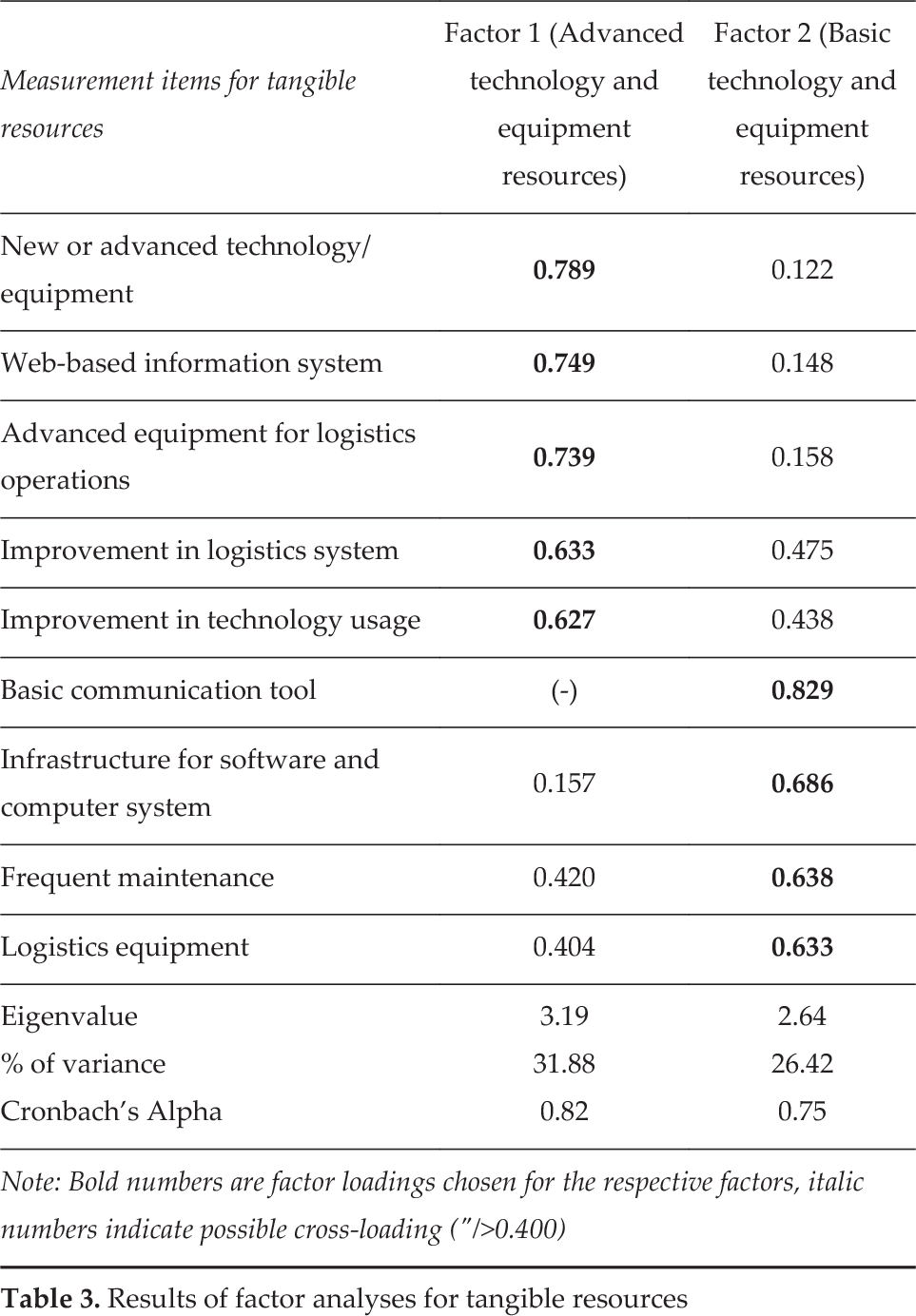
Note: Bold numbers are factor loadings chosen for the respective factors, italic numbers indicate possible cross-loading (“/>0.400)
The factor analysis for tangible resources reveals two distinct factors accounting for an eigenvalue above 1.0 and total variance approximately 58.3% (Table 3). To achieve these criteria, we decided to retain some items with slight cross-loading (>0.400) with other factors, which were determined by the judgment of the researchers [54]. Factor 1, identified as advanced technology and equipment resources, which consists of five items: new or advanced technology equipment, web-based information systems, advanced equipment in logistics operations, improvement in equipment and logistics facility, and technology usage. Factor 2, identified as basic technology and equipment resources, comprises four items: basic communications tools, software and computer systems, maintenance of logistics facilities. and equipment.
The factor analysis for intangible resources and capabilities reveals three distinct factors, characterized with eigenvalue above 1.0 and total variance approximately 56% (Table 4). Factor 1 includes six items: frequent communication, interaction, built up trust, and commitment pertinent to practices and routines that are intended for and interfaced with customers to meet demand requirements. It is labelled as demand management interface capability. Factor 2 includes four items: all are concerned with recruitment and development of competent staff. It is labelled as knowledge resources. Factor 3 includes three items, all of which are about building up good rapport and relationships through collaboration, coordination, and communication aimed at creating better understanding and information sharing. Thus, this factor is labelled as relational resources.
Results of factor analyses for intangible resources and capabilities

Note: Bold numbers are factor loadings chosen for the respective factors.
The same analysis was performed to measure 3PLs' performance. The factor analysis for performance outcomes reveals two factors, with eigenvalue above 1.0 and total variance approximately 73% (Table 5). Factor 1 includes six items that are concerned with customer service and innovative service. It is labelled as customer service innovation (CSI). Factor 2 includes two items related to equipment and distribution costs. It is labelled as cost leadership (CL).
Results of factor analyses for 3PLs' performance
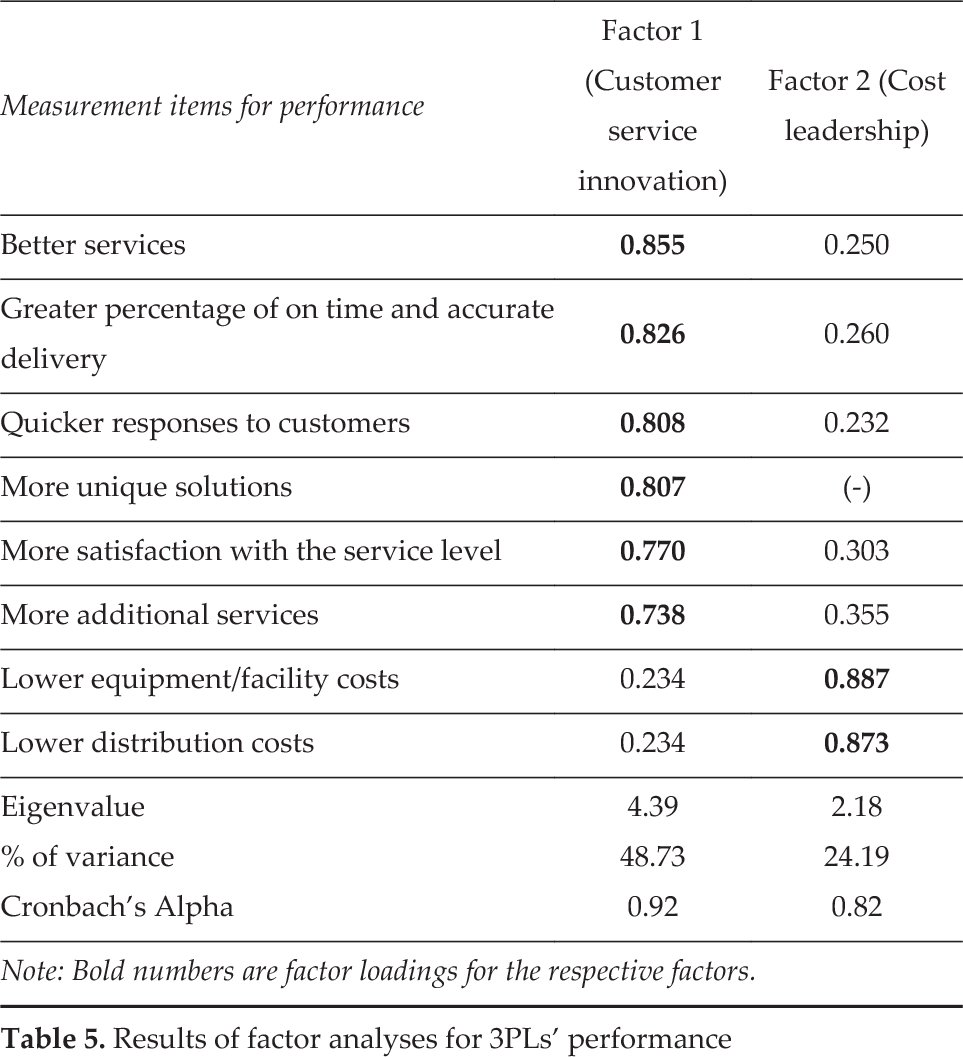
Note: Bold numbers are factor loadings for the respective factors.
Table 6 summarizes the Pearson's correlations between the above factors plus the two performance metrics. As indicated, the correlations between all variables are positive and above 0.3 (at p<0.01), suggesting the existence of some correlations. Since the correlations among independent variables are less than 0.75 [51], [50], multi colinearity should not be a problem for this study.
Correlation matrix of variables
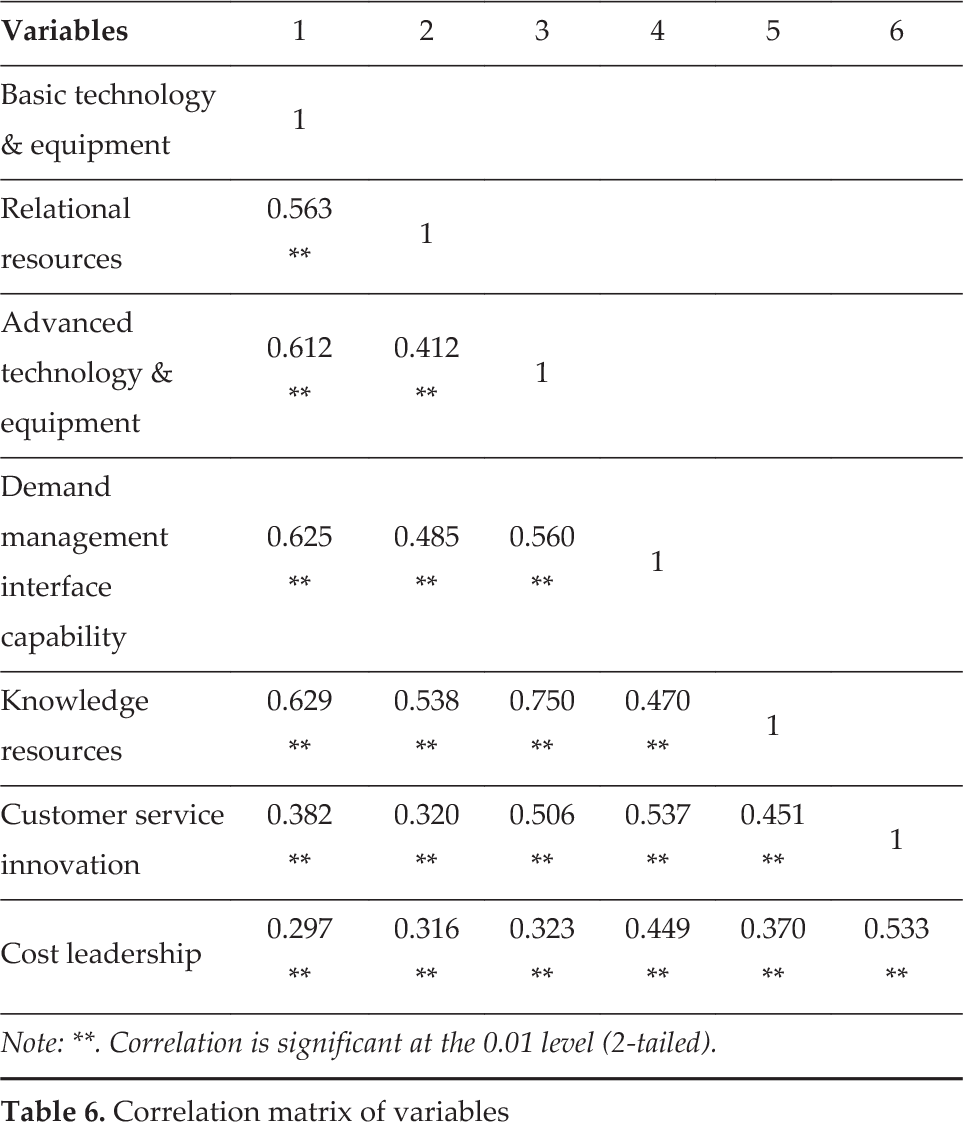
Note: **. Correlation is significant at the 0.01 level (2-tailed).
4.2 Stepwise regression analysis (H1 & H3)
In order to examine whether several resources are bundled together to enhance performance in terms of CSI and CL, stepwise regression analyses were performed. Before that, preliminary analyses were conducted to ensure that there were no violations of normality, linearity, and homoscedasticity assumptions.
Table 7 shows the results of stepwise regression for customer service innovation (CSI) and cost leadership (CL). In model 1, data management interface (β=0.63) explains 29% of variance in CSI. In model 2, both demand management interface and advanced technology and equipment resources together explain 35% of variance in CSI. Three other logistics resources: knowledge resources, relational, and basic technology and equipment resources do not affect CSI directly. The results partially support hypothesis H1. In model 3, demand management interface (β=0.67) explains 20% of variance (R2) in CL. In model 4, demand management interface and knowledge resources together explain 23% of variance in CL. Demand management interface capability provides the strongest contribution to CL. The other three logistics resources: relational, basic and advanced technology, and equipment resources do not affect CL directly. The results support hypothesis H3.
Results of stepwise regression analyses

Significant at 0.000;
Significant at 0.001;
Significant at 0.01
4.3 Hierarchical regression analysis (H2 & H4)
Additional hierarchical regression analyses were used for further testing hypotheses H2 and H4. We first performed regressions for the pairwise interaction terms (e.g., resource 1 × resource 2) between all five resources and found that none of the interaction terms are associated with CSI and CL. These results rule out the possibility of interaction (moderating) effects and therefore the mediating effects hypothesized by H2 and H4 should be tested. We then examined the mediation effects based on Baron and Kenny's [55] approach. The mediation effects were formally assessed using ‘Sobel Test’ [56, 57]. Tables 8–11 present the results of hierarchical regression analyses [55]. The resources in the left columns are treated as independent variables, and the resources in the middle column and the performance in the right column are considered as dependent variables. Step 1 tests if two resources/capabilities are associated with each other. Steps 2 and 3 examine if a resource/capability is mediating the impacts of other resources on performance.
Mediation effects of demand management interface (CSI)

Significant at 0.0001;
Significant at 0.001
Mediation effects of advanced technology and equipment resources (CSI)

Significant at 0.000
Mediation effects of demand management interface capability (CL)

Significant at 0.000;
Significant at 0.001
Mediation effects of management expertise (CL)

Significant at 0.000;
Significant at 0.001;
Significant at 0.01
Table 8 presents the results for the mediation effects of demand management interface capability on the relationships between basic technology and equipment, relational and knowledge resources, and CSI. The results (step 1) suggest that all paths from (a) basic technology and equipment resources, (b) relational resources, and (c) knowledge resources to the mediator (e.g., demand management interface capability) are significant, hence they have a positive impact on demand management interface capability. The results (step 2) indicate that all of these three resources are positively associated with CSI. Step 3 further indicates that the effects of basic technology and equipment resources and relational resources on CSI are fully mediated by demand management interface capability.
Table 9 presents the results for the mediation effects of advanced technology and equipment resources on the relationships between basic technology and equipment, relational and knowledge resources, and CSI. The results (step 1) suggest that all paths from (a) basic technology and equipment resources, (b) relational resources, and (c) knowledge resources to the mediator (e.g., advanced technology and equipment resources) are significant and positive, hence they each have a positive impact on advanced technology and equipment resources. The results (step 2) indicate that all of these three resources are positively associated with CSI. Step 3 further indicates that the effects of these three resources on CSI are fully mediated by advanced technology and equipment resources. Overall, the results (Table 8 and 9) partially support Hypothesis H2. The results match with our theories that demand management interface, advanced technology, and equipment and knowledge resources are bundled together to enable innovative customer services. Contrary to our expectation, knowledge resources are found to have direct and indirect effects on CSI (partially mediated by demand management interface capability).
Table 10 presents the results for the mediation effects of demand management interface capability for CL. The results (step 1) suggest that all paths from (a) advanced technology and equipment, (b) basic technology and equipment, and (c) relational resources to the mediator (e.g., demand management interface) are significant, hence they have a positive impact on demand management interface capability. The results (step 2) indicate that all of these three resources are positively associated with CL. Step 3 further indicates that the effects of these three resources on CL were fully mediated by demand management interface capability.
Table 11 presents the results for the mediation effects of knowledge resources for CL. The results (step 1) suggest that all paths from (a) advanced technology and equipment, (b) basic technology and equipment, and (c) relational resources to the mediator (e.g., knowledge resources) are significant, hence they have a positive impact on knowledge resources. The results (step 2) indicate that all of these three resources are positively associated with CL. Step 3 further indicates that the effects of these three resources on CL were fully mediated by knowledge resources. In conclusion, the results (Table 10 and 11) fully support Hypothesis H4.
5. Discussion
5.1 Theoretical Implications
This research advances management theories in a number of aspects. Firstly, it contributes to the development of constructs and measurement scales for 3PLs' resources and capabilities by advancing the theoretical model and the resource-based view (RBV) theory. Unlike most prior studies which focused on only one or two resources, this research identifies two major tangible resources, two intangible resources, and one capability which are crucial for 3PLs to achieve competitive advantages. In particular, this research goes beyond the basic distinction of tangible and intangible resources. While the seminal work by Penrose [26] suggested that there are resources which take supporting roles at times and can be bundled with other resources and capabilities to achieve superior performance, this research identifies these resources and capabilities for 3PLs. To our knowledge, this research provides the first empirical evidence highlighting the need to distinguish technology and equipment resources into basic and advanced resources, signifying the emerging importance of advanced technology for 3PLs to innovate. Overall, our approach in conceptualizing 3PLs resources and capabilities can also be utilized in researching other types of firms.
Secondly, this research is among the first to reveal the “black box” on resource bundling for 3PLs. Even the strategic management literature has acknowledged the need to reveal such a black box [58, 59]; prior studies tend to identify resources and capabilities which give 3PLs better performance without delineating exactly how bundles of resources and capabilities can be managed effectively. For example, the studies [15, 20, 21] suggest that IT and human resources are required to complement other capabilities but the exact orders and mechanisms in which such resources are bundled together to make 3PLs competitive remain a mystery. Corresponding to the call for research to enhance the understanding of the bundling effects of logistics resources [30], this research extends such studies with a model to explain the orders in which certain resources can be bundled to achieve superior CSI and CL. In particular, this research demonstrates that demand management interface capability is the key to success, and that it has to be bundled together with knowledge resources, and advanced technology and equipment, in order to innovate in customer service. Furthermore, such bundles of resources and capability can become even more effective with the support of basic technology and equipment, and relational resources.
Thirdly, this research reveals the importance of understanding the mechanisms in which certain bundles of resources and capabilities affect different performance metrics. Especially, it is important to recognize that the mechanisms which affect CSI are different from those which affect CL, and they need different bundles of resources and capabilities. Unlike CSI, our theories and findings suggest that advanced technology and equipment, knowledge resources, and demand management interface capability are bundled together to generate innovative customer service, but that only knowledge resources as a factor is required to be bundled with demand management interface capability in order to deliver CL. The findings can be explained by RBV theory and human capital theory [26, 60] positing that people (possessing skills, knowledge, and ability) are the ultimate sources of sustainable competitive advantage. Logistics service is a people and knowledgeintensive business. This research highlights the power of the simplified “axiom” about the importance of human resources or capital.
Fourthly, the findings also suggest that while the supporting resources (such as relational and basic technology and equipment) are important to enhance cost and service, they do not always directly affect 3PLs' competitiveness. These findings challenge the traditional wisdom that technological fix and restructuring can be the main source of cost cutting. 3PL firms may cut costs by employing fewer or cheaper staff but this might not lead to truly low operations costs and increased productivity. Instead, knowledge resources are required for the effective and efficient utilization of relational resources and basic and advanced technology and equipment. It is thus essential for 3PL firms to develop a team of experienced staff to manage their logistics operations and to enhance the impact of the firm's advanced and basic technology and equipment;, and relational resources on cost. In addition, while prior research identified the importance of relational resources, our findings further reveal that the impact of relational resources on cost and service performance is not direct, but mediated mainly by knowledge resources and demand management interface capability. Thus, the benefits of good rapport and close relationship with customers can be realized by developing effective organizational routines that focus on delivering customer needs, and, ultimately, experienced and knowledgeable workers are required to complement organizational resources in order to respond to customer requests and solve customer problems.
5.2 Managerial Implications
The research provides some managerial implications. Firstly, while 3PL firms acquire capabilities to develop advanced information technology and systems and automated logistics equipment to acquire, process, and transmit information, this research confirms that they need to have certain tangible resources, knowledge, relational resources in place, and a unique demand management interface capability. Next, to become competitive, logistics managers of 3PL firms need to align demand management interface processes with changing technology to fulfil ever***demanding customer requirements. Instead of merely developing organizational routines to meet customer needs, 3PL firms should simultaneously acquire and develop advanced technology resources to enhance service [23], and recruit and develop knowledge capable of translating advanced technology into innovative customer service provisions. Knowledge resources and advanced technology and equipment may be independently valuable and rare, but when they are bundled together in a specific manner together with demand management interface capability they become inimitable and non-transferable, leading to greater and superior service performance.
The findings of this research also provide a crucial clue for explaining why many 3PL firms were not able to achieve cost reduction. 3PL firms that could not achieve cost leadership were weak either in demand management interface or knowledge resources. 3PL firms tend to cut costs by employing fewer or cheaper staff but this research highlights the need for expertise in cost and resource management to lower operations costs and increase productivity. It is important to recognize that demand management interface capability and knowledge resources together form bundles of processes and accumulated knowledge which are socially complex and, therefore, less likely to be imitated and substituted, leading to superior cost leadership.
With regard to the roles of other resources such as basic technology/equipment and relational resources, our findings suggest that they are equally important even though they are not directly impacting cost and service performance. Such technology and physical resources are crucial for 3PL firms to reduce data re-entry, human error, and paperwork. In addition to 3PL firms' cooperation, trust and commitment, and constant communication and interaction with business partners will lead to improved operations time and cost performance. This research helps mangers to differentiate between simply meeting customer needs and creating innovative customer service and true cost leadership. The findings suggest that basic IT technology, warehouse and transportation facilities, and collaborative relationships with customers and suppliers are the fundamental requirement for Malaysian 3PL firms to satisfy customer needs. Equipment such as automated warehousing and storage require effective specialized knowledge to provide value-added services and solutions to customers, although such resources require effective demand management interface to work together with knowledge resources to innovate service offering and truly achieve cost differentiation.
6. Conclusion and Future Research
This research develops and tests a model of the bundling effects of logistics resources on 3PLs' competitive performance. The main contribution of this research is that it enhances the understanding of the bundling effects of 3PL logistics firms' logistics resources on customer service innovation and cost leadership. The results suggest that the 3PL logistics firms' superior competitive performance is derived especially from demand management interface capability, knowledge resources, and advanced technology and equipment. The performance effects of such resources are further enhanced by other resources such as relational resources and basic technology and equipment. While some previous studies indicate that some resources could be bundled together to enhance an 3PL firm's performance, this research further identifies and explains how different resources can be bundled together, advancing the use of resource-based view (RBV) theory.
The main limitation of this research is that it is based on a sample of 3PL firms from one country and only one capability is considered. Future research is suggested in order to examine the bundling effects of various resources and capabilities on 3PL firms' competitive performance using other samples, guided by our theoretical model. This will help to provide more insights into the “black box” of 3PLs' resource management/bundling as well as to advance the theoretical model. While the analyses in this research are based on multiple regressions, and help to clarify the mediation effects between certain resources and capabilities, such an approach could not reveal the total effect of all 3PL firms' resources and capabilities such as supply-management interface, information management, and coordination. Using our theoretical framework and foundation, future research should consider a structure equation model to verify the resource bundling model on 3PLs' performance.
Footnotes
7. Acknowledgements
The authors acknowledge the research grants provided by the Ministry of Malaysia Education and Universiti Sains Malaysia that have resulted this article.