




Abstract
This paper presents a study on stability monitoring for a radial symmetrical hexapod robot under dynamic conditions. The force-angle stability margin (FASM) measure method has been chosen as the stability criterion. This is because it is suitable for the stability analysis, in terms of external forces or manipulator loads acting on the body. Considering that a radial symmetrical hexapod robot can tumble along the contact point besides tip-over axis, this paper proposes an improved FASM measure method. Furthermore, it provides the method for calculating the stability angle of contact point and simplifies the algorithm of FASM. To verify the improved FASM measure method, three potential dynamic situations have been simulated. The simulation results confirm that, under dynamic conditions, the improved FASM is efficient, simple in terms of calculation cost and sensitive to manipulator loads and external disturbances. This means it has practical value in on-line controllers.
Keywords
1. Introduction
Typical hexapod robots can be categorized into bilateral symmetrical rectangular and radial symmetrical hexagonal ones. Radial symmetrical hexapod robots have six legs distributed asymmetrically around the body. The body can be hexagonal or circular. Rectangular symmetrical hexapod robots have two types of stable gaits: insect-wave gait and mammal gait [1]. However, in comparison with rectangular hexapod robots, radial symmetrical hexapod robots are able to walk with one extra gait, combining insect and mammal movements. Furthermore, radial symmetrical hexapod robots can walk in every direction due to their radial symmetrical structure. Radial symmetrical hexapod robots have sparked the interest of research communities because of their flexibility, good carrying capacity and excellent environmental adaptability [2–3]. Some kinds of radial symmetrical hexapod robots can even convert one or two legs into a manipulator.
However, when radial symmetrical hexapod robots are applied to real cases, like rescue, they face complicated situations [4–5]. For example, rough roads, unpredictable external disturbances, upstairs [6] and task demands. These situations decrease the stability of radial symmetrical hexapod robots or can lead to instability. Thus, stability monitoring is necessary for maintaining control of a robot, especially under dynamic situations.
There are several dynamic stability criteria which are widely used in the field of multi-legged and multi-wheeled systems. Stability measure methods that are energy-based consider stability via the energy change of a robot at every moment. For example, Dynamic Energy Stability Margin (DESM) [7] presented by Ghasempoor et al., Normalized Dynamic Energy Stability Margin (NDESM) [8] proposed by Garcia et al. and normalized Energy Stability Margin (NESM) [9]. In the presence of robot dynamics and manipulation effects, these stability criteria can provide a relatively accurate stability measurement. However, their implementation is not easy because of the difficulty in obtaining the moment of inertia of robot's every part. Zero Moment Point (ZMP)-based stability criteria mainly utilize the relationship between ZMP [10] and support polygon to evaluate the stability. This type of stability measure methods, as demonstrated by the ZMP method [11–12], Fictitious Zero-Moment Point (FZMP) and Centre of Pressure (COP) [13, 15] method, are widely used in humanoid robots and even terrain. Furthermore, they are beneficial to motion planning. Nonetheless, these methods are unavailable for multi-legged system on uneven terrain [14–15]. Stability criteria that are moment-based, like Dynamic Stability Margin (DSM) [16] and Tumble Stability Margin (TSM) [17], are available for uneven terrain and manipulator effects. However, they are not sensitive to the variation in height when a robot is under a vertical motion. Force-angle-based criteria use the angle between the support polygon and the net force acting on a robot to represent the stability of the system.
The force-angle stability margin (FASM) [18–20] is the most common force-angle-based criterion. It is applicable to systems subject to inertial and external forces and motion on even or uneven terrains. Additionally, it is sensitive to top-heaviness. The stability measure method for this paper is FASM. This is because of the considered structural characteristics of a radial symmetrical robot and the application demands such as disaster relief and adapting uneven terrain.
However, compared with wheeled robots, tracked robots, quadruped robots, biped robots and even the bilateral symmetrical hexapod robots (which generally tumble along tip-over axis), in some situations, radial symmetrical hexapod robots could tumble around contact point with ground. For example, suffering an external impact or walking laterally on slope. This is the clear difference between radial symmetrical hexapod robots and other kinds of robots. This should be considered when monitoring the stability of a radial symmetrical hexapod robot. Papadopoulos and Rey, who proposed the FASM measure method, do not pay attention to this situation [18]. Thus, once the situation occurs, the FASM will not be applicable as there is no calculation formula for it. Due to the lack of real-time feedback of the stability margin, a robot would lose control. Later, Li and Wang proposed a computing method for the stability angle of contact point respectively. Whilst Li did not take into consideration the external interference and the moment acting on COG [21], Wang's method was not effective [22]. Thus, the improved FASM was proposed. Its simple and effective computational formula for the stability angle of contact point, as well as its low calculation cost, make it efficient and reliable to use in a real-time controller.
This paper studies the improved FASM applied to a radial symmetrical hexapod robot under dynamic situation. Section 2 introduces the structure of a radial symmetrical hexapod robot, which is a kind of parallel robot. Section 3 presents the FASM measure method and Section 4 improves the FASM. Here, algorithm is simplified and the possibility that a radial symmetrical hexapod robot tumbles along the ground contact point is taken into account. It makes FASM more appropriate to practical application of a radial symmetrical hexapod robot. In Section 5, several examples of a radial symmetrical hexapod robot in dynamic situation are provided and the results of these situations are discussed. The paper is concluded in Section 6.
2. Radial Symmetrical Hexapod Robot
In this paper, a certain type of radial symmetrical six-parallel-legged robot will be presented. This radial symmetrical robot is designed and developed by Central South University and Shanghai Jiao Tong University. The virtual prototype of this robot is shown in Figure 1. This radial symmetrical hexapod robot can walk in every direction due to its radial symmetrical structure. Furthermore, any two adjacent legs can be lifted as manipulator to execute tasks, such as lifting weights. The body of this robot is made of steel and each leg is composed by three linear actuators. The linear actuator is driven by servo motor.

Radial symmetrical hexapod robot
Unlike most multi-legged robots, the legs of a radial symmetrical robot adopt parallel mechanisms instead of serial mechanisms, as shown in Figure 2. Compared with other legged robots, such as quadruped or biped robots, this mechanism of leg gives robots a higher bearing-load-ability [23]. The robot leg mechanism is composed by three chains: 2 UPS chains and 1 UP chain. The swing of the leg is realized by 2 UPS chains, whilst 1 UP chain realizes the lifting of the leg. It is easy to figure out that the DOF of a single leg is three [24]. Hence, the leg is capable of moving in three dimensions. A rubber sphere is used as the robot foot. This provides a buffer and helps the robot to better accommodate the uneven terrain.

Structure of parallel mechanical leg
3. The Force-Angle Stability Margin Measure Method
A selection of stability monitoring methods is different according to the robot applications. When this type of designed radial symmetrical hexapod robot is used in practical application, it faces complex road conditions, unpredictable external disturbances and task demands. For example, lifting weight and moving with loads. It requires the stability monitoring method to manage the effect of operating force/moment, outside interference, the centre of gravity height variation and different load on robot stability. Therefore, according to these actual demands, the FASM measure method is selected as stability evaluation criterion of this hexapod robot.
The principle of FASM can be described by the model as shown in Figure 3.

The force-angle stability margin measure
The stability angle can be computed by [18]

where Î
i
and f̂*
i
are the unit vectors of

where

To make the measure method sensitive to top-heaviness, the stability margin is weighted by the magnitude of
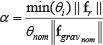
where θnom and
The relationship between the stability margin value and the stability status of robot is shown in Table 1.
Force-angle stability margin and the state

4. Improved Force-Angle Stability Margin Measure Method
To make the FASM measure method more efficient, we simplified the algorithm. Considering that the radial symmetrical hexapod robot could tumble along contact point under dynamic situation, we proposed a computational method.
4.1 Improvement in Simplifying Algorithm
To acquire the force-angle stability margin (α), the FASM measure method needs to compute the stability angle (θ) for each tip-over axis, then find out the minimum value from all of θ. Since the axis corresponding to the minimum θ is possessed of the minimum stability margin, once the tip-over occurred, the hexapod robot would most likely tumble around the axis. We can call that axis the actual tip-over axis. However, calculating each possible tip-over axis is unnecessary and time-wasting.
According to the calculation of ZMP, we have [25]

where
Supposing the maximum vertical component of ground reaction force, Fiz, appears in mth contact point, that is Fmz=max(Fiz),as mentioned above, we simply need to calculate the two stability angles whose corresponding tip-over axis is composed by mth contact point. The force-angle stability margin can be obtained as follows

4.2 Improvement in Considering Tumble along Contact Point
It has been mentioned that the FASM represents the stability of the system, without considering the situation that the radial symmetrical hexapod robot could tumble around ground contact point. This situation rarely occurs in other kinds of robots, like wheeled robots, quadruped robots and bilateral symmetrical hexapod robots. For radial symmetrical hexapod robots, this situation cannot be neglected. Therefore, a new method is proposed for computing the stability angle of contact point. This makes the FASM measure method more suitable to practical application of a radial symmetrical hexapod robot.
The stability angle of contact point can be obtained through geometrical relationship and mechanical relationship.
Geometrical Relationship
Those outermost points of a robot contact point with the ground form a convex support polygon during the progress of movement. Supposing p i is the position vector of the ith contact point with ground relative to the ground frame. pi is numbered in ascending order clockwise under the top view, shown in Figure 4. Let p c presented the centre-of-gravity (COG) position vector of the whole robot system, which can be calculated by

Geometrical relationship of improved Force-angle stability measure

where
The sidelines of support polygon are the tip-over axes, and most of robots would tumble along the tip-over axis. It can be denoted as a i :


where n is the number of ground contact points.

Mechanical Relationship
The forces relationship is shown in Figure 5. Taking gravity, operating force/moment, interference force/moment etc. into account, and from Newtonian principles, we define equilibrium equation for the hexapod robot as

Mechanical relationship of force-angle stability margin measure


where
The net tilting force,
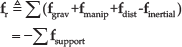

Hence,


Both

Similarly, only the component of

To unify the dimension, effective tilting moment are expressed by the arm of couple,

Therefore, the actual net tilting force acting on contact point is composed of

Consequently, the stability angle of contact point with ground can be computed as the angle between


where f̂*
bi
is the unit vector of
Considering the stability angles of tip-over axis, stability angles of contact point and the simplified compute process together, the improved FASM measure method can be expressed as follows


5. Results and Discussions
We set up three situations to verify the applicability of the improved force-angle stability margin measure method on the radial symmetrical hexapod robot and acquire the robot stability variation under different situations. These are situations that this type of hexapod robot would frequently face when used in practical applications, like a disaster site:
Lifting different weight
Movement on different slopes, including upslope, downslope and lateral movement on slope
Suffering horizontal impact under static status and motion.
Firstly, we numbered the legs of the radial symmetrical hexapod robot according to the clockwise ascending order on top-view, which is shown in Figure 6.

Radial symmetrical hexapod robot legs number
Supposing the friction is big enough to avoid the robot sliding and the sampling frequency of data in simulation is 1000Hz. The key system parameters of the designed hexapod robot are listed in Table 2.
System parameters

Case 1
The process of the radial symmetrical hexapod robot lifting weight is as follows: the robot is under static status and all of the robot legs are used as supporting legs at initial moment, leg 2 and leg 5 (the middle legs) then step forward at the same time, then a short-time six legs supporting period forms, then leg 1 and leg 6 (the front legs) lift the weight together. Figure 7 shows the moment that the robot lifts a box. Therefore, the whole process can be divided into three parts. 0 seconds to 2 seconds is middle legs stepping forward process, 2 seconds to 2.2 seconds is six legs landing process and 2.2 seconds to 4 seconds is front legs lifting process. During the lifting process, the end trajectory of the leg 1 and leg 6 are arced and the robot is able to lift up weight as high as 1010 mm in 2 seconds.

Hexapod robot lifting weight
Figure 8 (a) and (b) show the tip-over axis that, corresponding to the minimum stability angle (θ), is composed by the contact point that possesses the maximum vertical component of ground reaction force. As shown in Figure 8 (a), the θ of tip-over axis 4 is the minimum stability angle in the front legs lifting process. And the Fz of leg 5 is maximum value during the front legs lifting process, as shown in Figure 8 (b). From Figure 7, we can see that tip-over axis 4 is formed by the ground contact point of leg 5. Similarly, in the middle legs stepping forward process, the tip-over axis 3, which has the minimum stability angle, is made up by the contact point of leg 6 and contact point of leg 4. Thus, the minimum θ can be acquired by finding the maximum Fz.

Lifting 100N weight after stepped forward 200mm
Figure 9 (a) shows the force-angle stability margin of a hexapod robot that lifts different weight loads after the middle legs (leg 2 and leg 5) stepped forward a 200mm step. The manipulator forces/moments arise while lifting weight. However, in this case, NESM is invalid as the manipulation forces/moments were not taken into consideration [15]. In the front legs lifting process, we can clearly see that the stability margin decreases as the weight of load increases. From 2.2 seconds to 3.5 seconds, the stability margin is positive while lifting 320N weight, which indicates that the robot is at a stable state. At 3.5 seconds, the stability margin becomes zero and the robot is at a critical stable state. From 3.5 to 4 seconds, when the lifting height goes up, the stability margin turns into a negative value. This indicates that the robot is unstable and would tumble along tip-over axis 4, shown in Figure 7. In fact, leg 3 and leg 4 began to tilt in the simulation animation after 3.5 seconds. Therefore, the stability result of the measure method - which is to show if the robot is stable, unstable or critical stable - is consistent with the actual state of the robot. Also, it shows that the maximum weight the robot can lift is less than 320N. On the other hand, it can be observed that as the lifting height increases during the front legs lifting process, the stability margin decreases. Furthermore, the stability margin's time rate of change increases as the loads increases.

Improved force-angle stability margin for lifting different weight
Figure 9 (b) presents the results of stability that a robot lifting the same 100N weight but middle legs steps forward with different step lengths. The different step lengths reflect the effect of posture on robot stability. As shown in Figure 9 (b), the stability margin improved as the step length increases. However, due to the limit of motion space, the maximum step length is about 500mm. Both Figure 9 (a) and (b) demonstrates that the force-angle stability margin measurements can reflect the influence of different loads effectively, manipulator force/moment and pose on robot stability. In addition, the FASM can be used to monitor and measure the limit load that the robot can lift. Furthermore, it provides a lifting strategy that an appropriate step length can be chosen before lifting weight, in order to keep the robot under a preferable stable state.
Case 2
The three kinds of slope movements are shown in Figure 10 (a). A hexapod robot walks based on insect-wave tripod gait. The gait cycle is 4 seconds; supporting phase and swing phase are respectively 2 seconds. The walking velocity of a robot is 75mm/s and the walking step length is 150mm. The surface of the slope is even in simulation environment. As μ=0, we set two types of terrain: even and uneven. The uneven terrain is designed by putting a brick of a height of 20mm in front of leg 2, shown in Figure 10 (b). The simulation process includes two gait cycles. The robot starts to move at 0.5 seconds. The first gait cycle is from 0.5 seconds to 4.5 seconds and the second gait cycle is 5.5 seconds to 9.5 seconds.

Sketch of slope movement
Figure 11(a) shows the stability margin of a radial symmetrical hexapod robot walking on even and uneven terrain. From 0.5 seconds to 2.5 seconds; leg 2, leg 4 and leg 6 act as the swinging legs. Then, from 2.5 seconds to 4.5 seconds, they act as supporting legs. In general, the stability margin of a robot walking on even and uneven terrain has a similar variation trend. However, from 2.5 seconds to 4.5 seconds, it can be observed that when leg 5 contacts with the brick, the stability margin is lower than when leg 5 acts as a supporting leg on even terrain. On the other hand, if there are more than 4 legs acting as supporting legs on uneven terrain, and these contact points are not in the same horizontal plane, the ZMP and COP method would be invalid. In summary, from Figure 11(a), we can see that the improved FASM is suited to uneven terrain.

Improved force-angle stability margin for motion on slope
Figure 11 (b), (c) and (d) show the stability changing laws of three types of slope movements respectively. The results reflect the influence of different slopes and different forms of slope movement on the robot stability. From the stability margin shown in Figure 11 (b), we can see that the robot can climb a slope that is less than 25 degrees, whilst the max downhill slope is 30 degrees, shown in Figure 11 (c). Short-time instability occurs when the robot is walking down the 30 degree slope, which is called ‘jump’ phenomenon, but the radial symmetrical hexapod robot can soon restore stability. This form of downhill can ensure the motion trail. However, it makes the robot suffer shock, which should be avoided. Figure 11 (d) shows that the robot can keep a normally lateral movement under a 30 degree slope. It also demonstrates that the radial symmetrical hexapod robot is more likely to tumble along contact point on lateral movement if the slope is too large. However, the stability changes sharply when the supporting legs turn into swinging legs.
Case 3
To simulate the external shocks, we used a ball to impact the robot and set up three types of horizontal impact situations. These were: horizontal impact at stationary status, lateral impact act on motion state and longitudinal impact act on motion state. The lateral impact and longitudinal impact are shown in Figure 12. The mass, velocity and flying height of the ball are the same on the three impact simulation, which are shown in Table 3. However, the radial symmetrical hexapod robot is not completely overturned after every impact. The whole process can be divided into stationary process and walking process. The robot walks on even terrain at the speed of 100mm/s and adopts insect-wave tripod gait in the walking process.
Parameters of ball


Lateral impact and longitudinal impact
Figure 13 (a) shows the FASM result that the robot suffered the horizontal impact on stationary state and lateral impact on motion state respectively. The stationary process is from 0 seconds to 0.5 seconds. When the hexapod robot suffered the horizontal impact on stationary state, the stability margin dropped sharply. It went from positive numbers to zero and then into negative figures. Simultaneously, the robot began to tumble along the contact point, formed by leg 2 and ground. Therefore, the result of the improved FASM is consistent with the actual stability state of the hexapod robot. However, due to the support polygon becoming a contact point, it is difficult for the COP method and ZMP measure method to be applied in this unstable situation. The robot quickly restored to a stable state because of the gravity effect. Similarly, the robot finally recovered to a stable state after suffering lateral impact or longitude impact in motion, due to the inhibiting effect of gravity. Comparing the results, we can see that the robot possesses strong impact resistance ability under static state but poor impact resistance ability in lateral when it is walking. In summary, according to the results shown in Figure 13 (a) and (b), the improved FASM measure method can monitor robot stability when it suffers an external shock or tumble about the contact point.

Improved force-angle stability margin for impact process
6. Conclusions
This paper studies the use of FASM measure method on a six-parallel-leg radial symmetrical robot. Stability monitoring is an important area of research in robots. The stability criterion varies from the requirements and applications of a robot. This study uses the FASM as the dynamic stability criterion. This is due to the uneven terrain, external disturbance and task demands that a radial symmetrical hexapod robot would face. For a better and more comprehensive detection, an improved FASM measure method has been proposed. The computational algorithm is simplified, which can improve computational efficiency. Furthermore, the computing method for stability angle of contact point has been added. This makes FASM more suitable for practical application of a hexapod robot. To verify this improved FASM, several simulations were given. The results show that the FASM measure method is sensitive to height, manipulator force/moment, slope and external impact etc. The improvement in algorithm makes FASM more practical for a hexapod robot. Future work includes experimental study of using force sensors embedded in the feet of a robot and dynamic stability control that combines with the stability monitoring method.
Footnotes
7. Acknowledgements
This work was supported by National Basic Research Program 973 of China (Grant NO. 2013CB035500) and National Natural Science Foundation of China (Grant No. 51405515).