




Abstract
Reducing time-to-market is one of the most challenging tasks that pharmaceutical companies deal with. In this sense, the recipe development process represents one of the most critical phases. Multi-site production companies require an efficient recipe development model, with a robust modular structure, which must be appropriately shared among local laboratories and plants. To this extent, the ANSI/ISA-88 batch manufacturing standard, rising in the context of process control and automation, is rapidly becoming widely used in pharmaceutical companies. This paper presents a step-by-step approach to assessing the compliance to the ANSI/ISA-88 standard along with a BPM-oriented methodology applicable to the re-design of any generic recipe development process. Redesigning a recipe development process is a complex activity and can mask several pitfalls and criticalities. Thus, along with the methodology, some general evidence and suggestions are provided based on the experience of a project carried out in a large multinational pharmaceutical company.
1. Introduction
As most recent pharmaceutical companies' trends attests, the time needed for the development process of a new drug is continuously speeding up, especially concerning the post-approval of clinical phases [1,2,3]. Interest in process improvement and optimization has been a partial response to the observed trend of stagnant profit margins and the current growth of competition in this sector, regarding both general and patented drugs. Thus, reducing time-to-market and recipe development intervals are some of the principal features and challenges that pharmaceutical companies are dealing with [4,5]. Multinational corporations in particular require an efficient recipe development model, with a robust modular structure, which must be appropriately shared among local laboratories and plants. ANSI/ISA-88, in this sense, can be considered a valid contribution to reaching the so-called “golden batch”, providing a mature framework where information-streams properly integrate all the key actors involved. However, redesigning such a complex process, which is cross-functional and affects the main end-to-end development phases, can mask several pitfalls and difficulties.
ANSI/ISA-88 is rapidly becoming a widely used standard in batch manufacturing, especially in pharmaceutical companies [6,7,8,9,10]. The standard, first approved in 1995 by the International Society of Automation (ISA) and then updated at a later stage in 2010, arises in the context of batch process control and automation. However, the recent growth of interest in this standard on the part of multinational firms can be attributed to the well-established set of models and terminology [11,12,13,14,15] provided, which proved to be useful for managing the end-to-end recipe development processes (from R&D to commercial production).
Adopting a new product development model, according to ANSI/ISA-88 guidelines, affects both the conceptual and documental level. The American standard defines the recipe contents, differentiating between equipment independent recipes, which are managed by scientists at an enterprise/laboratory level, and equipment dependent recipes, which are enriched with specific information about plant and process cells required for commercial production [16,17,18]. Moreover, when dealing with numerous/different manufacturing sites, most difficulties in implementing the commercial production of drugs arise during the transformation of the generic recipe (which specifies product characteristics and overlooks processing equipment parameters) into a “master recipe”, calibrated to the specific machinery of a given plant. The reasonable need to differentiate the form and content of the documentation concerning different phases of the development process is clear, especially when we consider the scale-up required while passing from a pilot plant to a production plant: the parameters of materials and equipment usually change when processing a 10-litre batch or a 20,000 one. Despite this, all the information must be efficiently communicated between the main actors in the recipe development-chain. The transition from one recipe to another needs to be rationalized, and the knowledge acquired in every transformation activity must be accurately managed in order to reduce the overall time spent before commercial production, thus facilitating further development processes [19,20]. While the recipes and the process model are well defined, the main area lacking in the current ANSI/ISA-88 standard is the extent and content of the guidelines provided for the implementation of the general-to-specific recipe transformation.
Thus, in order to fully achieve the benefits of ANSI/ISA-88 implementation, this paper presents an integrative methodology, applicable to the re-design of any generic recipe development process in compliance with the ANSI/ISA-88 standard. The aim is to provide a step-by-step approach to assess the standard compliance and perform a recipe development process re-design, by leveraging process oriented techniques, such as a Business Process Management approach and the Business Process Model Notation 2.0 (BPMN 2.0) [21,22]. Any effective process improvement initiative requires a clear definition of the as-is and to-be scenario, in order to analyse the gaps and identify a proper road map to reach the expected results. In addition, a standard and appropriate notation is required to physically represent the flows of activities and documentation. Hereafter, paragraph 4 and 5 will describe in detail the path of the proposed method and a case study of the implementation of the method at a large pharmaceutical multinational company. Brief comments on the ANSI/ISA-88 standard (paragraph 2) and the BPM approach (paragraph 3) are also included, in order to introduce these concepts. Finally, the results and the conclusion (paragraph 6) are presented to highlight the benefits of this methodology and to discuss some common misalignments that may arise while assessing their compliance to the ANSI/ISA-88 standard.
2. ANSI/ISA-88 standard
ANSI/ISA-88 is an international standard, which widely addresses all the main features related to batch manufacturing processes, describing procedures and equipment requirements during all the development phases, from the enterprise/laboratory level to commercial production [23,24]. It is important to point out that reference models and guidelines provided by the ISA standard are not to be considered strictly normative (some clauses are informative as well). This ensures a good level of flexibility in representing the current structure in an “ANSI/ISA-88 way”, giving also the opportunity to collapse and expand parts of the reference model to better suit peculiar batch manufacturing cases. Hence, considering that the models provided are sufficiently abstract that they may be applied to a wide variety of batch manufacturing implementations, and that compliance certifications are usually performed by independent organizations, the assessment of the degree of ANSI/ISA-88 compliance is essentially to be meant as an alignment on the use of the terminology and models definition. Whereby a partial compliance exists, specifications and implementations must be described, and areas of non-compliance are to be identified. Since a full description of the standard is out of the scope of this article, a brief description is provided only for those elements that are significant for the described case, ensuring a clear understanding of the contents and omitting the non-essential information.
2.1 ANSI/ISA-88 structure
The ANSI/ISA-88 standard is divided into five parts that respectively deal with different features of the batch manufacturing process and control. Part 1 (Models and Terminology) [25] defines the reference models (physical, process and procedural model), addressing the relationship between the equipment, the “conceptual” process steps and the procedural tasks required to perform a batch production, subdividing them into different hierarchical levels. In this part the terminology that is common and consistent for the overall standard is also defined, and generic recipe contents are illustrated. Part 2 (Data Structures and Guidelines for Language) [26] defines the data model for a system architecture implementation, addressing the models and concepts of Part 1. This part as well illustrates a non-normative graphical notation (procedure function charts) to represent the execution sequence of equipment-dependent recipe procedural elements. Part 3 (General and Site Recipe Models and Representation) [27] instead defines a recipe-independent object model, which identifies the contents of equipment-independent recipes, describing how a standard library of process elements should be created. In this part, we also find how to graphically represent an equipment-independent recipe and how to perform the transformation to a site-specific recipe. Part 4 of the standard (Batch Production Records) [28] provides a detailed definition of batch production records, aimed at providing a reference model for the storage and exchange of batch production records in developing applications. At the end, Part 5 (Implementation Models & Terminology for Modular Equipment Control), which is still a draft, defines implementation models and terminology for modular equipment control, built upon Part 1's equipment control concepts.
2.2. Reference model, Recipes and Libraries
The landmark of the entire standard is the relationship between the process, procedural control and physical model, which is depicted in Figure 1. The very importance of the model is the logical separation between physical entities, such as process cells and equipment, forming the conceptual steps of a batch production process. Each model has a multi-hierarchy breakdown structure that allows it to pass from a high-level visualization of processes, procedures and production equipment, to a deeper description of each element. Hence, starting from the ANSI/ISA-88 Process Model, an overall process can be divided into process stages, which separates parts of the process into main conceptual phases. Process stages are then made of process operations, a clear division of processing tasks where the chemical or physical changes follow one another in the material processed. Farther on, process actions are the lowest level of subdivision, identifying the minor processing activities of the same process operation.

ANSI/ISA-88 reference model
Considering for example the pharmaceutical drug oral production process, typical process stages to be considered could be manufacturing and packaging. The manufacturing process stage is made of several process operations, such as dispensing, blending, wet granulation and film coating. For the wet granulation process operation some basic process actions are charge, mix, spray and dry.
The analogue breakdown approach is used to define elements of the procedural control model. Hence, procedures are divided into unit procedure, in operations and then into phases. The substantial difference between process and procedures is that procedure activities have a defined relation with the equipment required to physically produce a commercial batch, therefore they depend on specific plant conditions and can be considered operational work instructions.
Finally, the physical model logically groups equipment into process cells and then into units. Farther on, units can be composed of equipment modules and control modules, which are the list of devices that carry out the processing and the control activities.
The linkages between different levels of the models become clearer once the elements of each breakdown structure are understood. For example, considering the abovementioned drug oral production process, the generic process actions, charge and spray, which are part of the process operation wet granulation, can be linked to one or more procedural phases, such as the charging of a 600-litre bin, assembling a spray, or inserting an initial spraying parameter, consistent with the work instructions of a specific plant's production. Finally, procedural phases are then linked to one or more equipment modules of the physical model, such as the utilized fluid bed granulator or the specific 600-litre bin.
ANSI/ISA-88 has a wide interpretation of the term “recipe”, describing it as the necessary set of information that uniquely defines the production requirements for a specific product. Since recipes may be used from different parts of an enterprise, this information must be given considering the varying degrees of specificity required. Considering the recipe development process, four different recipes exist at different levels of implementation (from enterprise to production site). These recipes are related to each other and represent the natural evolution of documentation when more and more production details are added. Even though recipes vary in contents, especially regarding the equipment requirement to produce a batch, all of them follow a common structure made of categories, such as headers, formulas, equipment requirements, procedures, and other information. The four recipes identified by the ANSI/ISA-88 standard are shown in Figure 2 and briefly mentioned below:
General Recipe: is created without specific knowledge of information about the process cell equipment that will be used to manufacture the product; it identifies raw materials, their relative quantities, and processing requirements, but without specific regard to a particular site or the equipment available at that site.
ANSI/ISA-88 Recipe Model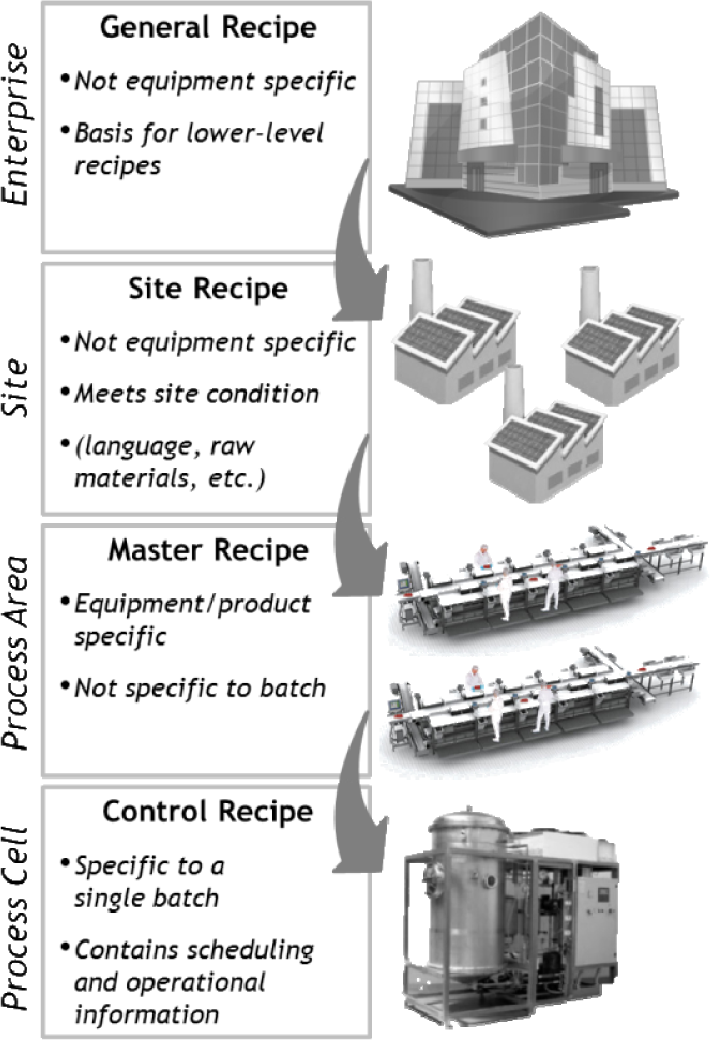
Site Recipe: is specific to a particular site, but is still not specific to a particular set of process cell equipment. It is the combination of site-specific and general recipe information. It may be derived from a general recipe to meet the conditions found at a particular manufacturing location.
Master Recipe: is specific to the equipment, raw materials and capabilities of a process cell or a subset of process cell equipment; it may be derived from the general or site recipe information or, alternately, it may be created as a stand-alone master recipe if the recipe creator has the necessary process and product knowledge.
Control Recipe: is a copy of a specific version of a master recipe and is then modified as necessary with scheduling and operational information so as to be specific to a single batch. It contains product-specific process information required to manufacture a particular batch of a specific product or portion of a product; it may be modified at any time, for example, to account for actual raw material quantities, material properties, the selection of units, or appropriate sizing.
ANSI/ISA-88 standard also defines the concepts of the transformation process, process elements library and recipe graphical representation through process procedure charts. The aforementioned recipes are used at different stages of the recipe development process, starting from the general one. ANSI/ISA-88 suggests standardizing the transformation process from one recipe to another, using a well-established set of transformation components. Even though the definition of how to perform the transformation is described in logical paths, the standard does not give specifications of the actual contents that should be present in these documents, providing the possibility to generate specific components for each case. The reason is that such non-procedurals and equipment information may vary depending on the type of batch manufacturing industry, and the ANSI/ISA-88 standard is intended to fit all the generic batch manufacturing processes. Moreover, both definition and graphical representation of the process steps should be implemented relying on a structured library of process elements. Equipment-independent recipes in particular (general and site recipes) should be created using only accepted and shared process elements, starting from a standard set of process actions that represent the building blocks of the process representation structure.
One of the objectives is to standardize the recipe development process, thus avoiding any misunderstanding while transferring information from the R&D level to production. Analogue considerations can be performed on the graphical representation of the processes. Unfortunately, ANSI/ISA-88 only suggests a graphical notation, called process procedure charts, which is specific for equipment-independent recipe representation but must be suited to each case.
3. A BPM approach to managing ANSI/ISA-88 compliance projects
Process modelling, as many publications confirm [29,30,31,32,33], is currently becoming a cornerstone for operational efficiency and process improvement projects, regardless of the industry sector to which it is applied. Adopting a process oriented approach and using a visual representation ensures a better control of performance and enables the detection of those existing inefficiencies that are hardly recognizable. Corporate process flows are often made of many figures at different stages, and the aggregation of several complex phases in few synthetic diagrams should be avoided. Indeed, a clear visibility of the entire stream of events is required in order to properly understand the linkages among activities, identify the strengths and weakness of a process and, eventually, facilitate interaction and integration with outsourcers [34,35] or with suppliers [36]. Additionally, process mapping and modelling can be considered one of the first steps for almost every improvement methodology that take place when analysing processes [37,38]. Both to identify opportunities and constraints, or even to handle a correct change management process, an as-is analysis and mapping are required. Having a clear understanding of the current stream of activities leads to a correct definition of an optimal to-be scenario. Once the desired future state is also clear, it is finally possible to perform a gap analysis and define an improvement implementation road map in order to achieve the expected results.
In each case, this cycle of improvement activities must be supported by a consistent graphical notation, capable of correctly representing the main subjects, events, activities and process rooting. Business Process Model Notation (BPMN 2.0) is considered one of the most efficient standards [33, 39] to represent in a graphical way a varied range of business and service processes. BPMN is an intuitive notation, suitable also for non-technicians figures, but capable of either representing complex process semantics or easing B2B and internal coordination. The activities of the flow and process representations are simple to understand, and clear communication is enhanced between who develops a new model and the final users who are affected by the analysed process. Furthermore, BPMN models consists of basic diagrams (BPD, Business Process Diagrams) which are built from a limited set of graphical elements, that are flow objects, connection objects, swim lanes and artefacts [40]. The following paragraphs explain why such a process oriented approach and flow-chart technique were chosen for the proposed methodology, highlighting the advantages obtained in the case study while assessing the ANSI/ISA-88 compliance.
4. Proposal for an ANSI/ISA-88 compliance assessment and roadmap identification
This paragraph illustrates the proposed methodological approach to carrying out an ANSI/ISA-88 assessment and provides a roadmap for full compliance, leveraging the above-mentioned tools of the Business Process Management approach. The aim of the method is to provide a reference framework which allows practitioners to perform an ANSI/ISA-88 compliance assessment in different contexts.
The motivations for such an effort lie in the need to support the implementation of ANSI/ISA-88 guidelines with a methodological and structured approach. Proven experiences have evidenced that implementing a new product development process in pharmaceutical companies is a difficult task, hiding several inefficiencies or inconsistencies concerning the flow of activities. ANSI/ISA-88 certainly provides a strong reference model, but implementing an effective transformation from the as-is process model to a compliant to-be one can be quite challenging for a company. The introduction of a BPM method at this stage can help identify gaps and define the road map, while BPM notation is a practical tool which can effectively provide clear visibility of the process and documental flows, enabling wiser decisions. To this extent, the proposed method was applied and validated on the case of a multinational pharmaceutical enterprise. We identify four main sequential phases to perform the activities in a structured way:
Moreover, two additional cross-activities must be run to support the implementation of the method itself:
Core team members' education in ANSI/ISA-88 standard.
Convergence meetings, following a project management methodology.
In order to point out the key information of the as-is process, accountable personnel, with deep knowledge of the company's process architecture and documentation, need to be involved. These core team members should belong to the corporate functions affecting the recipe development process, such as the introduction of new products, the technical integration of drug product development, process validation, manufacturing execution systems, operation quality, quality assurance, and IT/automation.
Data gathered within phase 2 will feed the subsequent steps, whereby all the fragmented information must be consolidated to provide clear visibility of the end-to-end stream process and to identify the requirements of the specific case, thus restricting the focus only to applicable areas of the standard reference model. Examples of collapsible and extendable areas are: recipe types, recipe information structure, recipe graphical representation, the transformation process of equipment-independent to master recipes, and contents of the equipment-independent recipe object model.
Moreover, as mentioned above, during this phase and the subsequent ones, training on ANSI/ISA-88 to all main figures interviewed is required, in order to ease the as-is/to-be transformation process model.
This methodology allows us to identify the misalignments on the main topics of ANSI/ISA-88, concerning recipe structure, process elements, graphical representation and libraries.
In more detail, the main topics to be addressed are summarized as follows:
Alignment on ANSI/ISA-88 terminology (process model, physical model and procedural model).
Process elements (process stage, operation and action) and process element standard libraries definition, following ANSI/ISA-88 data architecture.
General, site, master and control recipe contents and structure.
Graphical representation of equipment independent and dependent processes.
General-to-master recipe transformation process activities and document definition.
The identified road map represents the main deliverable of the proposed method.
Together with the explanation of the method, our proposal also provides a list of recommendations derived from the experience obtained from a real case implementation: redesigning a recipe development process is a complex activity, and can mask several pitfalls and criticalities. In order to facilitate the adoption of the proposed method and correctly implement the different phases, some general evidence and suggestions are provided. Below the most relevant considerations supporting phase 3 and phase 4 of the proposed reference model are indicated:
Generate templates for ANSI/ISA-88 compliant documents from company existing ones (Phase 3): considering that in pharmaceutical companies recipe development processes are well established by standard operative procedures, one of the most critical tasks is the effective representation of the future recipe development process, together with the transition itself. The proposed method suggests starting the redesign process by transforming existing documents related to a new product development (NPD) process of a specific pharmaceutical product, in order to generate standard ANSI/ISA-88 documents, such as a general and master recipe, to be used as a reference. By creating these new documents, a direct link between the main information of the current and future documentation is possible and the degree of similarity to the ANSI/ISA-88 standard is verified. Once the gaps between processes and documentation are clear, it is possible to outline short term and long term opportunities for improvement.
Ease the recipe development to-be process identification with BMPN notation (Phase 3): the recipe development process can be sensibly improved by the adoption of shared documents and the use of ad-hoc tools, such as a process element library or a set of transform components. During the assessment process, a to-be recipe development process has to be identified considering the aforementioned standard documents and tools. BPMN notation and process oriented methodologies have a significant impact on re-designing the recipe development procedures, providing a clear picture of the as-is situation and helping identify steps to reach an ANSI/ISA-88 full compliance. The use of BPMN to map the recipe development process can be considered a critical step of a repeatable approach for assessing the degree of similarity to ANSI/ISA-88 standard models and procedures.
Establish an education programme on ANSI/ISA-88 (Phase 3/4): in order to raise awareness of ANSI/ISA-88 benefits across the organization, after providing education on the method, it is advisable to continue the education process even after the assessment phase, especially if the company production processes are distributed into different plants.
Standardize process elements and share process element libraries (Phase 3/4): the definition of standard elements to describe the recipe development process is only a starting point. These elements, used to represent the recipe flow, should be exclusively selected from a shared library with a strong modular structure. Process actions represent the main building block to start from, in order to define the to-be standard process operations and stages. Identifying all the elements and the perfect linkages between them is a significant strategy for improving the general recipe standardization. As discussed above, a great amount of effort is made to transform the general recipe into a master recipe. This difficulty is generally due to the absence of standard contents and graphical representation used in all the documents involved in the recipe development process. Knowledge and information sharing is essential to reduce the time-to-market of new products. To overcome this problem, the proposed method suggests creating a set of stencils (e.g., in Microsoft Visio), according to the notation suggested by the ANSI/ISA-88 standard.
Define and adopt the general recipe and master recipe as standard documents (Phase 4): company documents are often not aligned to the ANSI/ISA-88 standard in terms of contents and graphical representation. The creation of specific templates for the general and master recipe, with the intent of providing reference formats for new product recipe development, is recommended. Furthermore, the general recipe template should be shared across the production sites and R&D functions, facilitating their usage and improving the level of standardization of these documents.
Standardize the transform components (Phase 4): one of the main difficulties is to define standard transform components, which are a set of equipment parameters and instructions that allow the transformation of process operations, described in the general recipe, into equipment settings and controls. Usually R&D performs the product development process on small-scale pilot plants, which can use completely different technologies from those of production plants. Farther on, the transformation process needs a long time to be performed, including deep characterization studies. Moreover, when product transfers among production sites are planned, the differences between technologies used in each plant become crucial. A consistent part of the transfer process is spent in customizing equipment parameters and working instructions for the different technologies used at the receiving unit. Hence, it is highly recommended to create a modular structure-based transformation components library, in order to standardize the transformation process for the development and transfer of future products.
Enterprise Recipe Management solution (Phase 4): in order to reduce process variability and batch recipe development cycle time, the increased repeatability of production processes and the reverse flow of information for recipe changes, facilitate introduction of new product/machinery, the adoption of a dedicated content management system or a product life-cycle management system (PLMS) is suggested. These issues are in fact the most relevant for the adoption of ANSI/ISA-88. A PLM enterprise platform is usually able to integrate people, data, processes and business systems allowing the proper management of the entire lifecycle of a product. According to the ANSI/ISA-88 principles, recipe documents and process elements, libraries should be shared among the organization and continuously updated, following the new product introduction process. The use of this kind of system may reduce the probability of human errors in the recipe creation and management process, and it is able to guarantee effective communication, capturing all the ANSI/ISA-88 data, including flows and parameters in a single format, and providing a mechanism for content reuse (Recipe Building Blocks), which is critical to recipe normalization. PLM software could also help organizations improve compliance to ANSI/ISA-88 in terms of the standardization of procedures and notations, even allowing the transformation of general and master recipe information into equipment-executable recipes. Moreover, the BPMN notation adopted in the proposed method facilitates the implementation of such enterprise management systems.
To sum up, the proposal combines a series of structured steps to drive the assessment and the definition of a roadmap toward a to-be model, providing a list of practical recommendations to overcome the potential pitfalls and criticalities that companies may be faced during the implementation of this standard.
The next paragraph describes how effectively the proposed approach helped in deploying a project for a multinational pharmaceutical company.
5. The case study
A practical experience of how a process-oriented approach can help when analysing and optimizing a recipe development process is now described. The considered company is a leading firm in the healthcare sector and commercializes a large variety of products all around the world, with production plants in more than 50 different countries. The peculiarity of the organizational model is its independent way of managing the production processes distributed on the sites, where operations are locally managed, whereas coordination and control functions are handled by a central committee. In recent years, the number of new product introductions and technical transfers between plants has noticeably increased due to marketing strategies and cost reduction programmes. As a consequence, the company decided to undertake several initiatives aimed at speeding up the time-to-market of new products and improving knowledge management within transfers. The most effective way to reach these goals was identified by top management in the adoption of a recipe management strategy, based on the ANSI/ISA-88 standard, focused on product life-cycle, which uses an end-to-end approach. The ANSI/ISA-88 initiative, discussed here, was then undertaken in the company's best-in-class manufacturing plant to define the standard recipe management strategy, in view of its worldwide application.
Figure 3 presents an illustrative project Gantt diagram of the industrial case, along with the details of the activities included in each phase.
The steps followed during the pilot project were consistent with the proposed approach and concerned the solid oral production process of pharmaceutical drugs performed by the company. The proposed method allowed the following objectives to be reached:
Map the as-is recipe development process.
ANSI/ISA-88 assessment project plan (illustrative)
Assess the degree of compliance of the analysed processes and documentation to the indications of the standard.
Identify recipe development process challenges and criticalities.
Define an applicable to-be recipe development process model.
Outline short term and long-term improvement opportunities, defining the implementation roadmap.
5.1 Main findings on the ANSI/ISA-88 reference model
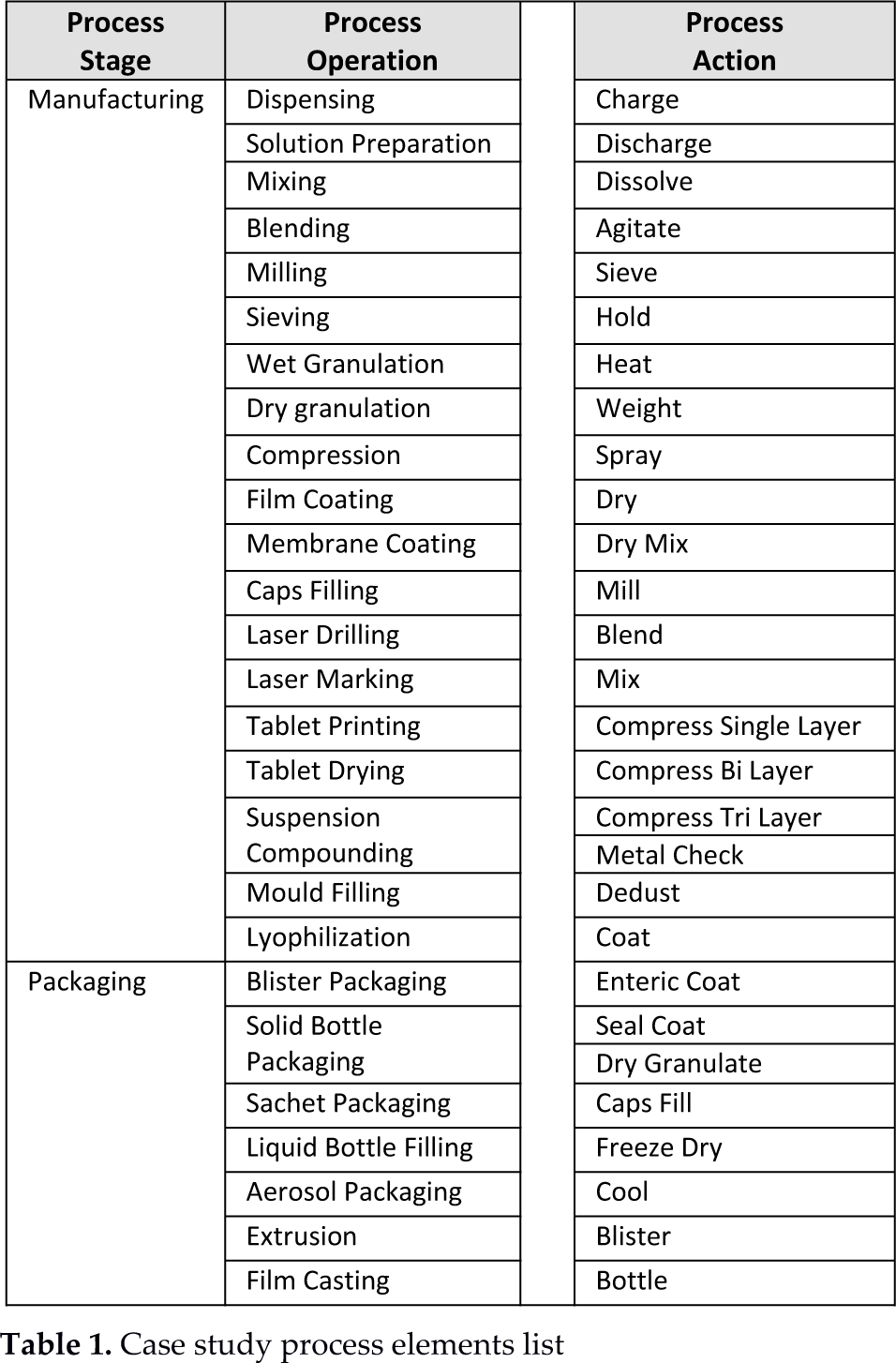
As described above, the ANSI/ISA-88 reference model is based on a clear separation of Process, Physical and Procedural Models, with a hierarchical subdivision in different layers. With regard to the Process Model, all elements are divided into processes, stages, operations and actions. In the documentation used within the company, this distinction was not clearly applied; indeed, production processes were mapped using elements that could be connected to both the ANSI/ISA-88 process operations and actions. This misalignment was not only found on a terminological level but also at a conceptual level. This lack brought a mix of logical information, which misled a correct implementation of the general and master recipes. Consequently, the as-is structure did not allow a complete standardization of the recipe development process. In order to align process representation and mapping, a list of standard elements with a univocal description was edited. This list gave also the input to implement the library of the standard process elements. Even though the analysis took place at a specific production site, the identified building blocks maintained an equipment-independent structure, allowing their application to similar plants. The process stages, operations and actions identified are listed in Table 1.
Case study process elements list
Concerning the physical model, the logical subdivision into the levels used at the site plant was considered coherent with the ANSI/ISA-88 approach. A comprehensive distance in terminology existed, but concept and layering were aligned with the standard guidelines.
By contrast, the procedural mode appeared noticeably different from the one described in the standard. Process elements, which “theoretically” describe how to perform process steps, had to be linked to same level procedural elements, which should describe how operators “physically” perform activities on specific equipment. In order to cover this gap, a conversion of terminology and layering was proposed, and implemented in the example of the general and master recipe. For reasons of confidentiality, more details of the physical and procedural elements cannot be reported in this paper.
5.2 Main findings from process mapping
More considerations were dealt with when analysing the documental flow of the as-is recipe development process. According to ANSI/ISA-88, the process is based on four main recipes (general, site, master and control). The documentation concerning the technical transfer and recipe development processes at the site consisted of a series of files containing all the relevant information for the introduction of the new product. The use of the BPMN diagram to map the as-is situation (see Figure 4) decisively helped identify the correct linkage between the document used and the one proposed by the standard.

An example of a BPMN2.0 diagram for the master recipe creation process (illustrative)
Figure 5 illustrates the linkage that emerged between the plants and the ANSI/ISA-88 standard documents.

Case study cross reference documentation
5.3 Main findings on recipe structures
Even though all the relevant information required by the standard existed or was generated during the project, the assessment brought to light the absence of a proper general recipe management in the analysed case. Three main aspects affected the ANSI/ISA-88 compliance. First, the technical transfer strategy and the criticality analysis documents provided a detailed production process flow chart. However, this flow chart could differ from one document to another. Process elements were mapped mixing process operations and process actions, the resulting terminology was not coherent with the ANSI-ISA/88 definitions and, often, different terms were used to indicate the same production element in different documents.
The second point concerned the graphical representation: even if ANSI/ISA-88 is not normative on the graphical representation to be used, it requires a logical coherence and suggests possible notation solutions, encouraging the creation of a process elements library for general recipe management. Indeed, the presence of a standard library ensures that only valid element definitions are used in equipment-independent recipes.
Another relevant finding is related to how these documents were produced, and by whom. Initially, documents were created mainly by the collaboration between R&D and the production plant but, as time passed, these documents were continuously updated with more and more details about materials, process characteristics and the equipment, on which the production process was tested and validated. Consequently, documents were added with equipment-dependent information and, then, could not be used as a general recipe. The main consequence is a loss of generality once the recipe is developed and implemented on a specific series of equipment, which implicates difficulties in transferring the information to different plants. In order to overcome this problem, while avoiding a drastic change in the procedure used, the proposed approach consisted of creating a general recipe structure and integrating it into the company's existing documents.
Fewer considerations emerged concerning the master recipe: from the ANSI/ISA-88 perspective, the master recipe should include all the relevant information to manufacture a product on a specific set of equipment. This information was available, spread over different documents, such as the production version and equipment recipe documents. The main problem concerned the division of recipe contents that did not match the ANSI/ISA-88 categories (introduction, header, formula, equipment requirements, procedure, other information).
With regard to the site recipe and the control recipe documents, an ad-hoc solution was proposed, which is to merge both documents, considering that this action would not affect the advantages of adopting the ANSI/ISA-88 standard. This decision was based on an on-going parallel initiative regarding the standardization of material and suppliers.
5.4 Main findings on the recipe transformation process
More considerations can be made concerning the transformation process, which allows the generation of a master recipe, equipment-dependent and site specific, starting from a general recipe, equipment-independent and valid for all production sites. As mentioned previously, the ANSI/ISA-88 master recipe should contain all the relevant information for the manufacturing process on a specific set of equipment. Thanks to the use of process parameters and procedures included in this recipe, the production site is able to start the manufacturing of the new product for characterization, validation, and registration for commercial purposes, according to the steps of the new product introduction process. Within the project, an important lack was revealed, due to the absence of a formalized and standard process. In the as-is scenario each process element of a production flow-chart was manually transformed into a series of instructions by using procedure templates or a production version of similar products. Critical process parameters were linked to equipment settings and sometimes this connection was not easy: critical parameters, indeed, may be measured in different units or refer to parameters not adjustable on the specific equipment. In order to standardize this transformation process, following the ANSI/ISA-88 guidelines, a set of transform components were created for the pilot project. These transform components consisted of a group of reusable tables, containing process parameters and instructions associated to specific equipment, under a series of conditions. These conditions established the link between the general recipe information and the master recipe contents. Once process operations and process actions are defined in the general recipe, and production equipment are selected at the site level, the production site can automatically define the set of instructions and parameters necessary to produce the product, using the transform components.
6. Conclusions
The aim of this paper was to describe how an ANSI/ISA-88 assessment could be easily performed with a dedicated Business Process Management approach and specific methodologies or notations such as BPMN2.0. This approach has been applied to a pilot project carried out in a large multinational pharmaceutical company. In the project, the authors managed to re-design the recipe development process and create a set of templates and libraries to be used as a reference to the ANSI/ISA-88 standard (general recipe, master recipe, process element library, transform components). The most important result of the initiative was the standardization of the NPI process and related documentation. Recently, the company applied the developed approach to the transfer of different products, obtaining a sensible reduction of time spent for the transfer and, at the same time, reducing the need for process experts travelling between the two plants. These results encouraged the company's management to introduce the developed recipe management process in similar sites by the end of 2014.
Despite these encouraging results, as described in the article, there are different pitfalls and criticalities that companies may face during the implementation of this standard. These can be summarized as follows:
Map the end-to-end as-is recipe development process with a BPM notation.
Start from defining a general recipe and a master recipe as standard documents.
Establish continuous education training on ANSI/ISA-88 contents, leveraging on the assessment phases.
Standardize and make use of defined process elements.
Share process element libraries throughout production plants.
Create a library of standard transform components.
Typical misalignments and gaps in an ANSI/ISA-88 compliance are also reported in this article as a result of the experience on the specific case. The practical evidence provided can be considered, on one hand as recurrent criticalities that may arise in any ANSI/ISA-88 assessment, and on the other hand as challenges to deal with, in order to obtain the desired benefits. Most opportunities in the adoption of this standard for recipe management process still reside in the possibility of creating executable recipes, applicable to the same equipment of different plants, through a one-to one correspondence of process actions to equipment phases. To reach this ambitious objective, a structured approach to the design of recipe development processes seems crucial.