




Abstract
Business process management (BPM) is a well-known holistic discipline used widely in practice for managing business processes and achieving better organizational performance. However, recently, due to technological development, using a traditional approach to BPM is not enough anymore. The answer to the limitations of the traditional BPM has been found in the introduction and application of the social software principles in the management of business processes within a new and emerging area called social BPM. In order to investigate its implementation and usage within the companies, a literature review has been conducted. It confirmed that social BPM is a developing phenomenon. Overall, 31 papers with case studies dealing with the usage of social BPM have been selected for further analysis. The case studies have been analysed with regard to structure, process and content dimensions as well as risk management and crisis.
Keywords
Introduction
The core of every organization is its set of business processes; hence, it is very important for the organization to pay close attention to their design and execution. If managed properly, business processes can prove to be indispensable for an overall better organizational performance, as has already been empirically proven in some previous research. 1,2 Due to the growing awareness of the benefits of business process management (BPM), there has been an increase in the number of organizations that have been redesigning their businesses following the concept of process orientation and implementing BPM. The success of BPM implementation and adoption in an organization depends on many various factors. Moreover, in recent years, there has been an increase of interest among both researchers and business experts for finding a solution to the limitations and problems of implementing and adopting BPM in a traditional way that arose over time and represent the crisis of the classical BPM. Business practice indicates that BPM crisis usually happens more often because of the adoption issues than because of the troubles during the implementation phase. 3 Among other, one of the most common problems of the traditional BPM is the difference between designed models and their execution in reality. 4 This and other traditional BPM issues, which are going to be addressed later in the article, could be reduced or resolved by introducing the social software and its principles into BPM. Therefore, this new approach is being called social BPM. Although there is a large body of literature regarding BPM, there are still a limited number of papers written about social BPM.
The goal of this article is to give an overview of the literature regarding social BPM as a newly emerged area of BPM and to show how it is used in practice. An additional goal of the article is to analyse experiences from business practice referring to the usage of social BPM for risk management and BPM adoption in organizations. In order to achieve the goal of this article, an analysis of literature about social BPM has been carried out. All of the analysed papers are case studies of social BPM in practice. Further analysis includes the overview of the presented case studies’ structures, processes, content and the role of BPM in risk management.
The structure of the article is as follows. After the introduction, a short theoretical background is given. The third part of the article describes the methodology used for the literature review and research, followed by the presentation of the obtained results and the discussion. At the end of the article, a short conclusion is given, including the limitations of this research and plans for future work.
Background
BPM is a holistic discipline focused on improving organizational performance by managing its business processes. 5 Although BPM has been previously seen as either technical or managerial discipline, nowadays numerous authors agree on its multidisciplinary and holistic nature. 6 As a result, this brought new understandings about BPM to light and indicated the need for including social and cultural aspects into the BPM studies, among others.
Due to technological development, there are certain limitations of implementing a traditional approach to BPM that can lead to the BPM crisis in an organization. If that happens, it is very important that the organization has some type of risk management so that any kind of BPM or process crisis could be dealt with as soon as possible in order to minimize the negative effects on the business and performance. As indicated in the literature, the main BPM-related issue is the so-called model-reality divide, and it refers to situations when employees do not follow the designed process models in practice. 4 Besides that, other problems are known to occur, like lost innovations, lack of information fusioning and information pass-on threshold. 4 These problems refer to the complications that employees experience when they propose an idea for process improvement. Moreover, due to the lack of employees’ involvement and understanding of the process, they sometimes feel like the people responsible for BPM in the organization are imposing their own will in terms of new process models or are forcing them to follow new process designs, although those processes may not work best when put into practice.
These problems mostly occur due to the lack of collaboration between the organization’s relevant BPM stakeholders or due to the lack of communication within the organization. 7 The model-reality divide issue can be a consequence of not including employees into the project of designing and modelling business processes and models. Consequently, the employees are often dissatisfied with the presented models. Most of the employees tend to continue to execute processes as they did before because they are used to doing their work in a certain way and are not willing to change or simply do not understand the new models and why other ways of process execution are better. However, these issues can be avoided or reduced if the employees are included in the designing and modelling of the processes. Moreover, there is often valuable knowledge existing within the organization, but that knowledge is often lost or obscured because the person responsible for BPM is not aware of its existence due to the lack of employees’ involvement into the BPM projects. 8
On the one hand, social BPM can be understood as a platform for BPM collaboration, 9 while on the other hand, it represents an attempt to resolve the problems which occur while implementing and adopting the traditional BPM. This way, it could be argued that social BPM is, in fact, an answer to the crisis of BPM within an organization. According to Olding et al., the key element of social BPM is user engagement. 10 In other words, social BPM enables enhanced integration of all stakeholders into BPM and the life cycle of business processes. 8
Implementing both BPM and social BPM can result in many benefits for the organization. For instance, Batista et al. list several social BPM benefits, like centralized repository, knowledge management, improvement of collaboration and communication, process integration, and BPM communities for process improvement, faster decision-making and so on. 11 In that sense, social BPM can play an important role in risk prevention since these benefits improve stability and the response time in organizations. Moreover, it has been argued that using an information technology (IT) software tool with a built-in warning system, like BPM systems, can be a good support for risk monitoring. 12 Furthermore, BPM can be beneficiary to many challenges, like dealing with uncertainties or reducing the complexity of events, which also enables better dealing with risks within organizations. 13
Methodology
This research reviewed the available literature on social BPM in order to summarize existing findings in this field of study. Special focus has been put on the case studies presenting the usage of social BPM in practice. The next two subsections present the methodology of choosing the literature and conducting the literature analysis.
Identifying literature
The literature gathering process started with the identification of the relevant databases for this research. As the result, the focus has been put on literature cited in Scopus and Web of Science (WoS) databases. The search strategies in WoS (SSCI and SCI) and Scopus (SCI-EXPANDED, SSCI, A&HCI, CPCI-S, CPCI-SSH, BKCI-S, BKCI-SSH, ESCI, CCR-EXPANDED, IC) were based on six keyword combinations as follows: (‘BPM’ or ‘business process management’) AND (‘social BPM’ or ‘social business process management’), (‘BPM system’ or ‘business process management system’) AND (‘social BPM’ or ‘social business process management’), (‘BPM software’ or ‘business process management software’) AND (‘social BPM’ or ‘social business process management’), (‘BPM’ or ‘business process management’) AND (‘Web 2.0’), (‘BPM system’ or ‘business process management system’) AND (‘Web 2.0’) and (‘BPM software’ or ‘business process management software’) AND (‘Web 2.0’).
The search has been conducted in July 2017 with the time span from the beginning to the end of July 2017. There were six search runs that resulted in 148 hits (100 hits in Scopus and 48 hits in WoS). The search approach is shown in Figure 1.

Primary study selection process.
After merging all 148 papers, 58 papers were found in both databases. Therefore, duplicated papers have been excluded, leaving 90 different papers for the further analysis. From these, basic data (e.g. authors, title, journal and year of publication) have been extracted and coded for the purpose of the analysis of social BPM entrance and positioning in BPM-related research fields. In the next step, the search strategy has been refined. First, 11 papers that are not ‘Conference papers’, that is, papers from scientific conferences or ‘Articles’ (papers in scientific journals) have been excluded. Then, 79 remaining papers have been filtered using following criterion: Paper was considered relevant if it contained any case study of social BPM. After reviewing the abstracts and keywords, 35 papers that did not report about case studies related to social BPM were eliminated. After applying this exclusion criterion, 44 promising publications remained that seemed to report about some real social BPM implementation. After collecting and analysing these 44 papers, 31 papers that reported in detail about social BPM case studies were selected to represent the basis for further analysis.
Review analysis
In order to achieve the aim of the article, all relevant data (e.g. authors, title, journal, year of publication, industry, collaboration partners, process scope, content and goals) from the selected 31 papers have been extracted and coded. Next, a framework for the study has been selected, as described further in the text.
Many authors agree that one of the main purposes of using social BPM within organizations is to enhance and facilitate collaboration among all relevant stakeholders in BPM implementation and adoption. 8,11,14,15 Therefore, the papers selected for this study have been analysed following the work of Niehaves and Plattfaut. 15 They argue that there is a lack of research on the topic, although it is a growing and developing area, and propose a conceptual framework for understanding collaborative BPM based on the observation of 37 papers. 15 The proposed conceptual framework suggests three dimensions: (1) structure, (2) process and (3) content dimension. 15 Within these dimensions, there are four main concepts with various sub-concepts, as shown in Figure 2. However, for the purpose of this analysis, sub-concepts have been adapted to fit the selected case studies’ contents and coded as shown in Figure 2.
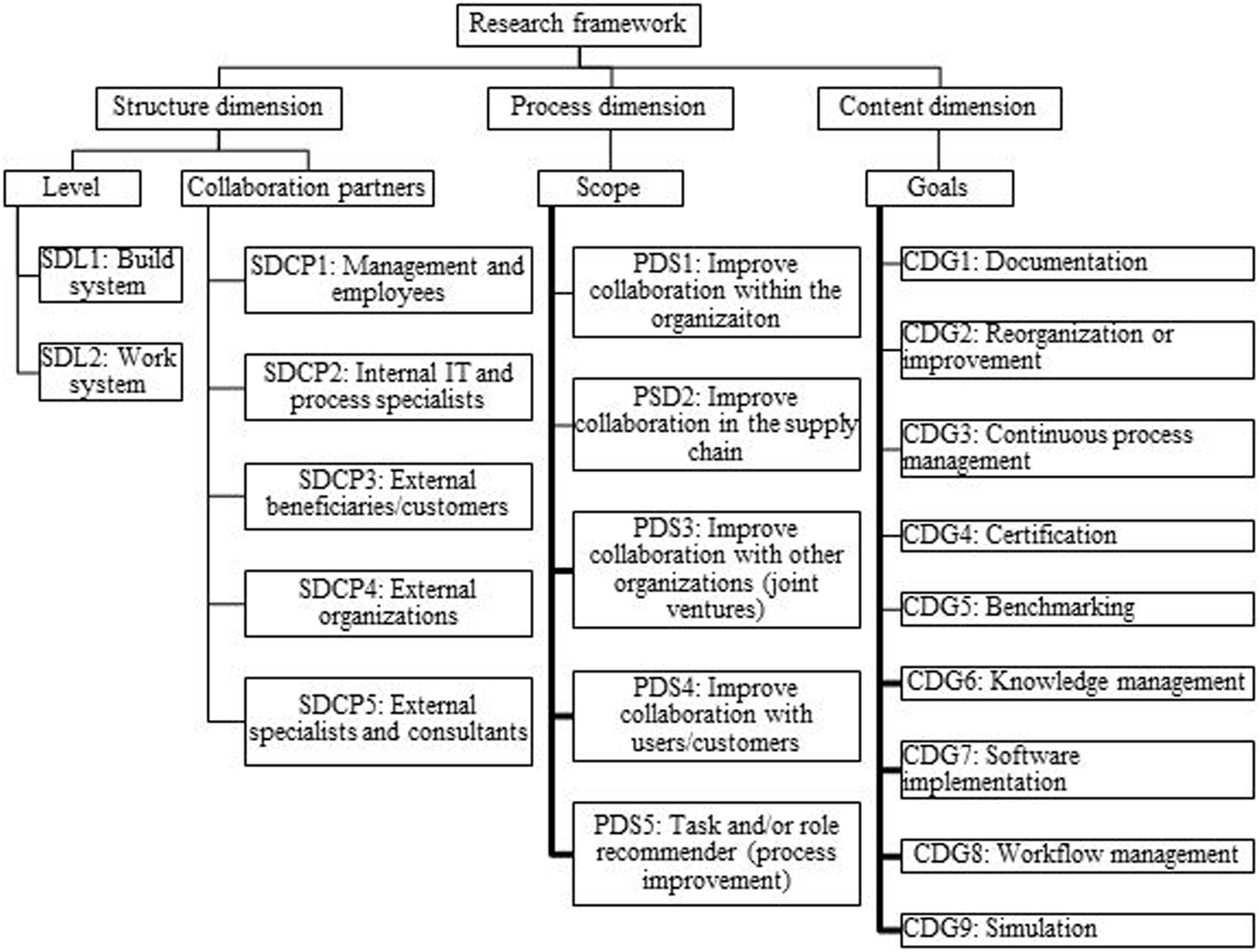
Research framework.
Structure dimension includes two main concepts: (1) level of business processes (work system) or BPM (build system) and (2) collaboration partners. 15 Original work is focused on 11 collaboration partners, 10 of which are included in this study as well. They are grouped into two internal and three external collaboration partners groups. Internal collaboration partners are comprised of (i) management and employees group that includes members of the top and middle management and employees and (ii) internal IT and process specialists which include technical specialists. External collaboration partner groups include (i) external beneficiaries/customers which are suppliers, distributors and customers, (ii) external organizations, including professional organizations and other companies and (iii) external specialists and consultants that include software and BPM consultants and single performers. Since there were no papers which included lawmakers into BPM collaboration process in the results of the original work, 15 it has been decided that this group should be excluded from the framework used in this research.
Collaboration is the key concept of process dimension and it includes five sub-concepts originally based on the work of Jagdev and Thoben. 16 However, for the purpose of this work, only four of the original sub-concepts have been included in this research, namely, (i) improving collaboration within the organization (including integrated companies), (ii) improving collaboration in the supply chain (contractual agreements), (iii) improving collaboration with other organizations (joint ventures) and (iv) improving collaboration with users/customers (transaction-based relationships). The last sub-concept has been added for the purpose of this study, since the literature review has indicated a task or role recommender as another collaboration group. Moreover, the task or role recommender can enable bottom-up process improvement approach rather than the traditional top-down approach, since this kind of a system provides opportunities for the employees to present their ideas for process improvement. Therefore, it has been considered important to include it as a sub-concept within the collaboration scope of process dimension.
Finally, content dimension includes BPM goals, which are originally based on the work of Rosemann. 17 There is a total of nine sub-concepts included: (i) modelling business processes to document the status quo and training new employees, (ii) reorganization or improvement of the organizational orientation (to process-oriented), (iii) continuous process management, (iv) certification that represents fulfilment of certain standards to others, (v) benchmarking with the purpose of comparing with other organizations, (vi) knowledge management for increasing organizational knowledge transparency, (vii) software implementation which enables compliance with organizational needs, (viii) workflow management and (ix) simulation with the purpose of identifying process weaknesses.
Results
This section presents the results of the analysis of the selected 31 papers.
First, the frequency of publishing papers regarding social BPM in total has been analysed. The analysis was based on 90 different papers from WoS and Scopus databases. Figure 3 presents the appearance of all 90 papers by publication year and document type. It is noticeable that since 2008, the number of social BPM conference papers has grown to about 10 papers per year, which is an indicator that the field is still in its developing stage, meaning that the maturity is not yet reached. Furthermore, the lack of papers published in journals and the high ratio of conference papers indicate that the topic of social BPM is a current theoretical topic and can be considered as an emerging area of BPM. Also, these results indicate an increase in researchers’ interest in the topic. Still, having in mind that the analysis includes only two high-quality databases, the lack of papers published in journals could be the indication of the lack of high-quality research conducted in the area of social BPM.

Appearance of social BPM papers by publication year and document type. BPM: business process management.
Further analysis was based on the conceptual framework developed by Niehaves and Plattfaut, as presented earlier in the methodology section of this article. 15 The results of this analysis are presented in Table 1 in the form of the concept matrix of the 31 selected papers for this study. All selected and observed papers are given ID codes and are referenced in the reference list at the end of the article. In addition, sub-concepts of the conceptual framework used for this study have been coded, as shown in Figure 2. In order to achieve the stated goals of this article, all authors have read and interpreted selected case studies. Table 1 presents a unified understanding of the representation of sub-concepts presented earlier throughout the 31 selected case studies.
Concept matrix of the selected papers.
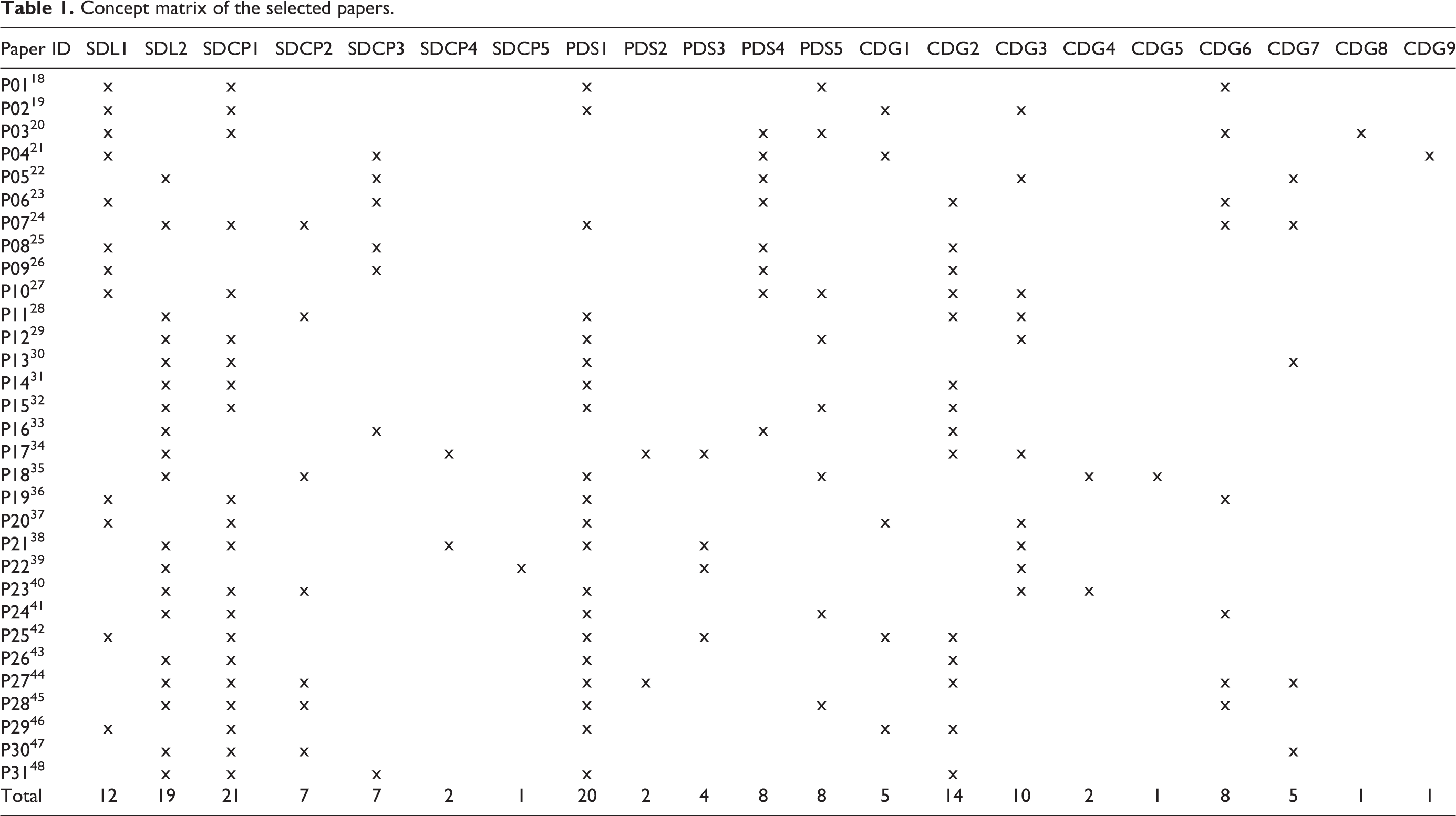
As evident in Table 1, when talking about the structure dimension and the level concept, there are 12 papers regarding the build system level and 19 regarding the work system level. In the case of collaboration partners, there is a total of 23 papers presenting internal collaboration partners. Among the selected papers, 21 of them refer to the management and employees (internal or domain experts) as collaboration partners in BPM, while seven of them refer to the internal IT and process specialists. There are only two papers that present both internal and external collaboration partners. On the other hand, there is a total of eight papers dealing only with external collaboration partners within social BPM usage in practice (external beneficiaries or customers, external organization and external specialists, consultants or single performers).
Process dimension results show 20 papers on the usage of social BPM for improving collaboration within the organization. Of those 20, 11 of them have improving collaboration within the organization as the only goal. There are two case studies using social BPM as the means for improving collaboration in the supply chain. Additionally, eight papers recommend using social BPM for improving collaboration with users and customers and eight papers recommend using social BPM as a task or role recommender. Finally, four papers present improving collaboration in joint ventures as collaboration scope.
Regarding the content dimension, results show that 14 papers report process-orientation reorganization or improvement as the goal of using social BPM, while 10 of them report continuous process management as the goal. There are also eight papers reporting knowledge management to be the goal of the social BPM usage and five papers reporting software implementation and documentation as the goal. However, only two papers present certification as a social BPM usage goal, while there is only one paper describing workflow management as the goal and one paper having simulation as one of the goals of the usage of social BPM.
Discussion
In this section, a short discussion about the above presented results will be given. The discussion will be presented in four subsections, three of them following the conceptual framework (structure dimension analysis, process dimension analysis and content dimension analysis) and the last one dealing with the relationship of the social BPM usage to manage risk in times of crisis.
The analysis of the selected papers, dealing with the usage of social BPM in practice, confirmed social BPM to be a new direction in managing business processes within organizations. Although some researchers argue that social BPM is just a buzzword, authors of the papers selected for this analysis clearly argument the differences between traditional and social BPM, positioning social BPM as a new, emerging area. 9,33,20 The main difference between traditional BPM and social BPM is the engagement of various stakeholders into the BPM life cycle and enhanced collaboration regarding the designing and executing the business processes. Unlike traditional BPM, where BPM is the responsibility of a BPM expert and employees are not included in process modelling, social BPM allows them to share their ideas for process improvements.
Since there is yet no clear definition of social BPM, one of the contributions of this article is the proposal of a possible definition, based on the analysis of the selected papers. It could be said that social BPM is BPM empowered by social software, technologies and concepts with the goal of strengthening internal process performances through a more efficient task and role recommendation, implementation of knowledge management and/or improvement of external collaboration with key stakeholders and customers.
Structure dimension analysis
The analysis of the selected papers indicates an unequal distribution of concepts in the literature. As presented, there are almost twice as more papers presenting case studies analysing collaboration on the business process level (work system level – 61%) than those analysing collaboration on the level of BPM (build system level – 39%). This ratio indicates that, in practice, social BPM is still not understood well enough, since most of the case studies analysed in this article described social BPM usage at the work system level rather than at the build system level. Contrariwise, the research conducted by Niehaves and Plattfaut presented an equal number of papers reporting about the work system level and build system level. 15 On the other hand, the results obtained from this analysis are in line with the original work from Niehaves and Plattfaut whose findings indicate very rare cases of papers including external organizations or professionals into the BPM collaboration process. 15 In this research, there are only two papers mentioning external organizations as their collaboration partners and only one paper mentioning external specialists. These results also indicate the newness of the social BPM field since its usage is still not widely spread outside the organizational boundaries and it is mainly used with the purpose of improving internal efficiency rather than as a bridge between the organization and its external partners.
Process dimension analysis
In the process dimension analysis, organizations also strongly focus on internal collaboration. The obtained results revealed that the majority of analysed papers report using social BPM for improving collaboration within the organization, while there are significantly fewer papers reporting on using social BPM as the means of improving collaboration in the supply chain. On the contrary, Niehaves and Plattfaut report majority of their analysed papers to be concentrated on improving collaboration in the supply chain. 15 Furthermore, results from Niehaves and Plattfaut 15 report no papers regarding collaboration in joint ventures. However, in this study, four papers examine improving collaboration in joint ventures under the process dimension.
Content dimension analysis
The results of the analysis focused on content dimension are partly in line with the results presented by Niehaves and Plattfaut. 15 They report that the majority of the papers deal with process-orientation reorganization or aim at continuous process management, while very little or no papers report about certification, benchmarking, knowledge management and software implementation. 15 In this study as well, the majority of the cases deal with process-orientation reorganization or improvement and continuous process management as goals of using social BPM. Moreover, in this analysis, there is also a lack of papers reporting about certification, benchmarking, workflow management and simulation. On the other hand, in this analysis, there are also a number of cases reporting on knowledge management, software implementation and documentation, which is not the case in previous research by Niehaves and Plattfaut. 15
Relationship to risk management in times of crisis
When it comes to risk management in times of crisis, there are also some interesting findings among the selected case studies. Mainly, two ways of using social BPM for risk management could be identified in the papers. First, there are papers reporting benefits of using social BPM for improving knowledge management and knowledge sharing as a way of decreasing or managing risks. Social BPM has an important role in risk management since its usage facilitates collaboration and knowledge sharing among employees within organizations. The higher the level of collaboration and knowledge (e.g. knowledge about the processes, understanding of activities, responsibilities, etc.), the more chance there is of a quicker reaction in case of a crisis. Second, there are papers focusing on task recommendation as a result of using social BPM and decreasing risks. Task and role recommendation enables better decision-making within the company and therefore lowers the risk of unwanted events which could cause a crisis. Besides that, social BPM offers a variety of opportunities which can play an important role in risk management. 14 However, the results of this literature review show that the potential of social BPM for enhancing risk management is still not well understood in practice.
Apart from supporting decision-making, task and role recommendations are also important in the context of current trends related to industry 4.0, digital transformation and customer experience management. Particularly in crisis cases, users use social software as a communication portal with companies, and this research shows that it is possible to link social software with operational management. Implementation of social BPM can enable a faster response to the crisis through task and role recommendations and thus contribute to managing user experience.
Conclusion
This study presented an overview of the structure, process and content dimensions of selected case studies dealing with the usage of social BPM in practice. The analysis revealed an unequal distribution of the representation of concepts within mentioned dimensions among selected papers. Mainly, there is a lack of focus on the usage of social BPM for workflow management, simulation and benchmarking as well as certification. Since those are all powerful and useful instruments, there should be more focus on the ways that social BPM usage could assist in achieving better process and organizational efficiency through mentioned instruments in practice as well as in theory. Furthermore, the paper has indicated how social BPM is used in practice for facilitating risk management.
The analysis of the selected case studies revealed that organizations are starting to use social BPM for risk management in practice. However, there are still lots of unused potential and opportunities enabled by social BPM that can be used for dealing with risks and developing strong risk management within organizations. In that sense, both theory and practice should focus on a better understanding of social BPM in risk management.
Possible usage of social BPM in practice could bring following benefits: New paradigms of collaboration within the organization by enabling more efficient internal work management based on dynamic and automated tasks and/or role changes and assignments. An example of this paradigm is the dynamic allocation of call-agents in help desk services by reacting on responses from social communication channels. More efficient project management in internal projects by improving the communication between project members. An example of usage of social BPM could include the development of a knowledge management system which would allow all project participants like IT specialists, process specialists and domain experts to share suggestions for process improvements of the IT system design phase. More efficient collaboration throughout the whole supply chain. An example is the application of social BPM for managing relationships with suppliers by implementing social platforms for identification of new suppliers or substitute resources, tracking existing suppliers by their reputation in social communities and similar evaluation issues. More effective omnichannel in the context of managing customer experience. Applying social BPM capabilities supplements omnichannels, like in the cases of including various social platforms in resolving customer complaints, which enables customers to keep a better track of their claim’s progress.
Although this work extends the body of knowledge, it also has some limitations. The limitations include a limited access to scientific databases and conduct a literature search in only two high-quality bases. Due to that, this literature review cannot be considered ‘exhaustive’ and could be expanded in a way that it includes other databases, besides WoS and Scopus. Moreover, the analysis of case studies is the result of the authors’ understanding and interpretation of the selected case studies, so there might exist different understandings of the topic.
Future research of this topic will include further and more detailed analysis of the papers selected for this study. Papers, which have been selected for this study, will be further analysed with regard to the industry type in order to examine if there is a link between the usage of social BPM and the industry type, like exploring the paradigms of collaboration in organizations especially for businesses in the service-oriented sector. Furthermore, the papers will be analysed with regard to the social BPM technology presented in the case studies. Moreover, since the selected papers present case studies of using social BPM in practice, further research should put more focus on the benefits and possible disadvantages of using social BPM in practice. Since this study proposed a definition of social BPM as the result of the case study analyses, further research of the topic should include refining and confirming the definition.
Footnotes
Declaration of Conflicting Interests
The author(s) declared no potential conflicts of interest with respect to the research, authorship, and/or publication of this article.
Funding
The author(s) disclosed receipt of the following financial support for the research, authorship, and/or publication of this article: This research has been partly funded by the University of Zagreb under the project ‘Modelling in the knowledge economy using decision support methods’ and partly funded by the Croatian Science Foundation under the project PROSPER – Process and Business Intelligence for Business Excellence (IP-2014-09-3729).