




Abstract
In the construction industry, research is being carried out to look for feasible methods and technologies to cut down project costs and waste. Building Information Modelling (BIM) is certainly currently a promising technology/method that can achieve this. The output of the construction industry has a considerable scale; however, the concentration of the industry and the level of informatization are still not high. There is still a large gap in terms of productivity between the construction industry and other industries. Due to the lack of first-hand data regarding how much of an effect can be genuinely had by BIM in real cases, it is unrealistic for construction stakeholders to take the risk of widely adopting BIM. This paper focuses on the methodological quantification (through a case study approach) of BIM's benefits in building construction resource management and real-time costs control, in contrast to traditional non-BIM technologies. Through the use of BIM technology for the dynamic querying and statistical analysis of construction schedules, engineering, resources and costs, the three implementations considered demonstrate how BIM can facilitate the comprehensive grasp of a project's implementation and progress, identify and solve the contradictions and conflicts between construction resources and costs controls, reduce project over-spends and protect the supply of resources.
1. Introduction
Construction costs issues relate to a low-carbon, environmentally-friendly, green building, natural ecologies, social responsibility and welfare [1]. As some natural resources are non-renewable, the value of construction is not just to maximize its profits from a financial perspective. Instead, the ultimate objective is to pursue the minimum natural resource consumption per building area and as per the total [2]. Because construction activity consumes a large volume of steel, wood, cement and other resources, it will ultimately result in the excessive exploitation of nature. For enterprises, comparative business advantage can only be achieved when they are good at controlling costs and waste. However, as some costs and construction standards are essentially incapable of curtailment or being lowered, the control of costs and waste does not simply mean squeezing any type of cost blindly; at the very least, it should not be at the price of sacrificing structural safety and weakening social responsibility.
The previous research has indicated that Building Information Modelling (BIM) technology is a promising way of addressing the costs and waste issues through the optimization of construction design [3], the management of construction assets [4], the minimization of unnecessary waste [5], and so on. As a multi-dimensional (3D, 4D for time, 5D for cost and nD for more) modelling and information integration technology, BIM allows all the parties involved in construction projects (e.g., government departments, owners, designers, construction managers, supervisors, operation managers, project users, etc.) to operate information in building information models (and vice-versa) during the entire project lifecycle [6]. BIM thus fundamentally alters the traditional manner of working whereby construction practitioners rely heavily on 2D symbols, texts and drawings for a project's construction, operation and maintenance. BIM can also achieve the objectives set during the lifecycle of construction projects, such as the improvement of productivity and quality as well as the reduction of errors and risks [4, 7]. It is acknowledged that BIM is a well-established costs management and monitoring platform, which not only affords building information models, but which also encapsulates the models in terms of construction management behaviours [8].
Although plentiful research findings have addressed issues such as how to apply various BIM concepts and technologies in facilitating architecture, engineering and construction practices [7, 9–12], there remains a lack of established quantitative knowledge as to how BIM can ameliorate the overall outcome of a construction project. This normally incurs a dilemma when the project stakeholders are deciding whether or not to largely apply BIM in real construction projects. In other words, rather than the technological considerations involved in BIM, it is a lack of authentically validated data that becomes the greatest barrier to BIM's acceptance and enforcement across the building industry. The objective of this paper is to address this issue by quantitatively comparing BIM treatments with non-BIM treatments in a real BIM-imbedded project. For this purpose, a BIM case study based on a real project would contain quantifiable and profitable proof that BIM has provided benefits for the project. As construction concerns a wide range of activities with different natures, it is equally important to establish methodological metrics and protocols to assess the performance and benefits derived from any specified aspects.
2. Literature Review
It has been demonstrated that the conventional techniques in construction can produce realistic costs overrun probabilities [13]. One possible explanation is that because a large number of construction design activities are still based on documentation, it is difficulty for the engineers to accommodate the occurrence of cost overruns incurred by change orders, rework, unforeseen conditions and delays in progress [14, 15]. If the design errors associated with informational context on drawings cannot be fully identified, delays in construction and unforeseen costs can be incurred. Due to the limited use of up-to-date technologies to supplement traditional documentation in limited cases, the enormous amount of information (especially for large-scale construction projects) makes the engineers struggling with coping with data search, verification and amendment of the as-planned status [16–19].
Many tools have been developed to help estimators get the job done more quickly and accurately [20, 30]. Such tools range from colour markers, digitizers and 2D on-screen take-offs, to the latest BIM software [31]. Among these, the BIM method has addressed the significant limitations of 2D drawings lacking the rich 3D context which estimators need in order to identify important cost-sensitive features [32, 33]. Major computer-aided design BIM software developers, such as Autodesk®, have included bill of material (BOM) functions in their BIM applications [34] to help with construction estimation and procurement. Manning and Messner [35] have investigated the benefits of using BIM during the early conceptual stages of the programming of healthcare facilities and they identify such primary benefits as rapid visualization, better decision support upstream in the project development process, the rapid and accurate updating of changes, the reduction of the man-hours required to establish reliable space programmes, increased communication across the total project development team (users, designers, capital allocation decision-makers, contracting entities and contractors), and increased confidence in the completeness of scope. While helpful during the early conceptual stages, there are still significant limitations when BIM applications are applied to the generation of detailed construction estimates during the construction phase given the complex consumption and disbursement of funds [36]. Due to the workload involved in monitoring the statistics (for example, materials, machines and capital), it is generally very difficult to accurately track costs and waste during construction [37]. An accurate costing may need a large number of units, departments and correlated positions to collaboratively analyse and summarize the provided date [38]. Moreover, difficulties in costs management and control can be derived from the complex consumption and disbursement of funds, whereby project costs and data imputations find it very difficult to react to time, space and process changes [39]. Ma et al. [40] have discussed some of the key issues for semi-automatic and specification-compliant costs estimation for the tendering of building projects based on the IFC data of the design model. They found that BIM-based costs estimates can greatly reduce estimators' workloads and the possible errors involved in traditional costs estimation. Shen [31] concluded that the BIM-assisted costs estimate demonstrated better performance over traditional estimating methods for the entry-level user. Both the visualization and aggregation functions of the BIM-assisted estimate tool had a significant impact on the performance of the detailed estimate. They further indicated that the more complex the estimating tasks were, the clearer the advantages were of using BIM tools instead of traditional estimating methods. Notwithstanding this, while current BIM applications are able to generate fairly accurate physical quantities of materials used in the design phase, the BIM effects in the context of real construction complexity also need to be investigated. Although many research works focus on the general implementation of BIM, a few look into the “proof in existence” from a “practical BIM case” perspective of companies [41].
3. A conceptual Framework for using BIM in Design and Construction
Given that the utilization of BIM in real construction projects has not been fully investigated (there is a lack of established proof of BIM's benefits in relation to the comprehensive outcome of a construction project), stakeholders are still confronted with the dilemma of making a decision as to whether or not to utilize BIM. The most significant barriers to BIM's implementation and acceptance across the building industry are recognition and enforcement by owners and a balanced framework for implementation that considers both monetary and managerial outcomes [42]. In fact, the latter is a prerequisite for the former, as owners are looking to adopt BIM as a tool once it has been proven effective [42]. For the purposes of this objective, this section proposes the potential benefits underpinned by the conceptual analysis of a cost-oriented framework that seeks to convince of the merits of BIM.
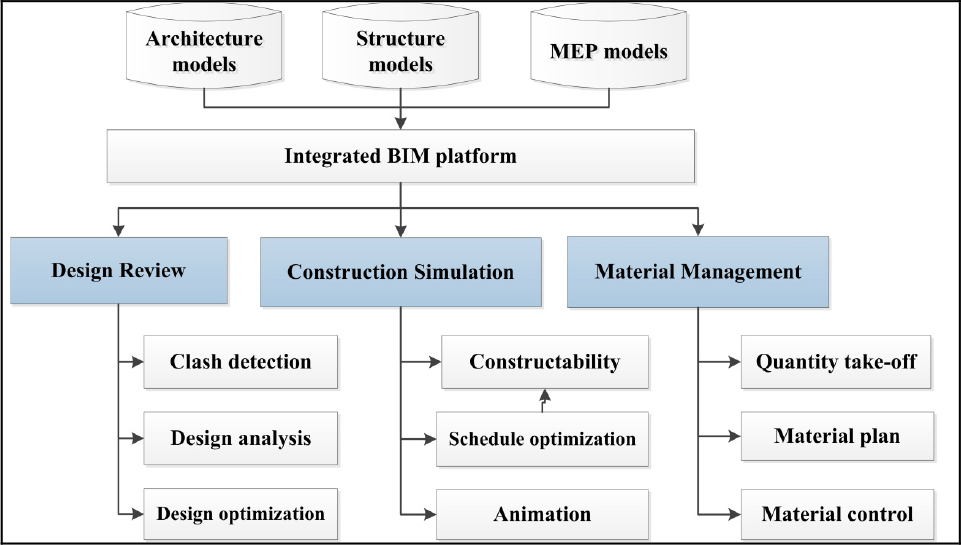
BIM functionalities in design review, construction simulation and materials management
3.1 Design, review and construction simulation using the 3D and 4D features of BIM
Conflict checking performed in BIM can help optimize engineering design, reduce errors in the construction phase and reduce the likelihood of loss and repeated work [7]. Considering commercial buildings, pipelines normally account for a large proportion of mechanical-electrical plumbing (MEP) systems. However, in practice – and taking into account the disunity of assembly paths, inconsistencies of assembly sequences and other factors -issues of pipeline design may incur serious assembly problems [43]. Using BIM for pipeline design is acknowledged as a promising approach, with its emphasized advantages such as: the designer can fully consider wiring and cable assembly planning within the environment; the designer can synthetically consider any requirements and rules as well as enhance the consistency and maintainability of products. 3D visualization capabilities coupled with time (i.e., 4D) transform BIM into a virtual construction platform. An anytime/anywhere comparison of the as-planned and as-built progress in BIM might keep the construction executors and supervisors (and even other participants with non-engineering backgrounds) very well informed of a variety of latent issues, such as constructability reviews, safety checks and proactive schedule optimizations, etc. [43–46].
3.2 5D accurate planning for decision-making
According to the creation of 5D (cost denotes the fifth dimension) information in BIM, the difficulty and workload of short-cycle costs analysis can be reduced while the efficiency and accuracy of dynamically maintaining costs data can be greatly improved [47, 48]. In addition, through building information models that reflect actual costs information, it is easy to identify which models are not assigned with the costs data when conducting quantity take-off or real-time inventory management [49]. The costs information can also be placed online for the remote access of costs information. On the one hand, the headquarters and the project departments can communicate anytime, anywhere, while on the other hand the costs control capacity can be significantly enhanced for the headquarters. Despite the ‘engineering-related data’ is one of the contributing factors for cost analysis, a commonly existing phenomenon in many construction companies is that it is very hard to acquire [40]. BIM is exactly the right platform and it can feed the basic engineering data to whoever needs them. To enable construction enterprises to formulate accurate plans regarding manpower, materials and machines, BIM provides effective support, greatly reduces waste in the sector of resources, logistics and warehousing, and has a significant effect on limiting quota-materials, target costs decisions and consumption control.
3.3 BIM-supported materials management
Construction materials management is one of the most critical tasks that all construction participants are concerned with during the construction stage [8]. A typical assets management activity consists of three steps: 1) calculating and aggregating the quantities, lengths, areas and volumes of the identified material items; 2) creating a materials purchasing and use plan; and 3) managing a materials inventory. In terms of the traditional management practices which are mainly based on 2D documented resources, there are three primary challenges that are identified and which might impact upon the outcome of a construction project: 1) construction is constantly progressing, but dynamic assets management can barely be achieved along with the progress; 2) even though materials quantities can be dynamically undated, this is very time consuming and workload-intensive; and 3) it is very difficult to accurately implement quantity take-off. With BIM, this becomes much easier. The static 3D model provides materials data for all the structural elements and site layout facilities. When a building information model is created, the associated materials lists can be parametrically linked to each of the objects within the model and then become available anytime. In reverse, these lists can be easily amended to renew the parameters of the objects in the model (such as quantities and dimensions), which is one of the most important features of BIM [50]. BIM can provide predefined materials templates. Materials requirement for a specified future period can be computed as the 4D model identifies all the elements to be constructed within that period. The computation is processed dynamically so that it reflects the latest requirement of the project [51]. After the calculation of materials requirements, construction planners begin to create materials use plans and monitor in real-time the status of each item, such as what percentage of a given materials plan has been completed, which order forms are outstanding, and whether the storage space is available on site, and so on.
4. Research Methodology Summary
Currently, there is a lack of quantified evidence about how BIM can benefit the real projects from the cost perspective. To address the issue, this paper formulates a framework to measure the BIM return from a completed project that was subject to the wide application of BIM in the above-mentioned aspects.
The Shanghai Disaster Recovery Centre is one of three centralized information system disaster recovery centres in China, constructed by the State Grid Corporation (Table 1). With five floors, the Shanghai Disaster Recovery Centre has four floors below ground. Three of these four floors were designed as computer rooms, precision air-conditioning rooms and ancillary equipment rooms.
Project information


Methodological framework for evaluating the benefits from the case study
5. Project Information
Initially, this project was confronted with many issues, such as the involvement of numerous professionals of diverse expertise, the complexity of the equipment and system involved, a tight schedule, tights requirement on costs control for materials and labour, and so on. In particular, the main building contains a large number of pieces of equipment, including air-conditioning devices, electrical devices, water pumps and other devices (1,228 in total); there are very complex electro-mechanical systems, including nine HVAC systems, 12 water supply and drainage systems and 18 electrical engineering systems, all in a limited space (each story's height is 5.5 m, the bottom of the beam is 4.53 m from the ground, the design of the ceiling in the corridor is 3 m, the space for pipeline installation is only 1.53 m wide). The schedule of construction is very tight. The project started on 25 March 2010 and was completed and passed for acceptance by 30 December 2011. Due to the special soft ground in Shanghai, the first two months were spent in dealing with the enclosure of the foundation pit. From 26 May 2010, when the earth excavation was started, to the end of December when the civil construction and equipment installation were completed, the actual duration of the project only lasted for seven months. It is difficult to accurately assess the project workload. Normally, it is necessary for owners to reference the brief budget data provided by the design and construction units. However, due to the large scale of the project, the complexity of the system and the tight schedule, the owners needed a more detailed and practical basis for the project settlement.
6. Establishing Non-BIM Data for the Case
The constructor of this project has many years of experiences in construction, and is now one of the biggest construction companies in China. As this project was selected as a BIM pilot project by the Shanghai government, the construction company was required to complete the design and planning using a series of traditional and BIM methods, as well as tentatively applying BIM in the following construction phase. This was why an array of BIM and non-BIM data could be set forth. There are three implementations: BIM in MEP design review, the 4D simulation of the construction scheme, and BIM-supported materials management and control. The data from the case study were collected via numerous project meetings with stakeholders through and reports. The costs data were first counted in Chinese currency (RMB) and then converted to USD, from which the percentages were derived. Due to confidentiality, some of the costs information could not be reported in this paper. Instead, the company allowed the reporting of ratios or comparisons of costs to derive percentage values. Individual interviews were also conducted in order to provide insight into individual perspectives to gauge their experiences and the overall atmosphere of the BIM environment at the company. Data were reported in percentage format from the interviewees, which could also contribute to the benefits of BIM.
7. Case Study
The evidence from the case study provides authentic data to explain how the roles of conflict detection, the construction schedule and materials management and control may impact upon the cost, and this expands our understanding of how to maximize the outcome of BIM via proposing alternative ideas, methods and techniques against the traditional methods. When analysing three implementations from a constructability and costs perspective, it becomes evident that the feasibility of enabling multidisciplinary communication and shared knowledge enabled in BIM together with costs objectives is pivotal, because BIM simulation makes the relation between waste/costs and design and management activities more transparent. From the questionnaire-based interview, a team with a strong ability to exercise flexibility in planning, decision-making, communication and management did not necessarily lead to a high level of difficulty.
7.1 Implementation 1: BIM in MEP design review
Currently, the Chinese construction industry generally has a profit margin of 5–8%. Only by MEP optimization can the profit margin be boosted to about 36–58% above the original basis, reaching 7.91–10.91%. The following figures present how MEP design issues were identified and addressed.
Figure 3 shows how a fan positioned in the refrigeration room conflicts with the thermal storage tank. The design drawings indicate that the fan elevation should be 4900 and that the thermal storage tank should be 4450. The base elevation of the storage tank is 100 in the design drawings, but after the completion of construction it became 200, so the actual elevation of the storage tank became 4550. The highest elevation that the fan could have was 3950 (when the fan reaches the bottom of the beam), which inevitably conflicted with the storage tank. By using BIM prior to the actual installation, designers could discover and address this conflict hidden within the drawings (Figure 4). This can save costs and further work caused by removing the already-installed fan and redesigning the drawings in order to have the fan installed elsewhere. The ideas formulated during this time focus on areas of the design that could take advantage of new products or processes, different uses of materials, simplified systems or reworked details. BIM integrates design information with the associated documentation, and is especially useful for checking errors, reviewing designs, roaming model and browsing details. BIM can also output animated representations.
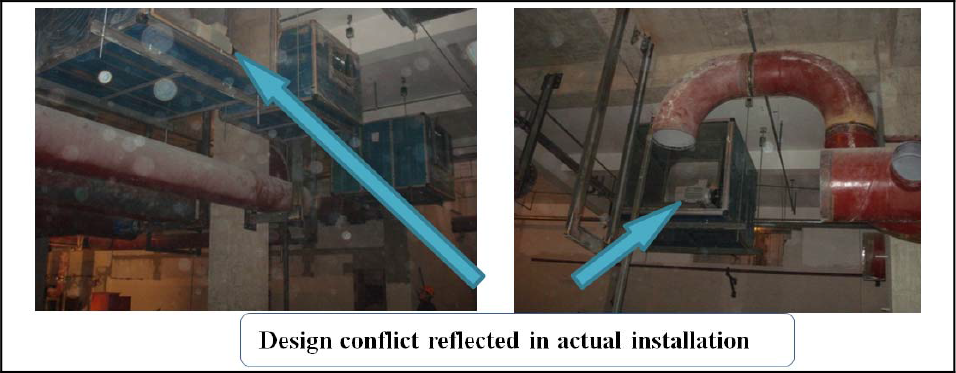
Photos of a fan-tank conflict in the refrigerator room

The real photos of the conflict in the refrigerator room
The public corridor is the most concentrated area for the pipeline, which also has a higher requirement in terms of both space and appearance. Figure 5 presents, in the mezzanine of the basement, how the lowest height of the beams is only 3.3 m from the ground. Also, because this space is typically concentrated with an extinguisher cylinder room, a fire pump room and an air-conditioner room, the pipeline in the hallway can be extraordinarily complex. Here, the pipes coming out from the bottom of the mezzanine are retroussé, which makes the vertical pipes more likely to conflict with the horizontal pipes. Once such a conflict occurs, it can be very difficult to reconcile. The solution focuses on how to make a reasonable pipeline arrangement meet the 2.7 m clearance requirement. Firstly, the designers verified the architectural completion surfaces, structural completion surfaces and the elevations of all the beams in the public corridor and then aggregated the data from the installation contractor for the pipeline's comprehensive design in the BIM software. Secondly, according to the conflict report generated in the BIM software, the designers highlighted the areas where serious problems were detected and then reported to the installation contractor for the pipeline installation. Lastly, the designers investigated the ceiling height of the most unfavourable positions in the public corridor. According to the BIM model, it was verified that the vast majority of the region could meet the requirement of a minimum clearance height of 2.7 m, whereas the only area that could not meet this requirement was the mezzanine area, where the highest bridge could only be made to 2.55 m (Figure 6a). Therefore, a redesign was made in this area (Figure 6b).

Pipeline layout design in the mezzanine area (BIM representations)

The bridge that needs to be redesigned in the mezzanine area
Based on the calculation of the above project, the comprehensive application of BIM technology found more than 2,000 errors in the original design. By the use of error classification and conflict inspection reports, the 500 most important errors were discovered and eliminated prior to the construction, reducing reworking, labour and materials waste. By changing from passive response to active control, BIM ensures the overall control of the costs during the process of construction. In addition, by optimizing the order of construction organizations and processes in BIM, we developed a more reasonable construction schedule which reduced the potential safety problems involved in cross-construction. All the costs-saving data are given in Table 2.
MEP design issues, time and costs saving data based on a BIM design review (Cost-saving (%) = [cost saving ($) / total MEP construction cost ($)]* 100%)

7.2 Implementation 2: 4D simulation of construction scheme
The following figure shows two stages of civil construction. During the first stage, the original construction scheme follows the construction order (Figure 7a). As the second stage is completed, the construction of facility rooms in the original scheme is still going on (Figure 7b). Subject to the progress of the construction of the facility rooms, neither the mechanical nor the electrical construction can be implemented in advance, nor can the construction duration be saved.

The original design of civil construction schemes (before optimization)
Using 4D-based construction progress simulation, the construction process was optimized. During the first stage, the construction scheme optimized in BIM synchronized the construction of the facility rooms and the integral construction (Figure 8a). When the second stage was over, the construction of the facility rooms had been completed so that the mechanical and electrical construction could start (Figure 8b). According to the BIM optimization, the mechanical and electrical construction was conducted in advance, without affecting the progress of the integral construction. The construction duration was preserved. An early criterion established by the owner was the required completion date. Sometimes, such dates are fixed firmly because of commitments or financing. One of the first activities of the construction manager is to confirm that this date can be met given the desired scope of the work. If it cannot, the owner has the choice of paying a premium to accelerate the schedule or else backing-off as to the desired scope of the project, perhaps completing it in phases. The constructor also looks at different delivery methods that may affect how quickly the project can be completed within the desired budget. This analysis will lead to a recommendation to the owner about the best project delivery method. BIM technology can be used to visually simulate construction schedules and construction system designs (Figure 9), as well as improve construction links and critical paths. With the pre-discussions and real-time coordination of the processes of the project in BIM, the efficiency of construction can be greatly improved.
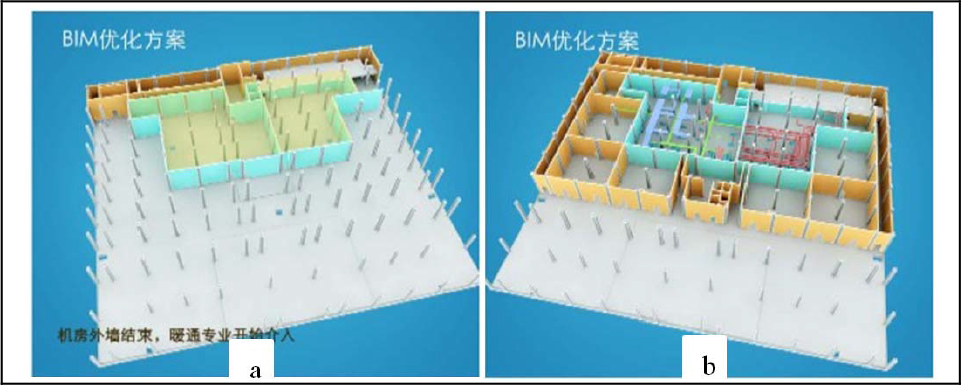
The optimized design of civil construction schemes

Construction scheme and simulation
Through the above measures (for example, the mechanical and electrical installation teams approached the construction site eight days ahead), the installation of HVAC was reduced from the original 81 days to 58 days; the fire-protection system from 88 days down to 60 days, the civil structure from 273 days down to 200 days, the decoration from 262 days down to 200 days, the plumbing system installation from 252 days down to 187 days, and the electrical system from 174 days down to 133 days. As a whole, the construction schedule of the project ‘Shanghai Disaster Recovery Centre’ was shortened by three months (Table 3).
Comparison of the original, anticipated duration and the optimized duration after BIM optimization

7.3 Implementation 3: BIM-based materials management and control
Materials management during construction takes corresponding measures in relation to site assets for the purpose of effective management and control [43]. The traditional materials management model involves construction enterprises or project departments developing a materials management scheme and system, mainly on the basis of the actual construction site layout [44]. This traditional method relies heavily on the construction site materials keepers, warehouse keepers and construction workers. Both the diversity of the construction site and its huge space determine the features of materials management and control (for example, long-term management activity, the great variety of materials, complex storage methods, and so on). In this case, the uncertainty of the construction process determined the instant variation of materials management schemes and plans. There were numerous professionals who decided upon a wide variety of materials, from objects as small as a screw to larger objects and even hundreds of tons of bulk materials, etc. Any inaccuracy of quantity take-off might either cause erroneous procurement, a backlog of materials on site, unexpected downtime or delay of the schedule (monetary waste). Here, this section summarizes how BIM-based materials management and control were conducted in this implementation.
The company began by establishing a BIM materials database. When the traditional MEP drawings were ready, the BIM engineers started the BIM model creation. Aggregating the associated costs data afterwards, this database was at the project level, which included the engineering data dispersed among various professionals (Figure 10). Based on the database, Figure 11 shows how people from different project departments and sectors were allowed to engage in materials management via the BIM database (e.g., data queries, analysis, and so on).

Process of establishing a BIM model database for materials installation

Configurative diagram of the BIM database for materials management
7.3.1 BIM-based materials classification control and quantity take-off
Materials classification is an important basic operation for materials management. During the data modelling stage, the BIM engineers defined the classification rules according to their properties, consumption, importance, price, etc. For example, if a type of material complied with such characteristics as ‘being highly needed’ or ‘being very expensive and difficult to prepare’, the attribute of this particular material was defined as ‘three-star material’, which means this kind of material must be in accordance with their counterparts in the drawings and the BIM. In addition, pipes, valves and other general materials were defined as ‘two-star material’, while the materials with lower allocations of funds, low demand and relatively minor significance were defined as ‘one-star material’. Figure 12 shows the materials classification throughout the entire project. After modelling the equipment, electrics, plumbing, ventilation and air-conditioning and other elements to be installed, the BIM manager organized each BIM engineer to perform a comprehensive optimization so as to eliminate any conflicts in advance which might be encountered during the construction process. Not only were the management personnel very familiar with the BIM 3D models, they were also familiar with the construction drawings created with the assistance of BIM. Based on a thorough understanding of BIM models and design ideas, the management staff could then inform the procurement team and construction team of the defined quantity of materials, as well as the purpose of the materials' use that was represented in the BIM. It prevented the commonly-occurring phenomenon in construction whereby only a very short section from a long objects and a small chunk from a whole piece are utilized. By doing this, the construction team could make the best use of materials and reduce materials waste and consumption to a minimum level. The air conditioning system-plan (BIM model) and the list of quantities are shown in Figure 13 and Table 4.
Air conditioning system materials quantity list


Materials classification within the entire project

The air conditioning system plan and the corresponding BIM model
7.3.2 BIM-based materials dispensing by quota
The refined management of installation materials has always been a problem in project management, as it is commonplace for materials waste and backlogs to occur on construction sites. The project had a well-organized materials procurement plan through BIM. This not only ensured the continuity of construction but so too did such flexibility adjust the working capital and reduce inventory and materials re-handling. Meanwhile, according to the actual representation of the project's progress in BIM, the materials personnel extracted the information about the construction materials' consumption at all stages of construction with great ease. When issuing the construction tasks' requirements, they enclosed the picking lists refined by the quota and used them as the basis for the materials dispensing department. By dispensing by quota via BIM, the phenomenon of the unplanned use of materials, such as erroneous dispensing, excessive dispensing and forgetting to dispense, was greatly ameliorated. Figure 14 gives a screenshot of the materials dispensing list, showing some of the specifications of the air conditioning system.
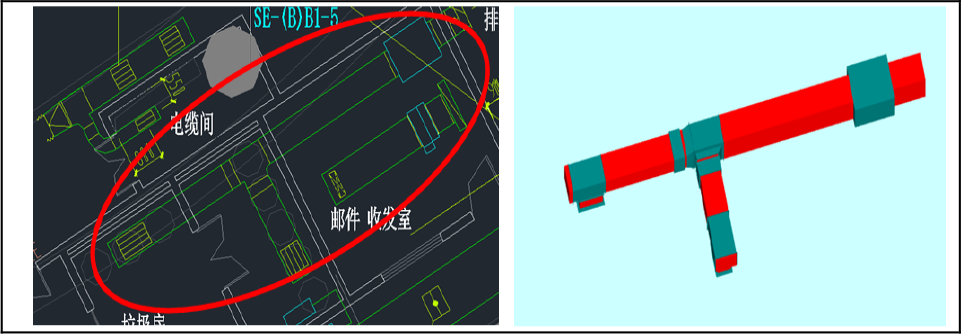
Design change of fume exhaust ductwork on floors 4 to 18 and BIM models
7.3.3 Timely management of project certification and variation in BIM
Project design changes and the adding-on of certificates are frequent affairs during construction. These often lead to materials backlogs if the changes are not addressed in time. In this project, BIM enabled the real-time modelling of the changed drawings and worked out the changed materials, labour costs, etc., during the process of BIM model dynamic maintenance, which was useful for the reissuing of certificates incurred by project changes. Using BIM, the department of project management dealt with the treatment of the materials backlog caused by changes before executing the project change. In principle, these materials were purchased by the owner, otherwise this would increase the amount of money tied up with any materials if they were handled improperly. Figure 14 shows the design change in the drawing and BIM. Table 5 shows the materials list generated by the design change.
Materials list generated by the design change

In summary, construction materials costs management should primarily be based on ‘quantity’; BIM can provide for accurate materials usage. With precise amounts of materials data, project managers can accurately audit for materials' procurement, issuing quantity limits, and timely changes of certificates, in order to reduce costs and improve efficiency.
8. User Interview
The questionnaire sheet (Table 6) regarding BIM's credibility, the workload comparison of BIM and non-BIM methods, the difficulty of learning BIM tools and the possibility of its future use was first prepared to acquire qualitative data from BIM users across different implementations. In general, there are: very positive attitudes towards the credibility of BIM in all three implementations (BIM is especially credible in MEP design review); an averagely diminished workload under BIM treatment across all three implementations (particularly effective in reducing the workload of optimizing construction schemes in BIM); an averagely acceptable difficulty level of learning BIM tools before users can command the basic BIM skills for all three phases (it is considerably difficulty to acquire a command of the skills involved in using BIM in materials management and control); and very positive feedback, suggesting a high likelihood of prospective BIM use. From the perceived benefits, it was therefore determined that, in essence, there were few barriers to promoting BIM's utilization in the company for this project.
User interview questionnaire

9. Discussions
Taking into account the large amount of information, complexity and tight schedule, the project ‘Shanghai Disaster Recovery Centre’ conducted an optimization on the basis of BIM. The BIM model provides details of the actual existence of buildings, including geometric information, physical information and information about rules, and also provides for possible states after the project is modified. The complexity of most modern buildings is typically beyond the capacity limit of the staff involved, who themselves are unable to grasp all the necessary information without relying upon technology and equipment. BIM and its supportive optimization functions provide for the possibility of complex project optimization. From the project-planning perspective, BIM could integrate both project design and costs analysis such that the impact of design changes on costs can be calculated in real-time. For more difficult construction issues, BIM could optimize designs and simulate construction, which brings significant improvements in terms of duration and costs.
For example, it is a struggle for constructors to work out the details from designers, who might overlook difficulties of installation. This could either incur extra costs and waste, or else delay the project schedule. BIM can reduce the possible losses and reworking due to design mistakes. For example, the pre-installing of a 3D model in BIM can help to address the design errors associated with design drawings. To eliminate the misunderstanding of complexities in design or identify sounder solutions, the best bet is to involve the constructors in the design discussions. With BIM intervening during the early stages of a project, costs engineers can bring real benefits to a project by evaluating and balancing all the reasonable design options against functional objectives, addressing urgent design decisions at the beginning of the design process, reviewing, amending, examining and addressing costs and budgetary issues, all in accordance with operational considerations. In other words, BIM facilitates the design team to put together the best design schemes that meet the owner's costs requirements and functional requirements.
10. Conclusions and Future Work
This paper provides quantifiable suggestions from a comparison study. The lessons learned from the project ‘Shanghai Disaster Recovery Centre’ provide evidence to support the potential benefits of cost-oriented arrangements of construction activities optimized via BIM (i.e., how BIM can be utilized to improve value for money). It is believed that BIM can facilitate design and construction phases by involving various stakeholders involved in the construction process (such as contractors, civil engineers, structural engineers, mechanical and electrical engineers) via the automated simulation of cost-activity information. The visualization of construction activity analysis assists the costs planning operators in the identification of conflicts and in the communication of design alternatives that might be more cost-effective and time-saving, as the present-day BIM tools have already enabled a feedback system that tracks the impact of design changes associated with costs. Nevertheless, there is a need for further researching on prolonging the lifespan and magnifying the effects of costs analysis using BIM. As there are multiple factors in construction projects relating to reworking, productivity and the discovery of waste, and BIM should be rigorously undertaken. The three implementations initiate a proof-of-concept of how BIM can be tentatively used in design review, error checking, constructability design and materials management and control. The paper provides many insights into the functionality of BIM and its possible implications for the outcomes of BIM-supported projects. Furthermore, it is suggested from the questionnaire-based interview that BIM was envisaged as leading to increased adoption. As organizational and project management functions (e.g., corporate strategy, management, social and organizational contexts, etc.) might be affected by the implementation of BIM, in future, these factors should be thoroughly learned [45–47].
Footnotes
11. Acknowledgements
Acknowledgement is given to State Grid Corporation of China, who initiated the research work presented in this paper. Acknowledgement also goes to China Construction Design International (CCDI), who provided the relevant BIM consultation service, including BIM technologies, training and data. This work is also partially sponsored by the Shanghai International Enterprise Cooperation Programme of STCSM (Science and Technology Committee of Shanghai Municipality) under Grant number of 12510701700.