




Abstract
Current building assessment methods limit themselves in their environmental impact by failing to consider the other two aspects of sustainability: the economic and the social. They tend to be complex and costly to run, and therefore are of limited value in comparing design options. This paper proposes and develops a model for the automatic assessment of a building's sustainability life cycle with the building information modelling (BIM) approach and its enabling technologies. A 6D CAD model is developed which could be used as a design aid instead of as a post-construction evaluation tool. 6D CAD includes 3D design as well as a fourth dimension (schedule), a fifth dimension (cost) and a sixth dimension (sustainability). The model can automatically derive quantities (5D), calculate economic (5D and 6D), environmental and social impacts (6D), and evaluate the sustainability performance of alternative design options. The sustainability assessment covers the life cycle stages of a building, namely material production, construction, operation, maintenance, demolition and disposal.
1. Introduction
Sustainable development is defined as development that meets the needs of the present without compromising the ability of future generations to meet their own needs [1]. There are three aspects of sustainability, namely its environmental, social and economic aspects. Research on the sustainability of buildings has concentrated on its environmental aspects. The underlying assumption is that “greenness” will lead to sustainability [2]. Indeed, buildings accounted for 36% of final energy consumption among the International Energy Agency's member countries in 2004 [3]. In addition to energy use, a number of environmental impacts (e.g., the emission of greenhouse gases, such as CO2) can also be attributed to buildings. Energy consumption and environmental impacts occur at all stages of a building's life cycle. Therefore, life cycle assessment (LCA) has become one of the most popular environmental assessment methods [4].
However, existing environmental assessment methods, especially those based on LCA, are difficult to understand or apply [5]. Indeed, the life cycle of a building includes the various impacts embodied in building materials, which should be tracked from the mining stage to each process of the manufacturing stage. A building is made up of numerous materials and systems. Hence, conducting a LCA for a building requires a large amount of reliable data and, therefore, takes quite a long time. Although a number of inventory databases are available-either commercially or otherwise-it can still be difficult to understand or apply LCA. As a result, a lot of designers find it difficult to conduct a proper LCA during the short design stage [5]. Even if they can, existing methods cannot aid design as they do not consider the other two aspects of sustainability (i.e., social and economic impacts). A client will not disregard economic factors while selecting among the options.
The rapid development of building information modelling (BIM) offers a viable solution for automatic building sustainability assessment. Currently, schedule information can be incorporated into 3D models to obtain 4D CAD models. Cost information can also be added to obtain 5D CAD models. There is no consensus on what should constitute the sixth dimension-we argue that it should be sustainability, due to the importance of the subject.
This paper aims to develop a 6D CAD model which can automatically perform life cycle building sustainability assessments. The main purpose of the model will be as a design aid rather than a post-construction evaluation tool. The motivation comes from the inability of existing building assessment tools to provide quick and reliable design decision support. The model will be able to:
Automatically derive quantities from a 4D CAD model;
Provide a life cycle costing analysis;
Provide a life cycle sustainability evaluation;
Compare environmental, social and economic impacts of different design options.
Sustainability is an important issue as it enables the earth to continue supporting human life as we know it. The first step towards achieving this goal is to measure it. Existing environmental assessment methods are limited in that they are difficult to understand and apply and that they ignore two aspects of sustainability. Since buildings account for a large proportion of environmental impacts, it is logical to target them. A 6D CAD automatic life cycle building sustainability assessment system will enable the client and designers to:
Compare the environmental, social and economic impacts of different design options;
Make informed decisions on the sustainability of designs.
It will also enable government departments to:
Develop a database of the sustainability performance of buildings;
Develop a minimum sustainability standard.
It is hoped that by providing quick and easy sustainability assessment for the design stage and by facilitating the development of a database and performance standards, buildings will become much more sustainable in the future.
2. Literature Review
The literature review will briefly introduce the methods of building environmental assessment (including the LCA method), their limitations and the development of BIM and nD CAD.
2.1 Environmental Assessment Methods for Buildings
The first step towards greener and more sustainable buildings is to evaluate their environmental performance. A number of assessment tools have appeared since the 1990s (e.g., the Building Research Establishment Environmental Assessment Method (BREEAM) in the UK; the Leadership in Energy and Environmental Design (LEED) in the US). The Hong Kong Building Environmental Assessment (HK-BEAM) has been developed based on the BREEAM, taking into account local considerations. The number of environmental assessment tools has increased dramatically since the 2000s. For instance, Haapio and Viitaniemi [6] reviewed 17 tools, only five of which are among the 26 tools reviewed by Khasreen et al. [4].
The ATHENA Institute has introduced a classification system, the “Assessment Tool Typology”, which has three levels [6]:
Level 1: product comparison tools and information sources (e.g., BEES; TEAM);
Level 2: whole building design or decision-support tools (e.g., ATHENA, Eco-Quantum, etc.);
Level 3: whole-building assessment frameworks or systems (e.g., BREEAM, LEED, etc.).
Some assessment methods are basically subjective scoring systems, e.g., BREEAM, LEED, HK-BEAM [7]. More objective assessment methods are usually based on the LCA method, which will be briefly introduced below.
2.2 Life Cycle Assessments
ISO 14040 defines ‘life cycle assessment’ as a technique for “assessing the environmental aspects and potential impacts associated with a product”[8]. It includes the following four phases:
Definition of goal and scope;
Inventory analysis;
Impact assessment;
Interpretation of results.
LCA is one of the most popular methods for evaluating environmental concerns. It has been extensively applied to building materials and component combinations as well as to the whole process of construction. For instance, Ortiz et al. [9] reviewed 24 research works on LCAs of BMCCs or the WPC, while Khasreen et al. [4] reviewed 25 such works. Instead of a whole range of environmental impacts, some research works focused on the life cycle energy analysis of buildings. For instance, Sartori and Hestnes [10] reviewed 16 such works, while Ramesh et al. [11] reviewed 25 of them.
2.3 Weighting Methods in Building Assessments
Basically, a building assessment method will measure the performance of a building and compare it with either typical practices or requirements. For instance, in the HK-BEAM system, 1–3 credits will be awarded for a reduction in the maximum electricity demand by 15%, 23% and 30%, respectively, for commercial and hotel buildings [12]. However, as there are many aspects of performance, a scale of weighting must be imposed on each aspect so that overall performance can be calculated.
A scale of weighting is usually embedded in all building assessment methods. Even if a method asserts that it has “no weighting”, an implicit weighting is present which either assigns an equal weight or a weight corresponding to the number of points available for each criterion. In the above example of the HK-BEAM system, the reduction of CO2 emissions or annual energy consumption can be given a maximum of 15 credits. However, recycling construction waste receive a maximum of only 2 credits [12]. Therefore, a higher weight is implicitly given to the reduction of energy consumption.
It has been generally agreed that weighting should be based on the relative importance of potential impacts. Some authors have argued that weighting should also acknowledge implementation costs or any difficulties involved (e.g., Lee et al. [13]).
A number of weighting approaches can be used to aggregate the impacts of different categories. Some are qualitative in nature (e.g., earlier versions of BREEAM, LEED and HK-BEAM), while others are quantitative (e.g., distance-to-target, willingness-to-pay (WTP), consensus-based methods such as the analytic hierarchy process (AHP) and multi-criteria decision analysis (MCDA), etc.).
The distance-to-target approach uses the difference (distance) between the current measured level and an administrative or “sustainable” target as the weighting factor. It has been used in a number of EIA methods, such as the eco-indicator method. The problem is that it cannot aggregate impacts from different categories and, therefore, it is not a real weighting approach [14].
The weighting indicators used in the environmental priority strategies (EPS) in product development are people's willingness-to-pay (WTP) to restore impacts on the five safeguard subjects they have identified [14]. Wu et al. [14] argued that the ‘green taxes’ levied on emissions and exploited resources can also be viewed as a social WTP. They therefore propose a weight approach based on green taxes. This method has been used in, e.g., Zhang et al. [15]. The analytic hierarchy process (AHP) method is a decision support method that breaks down a complex problem into a multi-level hierarchical structure of objectives, criteria and alternatives. The ranking of alternatives is done by aggregating relative magnitudes expressed in priority units in the form of paired comparisons. Examples of the use of AHP in EIA include Daniel et al. [16]. Multi-criteria decision analysis (MCDA) allows an interdisciplinary group of experts to decipher their understanding about the environmental impacts of a project, formally identify decision criteria and rank alternatives. It has been used in, e.g., Bojórquez-Tapia [17].
These methods were primarily developed to aggregate different aspects of environmental impacts. However, no single method alone can deal with sustainability assessments, which include the interrelations among environmental, social and economic aspects.
2.4 Limitations of existing building assessment methods
Despite the popularity of environmental assessment, certain limitations exist. Cole [2] has discussed in some detail the difference between the assessment methodologies for greenness and sustainability. Currently, most assessment methods only evaluate environmental performance, ignoring the two other aspects of sustainability. The implicit assumption has been that green designs will lead to sustainable outcomes. Unfortunately, this might not be true. For instance, a review by Petersen and Solberg [18] found that very few studies of environmental assessments had included any cost estimates, and therefore those studies had limited policy relevance. Indeed, cost is one of the most important considerations for private developers. Without information on cost, private organizations will not make decisions towards greener or more sustainable design.
In addition, environmental assessments are usually seen as highly data-demanding, work-intensive and-consequently-very expensive [5]. This has led to efforts to simplify procedures. Examples include Harris [19], Kuitunen Anastaselos et al. [20], the Rapid Impact Assessment Matrix [21], the simplified LCA methods of Bribián et al. [22] and Malmqvist et al. [5]. With the rapid development of BIM and nD CAD, the difficulties involved in performing an LCA might be greatly reduced.
2.5 Building Information Modelling and nD CAD
BIM is a technique that uses 3D models in conjunction with additional intelligence, such as time-related information (4D) and cost information (5D). nD CAD starts with 3D object-based design. These objects must be linked to 4D schedules created in other pieces of software. This can be done automatically by the use of scripting between each unique object ID and the planning activity. Once linked, the 4D model can be visualized with, e.g., Autodesk Naviswork. This 4D visualization technique has been achieved in many studies on 4D CAD (e.g., [23–26]).
Currently, there are very few studies of 5D CAD. A number of studies have limited themselves in their conceptual description (e.g., [27–30]). Others have tried to apply the concepts to real projects [31–34]. Basically, what they have achieved is automatic quantity generation. There remains, nonetheless, the problem of the absence of important items, such as reinforcements [33].
There has been no agreement as to what should be the sixth dimension of CAD. We propose that it should be sustainability because of the importance of the issue. The main idea as to how life cycle sustainability assessment can be achieved with 6D CAD is presented below.
3. Research Framework
Following ISO 14040 on the requirements of LCA, this research will be conducted in three phases, namely: i) the definition of its goal and scope, ii) the development of a 6D CAD system for automatic inventory analysis and impact assessment, and iii) the interpretation of results. They will be discussed in turn below.
3.1 Goal and Scope Definition
This research aims to develop an integrated 6D CAD system for the automatic assessment of the life cycle sustainability of buildings. The primary purpose of the 6D CAD system is to aid building design and decision support. Therefore, it resides in Level 2 of ATHENA's categorization [6]. The motivation comes from the inability of the existing building assessment tools to provide quick and reliable design decision support.
Therefore, the indoor environment included in Level 3 of ATHENA's categorization (e.g., BREEAM and LEED) is not included in this model. The reason for this is that it is not only affected by the area of windows and the design of air-conditioning systems, but also by the orientation and density of neighbouring buildings and the air pollution level of the location. These factors are very important in seriously polluted and densely populated cities such as Hong Kong. However, they cannot be readily assessed through nD CAD systems.
We aim to include all the life cycle stages of buildings. However, the transportation of materials from manufacturers to the site, and the transportation of labourers and equipment to and from the site, are not included. Again the main reasons for this are that they bear little relationship with the design of the building, and that the energy used in transportation is very low in the life cycle of a building. Table 1 below shows the scope matrix of the life cycle stages against three aspects of sustainability.
Scope Matrix of the life cycle stages against sustainability

The functional unit of our system is 1 m2 of gross floor area (GFA). Major materials and processes in a building will be included. However, the following parts will be excluded:
Materials that have been used in very small amounts (e.g., sealants);
Infrastructure requirements, such as road connections and widening, additional electricity substations, etc.;
Furniture;
External parts that do not constitute GFA (e.g., land-scaping, driveways, etc.).
3.2 A 6D CAD System for Automatic Inventory Analysis and Impact Assessment
The second phase is to set up a 6D CAD system to automatically conduct two stages of LCA, namely: inventory analysis and impact assessment. Commercially-available software such as SimaPro will be used. SimaPro is an LCA tool with an embodied EcoInvent LCA database. The database consists of life cycle inventory data and impact assessment results for a given unit of a basic commodity, including building products [35]. For instance, the database will provide the inventory data and environmental impact assessment (according to certain developed methods, such as ecological scarcity 1997 or Eco-indicator 99) for 1 kg of cement mortar or 1 m3 of concrete. What we need to do is provide the quantities of such materials used in a building. In addition, we need to assess the social and economic impacts as well.
The proposed 6D CAD system has three modules, namely: an input module, a core module and an output module (Figure 1). The input module collects necessary data for the system. These include:

Overview of the 6D CAD model
An object-based 3D design model, which might be created with, e.g., Autodesk Architecture or Revit, PDMS, etc.);
The 4D schedules, which might be created with, e.g., Microsoft Project or Primavera.
The location and site data, which might be used for the calculation of heating and cooling demands, etc.
The service-life assumptions of various components are required in assessing recurrent material requirements and maintenance costs. For instance, re-painting is normally required every 10 years, while carpet tiles need to be replaced every eight years, etc.
The core module consists of the 6D CAD model and various databases. The following steps are required to construct the model.
3.2.1 Step 1: From 3D to 4D
The fourth-dimension includes information on the equipment, labour and materials for temporary works. The 3D design needs to be linked with the 4D schedule. This can be done automatically with the help of scripting between each unique object ID and the planning activity. Once linked, the 4D model can be visualized in, e.g., Autodesk Naviswork. This 4D visualization has been achieved in many studies on 4D CAD (e.g., Kim et al. [26], Russell et al. [23], Staub-French et al. [25] and Zhou et al. [24]).
3.2.2 Step 2: From 4D to 5D
The quantities of the permanent works in the design can be automatically calculated with, e.g., the Vico so These quantities can be verified with those measured according to traditional methods, as shown in the bills of quantities (BQs). The rates of each item can be derived from the original, priced BQ, or a cost database provided by, say, a leading quantity surveying firm. This gives the cost of the permanent works. However, construction costs comprise more than just permanent works. Preliminaries, including temporary works, site staff, plants, etc., need to be considered as well. As the fourth-dimension includes the method of construction, most items of the preliminaries can be derived. Again, the rates can be derived from either the priced BQ or a cost database.
3.2.3 Step 3: Life Cycle Costing
Figure 2 shows the conceptual framework for determining the life cycle cost. The default life of a building is set as 50 years. The users of the model can amend it to suit their needs (N.B. The part dealing with construction costs has been explained in Step 2).

Conceptual map of economic assessment framework
The operational cost considered in our research consists of just the energy needed for heating, cooling, ventilation, lighting and electricity for appliances. Commercially-available software such as TRNSYS or EnergyPlus can be used to simulate the annual energy use. The cost of energy can be obtained from utility companies. The cost incurred in the future will be discounted with a suitable interest rate.
The maintenance cost involves the cost of replacing materials or systems have a shorter life than the building. Assumptions need to be made for the life of components or systems. For instance, the carpets need to be replaced every eight years, while window-mounted air conditioning units need to be replaced every 10 years, etc. The cost of replacing these components or systems in real terms is assumed to be the same as the original construction cost. However, they need to be discounted before adding up.
The end-of-life cost involves the cost of demolition and disposal. The volume of the building and a suitable rate from a cost database can be used to estimate the cost of demolition. The disposal cost involves transporting the demolished construction waste to the landfill sites and the relevant levy. Both costs need to be discounted. The total life cycle cost of the building will be the sum of the discounted cost at different stages.
3.2.4 Step 4: From 5D to 6D
The economic aspect of sustainability has been dealt with in the previous steps. This step deals with the life cycle environmental and social impacts (Figure 3). In Step 2, we derived the quantities of permanent building works. This can be exported to the environmental impact assessment tools, such as SimaPro. The software will produce the environmental impacts embodied in building materials.
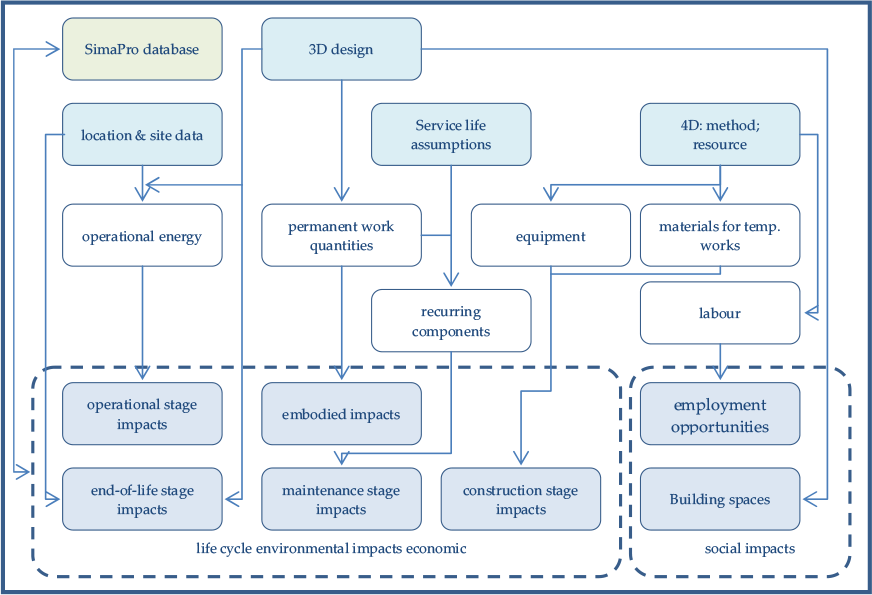
Conceptual map of environmental and social assessment framework
For environmental impacts attributable to the construction process, only the fuels used in the construction plant and the temporary materials used in construction (such as formworks) will be considered. The quantities derived from the 4D schedule information can be exported to the SimaPro software. The 4D schedule information also consists of the number of workers required for each construction process. This gives the employment opportunities, which is an important social impact.
For environmental impacts attributable to the operational stage, only energy use will be considered. The amount of energy use during the life cycle of the building was dealt with in Step 3, when we calculated the life cycle cost. The amount of building space provided is an important social impact. This could be readily derived from the design.
For environmental impacts attributable to the maintenance stage, only the impacts embodied in the recurring materials will be considered. The quantities of such materials were derived in Step 3. They will then be exported to the SimaPro software.
For environmental impacts attributable to the end-of-life stage, only demolition and disposal to landfill sites will be considered. The volume of demolition and distance involved in transportation will be exported to the SimaPro software.
3.3 Interpretation: The Output Module
The environmental impacts created by the SimaPro software in the above steps include many different categories (e.g., energy use, resource depletion, ecosystem damage). Each category consists of many sub-categories. While the methods reviewed in the literature review could aggregate these environmental impacts, they could not aggregate the economic and social aspects. A new analysis tool needs to be developed which is able to reveal the interrelationships between the environmental, social and economic impacts.
The nesting principle has been adopted, which allows the system to be used consistently at different levels of detail. This means that users will be able to perceive the impacts at different levels as per their requirements. This principle has been used in the Green Building Challenge (GBC) [36]. Table 2 shows the breakdown.
Level breakdown for categories of impact
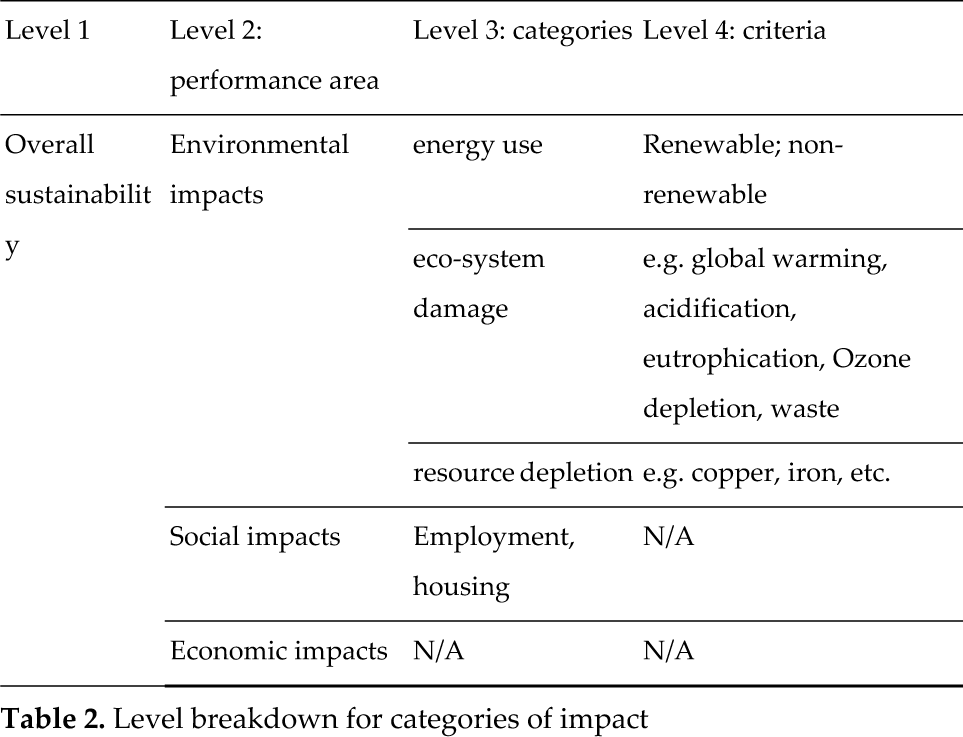
The individual Level 4 criterion will be evaluated against either a ‘normal’/‘standard’ building of the same type or a national/international prescribed standard. A score will be awarded to the criterion. A scale of weighting will be applied to all criteria at Level 4 so that they can be aggregated into a score at Level 3 (category). The scores at Level 3 will be similarly aggregated with a scale of weighting into a score at Level 2 (performance area).
A default weighting will be used to aggregate the scores. However, the users can also amend the weighting to customize their analyses. The analytical hierarchy process (AHP) method will be used to determine the default weighting.
In addition to the category breakdown shown above, the building is also broken down into its elements and components according to Table 3. This will facilitate the function of this model as a design aid, as the major impacts must first be located before we can reduce them.
Level breakdown for location of building

In addition to presenting the sustainability index as shown above, the model is capable of producing a number of analyses:
For a specific building performance criterion (e.g., the annual electricity consumption for air conditioning), the measured performance can be compared with a declared benchmark or a national/international standard. The results can be presented in the form of bar charts or tables.
Comparison of the performance of one criterion with others. For instance, the embodied energy performance might be compared with operational and maintenance energy performance or life cycle energy performance.
The system is able to store the data and compare the performance of different options for the same function. For example, we might compare the life cycle energy and life cycle cost of single-glazed windows with double glazed windows, or we might compare concrete structures and steel structure, etc.
3.4 A Validation Method
This paper focuses on developing the concept of a 6D CAD model; therefore, we will only discuss how it can be validated although no validation will be conducted at this stage. A target building should be selected for controlled experiments. The speed, accuracy and cost of deriving a life cycle sustainability analysis and comparing at least two design options with the proposed model will be measured and estimated. These will then be compared with those of traditional methods. Some thought needs to be given to the following questions in the validation process: should the costs and time required to develop an nD CAD (n=3, 4, 5) model be included in those of a 6D CAD model? Obviously, 3D CAD, 4D CAD and 5D CAD have their own uses and value, and increasingly clients are trying to develop those CAD models anyway. We propose that the time and costs of those nD CAD models should be recorded for comparison, whether or not they should be included.
4. Conclusion
This research proposes to conceptually develop a 6D CAD model which can automatically perform building sustainability assessments. The motivation comes from the inability of existing building assessment tools in providing quick and reliable design decision support. The basic system architecture of the model has been described in detail. This system could help developers and designers to make more informed decisions. It is hoped that by providing quick and easy sustainability assessment at the design stage and by facilitating the establishment of a database and performance standards, in the future buildings will become much more sustainable.