




Abstract
Several authors have emphasized the importance of analysing the impact of e-business, e-commerce and online-shopping on supply chain and operations management; however, it seems that to date no one has suggested a comprehensive framework that could help identify and support supply chain design decisions for companies about to enter the online-business in the consumer goods retail trade, encompassing the business drivers at a strategic level. This paper aims to bridge the gap between theoretical taxonomies or abstract models and the concrete supply chain design problems encountered by logistics managers who need to take their Food & Beverage retail company into the internet business while also preserving a consistent alignment with their current company strategy. Some insights on this area are presented along with a field study approach and a proposal of a 6-phase framework to jointly manage all the relevant strategic and functional aspects of supply networks.
1. Introduction
Nowadays, the market condition forces the Large Scale Retail Trade (LSRT) players to increase the efficiency and effectiveness of their processes and many companies have already begun to see the development of a competitive supply chain (SC) as a matter of survival rather than a choice. Specifically in the food and beverages (F&B) sector, globalization is pushing companies towards a very challenging objective: to increase the range of newer, fresher and higher quality products while guaranteeing an excellent service level to consumers with growing unpredictability in buying behaviour. This forces F&B companies to quickly adapt their supply strategies and configurations to unstable market conditions, and to continuously innovate in the socio-technological context. Specifically, electronic shopping is becoming more and more widespread and consumers' purchasing behaviour is changing, deeply influencing retail strategies and operations: assortments need to be reshuffled constantly while also reducing inventory costs through smaller supplies and more frequent deliveries; delivery performances also need to be improved through more responsive customer-driven supply chains [1]; in such a context, aligning a physical distribution structure with internet shopping requirements becomes strategic [2].
In the past, many companies recognized the potentially huge opportunities to be achieved through online commerce and tried to re-design their SCs by moving away from the traditional “push” approach and instead trying to switch to a “pull” oriented distribution. In certain cases, however, this move was made without enough caution: in 2000, while research papers celebrating the success of online grocery shopping were still being published [3], several players who had enthusiastically bet on the online grocery channel checked out of the market: the US company Priceline stopped its WebHouse Club grocery service in 2000; a month later, Massachusetts' Streamline and New England's regional competitor ShopLink closed down. The first e-groceries service, Peapod, only escaped bankruptcy in April 2000 thanks to a $73 million infusion from the $60 billion Dutch grocery conglomerate Royal Ahold [4]. This is because many of the pioneers of internet business during the so-called “dot-com bubble” competed in ways that violated nearly every precept of good strategy [5], and one mistake that most e-grocers made was to try to adapt their operations to the new technological opportunity, disregarding their original SC strategy or competitive advantage [6]. Indeed, to achieve the cost effectiveness caused by the impact of the Internet, the firm's value chain needs to apply the following strategy: “a company must configure the way it conducts manufacturing, logistics, service delivery, marketing, HR management, and so on differently from rivals and tailored to its unique value proposition” [7].
Several authors have pointed out the importance of analysing the impact of the Internet (e-business, e-commerce, online-shopping, etc.) on SC operations management [8] [9] [7] and the list of those who suggested paying attention to an appropriate alignment of structure and strategy is long [10] [11] [12] [13] [14] [15] [16] [17] [18] [19] [20]; nonetheless, it seems that nobody has succeeded in proposing a comprehensive framework that could help identify and support SC design decisions for companies about to enter the online-business in consumer goods retail trade, and encompass the business drivers at a strategic level.
Relevant SC conceptual frameworks can be found in strategic management, industrial marketing and purchasing as well as organizational behaviour domains. For instance, with regard to collaboration opportunities when designing supply networks, different studies [21,22,23,24,25,26] and different process reference models are available, e.g., the Supply Chain Council's (SCC) Supply Chain Operations Reference (SCOR) process model, which focuses on performance improvement, and the Voluntary Inter-industry Commerce Standard (VICS) Collaborative Planning, Forecasting & Replenishment (CPFR) model [24]. However, these models may not be very useful in providing a business oriented guideline for those companies which have to modify their SC structure to address the latest challenges originating from internet opportunities, and specifically not for the F&B retail trade.
Thus, our aim is to bridge the gap between theoretical taxonomies or abstract Operations Research (OR) models and the concrete SC design problems encountered by logistics managers who need to take their F&B retail company into the internet business while preserving a consistent alignment with their company's strategy. We followed an inductive/deductive research cycle combining literature and case studies; the insights from this field study approach are presented along with the proposal of a 6-phase framework useful to support the design of a competitive SC in the online F&B retail industry.
2. Literature Review
The SCM literature has provided frameworks made up mainly of traditional engineering and operations management modelling approaches that focus primarily on technical issues. Min and Zhou [23] synthetized the previous SC modelling efforts classifying the various frameworks on taxonomy based on classical guidelines (deterministic, stochastic, hybrid and IT-driven models) and with respect to their problem scope or application. They also identified the key challenges and opportunities associated with the SC modelling and highlighted a lack of models relating to soft issues (e.g., relationship management and conflict resolution between SC partners). Besides this, the majority of SC models show an OR approach, focusing on technical issues such as volume and timing of deliveries [27], multi-echelon inventory [28] [29] [30] [31], operational efficiencies [32] [33] [34] and inventory control [35] [36]. Some logistics support systems have been developed, although they exhibit some limitations due to the constrained focus on a subset of SC activities or problems related to the development of distribution networks [37]. However, these models do not seem to capture the essence of the economic trade-offs or the initial strategic analysis for a durable SC network design. Sijbrands [38] observed that the application of tools to support strategic decision-making for the development of logistics systems is still not widespread. Anupindi et al. [39] developed a “coopetitive” framework, in which sequential decisions (inventory and shipping decisions before/after the demand realization) are taken for decentralized distribution systems. Stank et al. [40] carried out a literature review in five academic departments that claims ownership of SCM to describe the logistics strategy management; as a result many SCM current conceptualizations do not fully express the discipline as it has been conceived in the last twenty years. Scott and Westbrook [41] proposed a three-stage approach to helping companies turn their SC into a better competitive system. The approach includes mapping, positioning and selecting the action that enhances SC effectiveness the most. However, analytical models that incorporate the many dimensions of a logistics strategy seem to be rare in strategic management literature. There are some qualitative models based on strategy development, although Meade and Sarkis [42] pointed out that these analytical models either focus on a single dimension of the logistics strategy or are static in their approaches. From the literature review it seems that no mathematical model could incorporate and jointly manage all the relevant strategic and functional aspects of supply networks, and the structural frameworks or taxonomies developed so far have provided little by way of guidance for effective SC management.
The Internet and the emerging e-business models have created expectations that many SC problems will be solved by the potentiality of the new technology and strategies. E-company strategies were supposed to reduce costs and/or increase service levels, flexibility and profits. However, the reality has not always matched these prospects; in fact many new e-businesses have begun to flounder in their expectations. In many cases, their downfall was attributed to their logistics strategies – see for example Webvan or Kozmo [43]. Other companies, such as 7-Eleven Japan, bloomed thanks to an excellent fit among their functional strategies, above all leveraging the physical network to develop their online business. Indeed, the Internet and the associated new SC paradigm have introduced a change in product distribution and order fulfilment strategies: from cases and bulk shipments to parcels or single items and smaller size shipments; from shipping to a small number of stores in a relatively long time to serving highly geographically dispersed customers in a relatively short time, with the possible additional complexity of reverse logistics management. The online grocery industry, for instance, is characterized by the need to reduce transportation costs but also by the need to deliver rapidly. Significant changes in consumer behaviour and technology availability are occurring at a rapid rate [44] leading to a growing fragmentation of markets and greater requirements in food safety, transportation performance, prices and product variety [45]. This pushes companies to improve their inventory, production, distribution and information management strategies and techniques. Nøkkentved [24] generalized and grouped the latest challenges created by the consumers into micro and macro trends. From the industry's point of view, he highlighted the need to decrease the time-to-market, to exploit the possibility of expanding the market to meet increasing customer demands. From the macro-economic point of view, however, consumers demand lower prices, more value and services rather than products, and show a decreasing brand loyalty. These challenges indicate the objectives that the e-Supply Networks need to try and achieve, given the specific characteristics of F&B goods: enhance product selection; customize services; provide a prompt and efficient order fulfilment; constantly communicate with customers and suppliers [46]. For this purpose, different companies are working on network rationalization, in order to evaluate the possibility of aggregation/disaggregation of their Distribution Centres (DCs) [46] or of distributing stock among various temporary locations. The keys to long-term competitive advantage in today's marketplace are flexibility and customer response [47] [48] [49] on top of operations management efficiency [51]. To maximise a competitive advantage, all SC's members should cooperate to serve the consumer [50] in order to avoid inventory level increases, thus creating slack time [52] or additional capacity [51] because these anticipations of uncertainties lead to increased logistics costs [52].
In the last ten years, a growing number of attempts to categorise e-business models have been recorded [53]. However, there does not seem to be any consensus yet on what constitutes an adequate framework for such classification and modelling thereof [54]. Some authors have developed descriptive models for e-businesses [55] [56] while Weill and Vitale [57] provided eight atomic e-business models “that firms can combine to create new e-business”. Nøkkentved [24] and Tapscott et al. [58] analysed different marketplaces and classified them into five types of B2B trade exchanges. Other authors concentrated on e-supply networks and on the cooperation among trading partners who come together to share information, conduct business transactions and collaborate [59] [60] [26] [61]. Dubosson et al. [62] introduced a quite extensive e-business model framework integrating a measurement system to link their critical success factors with KPI. Barnes et al. [63] presented a framework for a deeper understanding of the practice of online intermediation. Caputo et al. [64] were the first to outline an integrated approach for analysing the main factors that bind people who are interconnected through the Internet. In fact, exploiting the main criteria identified by Cucchiella et al. [65], for example, adopted structure, criteria to manage such relationships, they introduced some specific influencing variables to outline the integrated global model. The contribution of Hays et al. [66], who concentrated on the strategies and challenges regarding the leading worldwide e-grocers and their relative operations, is clear.
A new portrayal concerning the SC is emerging from the latest literature, industry and market trends: logistics contribute as a core competence to a competitive strategy accomplishment. Considering the broad spectrum of SC's processes, it is difficult to find a framework that can capture all aspects and features of SCs. This paper focuses on the strategic decisions concerning the SC activities while coping with the decisional phases concerning planning and operations decisions.
3. Analysis of the case studies
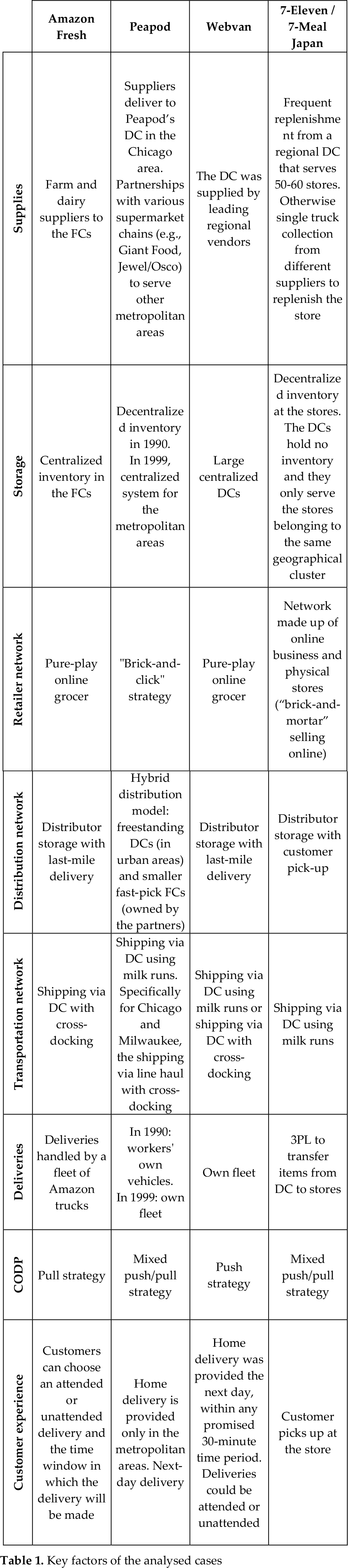
According to some authors, [67] [68] case studies are the preferred strategy in an exploratory research because they include direct observation and systematic interviewing. Thus we selected some exemplary SCs that are characterized by a configuration, an operational management and a control of the stages that achieved the best outcome for the whole system as well as a bankruptcy outcome:
According to Chopra & Meindl [43] and Stevens [69], in order to analyse the connection between the SC structure, activities, objectives and performances, it is of fundamental importance to distinguish the SCs for the:
Position of the customer order decoupling point (CODP), Structure of distribution and transportation network.
The CODP positioning, i.e., the push/pull boundary, influences both availability and delivery time of the products as well as the order fulfilment strategy. Both Peapod and Webvan were pioneers of the “shop online, not inline” vision, but they approached this challenge in two different ways with regard to the order fulfilment or the positioning of the CODP. Webvan decided to build massive and highly automated warehouses (50,000 SKUs, unlike those businesses in which a low level of stock is sought through product substitution) supported by a “hub-and-spoke” distribution network. They wanted a centralized order fulfilment and a decentralized delivery system hoping to accomplish a more cost/time-efficient “last mile” distribution. Even if a centralized DC configuration allows several operational benefits, Webvan did not take the cost of building mega and high-tech DCs as well as delivery costs to homes into account. Unlike this configuration, Peapod initially tried to implement a pure pull strategy (fast picking centres provided at Ahold's US stores) to eliminate any type of facility or stock. However, Peapod ran into significant problems in supplying the service (reaching 9% of stock-outs). For this reason the company migrated to a mixed push/pull strategy enriching its physical network with additional DCs (a centralized distribution model for each market/urban area) which reduced the occurrence of stock-outs to 2% [8]. SEJ adopted a mixed strategy from the beginning. Each store carries on average 3,000 SKUs and replenishment occurs several times per day (e.g., SEJ replenishes its store with breakfast items in the morning and dinner items in the evening) according to customer preferences. AF, on the other hand, purchases items from local suppliers only in response to a customer order. In this way same-day delivery is available thanks to the “pre-dawn doorstep delivery” (overnight delivery).
Given Webvan's push strategy, the company designed its facilities to handle 8,000 orders per day, so that its products could either be delivered directly from the DCs to the customers or through an intermediate staging station. The stations were positioned throughout a delivery region within 50 miles of a facility and each facility served a zone that included target customers within a 25-mile radius. The mixed strategy used by Peapod involved many relationships with local supermarkets (e.g., the partnership with Royal Ahold) to benefit from a constant supply and a fast pick fulfilment centre (FC) to serve the metropolitan areas. SEJ, instead, ships the online orders from the storage site (manufacturer/DC) to the pick-up points (store) from where the customers collect their merchandise. DCs have almost no inventory and the stores keep daily stock on the shelves according to proper use of the information available. Therefore, the information system has a direct impact on the ability to meet and deliver an order on time and, consequently, determines the success of e-tailers given its impact on the design and operations of the SC. SEJ, for instance, leverages the information management as e-business strategy to improve product availability while reducing inventory.
F&B retailers are very interested in implementing “best practice” solutions for the “network of (physical and decision-making) activities connected by material and information flows that cross organisational boundaries” [70]. This pushes the players to launch joint initiatives, mainly with the aim of optimizing distribution processes and reducing logistics costs (literature analyses transportation order sharing in an empirical study and finds it is possible to save up to 15% [71]): In Italy, a number of LSRT players (Auchan, Coop, Conad, Carrefour and De-Spar) are taking part in a project called “Progetto Piattaforme Multiproduttore” (a project part of the Indicod-ECR “Efficient Customer Response” initiative), which aims to optimize the coordination of information flows and optimization of goods flows from manufacturers to DCs to sale points. A similar project is “BeveRete” [72] launched on 22/07/2013, or the spreading of “e-transportation marketplaces” where buyers and sellers of transportation services meet to lower the logistics and managerial inefficiencies.
A synopsis of the key factors of the selected e-business is shown in Table 1. The description and analysis of the case studies were accomplished thanks to multiple sources of data collection (mainly corporate websites, literature, news etc.).
Key factors of the analysed cases
4. Strategic-logistic framework for a new e-business model
The objective of our research is to provide business-oriented guidelines by defining a framework for new e-retailers' SC, addressed to managers and logistics practitioners who prefer a practical approach to theoretical models. These guidelines were conceived with specific reference to the F&B sector in the LSRT industry, and thus are mainly valid in this (or in a similar) context.
Chopra and Van Mieghem [73] proposed a simple framework that managers can use to select the best e-business model to enhance their SC's performance. According to them, the three main questions to be asked in order to evaluate the situation should concern: the firm's desired strategic position, the SC capabilities needed to support its strategy and the SC structure. Typically the answers given to these questions depend on the customers' needs that include: timeliness (response time), availability (i.e., product variety, product availability), customizability (i.e., customer experience, quality of service, price, RL option). At the same time the customers' priorities have to be evaluated on the relative cost dimension. Hence their framework suggests weighing the e-business effect on the company's revenues and costs using a simple scorecard that encompasses some key drivers [73]. Once a company chooses the target customers, it has to ensure it achieves a strategic fit aligning its SC strategy (processes) with the competitive strategy during the SC design phase. For this reason three more issues should be carefully analysed: customer and SC uncertainty, SC capabilities, responsiveness spectrum.
We took inspiration from Stevens' three-stage approach (competitive environment evaluation, SC diagnostic review, SC strategy development) and propose an update to Chopra and Van Mieghem's questions:
What are the key drivers of cost and service? What would be a good SC structure and a good control system? How does the SC deal with inconveniencies/opportunities?
We believe that these questions can better help a manager identify which e-business would be the best for his organisation and which relative logistics processes need to be implemented for his specific situation.
The first question arises from the strategic domain [5] that requires a clear definition of the key factors necessary for the firm to attain a competitive position. The second one is partially inherited by the SC redesign principles, introduced by Van der Vorst et al. [44] to improve the efficiency of established SCs (we suggest considering the SC structure and the flow decisions as well as the control mechanisms, in order to coordinate information flow, and to establish operational policies and resource exploitation along the value chain). The third question originates from the fact that the logistical performance often does not conform to the logistical objectives due to the presence of uncertainties in the decision-making process (we agree with Davis [36] who stated that “uncertainty plagues” complex networks). In order to support a line of reasoning for these three questions, we propose the 6-step sequential approach represented in Figure 1 and described in Table 2 in detail.

Structure of the strategic decision-support framework
The strategic decision-support framework

Value proposition and business drivers
Early literature in strategy [74] defined three essential conditions for evaluating the firm's position in the market for the development of a consistent internal set of goals and functional policies aligned to its industry. We introduce business drivers into the framework because they “constitute the underlying sources of competitive advantage, and make competitive advantage operational” [5]. Hence, at first, the framework sets the SC goals, and then analyses any drivers that may include customer service initiatives (i.e., product availability or response time), monetary value, information transactions and elements of risk [23].
E-business topology
Assessing the typology of the cyber-mediary provides useful guidelines to define the new e-business. There are two structural dimensions that should be taken into account: horizontal and vertical structure. The horizontal structure refers to the number of tiers across the SC (long or short SC), while the vertical one refers to the number of suppliers and customers within each tier. Outsourcing (e.g., 3PL) or customer selectivity will alter the SC dimension by lengthening/widening it [75]. The distribution network's definition depends, primarily, on the roles played by the intermediaries in the e-marketplace [76]. Specifically the role of cyber-intermediaries, which concerns the distribution of products/services, requires specific operational features. We agree that a possible way of classifying them is provided by Barnes et al. [63] by taking two main dimensions into consideration: the role of cyber-mediaries and their relationships with the supplier-buyer. They proposed five different roles, each of them characterised by a certain level of affiliation to customers and suppliers.
Contextual factors
A SC does not merely represent a linear chain of one-on-one business relationships but a web of multiple relationships. The appropriate SC strategy depends on the industry, the company and the individual products. The product's nature, for instance, could require the product's need to be stocked and this requirement is more influential for food SCs where process and product characteristics (e.g., shelf life constraints, variability of quality, seasonality) should be given great importance. The potential significance of network context impacting on SC's behaviour has been widely studied as Harland et al. reported. The conceptual model necessary to define a new SC by Zheng et al., [78] considers several contextual variables such as the product's nature and the relative manufacturing process. From their exploratory survey the following contextual factors were determined: market environment; product package; operations process and supply network structure.
Uncertainty factors
Uncertainties in supply and demand are recognized to have a major impact on the manufacturing function [79]. Tom McGuffog [80], director of planning and logistics at Nestlé UK, stated that statistical forecasting software does not substantially assist the interpretation of demand. Forecasts may work very well for a while, but forecasters need to be aware of the variables, which could suddenly create new surrounding conditions [81]. Uncertainty propagates rapidly throughout the network and leads to inefficient non-value adding activities. Thus, the degree of SC responsiveness should be consistent with the implied uncertainty spectrum [43]. For instance, the higher the uncertainty in customer demand, the more important it is that those stages of the SC are managed based on a pull strategy [8]. Since the grocery industry is characterized by low demand uncertainty and high delivery costs, a pure pull strategy is not recommended. Instead a traditional retail strategy could be appropriate since managing inventory based on a long-term forecast does not increase inventory holding costs and delivery costs are reduced due to economies of scale.
Trade-off for the logistics capabilities
The SC constraints represent restrictions placed on a range of decision alternatives that the firm can choose from. Even if a firm's aim is to maximize customer satisfaction, there is a continuing industrial need to rationalize the management of logistics activities in order to balance the trade-off between service level and cost restraint. For instance, the primary purpose of SC design for functional products is to supply predictable demand efficiently at the lowest possible cost. For innovative products/services the design purpose is to respond quickly to unpredictable demand in order to minimise stock-outs or obsolete inventory [2]. A prerogative concerning the service supply to not be ignored, according to the “bricks-and-clicks” philosophy, is the responsiveness given by the combination of an existing facility network and the internet technology. These constraints may include [23]: the ability of the SC's financial, production, supply and technical capabilities to achieve the desired outcome; service compliance; extent of the demand to match the upstream supplying capacity with the downstream consumption. These constraints usually end up in a responsiveness/efficiency trade-off for each SC activity. Chopra and Van Mieghem [73] introduced an improved and more efficient framework using internet enhancements on process technologies and managerial policies. Therefore, in order to fully accomplish the service level without incurring a burden of costs, all the activities have to be balanced in terms of a single integrated chain. Some companies failed to deal with these “conflicts” successfully because they dealt with them only at the operational and planning levels rather than aligning them with the needs of the business.
For this reason, Stevens [82] integrated some functional conflicts in his framework.
Logistics decisions
Internet exploitation requires the SC system to align and adjust each function in order to achieve the shared objectives of the e-business planning and control areas [83]. The firm has to design the distribution and the transportation network carefully because these decisions will affect both the customer service and the firm's costs. The distribution network involves two key-decisions: the delivery location for the product (door-to-door delivery or picking up site) and the possible intermediary stages crossed by the physical flow. For instance, if there were a high product variety, a limited number of orders and multiple delivery destinations, the direct store delivery (drop-shipping) strategy for the e-grocers would not be advisable. Usually, in the US, there are three main e-grocery fulfilment models: national shipping, full-basket delivery and drive/kerbside pickup. In today's markets, above all in e-commerce, inventory and distribution must satisfy key customer needs of time and place utility. Research performed by Burt et al. [84] describes the distribution network pertinence and availability as the main causes of negative reactions by a customer who purchases on the Internet. Thus the e-retailer must try to avoid these potential problems by integrating three core elements: recognising customer service level requirements; defining the SC configuration; developing policies and procedures for managing the SC as a single entity. Given the need to accomplish an integrated SC, all the logistics activities do not simply require an interface among them but an actual link. Lee and Billington [85] stated that SC analysis is much more than just inventory modelling. It can be extended to distribution strategy analysis and to other types of SC issues, such as the “make or buy” decision for the transportation activity, as well. The insight on the subject cases (paragraph 0) confirmed the worldwide trend to outsource some activities to the 3PL. As early as 2003, a survey made in the US [86] recorded an increasing use of such outsourced services for developing competitive strategies for their SC. The cost reduction registered by many companies showed that these services do not exclude the control of their own logistics activities. Actually many 3PLs offer a high level of specialization that allows economies of scale to be achieved, for both the engaged parties, by consolidating the orders [87]. For instance, shipping via DC using the milk run transportation network seems recommended when small order quantities need to be delivered from the DC. The milk run reduces costs by consolidating, at the DC, outbound shipping orders addressed to different customers. The combined use of cross-docking and milk run was already implemented by SEJ who achieved cost reduction by sending small supply orders to a single store. In any case, this transportation network design works only if it is supported by a good coordination level and a correct routing/scheduling of the milk runs. Peapod, instead, reported a similar transportation cost reduction by making small door-to-door deliveries.
SC strategy
The SC strategy definition should represent the correct combination of the Internet and e-business models in order to achieve the expected cost reduction and flexibility. If there is no alignment, it is proved that the logistics strategy could lead to the internet business' downfall as some companies have lately demonstrated [8].
Every firm needs to achieve the strategic fit by matching the company's operations and the competitive tools, such as the goals from both SC and competitive strategies [43] [69]. Therefore, during the SC design phase, the firm has to create and exploit its distinctive competencies. Afterwards, all the processes and functions of the company's value chain (business areas) have to be coordinated with the competitive strategy. An integrated SC strategy is characterized by the linking and interaction of decision making at all levels of the firm's SC. For this reason, it can also be considered to be the foundation on which to define and prioritize initiatives related to business process design/redesign [70].
5. Conclusion and extensions
Grocery business operates on thin margins and it is imperative to identify the most efficient and effective ways for order fulfilment and delivery of parcelled and/or perishable items. Moreover the current trends indicate that survival is quite difficult. This is due to the fact that the global environment, which is characterized by increased demand, decreased customer loyalty, shorter product life-cycles and product mass-customization, forces companies to lower costs while increasing the quality and variety of products/services. Logistics strategies are moving towards strategic alliances, technological changes, and cycle time compression [88] [89] [90]. Our research started by analysing the opportunities provided – and not yet fully exploited – by the Internet retail channel, and tried to fill the gap that seems to be present in literature in explaining the relationship between SCM and firm strategy, while also offering an insight on the interactions between SCM and logistics activities [40]. We analysed the critical link between strategy and SC processes, showing the alignment between strategic and logistics issues for food and beverage e-tailers. In order to exploit this channel, a company needs to align its SC to the implied strategies and challenges, which may differ from the traditional physical retailing ones. Consequently we proposed a strategic framework for establishing new e-business models. In order to avoid the traditional highly theoretical approaches, we introduced some guidelines integrating literature's approaches with a field study. Specifically we provided an overview of the literature concerning models related to logistic flows, strategic frameworks, the latest challenges in the e-commerce market, and cyber-mediaries' classification. Finally, we proposed a three-phase framework to help managers guarantee the alignment between the company's competitive strategy and its SC's design and processes.