




Abstract
In this paper we investigate the most prominent drivers of brand equity, from a consumer-based point of view. We present a new approach for measuring brand equity, which can be applied regardless of the brand sector and is based on the Analytic Hierarchy Process. This approach has the main advantage of allowing for comparisons to be made between non-directly measurable elements and also has the advantage of enabling the ranking of intangible criteria, such as consumers' feelings or purchase intentions. We focus on the fashion industry, since we believe in the higher value of our approach when applied to brands which offer products with less tangible characteristics. Thanks to a case study – which involved about 250 interviewees – we succeed in finding and prioritizing the elements which can have an impact on the brand value. We also provide a global ranking for three apparel brands: Gap, H&M and Zara. The results from our model are consistent with other popular ratings and can be extremely useful for brand managers.
1. Introduction
Brands are important drivers of consumers' choices. They are among the most central intangible assets enterprises possess and often can make the difference between very similar products. The image of a brand can influence the consumer in consumption situations [1,2] and can be a means with which to convey positive or negative attributes related, for instance, to products' quality [3] or associated values.
From a more sociological point of view, brands can lead to purchase choices intended to represent a piece of our individual identity [4]. The social condition in which we live nowadays, indeed, has become more fluid, a “liquid modernity” – as termed by Bauman [5] – where solid containers of our collective identity fade into less determined forms of self-identities that constantly need to be recreated [6]. Accordingly, the idea of life-stable identities is no longer sustainable [5–7]. Our life patterns – and so also our purchase choices – become “the biographical solution of systemic contradictions”, according to Beck [8]. From this point of view, an Armani dress could be strongly desired for its power to seal the owner's belonging to a specific social group, more than for the recognized beauty of its design.
Furthermore, brand equity has proved to be positively related to market share [9], purchase intensions and consumer preference [10], price insensitivity [11] and products resilience in harmful situations [12]. The paramount importance of brands emerges from these first considerations and can also explain why a large body of literature is interested in measuring brand equity. Many different approaches can be considered in this field: those focused on a financial perspective, e.g. [13]; those centred on the strategic management of brands, e.g. [14, 15]; those based on behavioural sciences with a focus on customers, e.g. [16–19]; and other well-known methodologies developed by private companies, such as Interbrand or the advertising agency Young & Rubicam.
One main distinction can be made between financial-based brand equity and marketing-oriented approaches [20]. The former is mainly concerned with the financial value brands can produce for the business, the latter is based on the market's perceptions and consumers' behaviours. The study we are about to present follows a consumer-based approach since we highly value insights which come from an in-depth examination of customers' preferences; such insights, indeed, may be invaluable in guiding marketing strategies, advertising policies and so on. By contrast, financial-based methodologies often miss out on this advantage; so, the operative tips they can provide to management may be less powerful from a marketing perspective. In any case, a common limitation of consumer-based approaches is ignoring some important aspects of the business and often relying on less objective indicators, which may also be difficult to measure.
To overcome some of these limitations, we propose the use of the Analytic Hierarchy Process (AHP) to prioritize the determinants of brand equity and to gather insights that could be priceless when framing a new brand strategy.
AHP is a methodology – discussed by T.L. Saaty in [21] and that we will briefly summarize in Section 2 – which has the main advantage of transforming consumers' judgments, expressed by means of pairwise comparisons, into a numerical preference structure; in this way AHP can be used each time we deal with criteria that cannot be objectively and directly measured. Consumers are allowed to rank their decision making elements even when they are not totally conscious or rational. This is of paramount importance whenever we are dealing with purchase choices that are not totally driven by rationality or when we have to evaluate less tangible elements, such as the value of a certain design. Indeed, most purchase choices are driven by emotions much more than by rationality [22] and so are the values consumers associate with brands. Other benefits offered by AHP are that it is effective when the decision process involves both qualitative and quantitative indicators, it is flexible and easily adaptable to different contexts, it is reliable, since coherence in answers is checked, and it is helpful in the decomposition of problems which may be too complex to be faced as a whole. AHP and its generalization, the Analytic Network Process (ANP), are well-known and widely used methodologies, which have already been employed in marketing [23], in knowledge management [24], to analyse customer requirements in the development of new products [25–27], to assess firms' intellectual capital [28], or to evaluate the performance of firms in the fashion industry [29]. Nonetheless, their applications for measuring brand equity are surprisingly scarce, with just a few examples, such as that carried out by Costa and Evangelista [30].
To test our model we develop a case study which focuses on the fashion industry. This industry is of particular interest, since firms are selling products which often present less tangible characteristics that can easily connect with customers' emotions and values. Furthermore, the fashion industry has an important role in the worldwide economy and has been increasingly considered in a wide range of studies, e.g. [31–36].
The main scope of our investigation is to unveil the most prominent determinants of consumer-based brand equity (CBBE), so as to provide managers with useful insights into some of the most important elements they should take into account when aiming to increase their brand value.
2. Methodology
AHP and ANP are widely used in many different contexts, such as new product development [26,27,37], measurement of organizational performance [38–40] or the modelling of knowledge dynamics [41]. These methodologies allow decision making elements to be prioritized according to a preference structure that is often neither clearly stated, nor even conscious for the decision maker. Consumers express their preferences by means of pairwise comparisons between criteria that will influence their purchasing choices. This is a kind of approach that performs best especially when dealing with criteria that cannot be objectively compared, using a widely accepted measuring scale – so, as an example, whenever the emotional or symbolic content of products are taken into account.
Purchasing intentions are driven by a pool of multiple criteria and outcomes from each criterion can diverge – or contrast with one another, be too many, or not even properly understood – making the process itself difficult to manage. Brands are like containers where these criteria are embedded and brand image is often a means with which to simplify the purchasing choice. So it becomes essential to understand which elements associated to brands are most valuable to the consumer.
To deal with such a scenario, a clever choice is to split the whole into sub-systems which are easier to analyse, without losing track of the multiple relations. Thanks to AHP, evaluators can build a breakdown structure moving from a source node – representative of the main problem – to smaller and less complex components; by repeatedly decomposing the components, one finally arrives at the identification of the key variables – that are the elementary drivers which affect consumers' choices. It is worth noting that, when a criterion is split into a certain number of sub-criteria it becomes the source node of a cluster in which all the elements – the sub-criteria, to be precise – are homogeneous, being different specifications of the same facet of the problem.
The breakdown structure can be used to determine how much a single decisional element should be considered relevant in solving the main complex problem: so, a value is assigned to every element and it represents the element's priority in the decision process. To determine all the priorities, AHP requires the decision maker to express his or her personal judgment as to how important an element is with respect to the others, by means of pairwise comparisons. In any case, not all the elements can be compared: in fact, the homogeneity condition has to be respected. This means that comparisons among elements must not cross the boundaries of each single cluster – therefore, only elements which have a dependence on the same source node can be compared. Pairwise comparisons can be expressed either in natural language, or using a nine point scale [21], which allows natural language judgments to be turned into values. The semantic scale is shown in Table 1.
Saaty's AHP semantic scale

To give an example, if the judgment is equal to 1 the decision maker believes that the two elements which are compared should have the same priority in the decision making process; on the other hand, if the judgment is equal to 5 the first element should be considered much more important than the second. This approach allows decisional elements to be compared even when they are not objectively measurable or evaluators do not have a measuring instrument.
The decision maker's judgments on relative priorities are summed up in the pairwise comparison matrix, an n by n matrix where rows and columns represent the decision making elements to be compared. In the i-th row and j-th column the relative judgment is expressed by means of Saaty's scale. The matrix can be seen as an adjacency matrix of a graph, in which arcs represent the priority network and their values the influence between two elements. An element will be of higher importance for the decision making process as it impacts on a larger number of decisional elements and as its impact on other elements increases, not only on direct arcs, but also considering indirect influence over all the possible paths in the graph. It can be proved that the pairwise comparison matrix has a principal eigenvalue, the eigenvector of which can be used to represent local priorities for decisional elements within a cluster. In the AHP, global priorities are obtained by simply combining local priorities in a bottom-up approach. Therefore, starting from all the pairwise comparison matrices it is possible to determine the importance that each element assumes for the solution of a problem.
As priorities affect final choices, it is necessary to obtain reliable judgments from decision makers; when making comparisons based upon subjective judgments a measurement error is introduced: to keep it limited and acceptable, elements with a different order of magnitude must not be compared. In the same way, the number of comparisons should be kept limited. When variables can be univocally measured, absolute values are obtained and pairwise comparisons are easy – deriving from a simple application of transitivity. On the other hand, when directly expressing a personal pairwise comparison, perfect transitivity is no longer guaranteed. As an example, one could state that object A is three times warmer than object B, and that object B is twice as warm as object C, but at the same time state that object A is only five times warmer than object C. The error that would be introduced in this way is called inconsistency and it is higher, and more frequent, as the number of pairwise comparisons increases. A good strategy is to put at most nine elements in each cluster [42]. To have some inconsistency in judgments is, however, acceptable and also symptomatic of an opportunity to develop a better understanding of the problem. However, inconsistency should be kept at a low level and, in order to measure it, a Consistency Index (CI) has to be computed. This index expresses the distance from the optimal situation where all elements can be measured objectively and where transitivity is respected. Since inconsistency increases with a higher number of elements in clusters, the CI of the matrix is compared with the average inconsistency of matrices of the same order, in which judgments are completely random. This comparison is expressed by the Consistency Ratio (CR): when this ratio assumes a value no higher than 0.1, judgments can be considered as sufficiently coherent to be used in the decision making process. Nonetheless, the possibility of considering inconsistent judgements has been debated quite a lot in the literature [25,43,44]. Low consistency may arise in the interviews of potential customers. As a consequence, one should ponder if it is preferable to process only a few consistent interviews – following the most consolidated practice in AHP results analysis, but loosing statistical significance – or consider the entire population of respondents, including those people who seem to be less confident in their judgements. Prior research has demonstrated how, in some cases, including inconsistent judgements may not significantly affect final outcomes [25,43]. One possible way to check for significant differences is to refer to the compatibility index presented by Saaty [45]. This index is extremely useful because it allows for comparisons between vectors of priorities; the closer the vectors, the higher their compatibility [46]. Perfect compatibility is obtained when the index value is one. A 10% deviation from the optimal value is at the upper end of acceptability.
3. Determinants of Brand Equity
In order to apply the Analytic Hierarchy Process to brand equity we first needed to identify a set of criteria, intended to be the main determinants of brand value, from the consumers' point of view. To achieve this goal, we organized a brainstorming session, involving six groups ranging from seven to 10 postgraduate students, with some experience in marketing and management. Groups worked separately in the ideas generation phase and then together in the phase where ideas were judged and assembled in a decisional breakdown structure. Students were specifically instructed to adopt a consumer-based point of view and to focus on those elements that could impact more on the consumers' perception of the brand and on purchasing intentions. The joint effort of all the groups allowed the main criteria affecting brand equity to be selected and organized; those criteria were accordingly structured for use in the AHP. Below we list all the criteria at each hierarchical level:
Brand reputation
Company history Visibility of top managers Offered products and services
Reliability Packaging Quality Ease of use Awareness Customization possibilities Trend fitting Novelty Communication strategies
Media coverage Advertising expenditure Emotional value of the brand Use of popular testimonials Point of sale design Frequency of interaction with customers Sexual references in the advertising message Corporate Social Responsibility 4. Logo
Design Ease of recognition Uniqueness Naming 5. Consumer base
Presence in international markets Market shares Capillarity and effectiveness of distribution Extent of product range Product's fit with customers' needs Strategies for building customer loyalty
Attention paid to customers' feedback Loyalty programmes After-sale services Pricing
It is important to notice that the above mentioned criteria came freely from the previously discussed brainstorming session; nonetheless, they fall – for the major part – within the CBBE dimensions analysed by the majority of conceptual studies [20].
The further step, after having identified these drivers for CBBE, is to prioritize them, in order to understand which are really important and should be carefully considered by firms' management.
4. Case Study
In order to discover the most prominent criteria among those identified during the brainstorming session, we developed a case study, structured in two main phases.
4.1 Data Collection
In the first phase, we constructed a survey with 97 items – or pairwise comparisons – in accordance with the AHP methodology. We made no reference to any specific brand in this first survey. We collected complete data from 255 interviewees, who were potential consumers with some awareness of the topics of our investigation. Data were collected in Rome (Italy) over one single week. From a first analysis we immediately noticed that a relatively significant proportion of the answers provided were quite far from consistency. As we explained in Section 2, consistency is desired in AHP to guarantee a certain level of transitivity in judgments and inconsistency is accepted up to fixed thresholds. Nonetheless, we also considered the possibility of including non-consistent judgements to improve the statistical significance and without altering the final results. Therefore, we built two synthesis matrices by making use of the geometric mean of judgments [47], the former including only consistent individual judgments, the latter including all judgments. From these two matrices we derived two vectors of local priorities and we tested their compatibility: the results give evidence of non-significant differences – since the compatibility index is always lower than 1.1, as reported in Table 2.
Compatibility Index for vector of priorities
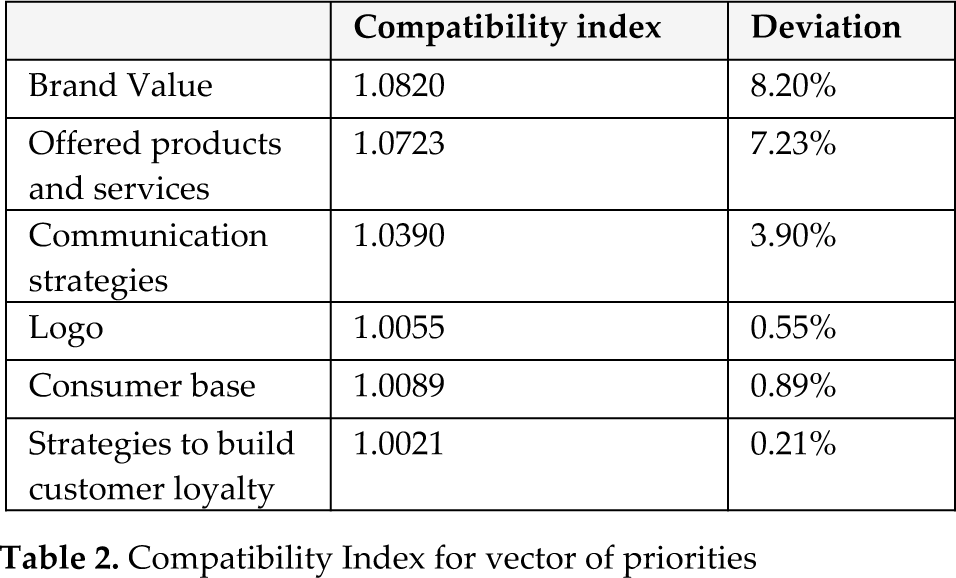
For this reason – and according to [25,43] – we believe higher thresholds for intransitivity should be considered, when comparing drivers of brand equity.
The second phase of our case study was mainly centred on the testing of the decisional breakdown structure of phase one. Moreover, we were interested in a deeper examination of the fashion industry. To this aim, we chose three apparel brands, which are internationally popular, well-known in our country, and which offer products that are, for a large part, in the same segment: Gap, H&M and Zara. In order to measure CBBE for these brands we structured new questionnaires, in accordance with the AHP methodology. About fifty questionnaires were administered to a subset of the interviewees who participated in phase one. This time standard thresholds for consistency ratio were respected.
4.2 Results
In Table 3, we present the global weightings for each criterion included in the decisional structure of phase one.
Global weightings for brand equity determinants

We immediately notice from the table how, at a first level of aggregation, Brand reputation and Strategies for building customer loyalty play a major role in determining brand equity. Nonetheless, the global weightings are almost equally distributed with a dip on Logo. We derive a reduced importance of logo design when compared with the other criteria – with the only exception being the relatively high global weight of the sub-criteria Ease of recognition. To analyse the second level of our decisional tree, it is necessary to obtain a better understanding of the components which impact on each criterion placed at the upper level. From this analysis we conclude that Company history is the element with the highest global weighting, immediately followed by Attention paid to customers' feedback, Visibility of top managers and After-sales services. The outcomes provide evidence to support the fact that customers are primarily concerned both with the past and present reputation of a company and with the commitment that the company itself puts into the after-sales assistance and in dealing with their feedback; as such, dealer performance may also be considered a key factor [48]. We could deduct that purchasing intensions are mainly influenced by past and present reputation and by customers' feelings of assurance concerning the assistance they will receive in case of problems. This is mostly true for products with a longer lifespan and is once again confirmed by Reliability and Quality assuming the highest weightings among the features of products. The results also support the strong importance of a direct and more emotional connection with consumers. In fact, the Emotional value of the brand stands out among the communication strategies, whilst Product's fit with customers' needs also acquires a relevant weighting. Finally, a correct price strategy is also very important, since it contributes to the brand positioning.
After having determined the global weightings, we further applied the AHP, so as to rank three apparel brands: Gap, H&M and Zara. We wanted to investigate brands in the fashion industry in greater depth mainly because of the high intangible value of their products. To be more clear, if one is evaluating a brand producing electronic components, it will be easier to assess the products' characteristics, quality and reliability; by contrast, the value of an apparel product is more bounded to its design and to the emotional and sociological values it carries with it. Customer evaluations will be, therefore, less objective in the latter case, making demand forecasting also more complex [31] and producing indirect consequences for other business functions, such as logistics [32]. In this sense AHP can help.
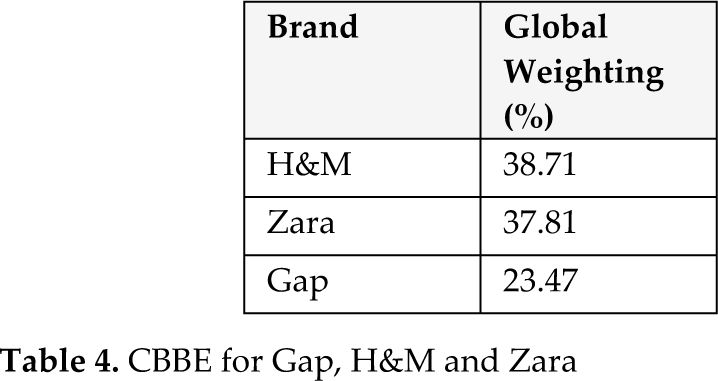
The final rankings for the chosen brands are reported in Table 4.
CBBE for Gap, H&M and Zara
5. Discussion and Conclusions
In this paper we provide evidence for the high potential value of the Analytic Hierarchy Process when used to measure consumer-based brand equity. Thanks to a case study which involved about 60 postgraduate students and more than 250 interviewees, we succeeded in finding and ranking those criteria which may have a major impact on brand value, from a consumer-based point of view. Criteria identified by focus groups give us a more clear idea of the elements consumers care about; moreover, the dimensions that spontaneously emerged are, for the most, included in previous CBBE studies [20].
The results from our research emphasize the importance of maintaining a good reputation over time; such a reputation has to be endorsed by the high quality of the offered products and services, by a positive image conveyed by top managers and by reliable after-sales services. In addition, customers strongly desire brands which are emotionally consistent with their values; they look for a dialogue with brands and for companies which take care of their feedback and needs. Finally, a logo which is easy recognizable and a pricing strategy which is coherent with the offered products and brand positioning are also relevant.
With regard to the apparel brands we examined in the second phase of our case study, we find H&M and Zara to be very closely ranked and that Gap follows just behind. This was just a first application we used to test this new methodology for measuring brand equity. Our final scores are also supported by other popular rankings, such as Interbrand 2012. Nonetheless, much more attention should be paid to the global weightings of criteria, because they are the major source of managerial hints that can help managers to improve their brands' value. These weightings direct attention to what the consumer really cares about. Furthermore, managers could accordingly apply AHP to measure their brands' performance with respect to each criterion. In this process we suggest including just the most important and direct competitors. In fact, as explained in Section 2, comparisons between brands will be limited to a maximum number of nine; of course, it will be always possible to compare more than nine elements including a brand which serves as a bridge between different groups of alternatives. In any case, such a choice would require much longer surveys for the higher number of comparisons; this emerges as a first limitation of the AHP methodology.
Further extensions of our research could check once again the main criteria influencing brand equity, exploring, for instance, a larger and more heterogeneous sample; also, applying the method to brands in other industries should be considered.
To conclude, we maintain the paramount importance and the high potential of AHP, when used to determine the most prominent determinants of brand value and when applied to brands associated with products which have less tangible and more ethereal characteristics.
Footnotes
6. Acknowledgments
We wish to thank Telecom Italia S.p.A. for providing financial support to carry out this research.