



Abstract
The furniture industry is growing to a great extent in Bangladesh. Many market researchers believe that the industry has enormous potentiality. However, the expansion of this industry may face complexities within a few years. Due to the wrong selection of facilities, many organizations failed to earn profit as expected. It also needs a large investment. Selecting a suitable place for a new facility is going to be the biggest question of upcoming years. This study aimed to analyze Bangladesh’s furniture industry, address the facility location problem, and provide a constructive solution to the decision-makers. In this study, seven criteria were considered: availability of raw materials, transportations, skilled labor, proximity to customers, energy availability, economic zone facility, and environmental impact, and five ideal locations or alternatives: Khulna, Chattogram, Bogura, Gazipur, and Manikganj. Thirty-four experts took part in the survey to analyze the significant criteria for selecting a furniture industry’s facility location and alternatives or potential locations for the facility. The Analytical Hierarchy Process (AHP) and Fuzzy AHP methods (FAHP), two MCDM techniques, were used to analyze the data set. A sensitivity analysis was done to determine the model’s robustness for any critical changes in the real world. The result showed that ‘energy availability is the most significant criterion to select a facility location for the furniture industry, where it got 35.1% criteria weight in AHP and 33.9% in FAHP. ‘Chattogram’ was selected as the most suitable place containing 33.74% normalized weight in AHP and 33.81% normalized weight in FAHP.
Keywords
Introduction
Facility location is the optimal place considering cost and other factors suitable for an organization. 1 Facility location selection is very significant for both existing and new organizations. In many cases, decision-makers struggle to select the best location. The selection of the best location for the facility is crucial because—it is a long-term investment that makes mistakes difficult to overcome, and it has a substantial impact on cost and revenue. 2 So, selecting the facility location considering one or two factors may cause a significant financial loss of an organization, and the decision should be based on both qualitative and quantitative criteria.
The furniture industry is considered to be the next big potential export industry in Bangladesh. Though the market is growing, there are already several competitors that are available in the market. After 1995, the industry has seen massive growth through earning foreign currency and contributing to the country’s consistent GDP growth. According to the Export Promotion Bureau (EPB), the furniture sector recorded export earnings of USD 76.41 million in July in fiscal year (FY) 2019–20. 3 The government of Bangladesh has declared the furniture industry as a ‘Thrust Sector’. 4 As the industry is growing and the market is expanding, competition is also rising. Now the organizations have to be more strategic and correct than before. In many instances, selecting the best facility location is one of the significant issues that the furniture industry faces. The availability of raw materials, transportation, skilled labor, and other aspects should be considered more seriously.
Though the industry is growing fast in Bangladesh, no research was found previously in this field to our knowledge, especially in this sector’s facility location problem. The challenges and potentiality the country has are not going to match with others. Limited land areas, a large population, energy crisis, port shortage, regular natural disasters, lack of adequate transportation systems are the significant challenges. Before setting up a new facility, these challenges should be considered. So, the outcome will be varied than in other regions. For those challenges in Bangladesh, facility location (manufacturing plant, warehouse, distribution center, etc.) plays a vital role in business profit because it is directly related to transportation cost, labor cost, land cost, etc. Moreover, the furniture Industry has to transport many bulky raw materials and the final product. It also needs a large amount of space and labor. So management should choose the right decision about the location to keep the cost low. 5 Facility location is also essential to build up a robust customer relationship management (CRM) to quickly and responsively fulfill customer demand. This study is about selecting the best location to keep the cost low to make a higher profit and build a robust CRM. The study analyzed the best facility location for Bangladesh’s furniture industry by the Analytical Hierarchy Process (AHP) and the Fuzzy Analytical Hierarchy Process (FAHP). All the data were collected primarily, and profound observations were undertaken. Seven criteria were considered that impact selecting a facility location and the five best locations of Bangladesh as alternatives. This case study aimed to provide a framework for the organizations of the furniture industry and a comparative study between AHP and FAHP. Through this study, the organizations will benefit and resolve to identify a suitable location for a new facility through scientific and mathematical solutions. This study aimed to bring science into humanity and contribute to the research field.
Literature review
Analytical Hierarchy Process (AHP) was invented by Thomas L. Saaty to make a decision-making procedure (1977, 1980, 1986), which offers decisions in the multivariate situation considering both qualitative and quantitative concerns. 6 AHP discusses both continuous and discrete comparisons and also physical and psychological events. 7 The objectives and ideas before judgment should be considered that so that ideas or psychological values can provide greater credence. To make a better decision, the problem needs to be known, goal, or objective or the purpose of the decision, criteria, sub-criteria, alternatives, stakeholders, and the group affected. 8 Much practice has been done by both researchers and managers to solve various decision-making problems. AHP is the most popular MCDM technique because of its simplicity and structure. The hierarchical modeling of the problem, the adaptation of verbal judgments, and consistency verification are significant assets. 9 Banai-Kashani proposed an alternative paradigm of AHP for location analysis with adequate consideration of relative importance. 10
However, AHP is often criticized as it includes vagueness and is biased by personal judgment. The fuzzy analytical hierarchy process (FAHP) overcomes these drawbacks. 11 Zadeh introduced the fuzzy set theory to deal with uncertainty and imprecision associated with information. 12 Buckley integrated fuzzy numbers with AHP. In this article, he mentioned that people find complexities defining exact ratios in comparing two alternatives, and vagueness remains in decision-making. 13 Having a defined uncertainty in fuzzy AHP compared and obtaining weights in the fuzzy form helps the decision-makers to understand better the importance of the factors and their uncertainty 14
Azizi et al. analyzed Iran’s furniture industry and found the best location for the furniture industry. They applied the AHP and TOPSIS method, where they took 25 criteria and 15 alternatives. The researchers concluded that market capacity was the most influencing criterion, and Qom was the desired location. 15 Burdurlu and Ejder applied AHP to select the best location for Turkey’s furniture industry. They considered marketing, production, transportation, and regional factors as criteria and Istanbul, Ankara, Kayseri, Denizli, and Adana as alternatives. They concluded that Istanbul was the best location for constructing a new furniture plant as it had a significant market capacity. 16 Ertuǧrul and Karakaşoǧlu compared fuzzy AHP and fuzzy TOPSIS methods in facility selection. The decision criteria were favorable labor climate, proximity to markets, community considerations, quality of life, proximity to suppliers, and resources. They stated that fuzzy AHP is better than fuzzy TOPSIS because of its widely used hierarchies. 17 Miç and Antmen preferred the fuzzy TOPSIS method to select a suitable hospital location. Their study considered demographic structure, investment costs, environmental factors, and infrastructure as criteria. They also stated that facility location had significance in quality services rather than transportation costs. 18 Uysal and Yavuz researched the ELECTRE method by selecting a logistic center where environmental safety had the highest weight among 11 criteria. 19 Niyazi and Tavakkoli-Moghaddam compared ARAS, COPRAS, and REGIME in facility location problems. However, the authors could not conclude which method would be more appropriate because of the mathematical modeling difference and the discrepancy in the methods. 20
Mahmud et al. applied AHP and ANP methods to select seasonal product facility locations in Bangladesh. 21 Sona et al. used FAHP to select the facility location where their objective was to keep the cost at minimal and least risk. However, only applying FAHP did not provide a clear picture. 22 Kabir and Sumi used Fuzzy AHP with the TOPSIS method in a concrete production facility location. Social, economic, technological, environmental, and transportation factors were relevant to the realistic scenario. 23 Rahman et al. considered 10 criteria and 5 alternatives applying AHP to select the facility located in the plastics manufacturing industry. 24 Ayaǧ and Özdemir implemented fuzzy AHP to evaluate machine tool alternatives, and they concluded that AHP was a useful technique for their selection process that helped them select the best machine tool out of nine alternatives. 25 Calabrese et al. studied sustainability issues that are most relevant for creating shared value for both business, society, and strategic planning and management with the help of fuzzy AHP. They noted that the method required a considerable effort, yet it had significant beneficiaries, which made it more strategic. 26
However, in these previous researches, researchers considered the criteria and alternatives based on their regions or countries. The criteria, sub-criteria, alternatives, and outcomes will vary in different regions and situations. No research was found based on the Bangladeshi furniture industry’s facility location problem. As Bangladesh is one of the most developing countries, it is needed to identify a suitable location for the competitive furniture industry by comparing the Analytical Hierarchy Process (AHP) and Fuzzy Analytical Hierarchy Process (FAHP) methods.
Data sampling plan
Analytical Hierarchy Process (AHP) or Fuzzy Analytical Hierarchy Process (FAHP) both are based on data analysis. The more the data are collected, the better the outcome. Another thing is that biased data can impact the final result significantly. So, a data sampling plan is critical in these two MCDM techniques. Data were collected from 34 experts in Bangladesh. The experts were from different fields like operations management, planning, business development, industrial engineering, and so on. Moreover, everyone was established and experienced in their particular field. Surveys were conducted and face-to-face interviews were taken to have a clear picture of their thoughts and judgments. All the questionnaires were well structured and provided the real scenario.
Research methodology
In this study, two MCDM techniques were applied. These two are very popular and familiar with their simplicity. In both methods, few steps were followed.
Analytical hierarchy process
Analytical Hierarchy Process (AHP) has its operations in various sectors. We applied APH in this study because it combines numerous data inputs from several sources to an integrated result. The decision process can be either subjective or objective or either quantitative or qualitative considerations. 27 AHP gives more accuracy than other methods while working with inconsistencies. 15 It disentangles a complex issue by breaking it down into smaller steps. Also, it can work without particular authentic information sets. 28 The robustness of the decision can easily be measured by applying sensitivity analysis with the AHP process. To carry out the pair-wise comparison, AHP mainly deals with relative importance between criteria and alternatives followed by weight calculations. The steps were given followed below.
Step 1: Determine the goal, criteria, sub-criteria, and alternatives.
Step 2: Make pair-wise comparison matrices of criteria, sub-criteria, and alternatives. In the pair-wise comparison matrices, the Saaty’s scale was applied (Table 1). It is the fundamental scale in AHP to compare the importance between two criteria or alternatives. In this scale, 1 refers to equal importance, and 9 refers to absolute importance.
The fundamental scale of the absolute number. 8

Now, if the identified criteria or alternatives are m, the pair-wise comparison matrix will be as follows,

where
Step 3: Evaluate every pair-wise matrix to normalize matrices and calculate the priorities and weights of each criterion and alternative. The weights were calculated with the help of this equation.

where

The normalized value of the criteria can be determined by a normalization process for the eigenvector, as shown below:

where W denotes the weight coeficient vector, and wi represents the weights of criteria i. and m denotes the total number of criteria.
Step 4: The next step is to investigate the consistency ratio (CR). CR holds a significant role in the AHP methodology. If CR was below 10%, then accept the pair-wise comparison matrix. Otherwise, reject it. The following equation determines the consistency Ratio (CR)


where the small n denotes the number of criteria. Random Consistency Index (RI) and which was taken from Table 2. 29
Random consistency index (RI).

Fuzzy analytical hierarchy process
Fuzzy Analytical Hierarchy Process (FAHP) is a modified version of AHP, which overcomes the imprecision of AHP. Different authors tried to establish a different version of the Fuzzy AHP method to solve many specific problems. Van Laarhoven and Pedrycz used triangular membership functions to modify the fuzzy method.
30
Chang also applied triangular fuzzy membership for the pair-wise comparison.
31
Buckley established the trapezoidal membership function as the extension of classical AHP for comparison ratios.
13
Mon et al. developed an entropy-based modified fuzzy AHP.
32
In this paper, the fuzzy AHP geometric mean was used to deliver suitable fuzzy group weightings.
33
Generally, the geometric mean method is used in the AHP implementation for aggregating decisions in a group.
34
One of the advantages of using geometric mean is that it is usually not affected by any sample fluctuations. The fuzzy number is a crisp numerical value in the interval [0 1]. It is determined by the fuzzy membership function. In this research, we implemented the Triangular Fuzzy Numbers (TFNs) as it is very much accessible and easy to apply. A triangular fuzzy number,

where
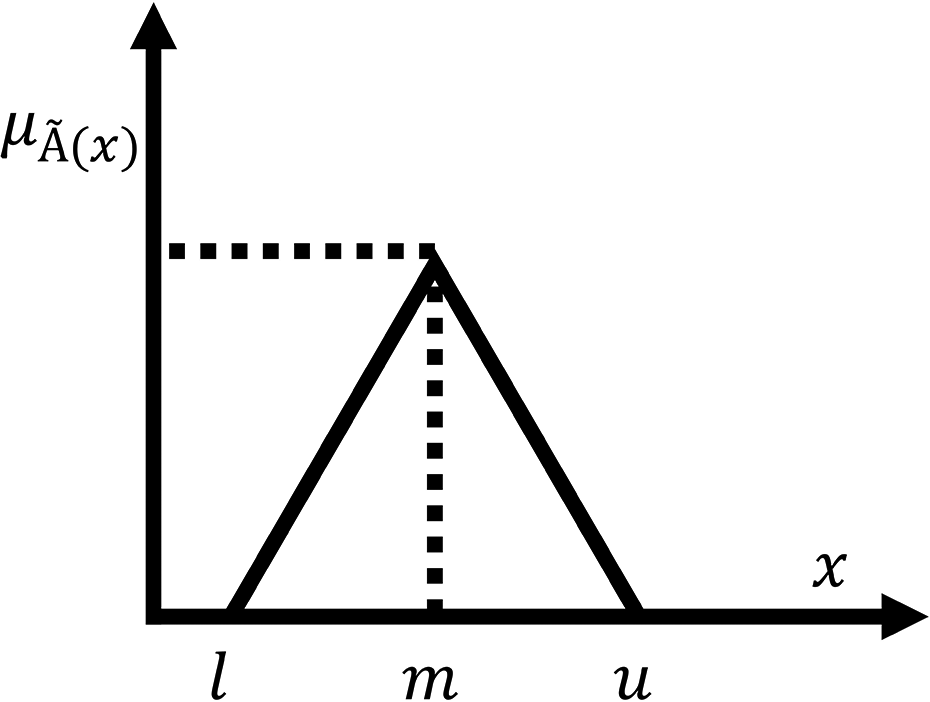
A triangular fuzzy number
Two fuzzy number,



In the fuzzy AHP method, four steps were followed.
Step 1: Determine the goal, criteria, sub-criteria, and alternatives.
Step 2: Like the AHP method, a pair-wise comparison matrix was developed. However, this time the fuzzy fundamental scale was used (Table 3).
Fuzzy fundamental scale. 35

Step 3: Compute the geometric weight wi. Let

where

Step 4: Defuzzification was done of the fuzzy weights to get weights of the criteria. Normalize the weight to find the priority of each criterion.
Problem formulation
Factory location has a high impact on the success of an industry or business. So, some criteria must be considered while selecting a suitable place for locating the workplace to ensure sustainable and smooth production. AHP and FAHP were applied in the selection procedure of the facility location of the furniture industry. Yaslioglu and Önder considered energy sources, raw material supplies/sources, proximity to customers, and skilled labor as criteria for facility location problems. 36 In comparison, Ozgen and Gulsun used transportation opportunity, infrastructure availability, and disaster risk as the main parameters for selecting factory locations. 37 In this study, seven criteria and five alternatives were selected from the surveys and interviews with experts. The criteria were the availability of raw materials (R), transportations (T), skilled labor (L), proximity to customers (C), energy availability (E), economic zone facility (EZ), and environmental impact (EI). These seven criteria were also included in previous study. 38 –40 Among these seven criteria, Yang and Lee applied the availability of raw materials, transportations, skilled labor, and energy availability in the facility selection model by AHP. 41 The alternatives were five different locations in Bangladesh that were selected based on their industrial and geographical characteristics. Khulna is the third-largest economic center of Bangladesh. 42 The Port of Mongla, the second busiest seaport of Bangladesh, is located 48 kilometers (30 mi) from Khulna, which is also considered a regional industrial center. 43 Bogura is known as the industrial city of North Bengal and acts as a communication hub. Bogura is close to the Indian border, so it is easy for the distributor to maintain raw materials, thus serving as an alternate place for furniture industries. 44 Manikganj is bounded by Dhaka districts on the south and east. 45 Close distance from the capital city gives Manikganj the advantage of having smooth transportation and available energy to establish an industry. Gazipur is one of the central districts for industrial development (Industrial policy, 2010). It has sufficient structural and logistic support to become one of the most feasible places to locate an industry. 46 Chattagram is the port city that is the busiest international seaport on the Bay of Bengal and the third busiest in South Asia. 47 Chittagong generates 40% of Bangladesh’s industrial output, 80% of its international trade, and 50% of its governmental revenue. 48,49 Thus, it makes Chattagram an established preferable area for the furniture industry. The alternatives (Khulna, Chattogram, Bogura, Gazipur, and Manikganj) were shown in Figure 2.

Hierarchy structure of goal, criteria, and alternatives.
A brief discussion of the seven criteria is given below.
1. Availability of raw materials (R)
A factory should be located where the raw materials are cheap and can be easily found. A sufficient supply of raw materials from the local area can reduce transportation, also the risk of running out of supply. The shortage of raw materials in the time of need will increase production cost, and the production rate can be hampered. 39
2. Transportations (T)
Transportation facilities like rail, road, or river are needed to be developed in the plant area. The facility location should be selected where the transportation cost will be minimum. Good transportation infrastructure between the production house to the distribution center and raw materials source can boost a company’s success. 40
3. Skilled labor (L)
Skilled labor is an asset to run an industry. The facility should be located where skilled labor with reasonable wages is easily accessible. So, the location nearest to the area that can provide workforce and training facilities is beneficial for the industry. 50
4. Proximity to customers (C)
The nearest location to the market always gives the advantage of distributing goods at a minimum cost. If the location is in the center of a vast market, a company can fulfill its demands within a short duration, and the distribution cost will be meager. 50
5. Energy availability (E)
No industry can run smoothly without energy. Water, fuel (gas or oil), electricity is must be needed to run a production. 39 So, the facility should be located where continuous energy flow is available at a reasonable rate.
6. Economic zone facility (EZ)
An economic zone gives the much necessary environment for an industry to run at full swing. Better infrastructure and business-friendly policies provide security to plant a facility.
7. Environmental Impact (EI)
The impact of climate and natural forces can disrupt production as well as distribution. Supply of necessary accessories can be harmed due to environmental causes like a flood, storm surge, drought, and so many. During the selection of facility location, environmental impact on the area should be considered. 51,52
Analytical hierarchy process (AHP) analysis
At first, a pair-wise comparison matrix of the criteria was made (Table 4), and found each criterion’s priority weight (Table 5). The crisp numerical value was taken from Saaty’s scale (Table 1).
Pair-wise comparison matrix of the criteria.

Priority weights of the criteria.

Eigen value = 7.170
CI = (7.170-7)/(7-1) = 0.028
RI = 1.32
CR= CI/ RI = 0.021 = 2.10% < 10%
From Tables 6 to 12, pair-wise comparison matrices of the alternatives were made to each criterion and determined each alternative’s priority weight.
Pairwise comparison matrix and priority weights for availability of raw material.
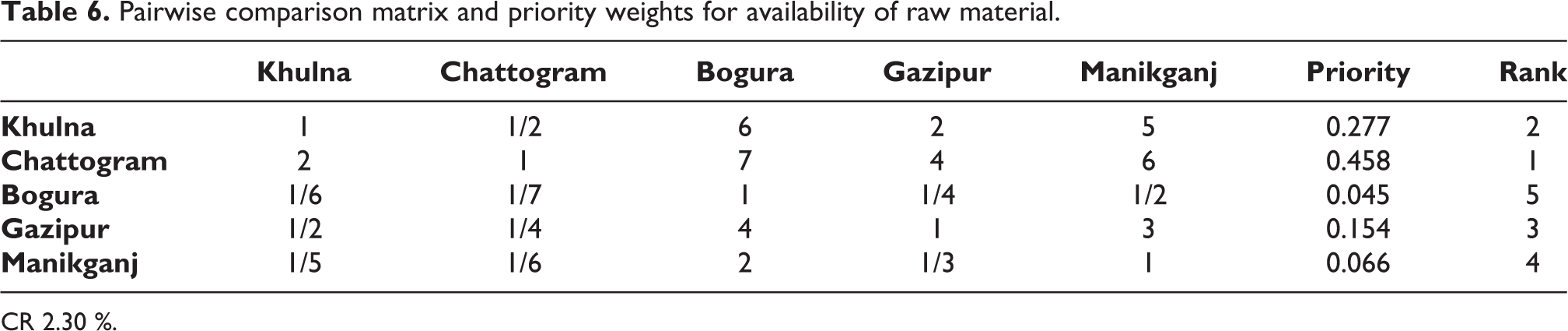
CR 2.30 %.
Pairwise comparison matrix and priority weights for transportation.

CR 2.60 %.
Pairwise comparison matrix and priority weights for skilled labor.

CR 1.50 %.
Pairwise comparison matrix and priority weights for proximity to customers.

CR 1.80 %.
Pairwise comparison matrix and priority weights for energy availability.

CR 2.20 %.
Pairwise comparison matrix and priority weights for economic zone facilities.

CR 2.80 %.
Pairwise comparison matrix and priority weights for environmental impact.

CR 3.3 %.
In Table 13, the synthesized value of each alternative was calculated. Then the priority weight of the criteria was multiplied with the local priority weight of the alternatives. Adding all the multiplied weights, we got the best alternative for the goal.
Synthesized table for the optimal alternative selection.

From Table 13, it is determined that Chattogram is the best alternative containing 33.74% priority weight, Gazipur, Khulna, Manikganj, and Bogura had 29.40%, 21.33%, 9.37%, and 6.15% priority weight, respectively.
Fuzzy analytical hierarchy (FAHP) analysis
Like AHP, at first, a pair-wise comparison matrix was made, and found out the normalized weights of the criteria (Table 14). However, this time Table 3 was used for the fuzzy number.
Pair-wise comparison matrix and normalized weights of the criteria.
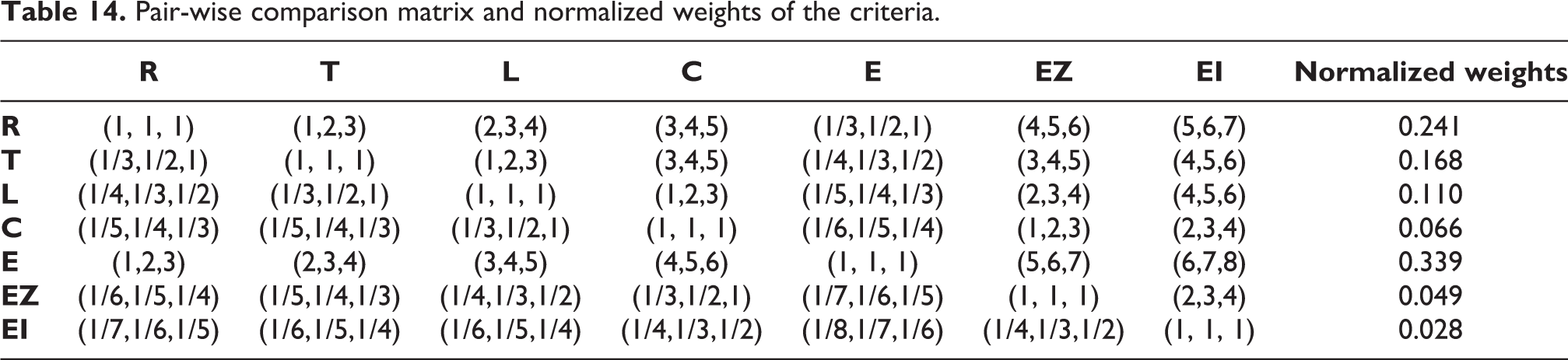
From Tables 15 to 21, we made pair-wise comparison matrices of the alternatives to each criterion and determined each alternative’s normalized weights.
Pairwise comparison matrix and normalized weights for availability of raw material.

Pairwise comparison matrix and normalized weights for transportation.

Pairwise comparison matrix and normalized weights for skilled labor.

Pairwise comparison matrix and normalized weights for proximity to customers.

Pairwise comparison matrix and normalized weights for energy availability.

Pairwise comparison matrix and normalized weights for economic zone facilities.

Pairwise comparison matrix and normalized weights for environmental impact.

In Table 22, the synthesized value of each alternative was calculated. Then the normalized weights of the criteria were multiplied with the local normalized weight of the alternatives. Adding all the multiplied weights, we got the best alternative for the goal.
Synthesized table for the optimal alternative selection.

From Table 22, it was determined that Chattogram was the best alternative containing 33.81% normalized weight. Gazipur, Khulna, Manikganj, and Bogura had 28.52%, 22.28%, 9.23%, and 6.15% normalized weight.
Sensitivity analysis
Sensitivity analysis is to identify how much a model is sensitive and robust in the presence of uncertainty. It is sometimes difficult and complex to maintain an excellent precision of the inputs in the real world. So, a slight variation in the input value can have a significant impact on the model output. Furthermore, sensitivity analysis helps understand how much precision is needed to maintain the model robust, valid, and dynamic. 53 There are many ways to do a sensitivity analysis. However, in this study, one factor at a time or the OAT method was applied. OAT is very popular and straightforward to use. Only one factor’s value will be varied in this method, and the rest will remain the same. So, the output will have the impact of only one factor. 54 OAT method also increases the result’s comparability, and if the model fails, then the modeler can quickly address the factor unambiguously. 55
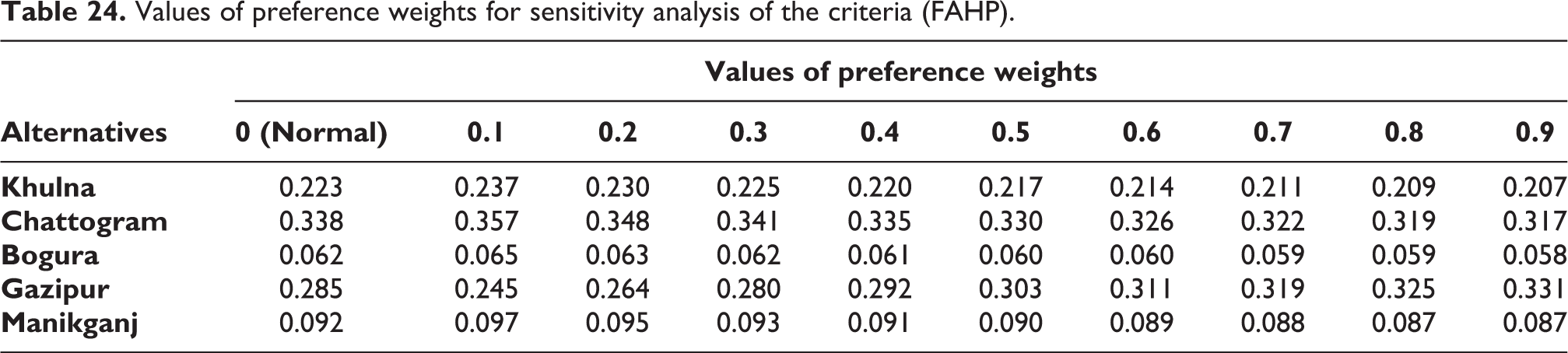
AHP and Fuzzy AHP both are highly sensitive to their criteria weight. The results may have been affected by vagueness, inaccuracy, and uncertainty. Tables 13 and 22 showed that energy availability (E) had the highest priority weight in AHP and FAHP. This criterion was picked because it had the highest priority weight, and that is why it would have the highest impact on the output. So, changing only the ‘energy availability (E)’ criterion would better visualize the model. The rest of the criteria remained the same. We varied the priority weight from 0.1 to 0.9 and observed the results, and investigated the impact of each variation of priority weight.
From Tables 23 and 24, we saw that the model had a significant change in both AHP and FAHP calculation. The alternatives shifted their value from the standard value. In Figure 3, we saw the impact of the sensitivity analysis of AHP. Here, we observed that Chattogram had its highest pick when we set the weight of “Energy Availability” 0.1. From 0.1 to 0.6, Chattogram was considered as the best alternative. When the criterion weight varied from 0.7 to 0.9, Gazipur became the best alternative, and Chattogram became second. Khulna, Bogura, and Manikganj were never good locations for the furniture industry as the priority weight was never higher than Chattogram or Gazipur.
Values of preference weights for sensitivity analysis of the criteria (AHP).

Values of preference weights for sensitivity analysis of the criteria (FAHP).

Values of preference weights for sensitivity analysis of the criteria (AHP).
In Figure 4, the sensitivity analysis of FAHP was demonstrated. Here, Chattogram had its highest pick when the weight of “Energy Availability” was 0.1. From 0.1 to 0.7, Chattogram was the best alternative. However, from 0.8 to 0.9, Gazipur was considered the best alternative, and Chattogram became second. Khulna, Bogura, and Manikganj were never good locations for the furniture industry as the priority weight was never higher than Chattogram or Gazipur.

Values of preference weights for sensitivity analysis of the criteria (FAHP).
Result
From the above calculations, the objectives of this study were obtained. Both AHP and FAHP resulted in Chattogram being the best location for the facility. Chattogram was selected as the best alternative because it had the best raw material availability and transportation system. It also stood second in energy availability. As energy availability, raw material availability, and transportation had the highest criteria weight, so these criteria influenced Chattogram to be the best alternative among these five locations. Furthermore, sensitivity analysis showed that the model was robust and minimal uncertainties were available. In Figure 5, the comparative result of AHP and FAHP was seen.

Result of the alternatives both AHP and FAHP.
Discussion
To our knowledge, this was the first study to date that explored the facility location problem of the furniture industry of Bangladesh. Though any previous literature on this field was not found, we found researches that worked on facility location problems in Bangladesh. Rahman et al. researched facility location selection of the plastic manufacturing industry in Bangladesh, and they found the cost of land and construction cost was the vital criteria, and Mongla would be the preferable location. 24 In this research, energy availability was the most significant factor. In developing countries like Bangladesh, productions are often interrupted due to load shedding or an energy crisis. So, before setting up a new facility, it needs to be ensured about energy availability. We also considered economic zone facility and environmental impact- two vital criteria yet not considered in any other researches to our knowledge. In many cases, the economic zone facilitates industries, and an ecosystem is built, which is very helpful. The environmental factor is also very significant because a facility takes a large investment where Bangladesh often fights natural disasters.
It was seen that AHP and FAHP choose the same alternative to be the best one, but their priority weight varied slightly concerning one another. However, in this study, AHP and FAHP had different priority weights because AHP only deals with crisp numeric values. Decision-makers sometimes find difficulties and complexities in evaluating their opinions in these crisp numbers. So, AHP has some uncertainties and vagueness. As FAHP deals with linguistic terms, it overcomes AHP’s drawbacks. So, where the information or evaluation is certain, AHP will be the best technique. If the information or evaluation is not specific and uncertainty and vagueness are available, FAHP will be the best fit.
This study was made to understand and explore the furniture industry of Bangladesh. So, the study is more suitable for the Bangladeshi furniture industry. Nevertheless, the model covers other areas also. For example, the criteria we selected can be used and impactful in the ready-made garments industry, lather industry, food industry, and so on. However, more criteria can be added or deducted depending on the specific industry. The alternatives also represented the most suitable locations in Bangladesh for industries. So, Chattogram can be considered first in other sectors as well. The model was formulated considering Bangladesh, but the framework is also implementable in other countries and regions. Countries like China, United States, Germany, Italy, India, and other promising countries in furniture industries can adopt this framework. However, the criteria and the alternatives should be according to that country’s preference. Moreover, AHP and FAHP can be used not only in facility locations but in other fields also. It is applicable in many complicated situations where these two MCDM techniques can provide a constructive solution: Supplier selection, human resource selection, deserter management, engineering field, and so on.
In this study, both AHP and FAHP were applied in selecting a facility location for the furniture industry and found a small difference in the output concerning AHP and FAHP. The pair-wise matrix’s consistency was excellent both in AHP and FAHP; otherwise, the output may vary by a significant margin. At the beginning of the research, a few business-holders with whom we had a verbal conversation thought Gazipur would be the perfect place for the industry. However, the study found that Gazipur has a limitation on raw materials availability to cost higher in transportation. Again, it does not have an economic zone facility yet. When we showed the study outcomes to the business holder, they were surprised and satisfied with how precisely AHP and FAHP worked. They also admitted that raw materials availability, transportation, and economic zone facility are very significant for any industry to grow up. So, Chattogram would be the best choice.
Conclusion
In this case study, AHP and FAHP, two MCDM techniques were applied to identify the facility location for Bangladesh’s furniture industries. The furniture industry is one of the fast-growing industries in Bangladesh and has a promising future. Increasing demand attracts many investors and business people to furniture industries, and they will need a better location to find out to expand their existing facility or build a new one. From AHP and FAHP, Chattogram was identified to be the best location for the facility. Chattogram has raw material availability, a sound transportation system, cheap labor cost, and energy availability crucial for the furniture industry. So, organizations will be benefited from this study that will require a suitable location for the furniture industry. This study provided a framework for organizations and industries to have better knowledge and opinion. The management of interested companies can have a better result for pair-wise comparison based on relative importance, which can contribute more accurately in uncertain situations. Every alternative’s strengths had been considered here, helping find other industries’ facility locations also. AHP and FAHP both showed around the same result. However, AHP had some limitations and drawbacks, which were overcome by FAHP. In this study, the limitation we had was that we only considered Bangladesh or a developing country in modeling. The criteria and model may vary in different countries and regions.
Azizi et al. applied AHP and TOPSIS methods to select the best location for furniture factories in Iran. Among the five main criteria and 25 sub-criteria, economic and market capacity get the most priority. 15 Where in this study, “energy availability” was most significant. Despite having a common objective, here we could see the weighting difference between the two countries. Criteria are selected based on that region’s strengths and weaknesses. Another researcher Ertuǧrul and Karakaşoǧlu proposed a fuzzy AHP and fuzzy TOPSIS method for facility location selection. The favorable labor climate got the highest criteria weight among five. Three decision-makers find labor-related features are the main criteria for selecting facility locations in Turkey. 17
In the future, researchers can apply more MCDM techniques like TOPSIS, Vikor, Promethee in the furniture industry’s facility problems, and the result can be compared between different methods. Also modified AHP process can be proposed in facility location problems. We had considered seven criteria. More criteria, sub-criteria, and alternatives can be added to get better results and demonstrations in the future. This framework can also be used in other industries to make an insightful judgment of alternatives through criteria and subcriteria. Even a researcher can design his research by specifying a single furniture manufacturing company to specify the facility location Plan of that company. Further study can be conducted by considering the cost of establishing a furniture plant while selecting any location. Nevertheless, this framework can be applied to other industries and the research world to better human beings.
Footnotes
Acknowledgments
The authors are grateful to Mr. Shahed Mahmud, and Mohammad Harun Or Rashid for their exceptional support, enthusiasm, knowledge, and exacting attention to detail have been an inspiration and kept the work on track. We also want to extend our gratitude to all the experts who participated in the surveys and interviews.
Declaration of conflicting interests
The author(s) declared no potential conflicts of interest with respect to the research, authorship, and/or publication of this article.
Funding
The author(s) received no financial support for the research, authorship, and/or publication of this article.
