




Abstract
Analysis of the spatial-temporal sampling of Unmanned Surface Bathymetric Vehicles (USBV) is vital for depth measurement performance, which is the basis for optimum sampling of multi-USBV cooperative parallel formations. This paper's ultimate goal is to find the optimum sampling style of multi-USBV parallel formations and to design the corresponding control law. First, the relationship between spatial-temporal sampling intervals and measurement performance is examined using the Objective Analysis method, giving an illustrative example of the sampling of two USBVs. Second, three types of spatial-temporal constraint are defined and the type of USBV is analysed, which is spatially constrained. Lastly, according to the spatially constrained USBV type, the control law for multi-USBV equal-distance parallel formations with spatial synchrony is designed based on self-propelled particles theory, which is validated in the simulations based on the USBV dynamic model.
Keywords
1. Introduction
Bathymetry is one of most important operations for orientation and depth measurement in ocean engineering and surveying. The combination of GPS and echo fathometer is fourth-generation bathymetry technology. Depth measurement, which usually depends on a mother ship and intensive labour, is difficult in shallow, unmapped or dangerous regions. The Unmanned Surface Vehicle (USV) is a new kind of observation vehicle that has the capacity for orientation and navigation, and whose operation can be by remote or autonomous control. A USV incorporating GPS and echo fathometer would represent a convenient, low-cost and safe survey vehicle for complicated environments.
When depth distribution is unknown, the sampling frequency, intervals and path of USV must be selected in advance, and these scales will seriously affect the quality and efficiency of measurements. If the scales are not chosen appropriately, this will lead to under-sampling or over-sampling. The Objective Analysis (OA) method is commonly used in oceanic and atmospheric data analysis, and is also used for performance evaluation of the vehicle's measurement. In accordance with the OA approach, the evaluation metric of measurement efficiency is usually established based on spatial-temporal decorrelation scales. OA has been used in multi-Underwater Glider elliptical formation experiments[5, 6] where it was applied to analyse sampling performance for different spatial intervals. The mechanism and effect of OA have been illustrated in a two-point simultaneous measurement in one dimension[7].
Considering the instantaneous nature of the oceanic process and the vehicle's velocity, a survey cannot be completed to an optimum standard by a single vehicle; therefore, a multi-vehicle cooperative formation represents an efficient style. The physical particle motion model is one of the most famous control theories for multi-vehicle cooperative formations. The self-propelled particle model, also called the unicycle model or the particle model with different constraints, is a class of physical particle motion model that has received growing interest over the past decade[8-11]. The particle model has a nonholonomic constraint and the particles can only surge and turn actively, which can be of use in cooperative formation control of most Unmanned Aerial Vehicles, Unmanned Underwater Vehicles and land robots. Although the particle model is suitable for cooperative control of not intelligent vehicles, researchers have carried out further research on many aspects, such as collective motion stability, dissipativity and consensus[12]. The self-propelled particle model based on coupled oscillators is used in UAVs' cooperative control[13, 14]. Based on the self-propelled particle model, the Lyapunov function, which ensures the particles' circular formation, was designed, which is used in cooperative ocean observation with Underwater Gliders[6]. The convergence is analysed for the particle model based on nearest-neighbour rules, which are used for coordination of mobile autonomous agents[15].
The paper is organized as follows. In Section 2, based on OA, the mapping performance is analysed using an illustrative example of sampling of two USBVs. In Section 3, the rule of spatial-temporal constraint is presented, and the USBV type with spatial or temporal constraint is analysed according to it. In Section 4, a multi-USBV equal-distance control law for spatially synchronized parallel formations is derived based on the particle model, and the simulation result is presented based on the USBV dynamic model. Conclusions are presented in Section 5.
2. Depth Measurement Objective Analysis
The sampling performance metric based on Objective Analysis is defined by [6]

Since the variety of the depth field is non-sharp, the exponential covariance function is chosen as

where σ and τ are the spatial and temporal decorrelation scales of the depth field, which are the parameters for describing its spatial and temporal variety, and their values are equal to the e-folding correlation scales of the depth field in space and time. C−1 is the inverse of the M×M matrix (C)
kl
=
The sampling performance is analysed as an illustrative example of sampling of two USVs. The two USVs' sampling intervals are [0, 2σ] in space and [0, 2τ] in time, and their locations in the same time are (1-0.5·d)σ and (1 + 0.5 · d)σ. The USVs' sampling times are (1 – 0.5 · δ)τ and (1 + 0.5 · δ)τ), i.e., the spatial and temporal intervals are d · σ and δ · τ respectively. According to OA, the change in sampling performance, along with d and δ in two dimensions, is illustrated in Figure 1. In the figure, d and δ are both in [0, 2] and the sampling performance is largest when d and δ are equal to 1. It is suggested that the sampling performance will be the largest when multi-USBV sampling intervals are fixed according to spatial and temporal decorrelation scales. In addition, according to (2), the types of spatial and temporal constraint are decided by the main contribution of the spatial and temporal exponential index.

Measurement performance variety with spatial-temporal sampling intervals
3. Analysis of USBV spatial or temporal constraints
According to (2), the type of spatial or temporal constraint is determined by a non-dimensionalized parameter, given by

where v0 is the USBV's velocity. In [7], a vehicle characterized as either spatially constrained or temporally constrained. However, according to (3), we give different definitions: a vehicle is spatially constrained if s0≤0.1; a vehicle is temporally constrained if s0≥0.1; when 0.1<s0<10, the sampling performance can be affected by both spatial and temporal intervals, so the vehicle is both spatially constrained and temporally constrained.
The Unmanned Surface Bathymetric Vehicle was developed to support depth measurement around islands and research into multi-vehicle cooperative control. A USBV is composed of an on-shore control unit and a ship unit. There is a wireless link between the two units, which is used to transfer control and measurement information. GPS, compass, echo fathometer and control system are integrated in the USBV. The location and depth data is transferred to the on-shore control unit when the USBV is afloat. Its propulsion is supplied by a single 400 W propeller, which is controlled by a PWM, and it can be rotated around the perpendicular axis using a stepper motor. In 2010, the USBV was test on Miaozihu Island, Zhou Shan City, China, as shown in Figure 2. However, since the test area was small, the data do not suffice for an analysis of the USBV's temporal and spatial sampling. We therefore use real depth data from surveys carried out by other ships to analyse the USBV's type of temporal and spatial constraint. The depth survey is carried out at 39.51°N, from 120.92°E to 120.64°E. The spatial decorrelation scale σ of the depth is acquired by calculating the e-folding length of correlation between the depth and the distance, which is approximately equal to 5600 m.
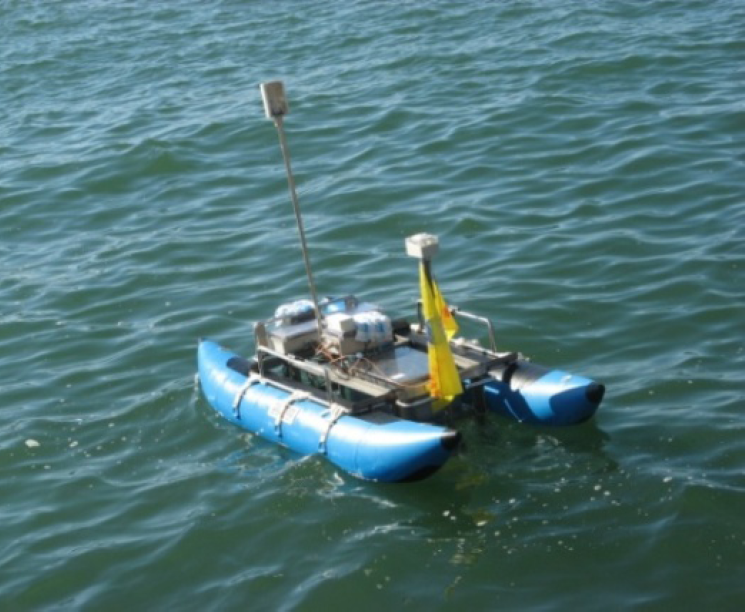
The USBV during the sea test in 2010
The USBV's cruise velocity v0 is about 0.75 m/s, and the temporal decorrelation scale τ is about ten minutes in magnitude considering the bathymetry effect of the tides. According to (3), if s0<0.1 the USBV is spatially constrained. If the velocity of the USBV is increased to 1˜90 m/s and other conditions are invariable, the vehicle's measurement will be both spatially and temporally constrained. If the depth changes acutely, forcing the spatial decorrelation scale σ to become smaller than 45 m, the USBV sampling will be temporally constrained.
Since a multi-USBV cooperative formation is efficient for depth measurement, which is spatially constrained, the sampling will be optimum when spatial intervals between the USBVs are fixed to the spatial decorrelation scale σ. Equal spatial interval control of the USBV parallel formation is desirable. This will be designed in the next section.
4. Multi-USBV equal-distance parallel formation
The parallel formation is a common style of cooperative depth measurement, and also forms the basis for other formation modes. Synchronized parallel control and equal-distance control are vital for optimized parallel formation of USBVs. According to the analysis of USBVs' temporal and spatial sampling in Section 3, the parallel formation with the largest sampling performance is the equal-distance parallel formation with spatial synchrony, where all the USBVs keep spatial synchrony in the direction of the parallel formation and maintain an equal distance between themselves. We have already studied the spatial synchronized parallel formation in [16]; the proposed paper will focus on how to design the control law for equal distance in parallel formation. The simulations are completed based on the USBV dynamic model.
4.1 Dynamic Modelling
In ship modelling, 6 Degrees-Of-Freedom equations are usually simplified to 3-DOF equations in a 2D plane, which is described in the earth-fixed coordinate axes and body-fixed coordinate axes.
Using quadratic damping terms v|v|, the 3-DOF USBV dynamic equations can be represented as:

where V = [u, v, r]' represents the body-fixed velocities, M is the USBV's inertia matrix, C(v) is the centrifugal and Coriolis matrix, D(v) is the hydrodynamics damping matrix, and τ represents the propulsion forces and moments. The matrices is defined as follows:
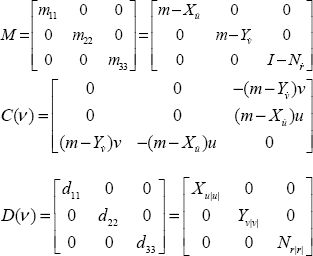
The 3-DOF equations can therefore be written as follows:
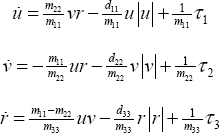
4.2 Control law design
In high-level multi-USBV cooperative formation strategy, the USBVs are treated as self-propelled particles. The particles model of variable velocities in [16] is used:

where the vector rk =xk +iyk ∈ C represents the position of kth USBV, vk represents the velocity of kth USBV, θk∈S1 represents the orientation of its velocity vector,
In the paper, the spatial synchrony in the direction of the parallel formation and the equal distance control law will be designed separately.
Theorem 1 [17]: For the particles model (6) of N particles, if particles' velocities are

the control law
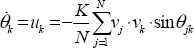
forces the convergence of all solutions to spatial synchronized parallel formation.
Without loss of generality, let the first particle be the virtual leader, let θ1 be the orientation of the virtual leader, and let K be a constant and K1 a constant associated with speed of spatial synchronized convergence.
To control law (8), the equal distance control is added:

where K2 is a constant associated with speed of equal distance convergence, δ0 = sgn(cos(θ1)) is the index of steering, and Dex =‖rk –r1 ‖ –d(j), d(j)=(j-1)d0, d0 is the expected distance of the adjacent USBVs, which is equal to spatial decorrelation scales σ of the depth field.
It is noted that the index j in (9) is different to that in (8), which is not random. In (9), the index j descends according to the particle position's imaginary part, and the first particle after ordering is used as the virtual leader.
Theorem 2: For the particles model (6) with particle velocities (7), the control law (9) forces the convergence of all solutions to spatial synchronized parallel formation along with θ1 and the equal distance d0 between neighbours.
The proof is omitted, which is similar to [16].
4.3 USBV's parallel formation simulation
Based on the USBV's dynamic model (5), the simulations of multi-USBV equal-distance parallel formations with spatial synchrony are illustrated using control law (9). According to the flowchart in Figure 3, the orientation θk in the control law (9) is used for the expected orientations for multi-USBVs. The orientation tracking is achieved by PID.

Flowchart describing the simulation
For the particles model (6), the simulation of multi-USBV equal-distance parallel formations with spatial synchrony is illustrated in Figure 3 using the control law (9) with K=-1, K1=0.05, K2=0.05, d0=10 m, N=4, and θ1=60°, which simulates a four-USBV parallel formation at 60° and with an expected velocity of 1.5 m/s.
In Figure 4(a), the group contains four USBVs and one virtual leader USBV; the USBVs' tracks are represented by the solid line and the virtual leader USBV is represented by the dashed line; the circles denote the initial USBV positions, which are random. In Figure 4(b), the convergence of the USBVs' velocities is shown. The distances from the virtual leader are illustrated in Figure 4(c). From Figure 4(c), it can be seen that the equal-distance parallel formation can be formed after 80 sec. All the simulations are carried out using the Matlab program; the time step is 1 sec and the total time is 200 sec.

Five-USBV 10 m equal-distance parallel formation with spatial synchrony at 60° and with 1.5 m/s expected velocity
5. Conclusions
The Unmanned Surface Vehicle is a multi-purpose vehicle and can carry a range of oceanic observing sensors; this is an important development in unmanned ocean systems. USBVs carry a combination system of GPS and echo fathometer, developed to map depths around ports and islands, or other unknown areas. The USBV has been tested in sea trials, which validates its feasibility. However, depth measurement performance does not only depend on the technological level of the system, but also on whether the spatial-temporal sampling can be used correctly. In the paper, the optimal sampling performance can be acquired when temporal and spatial sampling's intervals are fixed as temporal and spatial decorrelation length. Three types of sampling constraint have been defined in connection with practical applications, which differentiates this paper from other works. The USBV's spatially constrained type means that its performance depends on distance control. The control law for multi-USBV equal-distance parallel formations has been presented and validated by the simulations. This law can be used in optimizing multi-USBV depth measurement in the future.
Footnotes
6. Acknowledgement
This work is supported by special funding for basic scientific research from the Institute of Oceanography, State Oceanic Administration (GY02-2012T05) and the National Natural Science Fund of China (41076062). We thank the crews of the First Institute of Oceanography, State Oceanic Administration for their help in the USBV's sea test.