




Abstract
Problems of trajectory tracking for a class of free-floating robot manipulators with uncertainties are considered. Two neural network controls are designed. The first scheme consists of a PD feedback and a dynamic compensator which is an RBF neural network controller. The second scheme syncretizes neural networks with variable structures using a saturation function. Neutral networks are used to adaptively learn about and compensate for the unknown system. Approach errors are eliminated as disturbances by using the variable structure controller. The shortcomings of local networks are considered. The control is based on dividing aspects into three sections with classification and integration: state dimensional, neural network and variable structure separate control. When invalidations of the neutral network appeared, the controller was able to guarantee good robustness as well as the stability of the closed-loop system. The simulation results show that the methods presented are effective.
1. Introduction
Considering the dangers and the economy of the space environment, space robots should be designed to assist or replace astronauts in order to complete a large number of arduous, risky tasks [1–3]. Tasks for which space robots are used include: capturing failed satellites with a mechanical arm so they can be recycled; supplementing aircraft fuel and carrying out in-orbit repairs to extend the working life of equipment; handling and assembling major space stations; removing space rubbish to avoid collisions; docking and separating the space shuttle and the space station. As space technology develops further, in the future, space robot systems will play an increasingly important role in space activities. The ground robot is a nonlinear time-varying system [4–5]. The floating characters of the space robot and the zero gravity environment of space require stronger coupling and nonlinear characters than the ground fixed robot. The current control strategies include the proportional - integral - derivative controller (PID), the computed torque method, robust control, adaptive control, and variable structure control [6–10].
However, the control methods mentioned above are difficult to implement with good control accuracy. As the PID controller ignores the no-linear influence, it belongs to linear controllers and it cannot achieve high accurate trace control. The implementation of computed torque control and control goals depends on a precise model of the system dynamics. The robust controller compensates for nonlinear uncertainties; it can obtain better results to some extent, but its design is based on the uncertain upper bound of prior knowledge, and so it is a conservative control strategy and is not the best control strategy.
Intelligent control theory is an advanced stage of control development: a method of human learning and adaptive capacity simulation; a senior information control system, it includes expert systems, fuzzy control and neural network controls [11–18]. Xie Jian [19] proposed a neural network adjustment control strategy for the uncertain space robot, which approximated nonlinear functions and uncertain upper bounds with an RBF neural network. Newton [20] proposed a neural network control strategy, which successfully implement the proposed feed-forward dynamic model by learning and training, and obtained an adaptive control of a space robot. Gorinevsky [21] proposed a neural network control strategy for non-intact free-floating space robot systems, which achieved an adaptive control by adjusting the network weights. Feng B M [23] proposed a strategy that compensated nonlinear dynamic models of space robots on-line by using a radial basis function neural network, of which the neural network parameters were adjusted by using the Lyapunov function, so the system would be ensured and suppress parameter perturbations and external disturbances. Edgar [24] presents a neural network adaptive controller for multiple-input and multiple-output systems, it eliminates the modelling error by using robust terms which achieves good results. However, the neural network control schemes do not consider learning characteristics in the early stages of work and they do not consider the system stability problems that occur when neural network controllers fail because of parameter saltation.
An adaptive neural-variable structure PD control scheme based on Lyapunov firstly is put forward by the paper.
A RBF neural network is used to approximate the unknown nonlinear dynamics of the robot manipulators. However, considering that the RBF network belongs to local generalization neural networks and there are blind sections outside the approximation region, in order to improve control accuracy and dynamic features, the variable structure is smoothly integrated into the RBF network. In the initial stages of the control and the outside approximation region of the neural network, this new controller, compensating the control by implementing a variable structure with good robustness, improves the dynamic responses of the system. Within the approximation region, this controller can act as a compensator, overcoming the chattering of the variable structure and improve control precision. This integrated controller can speed up the convergence velocity of the tracking error and ensure that the system has good robustness in case of a failure in the neural network. In addition, the adoption of the PD feedback strategy makes the scheme presented by this paper easier to implement.
2. Question Description
In this paper, we make the following assumptions for the floating space robot, without a loss of generality [23]:
Taking into account un-modelled dynamics and disturbances which include friction torque, the dynamic equation for the free-floating n-joint space robot, of which the position and attitude are not controlled, is as follows [19]:

where q, q̇, q̈ ∈ R n are the joint position, velocity, and acceleration vectors, respectively. M(q) ∈ Rn×n is the inertia matrix (symmetric and positive definite), C(q, q̇) ∈ Rn×n is the centripetal-Coriolis matrix. F(q, q̇) ∈ Rn×n is the friction matrix. τ is the control input torque vector.
The rigid robot dynamics (1) have the following properties:
M
m
, M
M
X T [Ṁ (q) − 2C(q, q̇)] X = 0, ∀X ∈ R n .°°where M(q) is the time derivative of the inertia matrix
Further, without losing generality, the following assumptions on model (1) are made [9].
For robot dynamic systems (1), q r is defined as the reference trajectory, e is defined as the position tracking error, S is defined as the tracking error measure, and Λ ∈ Rn×n is defined as a positive definite matrix.
q̇ r = q̇ d + Λe, e = q d − q, s = ė + Λe .
Choose the Lyapunov function as

Its differential is

So the controller can be designed as

where K v is the feedback gain positive matrix, M̂(q), Ĉ(q, q̇), F̂(q, q̇) are its estimates, respectively.
Now, consider the trajectory tracking of robot dynamic system (1). If the structure of the model (1) and all the parameters inside the model are perfectly known and there are no external disturbances, then the above controller can guarantee the global stability of the closed-loop system. Nevertheless, when some uncertainties in the dynamic model (1) are contained by the system, the above designed control law cannot ensure that the system will have good dynamics and stability. In order to eliminate the system's uncertainties and ensure the asymptotic convergence of the tracking error, the control law needs be redesigned.
3. Variable Structure Control of Space Robots based on Neural Networks
For the uncertain robot system (1), a closed-loop system error equation can be obtained.

in (4),
For the uncertainties of the system, because the RBF network that belongs to local generalization networks can greatly accelerate the learning velocity and avoid local minimums.

where

where c j and σ j represent the centre and the spread of the jth basis function, respectively. In an actual application, c j and σ j are predetermined by using the local training technique. ||x − c j || is a norm of the vector x–c j .
For further analysis, the following assumptions are made.

A new adaptive tracking control law for uncertain robots based on neural networks should be designed as

where τNN is a neural network controller, Δτ is the variable structure compensator which is designed to eliminate the effects of the network approximation error.


The adaptive correction laws of the neural network weights are

where the gain
The Lyapunov function can be chosen to prove the stability of the closed-loop system.

Differentiating V with respect to the time along the trajectory of the error equation (4), and using property P2), we obtain
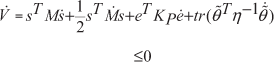
where the process of concrete proof is omitted.
According to the Lyapunov theory, s, e and e and
4. Variable Structure Syncretic Control of Space Robots based on Neural Networks
RBF network belongs to local generalization networks with a certain approximation region. Its approximation region can be divided according to the state space. Parameter learning laws are all defined within the approximation region. However, there are blind sections outside the approximation region. If variable structure control can be utilized to compensate for the nonlinear error outside the approximation region, the controller not only can improve the control precision, but also can still ensure the system has good robustness under conditions of neural network invalidation.
When the neural networks are used to approach uncertainties, the state space of the neural network is divided into three parts [22], namely, neural network control areas Ω NN , variable structure control areas, and the integrated control areas Ω NV between the foregoing two control zones. So it can be defined as follows:
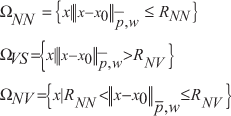
where x = (q, q̇, q̇ r , q̈ r ), x0 is the location of the fixed state space. R NN is the spherical radius of the neural network approximation region. R VS is the spherical radius of the integrated control region. ||*|| p̄,w is the norm of the weighted p̄ of the variables (*) .
The integration function can be defined as

Then expression (7) is redesigned as


where the τ1 is the same as the τ1 of (4). The τ NN is the same as the τ NN of expression (9). τ VS is the variable structure controller. U d =diag(u1, ⃛,u n ) is the variable structure gain matrix, which satisfies u i ≥| f i (υ)|.
The adaptive learning algorithm of the neural network weight matrices should be redesigned as

where η,

Differentiating V with respect to time along the trajectory of the error equation (4), we obtain the following equation:

Using (4), and (16)–(17), we obtain the following

By inserting s=ė+Λe, we come to the following equation:

Using (7), and (11) of the adaptive law,

Considering

So

Hence, it can easily be concluded that e ∈, L2 蝅 L∞,

Because si is bounded, s is uniformly continuous, Which shows that &Vdot;1(t) is a uniformly continuous function of time. And because V1(t) is bounded and V1(t)>0, By using Barbalat lemma, when t → ∞. The paper can obtain that
5. Simulation Research
The paper takes the free-floating two-link space robot as a model to verify the effectiveness of the proposed syncretized neural network control scheme. The simulation parameters are m0 = 500kg, m1 = 12kg, m2 = 10kg, b0 = 1.0m, b1 = 1.0m, b2 = 0.75m, a1 = 1.0m, a2 = 0.75m, I0 = 66kg.m2, I1 = 1.5kg.m2, I2
The desired trajectory is:

The friction parameters selected:F(q, q̇)
For the sake of fairness, each parameter of the two control laws takes the same values. The simulation parameters are respectively U
d
= diag(30,30), ξ
dm
The initial joint positions and velocities are zero. The current location of the state space is chosen as

where q ∈ [–2, 2] rad, q̇ ∈ [–4, 4] rad/s, q̇ r ∈ [–5, 5] × [–5, 5], q̈ r ∈ [–5, 5]×[–15, 15].
Thus, the approximation region of the neural network is chosen as

The network's initial weights are zero. The width of the Gaussian function is 10. The centre of the Gaussian function is randomly selected within the input and output range. The simulation results are shown in Figure 1 – Figure 5.

Joint1 tracking curves of syncretic controller

Joint2 tracking curves of syncretic controller

Position errors of joints
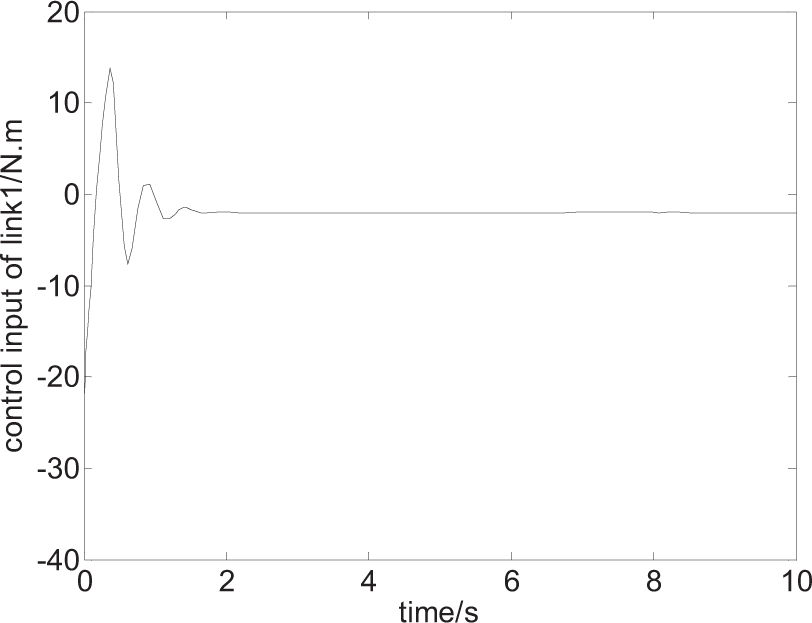
Joint1 control torque of the syncretic controller

Joint2 control torque of the syncretic controller
As can be seen from the figure, the syncretic controller designed by this paper not only can effectively track the desired trajectory in a very short period of time, but also can compensate for all uncertainties, especially, at the early period of control because the variable structure controller compensates for the comparatively large approximation errors which are caused by the neural network. In the early control, Neural network cannot finish study in a short period of time, so neural network controller cannot completely approach uncertain model, at this moment, variable structure controller had compensation effect, thus the two controller together achieve good control effect. The integrated controller can improve control precision and speed up the error convergence velocity more effectively.
6. Conclusions
In this paper, the tracking problems of free-floating space robot manipulators with uncertainties are studied, two kinds of neural-variable structure controllers are designed and, at the same time, adaptive control laws based on Lyapunov can ensure the convergence of the algorithm. None of the proposed schemes need a precise model of the space robot and can guarantee fast tracking for the system in case of a large initial error. The control scheme can be more easily implemented. By integrating the saturation function, the neural network variable's structure integrated controller combines the better approximation capability of the neural network with the stronger dynamic properties of variable structures. So, in comparison with a hybrid controller, the neural-variable structure integrated controller is able to compensate for the system uncertainties more effectively, overcome the defects of local generalization networks, speed up the convergence velocity of the error and improve the control precision.
7. Acknowledgments
The paper is supported by National science and technology support plan(No.2013BAC16B02), Zhejiang Provincial Natural Science Foundation Emphasis Project (No.LZ12F02001), Zhejiang Provincial Natural Science Foundation (No. LY13F020020) and (No.Y14F030011), Zhejiang Provincial Education Department Science Research Project (No.Y201330000), Zhejiang Provincial Science and Technology Project (No. 2013C3110).