




Abstract
The pose of the moving platform in parallel robots is possible thanks to the strong coupling, but it consequently is very difficult to obtain its forward displacement. Different methods establishing forward displacement can obtain different numbers of variables and different solving speeds with nonlinear equations. The nonlinear equations with nine variables for forward displacement in the general 6-6 type parallel mechanism were created using the rotation transformation matrix
1. Introduction
The pose of the moving platform in parallel robots can be realized thanks to the strong coupling, however this also means it is very difficult to obtain its forward displacement. The Stewart mechanism is a general 6-6 type parallel mechanism whose upper and lower platforms are flat arbitrary hexagons connected by 6 sliding pairs with spherical pairs at both ends. The position solutions ultimately boil down to solving a set of nonlinear equations. Solving these equations is extremely difficult and we are faced with which is another difficult problem of mechanism even after completing the displacement analysis in the space 6R series mechanical arm [1]. The forward displacement of the Stewart mechanism is a class of strongly nonlinear algebraic equations with many variables. Different methods establishing forward displacement can obtain different numbers of variables and different solving speeds in nonlinear equations.
For a long time, many scholars at home and abroad have researched this problem [2–11]. Wampler CW [2] carried out a forward displacement analysis of general six-in-parallel SPS (Stewart) platform manipulators using soma coordinates. Innocenti C. [3] solved the problem of forward kinematics in polynomial form of the general Stewart platform. Rolland L. [4] solved the forward kinematics problem with an exact algebraic method for the general parallel manipulator. Wang Y. [5] solved forward kinematics of general Stewart-Gough platforms with a direct numerical solution. Liang [6] and W. Lin [7] achieved forward displacement of the triangle and quadrangle platform-type parallel robot respectively with the use of coincidence hinges, and C.D. Zhang [8] achieved forward displacement of the hexagonal platform-type parallel robot. Compared with the platform type, the 3-D type can effectively avoid the interference of branch chains and extend the working space of the moving platform and the swing range of positive angle. But it exacerbates the coupling of the pose in the moving platform so that it is more difficult to obtain forward displacement. Based on the basic constraint equations of the parallel robot, intermediate variables and mathematical processing in Matlab, three independent equations were established that use the positive angles of the moving platform as the variables [9]. Nonlinear equations which have forward displacements as four variables in a platform-type parallel mechanism were set up [10], and nonlinear equations with seven variables in 3-D parallel mechanism were built [11].
The methods for solving forward displacement in the Stewart platform generally have an analytic and a numerical method. The analytic method for finding the closed form of the forward displacement can give the exact solution, but often generates the middle polynomial which is too large and so is hard to calculate [12]. For the kinematics of the Stewart platform, steps were taken to obtain an estimated number of solutions, some of the real solutions and the closed form of some special configuration, but this is still a long away from completely solving all the real solutions of the equations [13–17]. The numerical methods used for the Stewart platform are mainly the Newton-Rapbson iterative method (referred to as NR method) [18], the homotopy method [19–21], the chaotic method [22], the neurons algorithm [23], the additional sensor method [24], etc., The NR method does not need to solve the complex nonlinear equations with n-order. But in the NR method the calculation speed is unstable, and its convergence of the calculation results and the speed of convergence are all dependent on the initial value. The homotopy and the neurons methods can work out all the solutions, but require large amounts of calculation. The additional sensor method uses the necessary number of additional sensors and a certain arrangement to simplify the solving process of forward displacement position, but the simple additional sensor method has a very high demand with regards to the level of error in the processing and assembling platform parts so that it makes it difficult to calibrate the platform structure.
In the numerical iteration method or the constraint optimization method, if the initial value selected is improper, the convergence of the result is more difficult and all the solutions are more difficult to obtain. This problem has not been fully resolved until now, thus it has been the research focus of many scholars [25]. The Newton iterative method is the traditional numerical iterative method and it has second-order convergence and high performance but this method is extremely sensitive to initial values. Sometimes this phenomenon is considered to be the arithmetic singularity or inevitable singularity, in fact, the reason for the numerical instability is that the NR method is a nonlinear discrete dynamical system where the chaos and fractal phenomena will be generated in the sensitive area. In mechanism and optimal design, the chaos phenomenon is considered to be incomprehensible and unusable, or it is regarded as random figment of the imagination to be ignored.
The rapid development of chaos theory is one of the major achievements of the last century [26]. With the continuous development of society, many nonlinear phenomena and models continue to emerge and so research in this field is on the rise. The international academic community generally sees non-linear mathematics, nonlinear natural science and social science and their technological development as part of the mainstream in the 21st century, while chaos is the basic pattern of almost all sports phenomenon in the natural world. Chaos is considered to be a phenomenon that is seemingly irregular and similar to a ‘random’ in a deterministic system. The most essential characteristic of chaotic behaviour is extreme sensitivity to the initial conditions of the nonlinear system. It has many basic characteristics such as boundedness, ergodicity, intrinsic randomness, scaling, universality, fractal dimension, the positive Lyapunov exponent, unlimited broadband power spectrum and sub-dimensional power spectrum.
The Lyapunov exponent is one of a number of effective methods for depicting the chaos specific property of a nonlinear system. If one of the Lyapunov exponents is positive, the system is chaotic, and if a system has two or more positive Lyapunov exponents, the system is hyper-chaotic. The greater the number of positive Lyapunov exponents, the higher the degree of instability in the system [27, 28]. It is of important theoretical and practical significance that the chaotic and hyper-chaotic systems are used to calculate kinematics. The chaos method can calculate all the real solutions within the scope of the real number and it has high computational efficiency because it does not seek plural results. Of course, imaginary solutions could not be obtained with this method. The method described in Y.X. Luo, D.Z. LI (2003) [22] considers that the points of Julia centralization in the Newton iteration method will appear in the neighbourhood where the Jacobian matrix of the equations is equal to zero. But this guess has not been proven. For the multivariable Jacobian matrix, first, its symbolic expression is found; second, all the variable values are determined except for one variable; finally, the chaos zone is searched for the variable to be determined. So solving the matrix is quite complex. The chaotic sequence method is a new method, in which the initial point of the Newton iteration is generated using the chaotic and hyper-chaotic system and all the real solutions in the mechanism synthesis can be effectively solved [28–32]. But the Hénon hyper-chaotic Newton iteration method cannot solve the mechanism synthesis problem of 6-SPS. When the solutions do not converge using the Newton method or the quasi-Newton method, the mathematical programming method can be adopted [33]. The mathematical programming method together with the hyper-chaotic system was put forward to solve the synthesis problem of 6-SPS by transforming it into nonlinear equations with six variables [34]. The Hénon super-chaotic sequence was combined with the Newton descent method to create the super-chaotic Newton descent method in order to solve this problem by transforming it into nonlinear equations with nine variables [35]. The quaternion method was used to establish nonlinear equations in the synthesis problem of 6-SPS with eight variables and it was solved by using the hyper-chaotic neural networks damped least-square method where the hyper-chaotic neural network produces the hyper-chaotic sequence as the initial iteration value in the damped least-square method [36].
In this paper, nonlinear equations with nine variables on forward displacement in the general 6-6 type parallel mechanism were created using the rotation transformation matrix
The Euler equation for the free rotation of a rigid body was converted to the chaotic system by using chaos anti-control and chaotic sequences were produced. By combining the characteristics of the chaotic sequence with the mathematical programming method, all the solutions of the equations on forward displacement were solved. The numerical example shows that the new method has fast convergence, it can find all the possible real solutions that be found out and it proves the correctness and validity of this method when compared with other methods.
2. Chaotic anti-control of rigid motion
Chaos control can suppress or eliminate chaotic dynamical behaviour. Chaotic anti-control, through external input or adjustment to internal parameters, mainly results in the original non-chaotic system becoming chaos or the chaos of the original system becoming stronger. In order to implement the control and anti-control of chaos, the controller should be designed as simply as possible in order to ensure low-cost, easy realization and convenient use. The creation of a chaos generator to implement chaotic anti-control is a problem for engineering design. A successfully designed, simple and strict chaos controller demands an equivalent level of competency in mathematics and the capability in the engineering design [27,28].
Feedback control is one of the basic methods for the control and anti-control of chaos. The linear feedback controller is the simplest controller that can be used to implement chaotic anti-control. Using Lyapunov exponents of control or anti-control of chaos is one of a number of effective ways to describe the chaotic properties of nonlinear systems. The number of Lyapunov exponents is the same as the dimension n of the state space of the system. If one of the Lyapunov exponents is greater than zero, the system is chaotic, and if at least two of Lyapunov exponents are positive, the system is hyper-chaotic. The greater the number of positive Lyapunov exponents, the higher the degree of instability in the system.
The Euler equations of free rotation of the rigid body are given in Chen H K, Lee C (2004) [27] and Y.X. Luo (2008) [28] as:

where I1, I2 and I3 are the main moments of inertia, ω1, ω2 and ω3 are the angular velocities of the spindle, and M1, M2 and M3 are the imposed torques, respectively. Through the linear feedback system, a non-chaotic free rotation system of rigid body is transformed into a chaotic system. Because the angular velocities are the changing parameters of the system (Note: The mechanism synthesis only requires that chaotic sequences be produced without considering the parameter detection. Of course, it is easy to detect the angular velocities in this engineering system), the imposed moments are feedbacked linearly by the angular velocities, that is, M = Aω, where

Supposed ω1=x, ω2=y, ω3=z, a = a11/I1, b = a22/I2, and c= a33/I3, Eq.(1) is transformed into Eq.(2) as follows

The conditions whereby the system produces chaos are as follows [32]:
Selected I3 = 3I0, I1 = 2I0,I2 = I0 (to meet I3 > I1 > I2), a = 5,b = −10,c = −3.8 (to meet a>0,b<0,c<0 and 0<a<-(b+c)), the strange attractor of the system is as shown in Fig.1 and the Lyapunov exponent in Fig.2. It is seen in these Figures that this system is chaos.
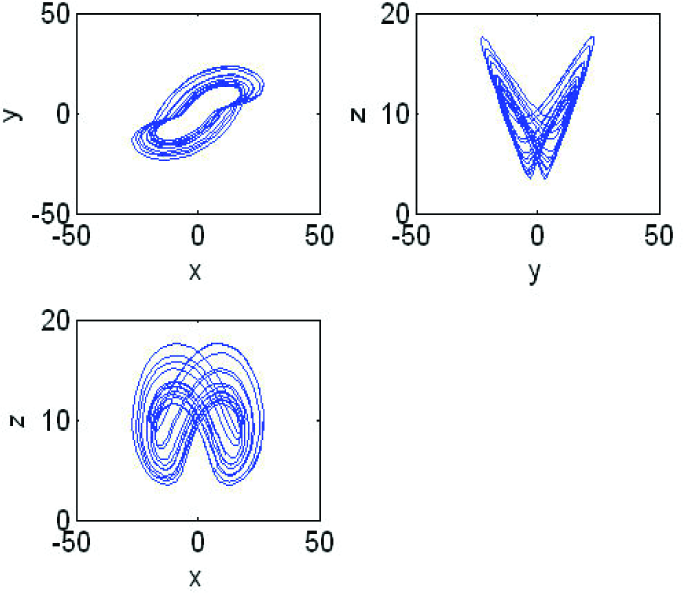
Strange attractor of system
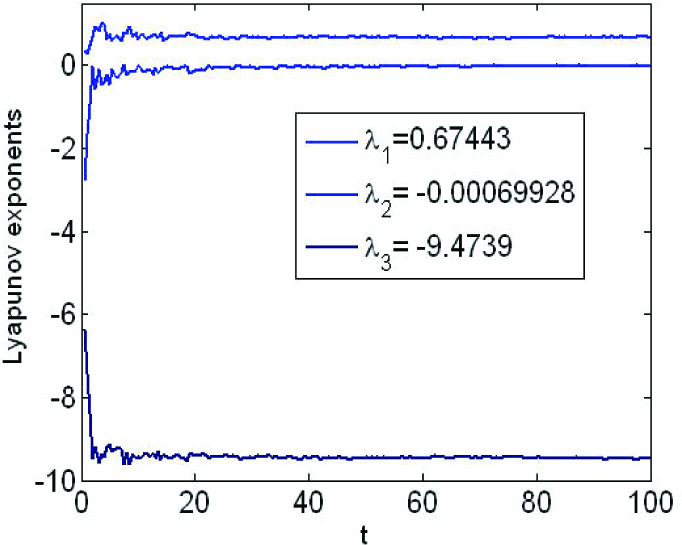
Lyapunov exponent of system
3. The mathematical programming method for nonlinear equations
The Newton iteration method as a traditional method is an important iterative technique for problems that are one-dimensional and multi-dimensional. When the solutions do not converge using the Newton method or the quasi-Newton method, the mathematical programming method can be adopted [33].
The nonlinear equation is given as:

where, fi(x) has a continuous second-order derivative on the open convex set, and fi(x*) = 0(i = 1,2,…,n) at x* x0.
Assuming si = sign(fi(x0),

Then Eq.(3) is transformed as:
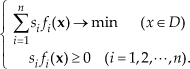
Because si fi(x)>0,
4. The mathematical programming method based on chaotic anti-control for solving nonlinear equations
Using the mathematical programming method based on chaotic anti-control, all solutions of nonlinear equations can be obtained. The calculation steps are as follows:
Constructing the chaos set x0(i,j) according to Eq. (2), i=1,2,…,n where n is the number of variables, and j = 1,2,…, N where N is the length of chaos sets.
Supposing that the variable interval of x(i) is [a(i),b(i)], the chaos set is mapped to the variable interval to generate the jth initial value of x(i), that is, x(i,j).
x(i,j) regarded as the initial value of the mathematical programming method, Eq. (5) has been iterated j times, then all the solutions x* are obtained.
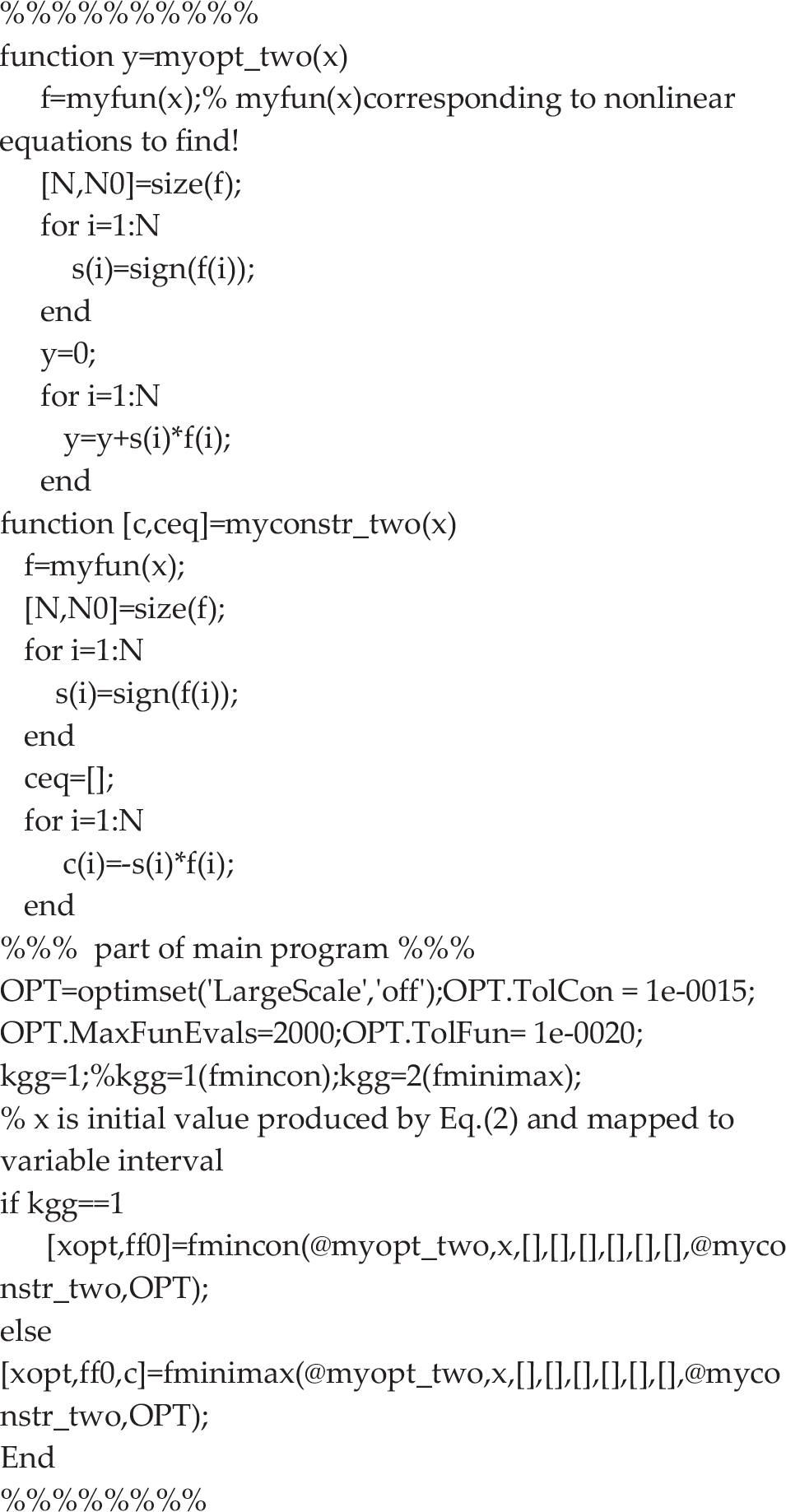
In accordance with the protocol for the fmincon function in Matlab, the objective function @myopt_two and the constraint function @myconstr_two are written, and the Matlab function as fmincon or fminimax is run for each initial value.
5. Mathematical modelling of forward displacement
The structural diagram of the general 6-6 type 3-D parallel mechanism is shown in Fig.3. In this mechanism, the upper plane is connected to the lower by six branched chains with ball joints and sliding pairs. The fixed coordinate system O1x1y1z1 and the moving system O2x2y2z2 are established respectively in Fig.3, where, the coordinates of A and B are

Structural diagram of the general 6-6 type 3-D parallel mechanism
From the condition of the rod length, the following equations can be obtained:


where,
After substituting Eq.(3) into Eq.(2) and expanding it, we can obtain the equation as:





From the Eqs. (12–14), nx, ny and nz can be obtained. Therefore, Eqs. (6–11) are the key and also the difficulty of the forward displacement in the general 6-6 type 3-D parallel mechanism [35]. They are also the mathematical models in this paper which are denoted by the following equation as:

where, there are nine unknown variables lx, ly, lz, mx, my, mz, x, y and z, which are written by x=[lx,ly,lz,mx,my,mz,x,y,z]T.
6. Numerical example
In Fig.3, the coordinate of point Ai in a static coordinate system x1y1z1 is A1(0,0,0), A2(2,0,0), A3(4,1,0), A4(5,3,1),A5(3,5,-1), A6(−1,2,2), and the coordinate of point Bi in a dynamic coordinate system x2y2z2 is B1(0,0,0),B2(1,0,0), B3(2,1,0),B4(4,3,2), B5(3,4,–1), B6(−2,–1,3), l1=11, l2=12, l3=13,l4=15, l5=14, l6=10, thus finding the mechanism's total position forward solutions.
First we put all the data into
If we use the fminimax function to run the anti-control of the chaos mathematical programming method, it will take 45.5s to find all the solutions, which are shown in Tab. 5, Tab. 6 and Tab. 7. Actually, Tab. 1 and Tab. 3 are the same as Tab. 5 and Tab. 7, the only difference is the order of solutions and corresponding initial values are not for the same data.
Four real solutions in example based on the fmincon function

Corresponding initial values to four real solutions based on the fmincon function

Corresponding Euler angles to four real solutions based on fmincon function

Four real results in example based on the quaternion hyper-chaotic mathematical programming method

Four real solutions in example based on the fminimax function

Corresponding initial values to four real solutions based on the fminimax function

Corresponding Euler angles to four real solutions based on the fminimax function

7. Conclusions
In the problem of the forward displacement of parallel robots, we need to solve a class of strongly nonlinear algebraic equations with many variables which are consequently extremely difficult to solve. Different methods establishing forward displacement can obtain different variable numbers and different solving speeds in nonlinear equations. The nonlinear equations with nine variables for forward displacement in the general 6-6 type parallel mechanism were built up using the rotation transformation matrix
Footnotes
8. Acknowledgments
This research is supported by the National Natural Science Foundation of P.R. China (No:51075144) and the grant of the 12th Five-Year Plan for the construct program of the key discipline (Mechanical Design and Theory) in Hunan province(XJF2011[76]).