




Abstract
This paper deals with a unique principle of energy harvesting technologies. An energy harvesting device generates electric energy from its surroundings using some kind of energy conversion method. Therefore, the considered energy harvesting device does not consume any fuel or substance. The presented energy harvesting system is used forenergy harvesting of electrical energy from mechanical shocks. The presented energy harvesting system uses a very sensitive vibration energy harvester, which was developed for an aeronautic application at Brno University of Technology. This energy harvesting system is a complex mechatronic device, which consists of a precise mechanical part, an electromagnetic converter, power electronics (power management) and a load (e.g., wireless sensor). The very sensitive vibration energy harvester is capable of usingthe mechanical energy of mechanical shocks and it can harvest useful energy. This energy harvesting system is used with a wireless temperature sensor and measured results are presented in this paper.
1. Introduction
Energy harvesting technologies have emerged as a prominent research area and continue to grow at rapid pace. A wide range of applications are targeted for the harvesters, including wireless sensor nodes for structural health monitoring, embedded and implanted sensor nodes for medical applications, monitoring of mechatronic systems (e.g., tire pressure in automobiles), recharging the batteries of large systems, etc. An energy harvesting device generates electric energy from its surroundings using an energy conversion method. Therefore, the energy harvesting devices considered here do not consume any fuel or substance.
This paper deals with an energy harvesting system for the harvesting of electrical energy from mechanical shocks. The presented system uses a very sensitive vibration energy harvesting device [1], which was developed forharvesting energy from ambient mechanical vibrations in aeronautic applications [2]. This very sensitive vibration energy harvester is based on a unique spring-less resonance mechanism [3] and it can provide sufficient electrical energy to power a wireless sensor or an autonomous application with a power consumption of several miliWatts [4]. This energy harvesting system is a complex mechatronic device, which is described in paper [5]and it consists of a precise mechanical part, an electromagnetic converter, power electronics (power management) and a load (e.g., wireless sensor).
This system is very sensitive to vibration excitation and the aim of this paper is to present thepossibility of using this system for energy harvesting from random mechanical shocks.
2. State of the Art –Energy Harvesting from Mechanical Energy
Ambient energy is everywhere in the environment surrounding us [6]. This ambient energy is available in the form of solar energy, thermal energy and mechanical energy.
This paper is focused onharvesting energy from ambient mechanical energy. Mechanical energyoccurs in most engineering applications in the form of vibrations, shocks, random movement, deformation, etc. The principle behindharvesting energy from mechanical energy is usually a resonance operation of an oscillating mass and consequentlythe electro-mechanical conversion of kinetic energy into electrical energy [6].
A well-known branch of energy harvesting is the generation of electrical energy from ambient vibrations [7], [8]. These devices operate correctly and efficiently only in a narrow resonance bandwidth. Therefore the design of a vibration energy harvester is tuned to the operation resonance frequency that equals the main frequency of vibrations at an operating location. An excited oscillation movement inside the mechanism is converted by any physical principle of the electro-mechanical conversion [9]. The vibration energy harvesters usually use principles of a piezo-electric, electro-static or electro-magnetic mechanical conversion [10].
Our mechatronic team developed the sensitive electromagnetic vibration energy harvester during years 2004–2010, published in [2], [3], [5]. This harvester was tested in aeronautic applications and the device is capable of independently powering autonomous devicessuch as wireless sensors, remote applications, etc. The maximal output power is around 35 miliWatts, depending on the harvester volume and mass. This vibration energy harvester has got a very sensitive resonance mechanism inside which is under patent protecting and provides sufficient harvesting of energy [1].
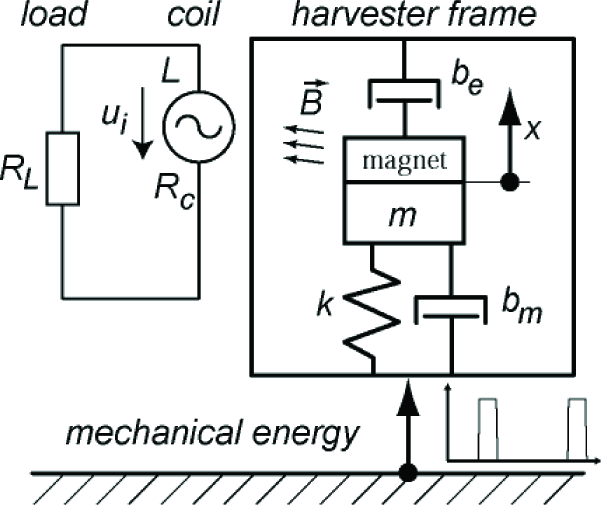
Nowadays our mechatronic team is looking for an independent source of electrical energy for wireless sensors in heavy industry applications. Similar studies were published in papers [11] and [12]. There are many sources of ambient mechanical energy, mainly mechanical shocks. The idea of this paper is using the sensitive vibration energy harvester for the harvesting of electrical energy from these mechanical shocks. The sensitive resonance mechanism inside the harvester can be used for the electro-mechanical conversion of shocks into the useful electrical energy as is shown in Figure 1.
Complex Model of Electromagnetic Energy Harvester
3. Electro-magnetic Vibration Energy Harvester from Brno University of Technology
The electro-magnetic principle of the energy converter is used in our developed vibration energy harvester. This harvester consists of an oscillating magnetic circuit and a fixed self-bonded air coil [3].
The resonance mechanism is a fundamental part of the energy harvesting device. It consists of the oscillating mass m, stiffness k and damping losses bm. It is excited by an acceleration of the mechanical shock. This movement causes a relative oscillation of the mass with a magnetic circuit against the fixed coil L, with the inner resistance Rc. The schematic diagram [1] of a simplified linear harvester that illustrates the basic principle of this harvester is shown in Figure 1.
Due to Faraday's law the oscillation movement provides a change in magnetic field B through the fixed coil and it induces voltage in the coil ui. It causes the generation of electricity, which causes dissipating forces, which are depicted in this system as damper be. This is electromagnetic damping and depends on a current through load RL.
The design is based on a unique spring-less resonance mechanism [1], which provides a suitable sensitivity of the used energy harvesting application. The design is shown in Figure 2, where the moving mass is designed as a pendulum with the magnetic circuit is on the pendulum end.

Topological model of Sensitive Resonance Mechanism
The stiffness of a springy element is provided by repelling forces between fixed permanent magnets and a movable permanent magnet on the pendulum. This mechanism does not contain any mechanical springs and friction forces in the joint of the pendulum cause mechanical damping forces. A joint design, materials and geometry have to be adapted inrelation to the required sensitivity of the harvesting system.
The tested energy harvester [13] is shown in Figure 3 and is assembled from aluminium frame parts and plastic parts. The coil frame and permanent magnet holders are made from plastic material. The total dimensions of the harvester are 50×40×40 mm and its weight is 135g. The resonance frequency of this harvester is around 16.8Hz. Due to the non-linear stiffness of the repelled magnets the resonance frequency can be shifted on the basis of excited movement. The inner resistance of the fixed coil is 226 Ω.

Electromagnetic Energy Harvester with Wireless Sensor
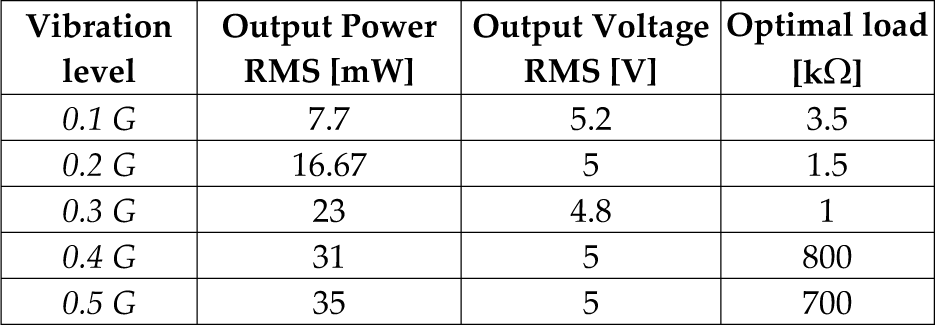
This vibration energy harvester was tested on a lab shaker for different levels of excited vibrations [13]. Measured characteristics for different vibration levels are presented in paper [1] and a review of harvested energy is shown in Table 1. The harvester was excited by the resonance frequency of vibrations. The harvested power depends on the vibration level and impedance of the connected electrical load. Maximal output power is around 35 mW.
Measurement of Electromagnetic Energy Harvester
The applications of this vibration energy harvester are evident from these measurements and this system can be used as the independent source of energy for wireless sensors. An example of the wireless used is shown in Figure 3. Our energy harvester is shown with a wireless sensor module from AmbioSystems LLC. This energy harvester is capable of continuously powering this wireless sensor.
The measurements in Figure 4 show thesensitivity of this harvester against time. It shows the response of this harvesting system to the initial mechanical displacement pulse. This system can induce voltage by around 15 seconds. Induced voltage decreasesin value with time due to mechanical damping losses. The connected load (electronics) affects the decrease in output voltage with time by dissipation losses in the load. The short circuit has maximal dissipation losses and the oscillation mechanical system is stopped during 4–5 periods.

Response on Initial Harvester Displacement without Load
4. Test of Energy Harvesting from Mechanical Shocks
The response of our sensitive vibration energy harvester is tested. The sensitive harvester can harvest energy from non-resonance behaviour too. Therefore, a mechanical impulse in the form of a mechanical shock is provided. The mechanical shock test of our sensitive energy harvester is shown in Figure 5. The harvester was excited by a mechanical lab shakerwith displacement of the harvester basearound 3mm, which corresponds with the maximal shock acceleration of around 12.5 G.

Test of Energy Harvester Excited with Mechanical Shock
The response of output voltage in an open circuit was investigated and measurementsare shown in Figures6–11. The frequency of the mechanical shocks was changed and the responses of the energy harvesting system were observed. The RMS value of output voltage depends on the frequency of the mechanical shocks and is shown in figures below. The frequency of excited mechanical shocks between 2 – 3 Hz provides the maximum RMS value of the output voltage of our vibration energy harvester.

Response on Mechanical Shocks 0.5 Hz– Output Voltage RMS 5.1 V

Response on Mechanical Shocks 2 Hz – Output Voltage RMS 8 V

Response on Mechanical Shocks 3 Hz – Output Voltage RMS 8.1 V

Response on Mechanical Shocks 4 Hz – Output Voltage RMS 3.5 V

Energy Harvesting from Random Mechanical Shocks, Measurementsand Wireless Sensing

Wireless Measurements of Temperature in Place of Energy Harvesting Test
The higher frequency, around 4 Hz, causes behaviour such as vibration and the waveform of the induced voltage is affected. It is clear that the maximum output power will be harvested during resonance behaviour. However, the shock response of this system can be used for energy harvesting application too. Therefore, this test shows a possible use of our sensitive vibration energy harvester as a suitable source of electrical energy for wireless application in the environment, which is excited by mechanical shocks. The acceleration and shape of the mechanical shock affects the harvesting of electrical energy. Mechanical shocks,which are often observed in heavy industrial application, can be used as a suitable source of electrical energy for energy harvesting applications.
Suitable electronics and power management circuits have to be used for the processing of harvested energy. Several strategies can be used and they were published in papers [14, 15]. Our team tests the solutions of our colleagues, which is described in paper [16]. This circuit did not operate correctly, due to different impedance with the optimal operating point of the harvester, as was mentioned in Table 1. This is the main problem of common power management circuits. The impedance of the electronics has to correspond with the parameters of the energy harvester. Therefore, only commercial products, which were developed for similar energy harvesting devices, can be used for our energy harvesting application. We tested several products and found that the wireless module with the power management circuit from AmbioSystems LLC cooperates correctly with our harvester(information about this product is available at website [17]). This productprovides the optimal solution for wireless sensing, with the source of electrical energy from mechanical shocks.
5. The Energy Harvester as a Source of Energy fora Wireless Sensor
The presented sensitive vibration energy can be used as an autonomous source of electrical energy in the environment, which is excited by random mechanical shocks. This energy harvesting system was tested as an autonomous source of energy for a wireless sensor. The wireless module fromAmbioSystems LLCwas used with a temperature sensoralso from this company. The temperature sensor will measure environmental temperature with frequency of measurements 1 Hz if electrical energy is provided by the energy harvester. This wireless module allows for the integration of energy harvesting electronics and power management, with a wireless sensor interface. Using this module with our energy harvester provides a unique platform for self-powered sensing applications.
A complex mechatronic system was used for thetesting of this energy harvesting application. The testing apparatus consists of a mechanical system with random shocks, acceleration measurement, an energy harvester, output voltage measurement, the AmbioSystemswireless temperature sensor and a laptop with anAmbioSystems wireless receiver. This testing apparatus is shown in Figure 10.
The wireless sensing of the temperature sensor was observed in the remote laptop. The laptop with the AmbioSystems wireless receiver was placed in a neighbouringlab; it is shown in Figure 11.
The mechanical system tested consists of a fixed frame and an aluminium beam. The energy harvester is placed on the free end of the supported aluminium beam. The opposite end of the beam is excited by an external random mechanical shock and the acceleration of the end of the beambearing the energy harvester is measured by the accelerometer. The measurement of the used mechanical shock is shown in Figure 12.

Acceleration of Used Mechanical Shock
This shock causes oscillation of the sensitive energy harvester and the voltage is induced. The output voltage with an open circuit is shown in Figure 13, as a response to the mechanical shock.

Voltage Response on Example of Mechanical Shock
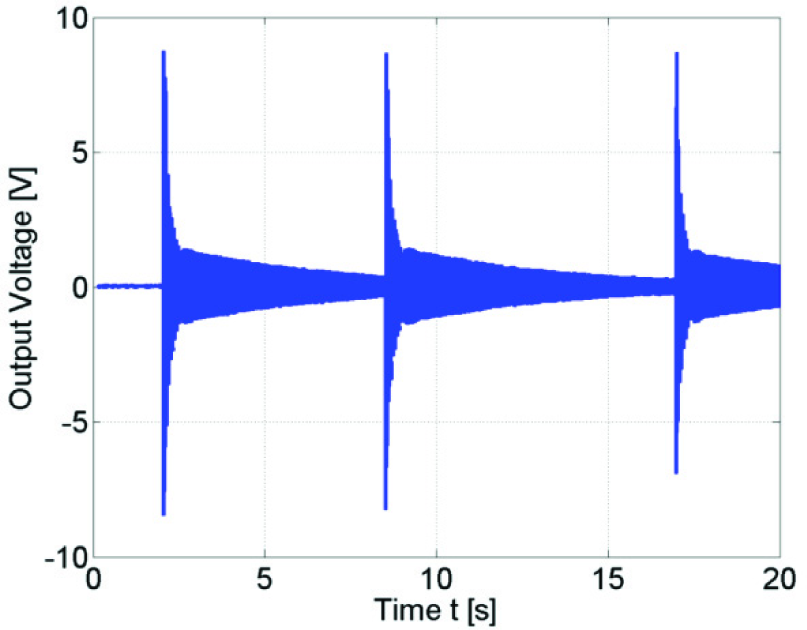
These shocks were randomly repeated at around 3–10 second intervals. An example of the output voltage of the energy harvester is shown in Figure 14. This energy harvesting system was used for powering a wireless temperature sensor and the operation of the whole mechatronic system was tested.
Voltage Response on Random Mechanical Shocks
This energy harvesting systemcan provide asuitable tool forautonomous wireless temperature monitoring, as is shown in Figure 15. This figure shows a report of lab temperature, which was measured the harvested energy from random mechanical shocks. Electrical energy, which was harvested from a mechanical shock response, can be used for 3 wireless measurements of the lab temperature and the measured data can be received by thecomputer atadistance of 20 metres fromthe testing lab.

Logging Utility of Ambio Wireless Temperature Sensor
6. Conclusion
Our developed sensitive vibration energy harvester can be used for harvesting energy from mechanical shocks and for wireless sensing tasks, as was presented in this paper. The future harvesting of energy can be improved with modern power management circuits, which can be optimized for chosen applications. The use of modern energy storage elements can also improve the operation of such an energy harvesting system. This mechatronic solution of the presented energy harvesting system may provide a new autonomous energy source and it promises to be useful in heavy engineering applications for wireless sensing and monitoring systems, or in intelligent diagnostic systems.
The wide use of energy harvesting systems has been mentioned several times, for example in publications [6, 9, 10 and 18]. Energy harvesting technologies, especially harvesting from mechanical energy, promise future expansion to control systems, e.g., [19]. Energy harvesting systems from mechanical energy can follow photovoltaic energy harvesting systems, which are commonly used in various applications,e.g., [9, 10, 12 and 20].
Footnotes
7. Acknowledgements
The present work has been supported by the project “Complex Affordable Aircraft Engine Electronic Control (CAAEEC)” under The Technology Agency of the Czech Republic and additionally this work was supported by the faculty project FSI-S-11-23.