




Abstract
With the growing popularity of wireless sensor networks, the environment in which the network is located becomes more undesirable. In addition, the problems of spectrum scarcity and the short sensor lifetime have become increasingly prominent. In this article, we incorporate the two technologies of cognitive radio and energy harvesting to solve the above problems of wireless sensor networks under impulsive noise. First, we use a Middleton Class A noise model to imitate the practical environment and the fractional lower order moments detector is employed to perform spectrum sensing for the sensors of wireless sensor networks, which are performing as the second users. Second, a new time-slots structure is proposed for the self-powered second user and the analytical expression of the second user’s average throughput is derived. Finally, we maximize the second user’s average throughput by a joint optimization of the sensing duration and data transmission duration while giving the primary user sufficient protection. Simulation shows that a much better performance can be achieved by fractional lower order moment detector than the traditional energy detector. Moreover, our optimization of the time-slots allocation is feasible and the maximum second user’s average throughput can be obtained.
Keywords
Introduction
With the increasing popularity of wireless services and applications, such as smart cities and e-healthcare systems, the wireless sensor networks (WSNs) play an indispensable role as a popular solution of information collection. 1 Taking into account the application scenario, WSNs should ensure that the user can be provided with reliable data for a relatively long period. However, traditional WSNs operate in the industrial, scientific, and medical (ISM) band where sensors may suffer spectrum shortage and severe interference due to a large number of potential applications in this band. 2 To deal with the issue of spectrum scarcity, cognitive radio (CR) can be integrated into WSNs for allowing sensors to utilize licensed bands opportunistically when they are not heavily occupied by licensed primary users (PUs).3,4
For establishing cognitive WSNs, reliable spectrum sensing is essential because the operation of CR sensors as the second users (SUs) starts with detecting the absence of PUs. Compared with traditional sensors, spectrum sensing will increase the energy consumption of CR sensors which are typically powered by batteries. For guaranteeing longer lifetime of CR sensors, promising technologies for improving energy efficiency has been proposed. 5 As one of the effective approaches, energy-harvesting (EH) technology is the most widely studied one for improving the energy efficiency of WSNs.6–11 CR sensors equipped with EH circuits can harvest energy from either PU signals or ambient energy sources, which support the sensor to work sustainably without replacing the battery. 7
After EH technology being employed in cognitive WSNs, the frame structure of the network will be composed of EH duration, spectrum-sensing duration, and data transmission duration. How to maximize the network throughput by allocating time-slots for each duration is a question worthy of study. Extensive research efforts have been made in the literature. An EH SU model, investigated by Hoang et al., 8 states that the SU can harvest the radio frequency (RF) energy of the PU signal after detecting that the channel is occupied by a PU. For supplying the energy consumption of spectrum sensing, Liu et al. 9 proposed a multislot simultaneous spectrum-sensing and EH model and maximized the throughput of the SU under the constraints of sensing performance and EH. Li et al. 10 used the Markov decision process framework to determine the optimal spectrum-sensing energy, the transmit energy, and spectrum-sensing interval to optimize the long-term average throughput of the SU and the interference caused to the PU. For most of the existing contributions, there are several assumptions in common. First, EH is always operating after spectrum sensing, which makes the SU not to be self-powered; second, spectrum sensing is usually considered being performed under the additive white Gaussian noise (AWGN) channel; and third, energy detector (ED)-based sensing method is employed for simplicity. However, WSNs are usually corrupted by low-probability, high-amplitude impulsive interference due to the environments where the networks are implemented. This kind of interference can be natural or man-made and has been found to be significant in many environments.12–14 Examples include atmospheric noise, power lines, automobile ignitions, and wireless systems in the vicinity of the cognitive WSNs.
Being different from AWGN hypothesis, ED-based sensing in a channel contaminated by strong impulsive noise suffers a significant performance loss. Therefore, the analysis of network performance needs to be reconsidered under impulsive noise assumption. In this article, we investigate the EH-aided self-powered cognitive WSNs performing under impulsive noise. Fractional lower order moments (FLOM)-based detector is utilized in our scheme, and we maximize the SU’s average throughput through the joint optimization of spectrum-sensing duration, data transmission duration, and sensing parameters. The main contributions of this article are summarized as follows:
We study the problem of spectrum sensing under Middleton Class A noise adopting FLOM-based detector and derive the analytical expressions of the probability of false alarm
We propose a frame structure of the self-powered SU with three durations of EH, spectrum sensing, and data transmission. Using the proposed structure, SU can perform EH in the data transmission time-slots when the PU is detected as present.
We make the optimization of SU’s average throughput without interfering the PU’s signal by satisfying the tolerant detection probability constraint.
The following parts of this article are organized as follows. The noise model are defined in section “Middleton Class A noise model.” The sensing performance of the ED and FLOM detector are derived, and the frame structure with EH are proposed in section “Spectrum sensing and energy harvesting under Middleton Class A noise.” In section “Throughput analysis and optimization,” the average throughput of SU is analyzed and optimized. Section “Simulation and results” includes the simulation and the results, and the conclusion is drawn in section “Conclusion.”
Middleton Class A noise model
There are several models approximating practical impulsive noise such as Middleton Class A model, symmetric

where
In addition,
Spectrum sensing and EH under Middleton Class A noise
Spectrum sensing under Middleton Class A noise
A CR-based sensor wants to access licensed bands opportunistically, it must detect the presence and absence of the PU signal in advance, which is known as spectrum sensing. Due to the two opposite states of the PU signal, the problem of spectrum sensing can be considered as the following binary hypothesis testing problem 16

in which,
First, the ED-based spectrum sensing is considered as most of the existing literature. The corresponding test statistic can be expressed as

Based on the Bayesian model defined in Kay,
17
we assume that the PU signal
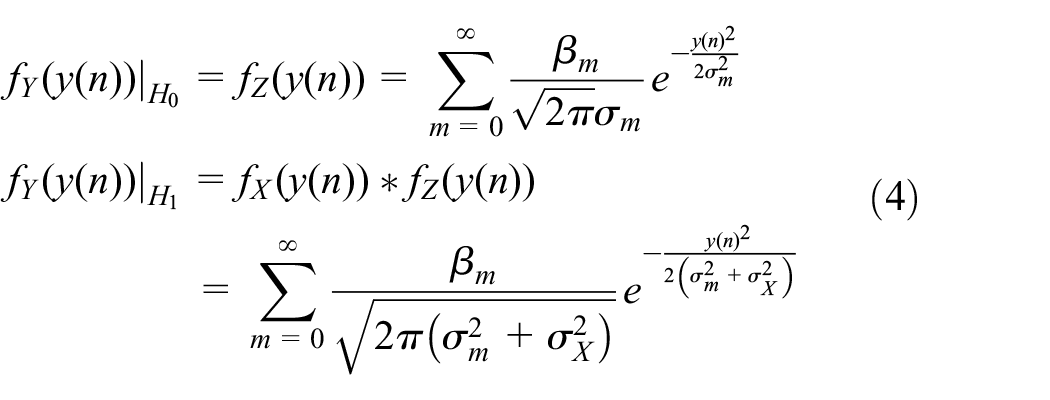
According to the central limit theorem (CLT),
18
when the number of observed samples

in which

Thus, the probability of false alarm

where
The structure of ED is simple and easy to be established. However, the performance of ED-based sensing is not satisfactory, especially when the noise has high impulsiveness. FLOM-based detector showed its capability of sensing under Middleton Class A noise in a study by Xu et al. 19 By means of fractional power operations, the large amplitudes of impulsive noise will be significantly mitigated, as a result the sensing performance will be improved.
So, second, FLOM-based sensing is considered in this article. The corresponding test statistic of the FLOM-based detector is given in equation (8)

where
The structure of FLOM-based detector is shown in Figure 1. Similarly, when the number of observed samples

in which


Structure of FLOM-based detector.
Similarly, with the assumption that the noise

Since the

where
Then the equation (11) can be further simplified as

So we can obtain that

Thereafter, the probability of false alarm

where
EH
For a practical implemented WSN, the lifetime of the sensor is the longer the better. Spectrum sensing solves the problem of spectrum access for the SU, but it increases the energy consumption compared to the traditional sensors. So we investigate a self-powered SU that has no fixed power and has to extract energy by harvesting the ambient RF energy, then converts the harvested energy to the electrical power to supply itself. Moreover, the SU is assumed to be equipped with only one antenna, due to the hardware limitation. Therefore, at any certain instant, the SU can only perform one of the following three operations: EH, spectrum sensing, or data transmission.
20
The time-slots structure of the SU proposed in this article is shown in Figure 2. In each frame with duration
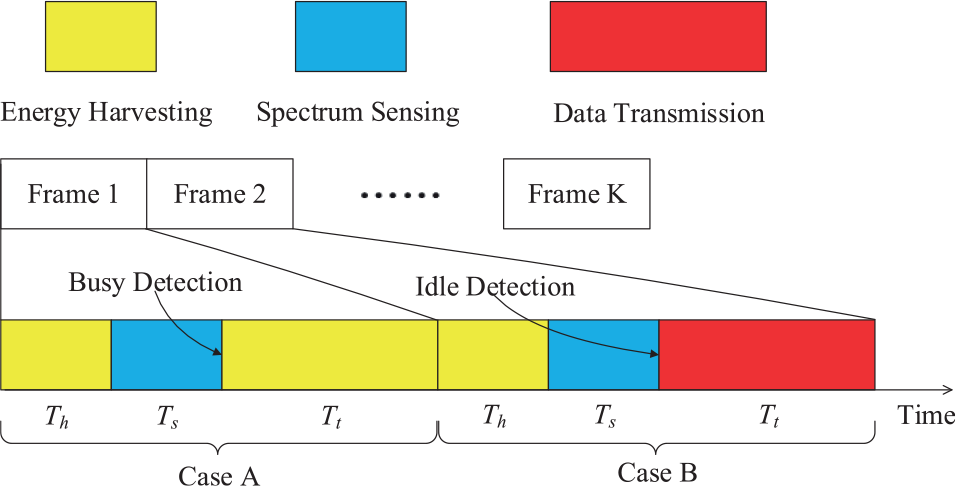
The time-slots structure of the SU.
As shown in Figure 2, the SU will perform the following 3 steps:
1. EH: During time-slots (0,
2. Spectrum sensing: During time-slots (
3a. EH: If the result of spectrum sensing is that the PU signal is present, the SU still performs EH during time-slots (
3b. Data transmission: If the result of spectrum sensing is that the PU signal is absent, the transmitter of the SU is powered on for data transmission during time-slots (
During EH time-slots, energy is harvested and deposited at a fixed rate
From Figure 2, it is obvious that SU has two different operations after EH and spectrum sensing. Depending on whether EH or data transmission is performed after spectrum sensing, we can classify SU’s successive operations into two cases: Case A, SU performs EH, spectrum sensing and data transmmission sequentially; Case B, SU goes through EH, spectrum sensing, and data transmission. The probability of occurrence of different cases is different due to the randomness of the channel status and sensing results. So the probability of each case needs to be further calculated.
Case A: It happens when the result of spectrum sensing is PU signal present. No matter the result is correct or not, the SU will operate EH after spectrum sensing. The probability of Case A can be written as

where
Case B: It happens when the result of spectrum-sensing PU signal is absent. No matter whether the result is correct or not, the SU will operate data transmission after spectrum sensing. The probability of Case B can be written as

Obviously,
Case B1: SU correctly detects the absence of PU. The probability can be written as

Case B2: On the other hand, SU wrongly detects the absence of PU. The probability can be written as

Throughput analysis and optimization
Throughput analysis
The SU’s throughput may vary with time due to the randomness of channel status. So it is reasonable to analyze the average throughput of SU over a long period of time. In other words, the throughput should be a probability-weighted statistic. Consider that the channel is correctly detected as PU absent at an instant, before which the channel may be detected as PU present for

Similarly, the SU may detect the PU’s presence for

Before data transmission, the energy gathered by harvesting under both conditions is
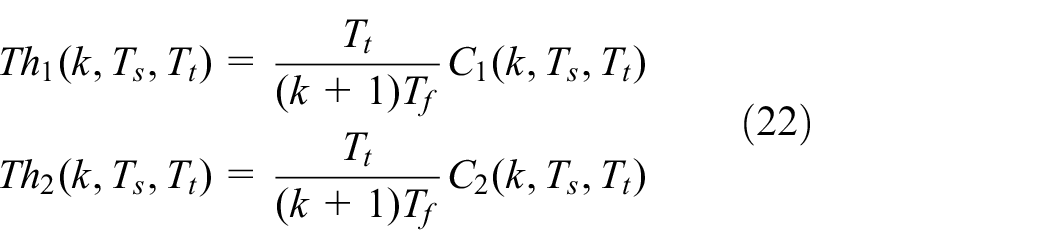
By combining equations (20)–(22), the average throughput of the SU for a relatively long time can be expressed as a probability-weighted summation of the instantaneous throughput as follows

Throughput optimization
In this article, we aim to maximize the average throughput of the SU under some essential constraints. First, the SU should provide sufficient protection for PU. It means that the detection probability of spectrum sensing should be no less than a tolerant threshold. In addition, for the SU is self-powered, the energy harvested should be sufficient to perform spectrum sensing and data transmission. This implies that, the harvested energy should be no less than the energy consumption of spectrum sensing. Considering the worst condition where Case B first happens, that is

where
Assume that

Now consider a certain value of spectrum-sensing duration

Then the maximum average throughput with

The same as
It is worth mentioning that, the SU’s average throughput
Searching algorithm for optimal

Simulation and results
Spectrum-sensing performance analysis of FLOM-based detector
In this section, we give the simulations of the sensing performance based on FLOM detector and show how it outperforms ED with different order

Probability of detection
From Figure 3, it can be seen that traditional ED-based sensing
Average throughput of SU versus time-slots allocation
For evaluating the impact of the time-slots allocation on the SU’s average throughput and verifying the feasibility of the optimization method, the SU’s average throughput varying with sensing duration and transmission duration is simulated. To simulate the typical impulsive noise environment, the noise parameters are set as
Simulation parameters and values.

SNR: signal-to-noise power ratio; PU: primary user.
The simulation results with the parameters aforementioned are shown in Figure 4. Several conclusions can be drawn from observing Figure 4. First, the SU’s maximum average throughput will be obtained with an optimal pair of values of spectrum-sensing duration and data transmission duration. In this scenario, the optimal sensing duration and data transmission duration are

The SU’s average throughput versus sensing duration and data transmission duration.
For comparing the performance of FLOM-based sensing and ED-based sensing, Figure 5 shows the corresponding SU’s maximum average throughput with the sensing duration

The SU’s maximum average throughput versus sensing duration of FLOM-based sensing and ED-based sensing at (a)
Impact of the EH rate and the PU signal’s SNR
Now we consider the impact of the EH rate on the time-slots allocation and the SU’s maximum average throughput for both sensing methods at
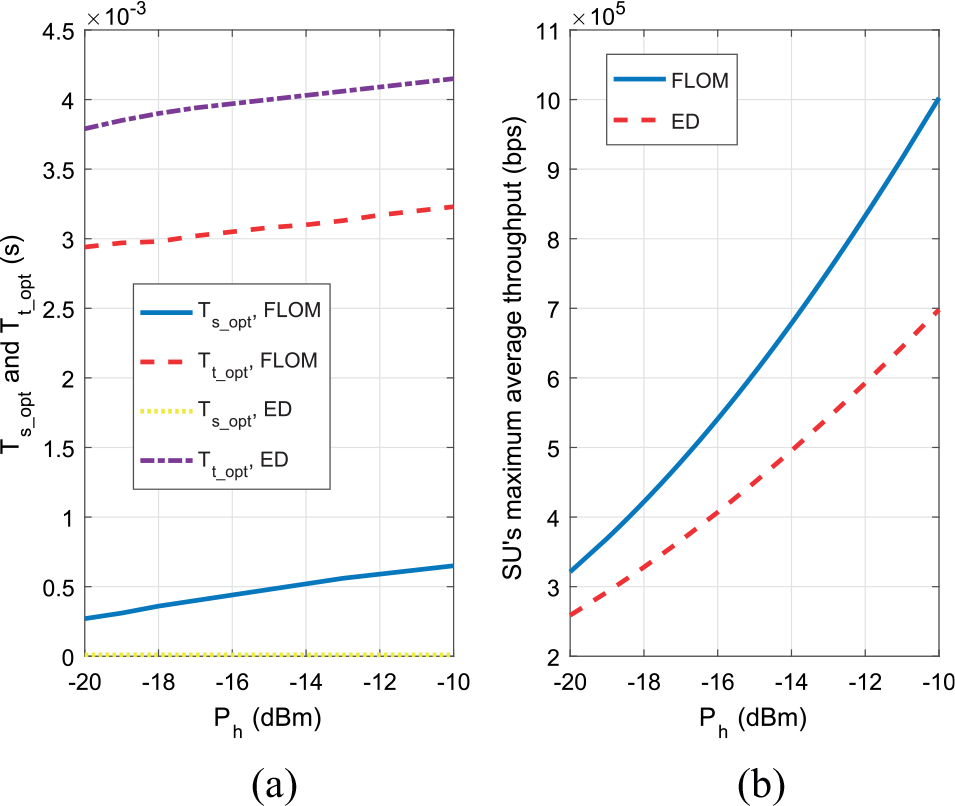
(a) The optimal sensing duration
Next, the effect of PU signal’s SNR on the SU’s maximum average throughput and time-slots allocation is investigated. At a fixed EH rate
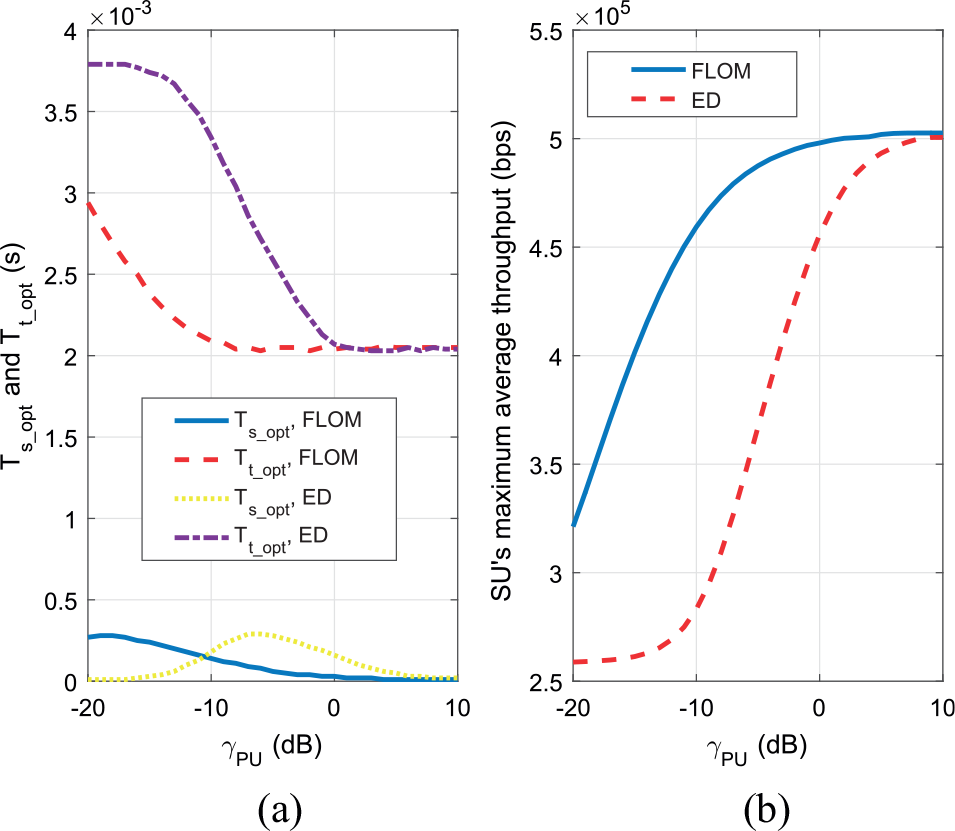
(a) The optimal sensing duration
Conclusion
Spectrum scarcity and the short sensor lifetime are two urgent problems needed to be overcome for establishing WSNs. The two technologies of CR and EH can help WSNs solve these problems. By dividing the frame of SU into three segments, naming EH duration, spectrum-sensing duration, and data transmission duration, the SU can be self-powered and access unlicensed spectrum bands. A maximum SU’s average throughput can be obtained by a joint optimization of the three durations under the constraint of protecting PU’s communication. In addition, by employing the FLOM detector, spectrum sensing can work reliably under Middleton Class A noise, and the maximum SU’s average throughput will be much higher than using ED-based sensing at low PU signal’s SNR.
Footnotes
Handling Editor: Ning Zhang
Declaration of conflicting interests
The author(s) declared no potential conflicts of interest with respect to the research, authorship, and/or publication of this article.
Funding
The author(s) received no financial support for the research, authorship, and/or publication of this article.
