




Abstract
Moving shadows constitute problems in various applications such as image segmentation and object tracking. The main cause of these problems is the misclassification of the shadow pixels as target pixels. Therefore, the use of an accurate and reliable shadow detection method is essential to realize intelligent video processing applications. In this paper, a cepstrum-based method for moving shadow detection is presented. The proposed method is tested on outdoor and indoor video sequences using well-known benchmark test sets. To show the improvements over previous approaches, quantitative metrics are introduced and comparisons based on these metrics are made.
1. Introduction
In many computer vision applications, moving shadows may lead to inaccurate moving object detection results. All moving points of both objects and shadows are detected at the same time in most common video foreground object detection methods requiring inter-frame differentiation or background subtraction. In addition, moving shadow pixels are normally adjacent to moving object pixels. Hence, moving shadow pixels and object pixels merge into a single blob causing distortions of the object shape and model. Thus, the object shape is falsified and the geometrical properties of the object are adversely affected by shadows. As a result of this, some applications, such as classification and assessment of moving object position (normally given by the centroid shape), give erroneous results. For example, shadow detection is of utmost importance in forest fire detection applications [1] because shadows are confused with smoke regions as shown in Figure 1. Another problem arises when shadows of two or more close objects create false adjacency between different moving objects resulting in the detection of a single combined moving blob. It is also well-known that shadow regions retain underlying texture, surface pattern, colour and edges in images.

The source of the shadow regions are the moving clouds
In recent years, many algorithms have been proposed to deal with shadows of moving objects. In [2] it is pointed out that Hue-Saturation-Value (HSV) colour space analysis as a shadow cast on a background does not change its hue significantly. There have been some further studies on HSV colour space analysis for shadow detection such as [3] and [4].
In Jiang and Ward's [5] research, classification is done on the basis of an approach that shadows are composed of two parts: self-shadow and cast shadow. Self-shadow is defined as the part of the object which is not illuminated by the light source. The cast shadow is the area projected on the scene by the object. Cast shadow is further classified as umbra and penumbra. This detailed classification is also used in [6].
Some other approaches in the field are also used. The usage of multiple cameras for shadow detection is proposed by Onoguchi [7]. Shadow points are separated using the fact that shadows are on the ground plane, whereas foreground objects are not. Another proposed method uses geometry to find shadowed regions [8]. It produces height estimates of objects using their shadow position and size by applying geometry.
There have also been some useful comparative evaluations and classifications of existing approaches. The shadow detection approaches are classified as statistical and deterministic type, and comparisons of these approaches are made in [9], [10] and [11].
In this paper, a deterministic two-dimensional cepstrum analysis-based shadow detection method is proposed. As the first step, hybrid background subtraction-based moving object detection is implemented to determine the candidate regions for further analysis. The second step involves the use of the proposed non-linear method based on cepstrum analysis of the candidate regions for detecting the shadow points inside those regions.
The next section presents the proposed cepstrum-based shadow detection method. Results of the proposed method and comparisons with previous approaches are presented in Section 3. The final section presents conclusions.
2. Cepstrum Analysis for Moving Shadow Detection
The proposed method for moving shadow detection consists of two parts. In the first part, a method based on hybrid background subtraction [12] is used to determine the moving regions. After determining moving regions, cepstrum analysis is carried out on detected moving regions in order to yield the regions with shadows. The proposed cepstrum analysis method for shadow detection is composed of two parts. The first part includes the separation of the moving regions into 8×8 blocks and the application of the 2D cepstrum to the blocks of interest and their corresponding background blocks to decide whether or not the texture and colour properties are preserved for that moving block. If it is decided that the properties are preserved for the block, the algorithm proceeds with the second part. If not, the detection algorithm marks the block as a moving object block. In the second part, a more detailed pixel-based approach is considered. 1D cepstrum is applied to each pixel belonging to the block to decide if the pixel is a moving shadow pixel or object pixel.
Note that the block size of 8×8 is decided for optimization of the shadow detection performance. It is seen that for larger block sizes, the precision of the algorithm for moving shadow pixels inside the block becomes worse resulting in a decreased shadow detection rate. For smaller block sizes, the algorithm loses its advantage of eliminating false moving shadow pixels resulting in a decreased shadow discrimination rate.
The following subsections present the parts of the proposed cepstrum analysis method.
2.1 Part I: Cepstral Analysis of Blocks
The cepstrum ◯[n] of a signal x is defined as the inverse Fourier transform of the log-magnitude Fourier spectrum of x. Let x[n] be a discrete signal, its cepstrum x[n] is defined as follows:

where F{.} represents the discrete-time Fourier transform, |.| is the magnitude, ln(.) is the natural logarithm and F−1{.} represents the inverse discrete-time Fourier transform operator. In our approach, we use both one-dimensional (1D) and two-dimensional (2D) cepstrums for shadow detection.
Moving regions in video are divided into 8×8 moving blocks as a subset of the whole moving region. Let the i-th moving 8×8 block be defined as R. Then, 2D cepstrum of Ri, ◯[n] is defined as follows:

where F2D{.} is the 2D discrete-time Fourier transform and F2D−1{.} is the inverse discrete-time Fourier transform operator.
Similarly, let the i-th corresponding background block for the current image frame be defined as

Theoretically if the block of interest is part of a shadow, it should have the following property[13]:

where α is a positive real number less than 1. The effect of this on the difference matrix in the 2D cepstral domain is:

Notice that this operation is done for R, G and B values of the block separately. Therefore, the distance metric Mi is used as follows:

where mi,r mi,q and mi,b is the R, G and B component distance metric, respectively. Therefore, the decision algorithm for the first part is:

where σ is a determined threshold. After detecting possible candidate 8×8 shadow regions, we examine each pixel of such regions one by one to determine the exact boundary of shadow pixels as follows.
2.2 Part II: Cepstrum Analysis of Pixels
Red, green and blue values and the estimated background values of the pixel positioned at × = (xl, x2) in the nth frame are defined as:

Theoretically, a shadow pixel positioned at x in nth frame should have the property:

We use a DFT of size 4 in our implementation and check the second, third and fourth cepstral coefficients, v̂ x,n [2], v̂ x,n [3], v̂ x,n [4] and their counterpart cepstral coefficients of background location, b̂ x,n [2],b̂ x,n [3],b̂ x,n [4]. They should be equal if the pixel of interest is a shadow pixel. First cepstral coefficients, v̂ x,n [1] and b̂ x,n [1] should be different due to the effect of the natural logarithm of coefficient α. Using this fact, we define a difference vector: d x,n =|v̂ x,n -b̂ x,n |. Shadow detection method for moving pixels inside the block is given as follows:

where τ is an adaptive threshold changing its value as a function of the background pixel value for the current image frame.
3. Experimental Results
In this section, the outcomes of the proposed algorithm are presented and comparisons with some of the previous approaches are made. The benchmark test set available in [14] is used in this paper as it is widely referenced by most of the researchers working in the field. Each video sequence in the benchmark test set has a different sequence type, shadow strength, shadow size, object class, object size, object speed and noise level. The detailed benchmark test properties are given in Table 1.
Used benchmark test properties in detail

The video sequence “Campus” (Figure 2a) has very low shadow strength as well as high noise level. In Figure 2b, it is clearly seen that two moving objects are detected perfectly and most of the moving shadow points on the ground are successfully marked. Similarly, the algorithm is applied to other video sequences having different properties in the test benchmark and it is seen that moving object points and moving shadow points' classification is successfully obtained as shown in Figures 3, 4 and 5.

(a) Original video frame(b) Detected moving objects and shadow regions from “Campus” video
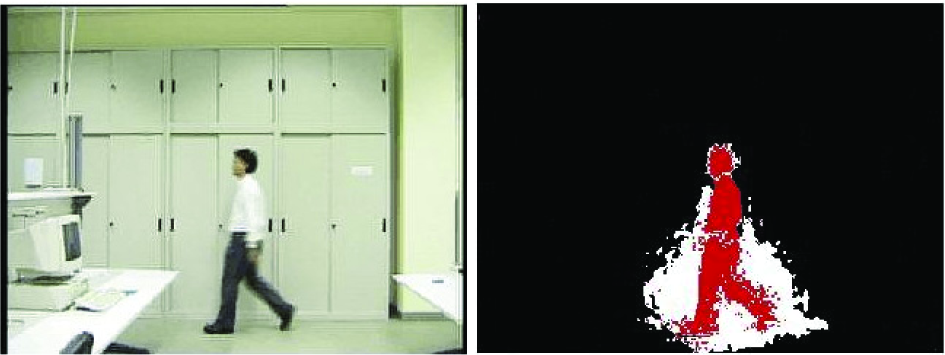
(a) Original video frame (b) Detected moving object and shadow regions from “Laboratory” video
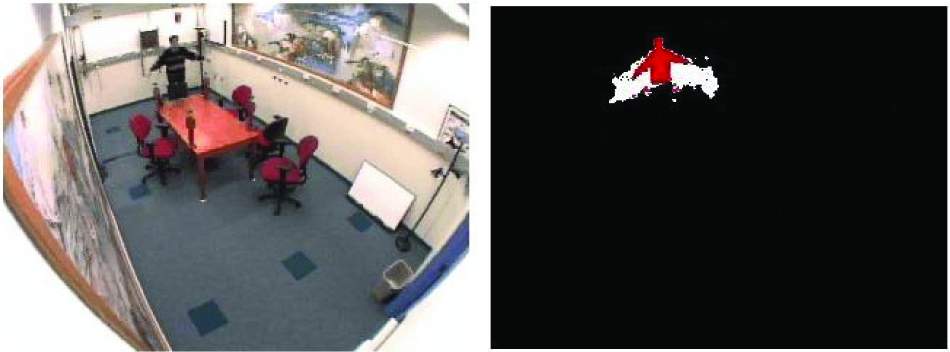
(a) Original video frame (b) Detected moving object and shadow regions from “Intelligent room” video

(a) Original video frame (b) Detected moving objects and shadow regions from “Highway II” video
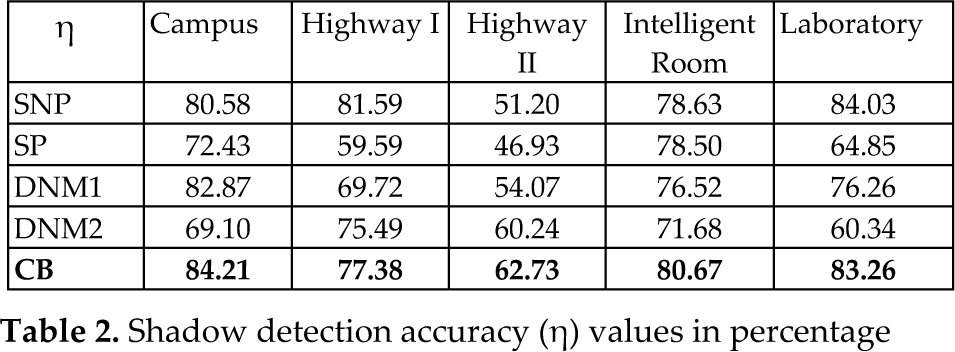
In order to compare the performance of the proposed method with the others, quantitative measures are used. In this study, shadow detection accuracy η and shadow discrimination accuracy ξ metrics introduced in [10] are used as the quantitative measures for comparison purposes. The reason for selecting [10] for comparison is due to the existence of detailed classification schemes and utilization of different approaches available in the literature for shadow detection in its content. Table 2 and Table 3 summarize the performance of the proposed method and the other methods using the same benchmark test set. In the tables, the abbreviations SNP, SP, DNM1, DNM2 and CB stand for the statistical non-parametric approach, the statistical parametric approach, the deterministic non-model-based approach using colour exploitation, the deterministic non-model-based approach using spatial redundancy exploitation and the proposed cepstrum-based approach, respectively. The ξ and η values in percentage for the proposed approach are commonly better than the SNP, SP, DNM1 and DNM2 approaches used by the other researchers in the literature. Note that this comparison is made based upon the available results given in [11].
Shadow detection accuracy (η) values in percentage
Shadow discrimination accuracy (η) values inpercentage

4. Conclusions
In this paper, a shadow detection method based on cepstral domain analysis is proposed. The method is a two step approach with moving object detection followed by cepstral analysis for moving shadow detection. The cepstral analysis steps are based on the fact that shadow regions retain the underlying colour and texture of the background region. After determining the possible shadow blocks in the first step, a pixel-based decision mechanism is used to determine the exact shadow boundaries.
In benchmark data test sets, it is observed that the proposed method gives good results. It is seen that the proposed cepstral domain method can successfully determine shadow regions retaining the underlying colour and texture of the background region. The shadow pixels and object pixels are segmented accurately in all video sequences. Finally, quantitative measures are defined for comparison with previous approaches. The detection and discrimination rate comparisons show that the proposed method gives better results than other approaches available in the literature.
Footnotes
5. Acknowledgments
The research leading to these results has received funding from the European Community's Seventh Framework Programme (FP7-ENV-2009-1) under grant agreement no FP7-ENV-244088 “FIRESENSE - Fire Detection and Management through a Multi-Sensor Network for the Protection of Cultural Heritage Areas from the Risk of Fire and Extreme Weather”.
This article was presented in part at the 2010 IEEE International Workshop on Multimedia Signal Processing, France, Oct. 2010