




Abstract
Commercialization is a critical step in technological innovation. Nevertheless, many scholars believe that it is often the least well-managed activity of the whole innovation process. The launch stage seems to be particularly critical in high-technology markets because of the volatility, interconnectedness and the proliferation of new technologies they experience. However, academic and practitioners' literature has not, so far, developed a clear understanding of the factors that distinguish an effective commercialization from an unsuccessful one, especially in high-technology environments. This paper discusses the results of a research project that aimed to understand the ingredients for success in the commercialization of a technological innovation. The first stage of the research consisted of a comparative historical analysis of 18 innovations, which were commercialized in consumer high-tech markets in the last 30 years. The analysis advocates that an effective commercialization comprises three sub-strategies: Early adoption strategy, Adoption network configuration strategy and Mainstream adoption strategy, with each one characterized by a coherent set of commercialization dimensions. The relative importance of each sub-strategy in determining the innovation commercial success depends on the type of innovation that is commercialized, be it radical or incremental and discontinuous or continuous.
Keywords
1. Bringing to Market Innovation: A Challenging Task
Commercialization is widely acknowledged to be a critical step in the technological innovation process. It is a very risky activity, as shown by the disappointing success rates for fully commercialized new products [1] and by the huge number of innovations that, although functionally superior to competing ones, turned out to be far less successful, mainly because of a poor commercialization strategy [2]. Moreover, commercialization is often the single costliest stage of the whole innovation process [3]; for example, Gillette spent about $110 million on advertising for its new Sensor in the first year after launch, while the total R&D expenses amounted to $200 million [4]. Therefore, an effective commercialization is a fundamental determinant of the innovation's success and there is abundant empirical evidence supporting this assumption, see for example [5]. Notwithstanding the acknowledged importance of commercialization, many scholars think that it is often the least well managed part of the whole innovation process [6].
The difficulties that firms encounter in effectively bringing technological innovation to market seem to be exacerbated in high-technology markets, mainly because of their volatile, fast-moving and uncertain nature [7], the proliferation of new technologies and the shrinking of many product lifecycles [8], which all restrict the window of opportunity in which the innovation must be introduced and established. Moreover, high-tech markets are becoming more and more interconnected, this making it tough to get customers adopt new products [9, 26]. Finally, these market arenas are characterized by a significant degree of customer uncertainty, which descends from the previously discussed features. Some scholars state that customers in high-tech markets experience a so-called “FUD (Fear, Uncertainty & Doubt) Syndrome”, i.e. a soaring level of fear, uncertainty and doubt about the capability of a new technology (and of the firm commercializing it) to actually satisfy the needs it promises to address [7]. In this context, poor commercialization decisions are likely to impact on the innovation's success and the overall competitive advantage of the firm even more strongly than in traditional markets, as discussed in [10, 11].
Nevertheless, academic and practitioners' literature has not, so far, developed a comprehensive understanding of the factors that distinguish an effective commercialization of technological innovation from an ineffective one, especially in technology-intensive markets. The purpose of this article is to describe the results of a research project that was started about one year ago and was aimed at identifying the characteristics of a commercialization that are capable of maximizing the likelihood of the innovation's commercial success. The first stage of the research consisted in a comparative historical analysis concerning 18 technological innovations that were launched in high-technology markets over approximately the last 30 years, 8 of which were extremely successful, whereas 10 turned out to be a commercial failure (see Table 1).
List of studied innovations.

The analysis has revealed interesting underlying patterns and has helped disclose the influence played by some contextual variables (basically, the degree of radicalness and discontinuity of the innovation) on the commercialization effectiveness. The research methodology adopted to perform the comparative historical analysis is described in Figure 1.

Synthesis of the research methodology
2. Definition and Dimensions of the Commercialization of Innovation
Commercialization of innovation can be defined as the set of decisions and activities that are necessary to present a new product to its target market and start to generate income from its sale [12]. This definition can actually encompass a wide set of strategic and tactical variables. Nevertheless, the most critical dimensions of the commercialization of innovation, according to the literature we reviewed, see, for example, [7, 11], [13], and the empirical evidence that was gathered, are those listed and briefly described in Table 2.
The dimensions of the commercialization of high-tech innovation.

From a managerial point of view, it is critical to understand that the impact of these commercialization dimensions on the innovation success cannot be assessed in absolute terms; rather, it is contingent at least upon the characteristics of the innovation being commercialized and of the market to which it is targeted [7]. The analysis we carried out revealed that the most critical contextual factors in this respect are: the degree of radicalness and discontinuity of the innovation and the innovativeness of the targeted market segment.
2.1 Defining radical and discontinuous innovations
The concept of innovation radicalness has been largely debated in literature, for example [14]; a “customer-centred” definition that is provided by the Product Development & Management Association (PDMA) in its glossary 3 : radical innovation is “a new product, generally containing new technologies, that significantly changes behavior and consumption patterns” in the target market. On the contrary, incremental innovation is “an innovation that improves the conveyance of a currently delivered benefit, but produces neither a behavior change nor a change in consumption”. Our analysis revealed that the higher the degree of this “customer-related” radicalness, the higher the level of uncertainty perceived by potential customers. As a result, when launching a very radical innovation, a firm needs to adopt specific commercialization approaches to overcome these uncertainty barriers and maximize the likelihood of commercial success. We will return on this point ahead in the paper.
Taxonomy of the innovations under investigation.
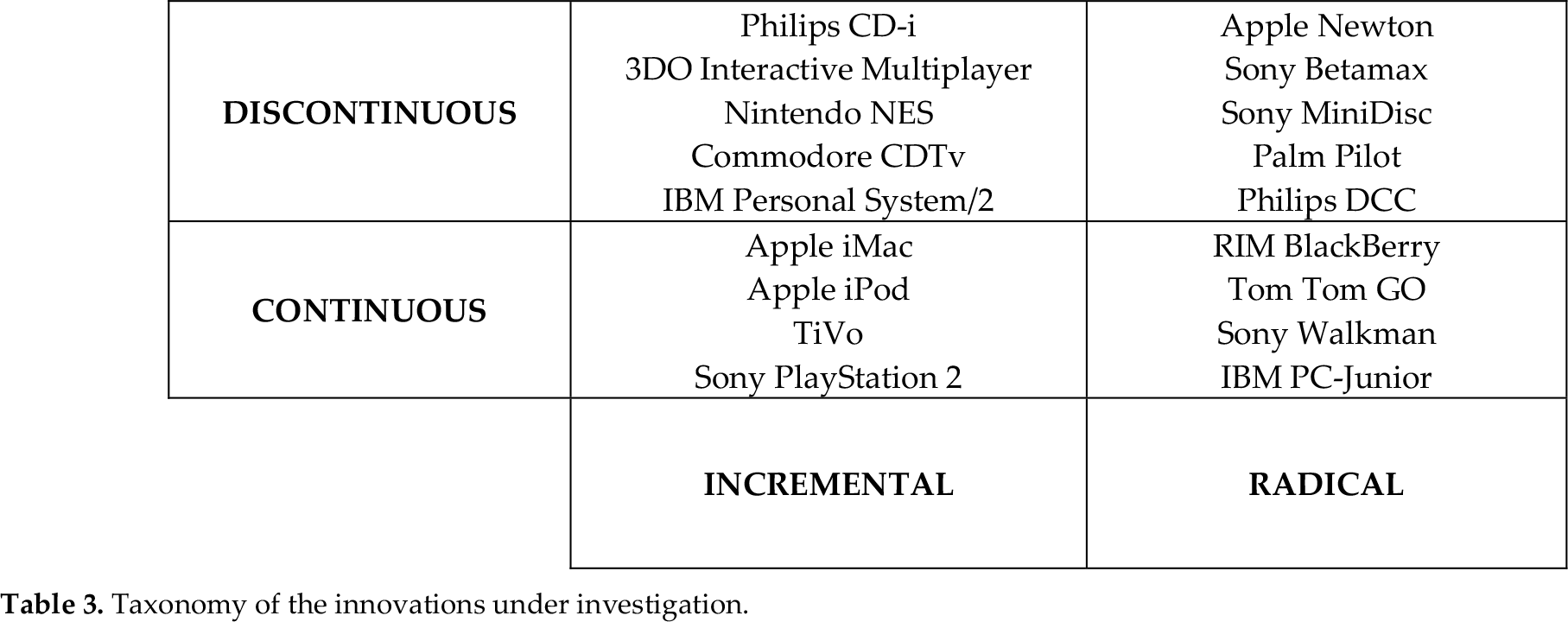
High-tech markets are getting more and more interconnected [9]; as a consequence, the value of an innovation does not depend exclusively on its intrinsic characteristics, but also on the existence of an infrastructure that adequately supports it. This “adoption network” [15] is comprised of companies that supply products or services complementary to the innovation, and firms involved in distributing the innovation or information about it. The decisions of the players of this adoption network and the support they provide to the innovation are therefore capable of influencing its commercial success. We label an innovation that requires a deep change in the infrastructure that supports it, in order to deliver its intrinsic value, as discontinuous. On the contrary, a continuous innovation is one that works effectively within an already existing infrastructure. We found that the capability to obtain an adequate support from the critical players of the adoption network before it diffuses in the bulk of the target market is a critical determinant of a discontinuous innovation's ultimate commercial success. This point will be further discussed in the next section of the paper.
Table 3 classifies the studied innovations into radical vs. incremental and discontinuous vs. continuous, according to the definitions given above.
2.2 Defining early and mainstream market
According to the Diffusion of Innovation theory [16] and the marketing scholars that have adopted its standpoint, for example [17], the target market for a technological innovation is not a homogeneous entity. It comprises two sub-groups with distinctive characteristics: the early market and the mainstream market. When launched into the market, the innovation is first adopted by a relatively small number of individuals (about 15–25% of its target market) with a high disposable income, who are familiar with technologies, who have the competencies to critically evaluate its functionality and who exert, precisely because of these characteristics, a strong opinion leadership over the other potential clients. It is only after diffusing into this early market that the innovation enters its mainstream market, that comprises individuals who are risk-averse and, although able to perceive that the innovation can potentially satisfy some of their needs, are highly uncertain about its capability to actually do this. They look for people familiar with technologies who have already adopted the new product in order to reduce their inherent uncertainty towards its technical content. Table 4 synthesizes the fundamental characteristics of early and mainstream market customers.
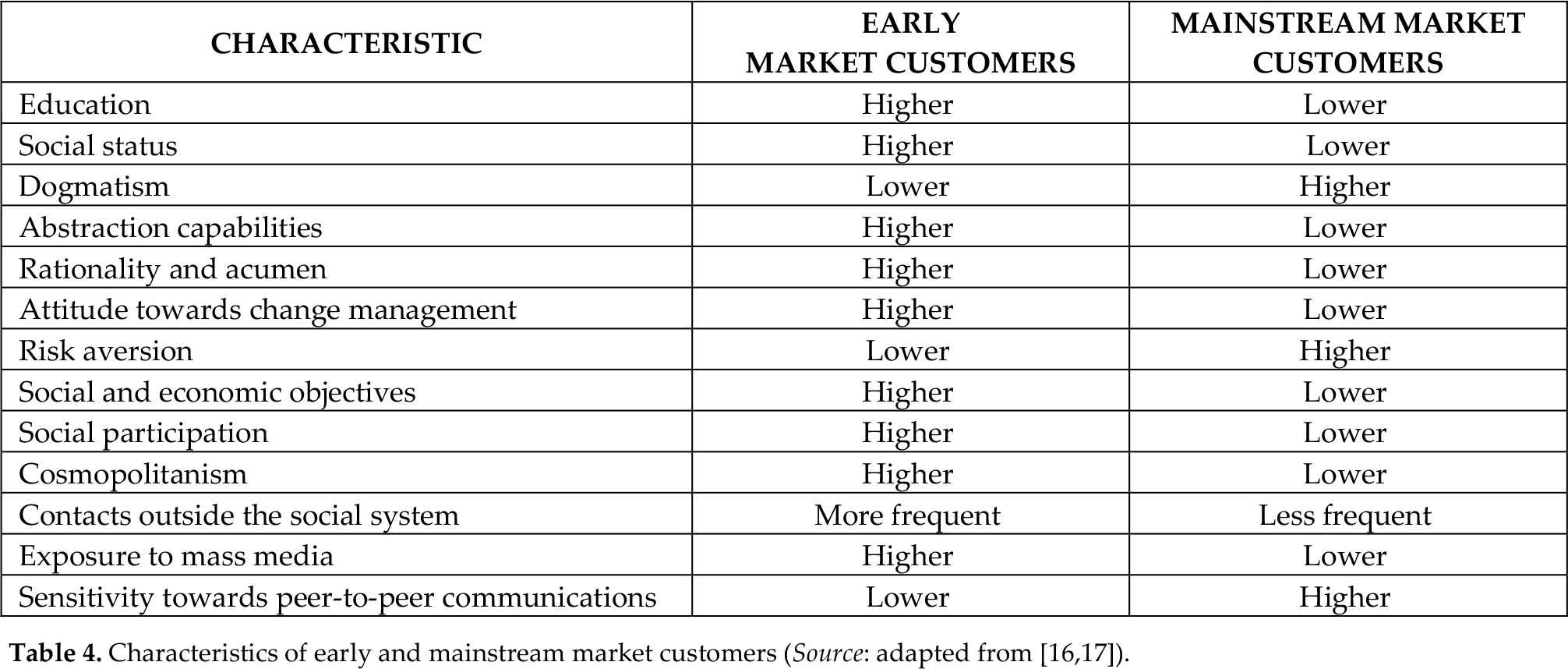
We have found that the distinction between early and mainstream market is important for understanding the impact that different commercialization decisions have on the innovation commercial success, as it will be discussed further in the paper.
3. Suggesting a Contextual View for the Commercialization of Innovation
The empirical analysis we conducted suggested that radical innovations require different commercialization approaches than incremental innovations. Similarly, the probability of commercial success for discontinuous innovations is maximized by different commercialization strategies to continuous new products. Finally, the need emerges for radical and discontinuous innovations, as well as incremental and continuous ones, to take commercialization decisions that suit the segment of the target market (i.e. early or mainstream market) into which the new product is diffusing. The next paragraphs will focus in depth on these points.
3.1 The effect of innovation radicalness
For radical innovations, a large diffusion and a positive acceptance into the early market is fundamental for determining their overall commercial success. This is due to the fact that the more radical the innovation, the higher the technological uncertainty perceived by the members of the mainstream market. In turn; the judgments of earlier customers have a stronger influence over their adoption decisions. For radical innovations, therefore, the opinion leadership role exerted by early market customers becomes critical in determining their diffusion in the mainstream market, and consequently in influencing their overall commercial success.
The most critical dimensions of the commercialization for determining the innovation's acceptance in its early market are the following:
Timing – In the early market, it seems that launching a whole product that is completely developed and perfectly working is far more important than anticipating the timing of market entry in order to exploit first mover advantages. In the attempt to pursue a pioneer advantage in a new business arena, firms often underestimate the importance of arriving on the market with a whole product that is completely developed. This typically translates into an extremely unfavourable appraisal by the early market, which comprises of the customer segments most sensitive to the innovation technical content and sophistication. This mistake is particularly evident in the case of Apple Newton: in 1993 Apple launched a PDA that lacked PC connection functionalities (although they were intensely publicized in the preannouncement campaign) and that incorporated handwriting recognition software not completely developed and therefore not properly working.
Whole product configuration – In order to encourage the adoption by early market customers, the whole product configuration should include a limited number of functionalities that are perfectly working and are designed with the purpose of emphasizing the technical advantage and sophistication of the innovation. Compare, for instance, Apple Newton and Palm Pilot. The former rose a very negative response among early market customers (i.e. companies that used the PDA for sales force automation, business men and top managers), and was launched with a configuration that included many additional functionalities (e.g. advanced handwriting recognition, infrared communication, wireless connectivity with printers and other devices such as fax transmission), few of which were properly working. On the contrary, Palm Pilot was enthusiastically accepted by its early customers (managers that spend most of their time travelling or taking part in business meetings), although at launch its basic configuration comprised very few functionalities (basically, calendar, synchronization with Macintosh and PC and simplified handwriting recognition through the Graffiti software), that nevertheless worked perfectly.
Targeting – A careful and proactive targeting of the innovation's early market is a fundamental ingredient for success. In other words, when launching a technological innovation, firms should identify one or more market segments that will be more likely to adopt the innovation early and should carefully understand their characteristics and underlying buying reasons. This is a critical pre-requisite for designing a whole product configuration that adequately satisfies their needs and for setting up a communication campaign that addresses them specifically. Consider for instance the case of IBM PC-Junior, the first IBM's home computer launched in 1984. IBM was not able to foresee that its machine would be first acquired by businessmen who already used a PC in their office and wanted to bring some work at home. Consequently, the PC-Junior did not have a hardware configuration able to support the most diffused business applications (despite this capability often being claimed in the communication campaign). Although these hardware requirements were not essential for the home-pc use foreseen by IBM, they generated a strongly unfavourable appraisal by the first customers that adopted it. Conversely, when launching its Walkman in 1979, Sony understood that its early market would have comprised young people (between 20 and 25 years old) especially fond of sports and outdoor living; this helped Sony design a communication campaign specifically targeted to these early customers and capable of awakening their interest in the Walkman.
Communication – In order to stimulate early customers' adoption, the communication campaign should emphasize the technical content of the innovation, which is typically the most important attribute in the eyes of early market members, rather than underline its belonging to a renowned family brand. In the case of Philips Digital Compact Cassette (DCC), for instance, the communication campaign presented the DCC as an evolutionary advancement of the Philips' Music Cassette (MC) at its launch and did not adequately put emphasis on its underlying technology. As a consequence, early market customers (i.e. young music enthusiasts) did not perceive its revolutionary nature and were more attracted by Sony MniDisc, a competing innovation launched in November, 1992 (only two months after Philips DCC) and positioned itself as a real technological breakthrough. Furthermore, an early preannouncement of the innovation is generally helpful in nurturing the early market's interest toward a new technology and influencing their adoption decisions. Nevertheless, it is important that the preannouncement campaign focuses exclusively on those features of the innovation that will be available at launch, to avoid giving emphasis to functionalities that are not accessible or are not perfectly working, which translates into a very negative reaction of early customers that freezes further diffusion of the new product in the mainstream market.
3.2 The effect of innovation discontinuity
A discontinuous innovation requires that one or more critical players of its adoption network change their behaviour in order to provide some kind of essential support. Philips DCC or Sony MniDisc, for instance, are discontinuous as their commercial success was significantly influenced by record labels' decisions, and specifically by their choice to deliver, or not, songs in the DCC and MiniDisc recording standards. Similarly, Nintendo NES and 3DO Interactive Multiplayer are discontinuous because their diffusion depended on the availability of new games and other titles specifically delivered by software developers.
The empirical analysis shows that, for discontinuous innovations, support from the critical players of the adoption network is much more important in influencing mainstream customers' adoption decisions than early customers' ones. Customers in the early market, in fact, are attracted by the technical content of the innovation and its degree of sophistication. They buy technology for its own sake and do not care too much about the availability of complementary products (e.g. a large availability of compatible software titles) or services (e.g. installation or after sale support). This issue matters when the innovation is bought, primarily because of the improvements it is capable of bringing to the life of the customer, which is the key buying reason for the pragmatists of the mainstream market. In other words, whereas customers in the mainstream market buy exclusively when they perceive the innovation is adequately supported by the adoption network, this is not the case for early market customers, whose adoption decisions can occur before the firm has adequately shaped the adoption network.
Therefore, it emerges that the commercial success of a discontinuous innovation depends on the capability of the innovating firm to shape the decisions of the critical players of the adoption network far before it diffuses into the mainstream market. Furthermore, the empirical analysis shows that the players of the adoption network are likely to support the innovation before it diffuses into the mainstream market only if the innovating firm shares with them the risks and the costs that may arise. Without sacrificing part of the discontinuous innovation's potential profits in effectively shaping the adoption network, firms risk dramatically hampering its diffusion in the bulk of the target market, translating into a far more substantial profit loss.
The most critical dimensions of the commercialization in terms of shaping the decisions of the critical players in the adoption network are the following:
Partnerships and alliances – Obviously, the type of interorganizational linkages that the firm establishes with external organizations during the commercialization of the innovation, represents the single most important dimension for stimulating the support of the adoption network's players. First of all, firms should allow other companies to produce and commercialize goods (being them software, complementary devices or competing products) that incorporates the innovation's underlying technology. This is the approach adopted, for instance, by Palm in the commercialization of the Pilot, whose operating system and interface specifications were publicly accessible. On the contrary, the diffusion of Sony Betamax in the mainstream market was significantly hindered by the decision to keep the underlying technology completely proprietary (it was licensed to Zenith only more than one year after the Betamax launch). Similarly, for content-based innovations, the firm should freely (or at a very low price) release the software development tools to potential developers. A relatively high price, although is not an obstacle for large software firms, would understandably discourage several small players that are often the bulk of the developers' community. For instance, the Palm Pilot's Software Development Kit (SDK) was freely given out, whereas 3DO Company and IBM sold the development platforms for the Interactive Multiplayer and the Personal System/2 at a few thousand dollars. Finally, firms launching a discontinuous innovation should be aware that simple commercial transactions are generally not enough for convincing the critical players of the adoption network to support the innovation; partnerships and other types of agreements that entail a sharing of risks and profits are far more effective. For instance, Palm granted a lump sum incentive to each electronic retailer that accepted to sell the Pilot (a 20 million dollar grant was awarded to Circuit City, for instance) and Nintendo established really advantageous agreements with firms that agreed to develop games for the NES. Conversely, for the commercialization of the MiniDisc, Sony did not establish any type of partnership with record labels or with video rental channels and film makers, when launching the Betamax.
Positioning – The empirical analysis also reveals that a confused positioning of the innovation, especially a lack of clarity about its compatibility with existing products and systems, hinders the support from the players of the adoption network. In the case of 3DO's Interactive Multiplayer, for instance, several software developers complained about the uncertainty about the type of applications the firm longed for. Conversely, the Nintendo NES was plainly positioned and, as a result, games developers were capable of producing titles that perfectly fitted with the NES's target market characteristics.
3.3 Selling innovation to mainstream customers
The analysis reveals that an adequate diffusion in the early market can help lower the uncertainty perceived by the members of the mainstream market toward the innovation and therefore positively influence their adoption decisions. Nevertheless, this it generally not enough to achieve a level of diffusion that can determine the innovation's commercial success. This is due to the fact that mainstream customers have different characteristics and show dissimilar buying behaviours from earlier ones. They do not buy technology for its own sake but appreciate innovations that have substantial and visible advantages over the available alternatives and can improve their way of living or doing business. Therefore, they look for complete, end-to-end solutions for their needs, want to be educated about the new technology, require a high level of customer service and are attracted by simple and easily understandable solutions. As a consequence, the most effective commercialization approaches for selling the innovation in the early market are typically very different from those that can stimulate adoption in the mainstream. In particular, the analysis shows that the firm should modify its commercialization approach independently from the characteristics of the innovation (being it radical or incremental, continuous or discontinuous), as long as the innovation diffuses into the target market, in order to fuel its acceptance among mainstream customers.
The dimensions of the commercialization that are the most critical in stimulating the adoption by mainstream market customers are the following:
Positioning – The innovation should be clearly positioned and its advantages on critical attributes of importance over competitors and substitute products, ought to be clearly communicated. A clear positioning can be achieved through a communication campaign that conveys a homogeneous message associated to the innovation. This aspect was overlooked by TiVo in the commercialization of its first generation of digital video recorders, which were even labelled with several different names (e.g. digital video recorders, personal video recorders, and personal digital recorders) during the communication campaign. Distribution channels also play a pivotal role in conveying an unambiguous positioning for the innovation. If each retailer is given the opportunity to autonomously manage the position of the innovation in the shelf space, this can result in a great heterogeneity among the various distributors, as happened with Philips CD-i and Commodore CDTv, for example. This heterogeneity typically depends on the firm's decision to establish a simple commercial relationship with distribution channels, therefore exerting a loose control over their critical decisions.
Distribution – In order to stimulate the diffusion of the innovation in the mainstream market, it is critical that distribution channels perform an intense customer education function. Notwithstanding the opinion leadership role played by early customers, in fact, customer education appears to be fundamental for adequately explaining to mainstream customers the technical functionality of the product and its real potential and, ultimately, for driving their adoption decisions. For instance, Research In Motion (RIM) strongly invested in educating its direct sales force and rewarding its specialized distributors in order to ensure that they properly explained to potential customers the innovative features of the BlackBerry. Similarly, Palm heavily rewarded the retailers that agreed to distribute the Pilot, in order to convince them to organize useful demonstrations of the use of Graffiti, its innovative handwriting recognition software. Nevertheless, it is important that customer education initiatives are not quickly discontinued. This mistake is evident in the case of Philips CD-i, whose demonstrations in retail chains were interrupted only 3 months after the launch. It is evident that distributors could be motivated to educate potential customers only in exchange for higher sales margins or other types of compensation; a firm should understand that sharing the innovation's profits with these critical actors of the adoption network is an important determinant of an effective commercialization.
Whole product configuration – It is fundamental that the innovation is commercialized in the mainstream market with the most complete configuration. The need to separately acquire software or complementary devices to fully exploit the innovation's potential, generally hinders mainstream customers' adoption. Innovation that came with a ready-to-use configuration included Tom Tom Go or Apple iMac. The negative effect of an incomplete whole product configuration is worsened by: a) a communication campaign that stresses precisely those functionalities that are not available in the basic configuration of the innovation. This was, for instance, the case of Philips CD-I, whose Full Motion Video (FMV) functionality allowed the product to play complex images in motion, was not available at launch, or of Apple Newton, whose Connection Kit allowed the device to communicate and synchronize itself with the PC, was available as an add-on only one year after the launch; b) a relatively high-price for complementary products and services, as happened with the TiVo additional services' subscription fees.
Pricing – Firms commercializing a high-technology innovation often adopt a skimming pricing strategy. In this case, it is important that the price of the innovation is significantly lowered before it diffuses among mainstream market's customers, as they are highly price-sensitive. This happened with all the successful innovations that we studied, whose price was significantly diminished on average one year after the launch. Maintaining the price at a relatively high level for a long time after the innovation has diffused in the mainstream can be really detrimental for its diffusion. This may happen when the innovation experiences a limited dissemination after launch and the firm tries to achieve the established profit goals by keeping the price at a high level for a longer than foreseen period, but this behaviour further hinders the diffusion of the innovation in the mainstream market. This mistake was evident in the commercialization of TiVo, whose price was kept relatively stable for a prolonged period (more than 2 years).
4. Commercialization of Innovation as a Set of Interrelated Sub-Strategies
The results that have been discussed so far suggest that an effective commercialization of technological innovation, i.e. one that maximizes the likelihood of the innovation commercial success, should be conceived as a mix of three interrelated sub-strategies (see Figure 2):
Early adoption strategy – an internally coherent set of commercialization decisions that are aimed at stimulating the diffusion of the innovation in the early market, in a way that encourages its members to build a positive attitude toward it;
Adoption network configuration strategy – an internally coherent set of commercialization decisions that are aimed at obtaining support, necessary for enabling the diffusion of the innovation in the mainstream market, from the critical players of its adoption network;
Mainstream adoption strategy – an internally coherent set of commercialization decisions that are aimed at stimulating the diffusion of the innovation in the mainstream market.

The sub-strategies comprising an effective commercialization of innovation.
The model in Figure 2 also depicts the relationships between the three sub-strategies. In particular, it points into evidence that the effectiveness of the Mainstream adoption strategy will be higher if the Early adoption strategy and the Adoption network configuration strategy are properly executed.
Nevertheless, the relative importance of the three sub-strategies in determining the commercial success is influenced by the type of innovation being commercialized (see Figure 3).

Relative importance of Early adoption strategy, Adoption network configuration strategy and Mainstream adoption strategy according to the type of innovation.
Whereas an adequate Mainstream adoption strategy is always necessary, independently from the type of innovation, for ensuring a satisfactory diffusion in the target market, the Early adoption strategy and the Adoption network configuration strategy become essential respectively with radical and discontinuous innovations.
The analysis also reveals that the effectiveness of each sub-strategy depends on the way in which the fundamental commercialization dimensions (i.e. timing, targeting and positioning, distribution, pricing, communication, whole product configuration, partnerships and alliances) are managed (see Figure 4).

The most important commercialization dimensions for each sub-strategy.
All told, therefore, our results show that there is not a single best way for bringing to market an innovation: the optimal solution depends at least on the characteristics (in terms of radicalness and discontinuity) of the innovation itself. The framework discussed in this paper suggests a way through in which product and marketing managers could plan a commercialization that takes into account the characteristics of the innovation and therefore is likely to be more effective:
Step 1 – Assess the radicalness and the discontinuity of the innovation;
Step 2 – Identify the commercialization strategies (Mainstream adoption strategy and/or Early adoption strategy and/or Adoption network configuration strategy) that are the most critical for that type of innovation (see Figure 3);
Step 3 – Identify, for each critical strategy, an internally coherent set of commercialization decisions that are likely to maximize its effectiveness (see Figure 4).
Finally, the paper outlines the importance of considering the commercialization of the innovation as an internally coherent set of both strategic (timing, partnerships and alliances, targeting and positioning, whole product configuration) and tactical variables (communication, pricing and distribution), as advanced by other scholars [18, 25], [27, 28]. This point suggests that product managers should plan the commercialization of the innovation at the outset of the development process, since decisions concerning the aforementioned strategic variables influence a large portion of the developmental activities. Moreover, as far as strategic dimensions need to be consistent with tactical ones, the latter should be analysed with an adequate anticipation too; this assessment may result in fact into a reframe of the strategic decisions.
Footnotes
1
In particular, we studied the commercialization of MiniDisc in Europe and the USA, where it was subject to more serious commercial breakdowns than in Japan.
2
In particular, we studied the first generation of TiVo; the second one, launched two years after the first generation, is on the contrary experiencing a relevant commercial success.
