




Abstract
This study explores the response of autistic children to a few design features of the robots for autism therapy and provides suggestions on the robot features that have a stronger influence on the therapeutic process. First, we investigate the effect of selected robot features on the development of social communication skills in autistic children. The results indicate that the toy's “face” and “moving limb” usually draw the children's attention and improve children's facial expression skills, but do not contribute to the development of other social communication skills. Secondly, we study the response of children with low-functioning autism to robots with verbal communication functionalities. Test results show that children interacted with the verbal-featured robot more intensively than with the experimenter. We conclude that robots with faces and moving limbs can engage autistic children in a better way. Facial expression of the robots can elicit a greater response than prompting by humans.
1. Introduction
Autism is associated with impairment in communication skills and stereotyped behaviour that affect children's reciprocal social interaction [1]. Kanner described that the typical autistic child “never looked into anyone's face” [2]. Weeks et al. conducted experiments with autistic and non-autistic children who were asked to sort photographs of people with different features, e.g., sex, age, facial expression of emotion and type of hat worn [3]. During the experiments autistic children sorted the photos by the type of hat, while non-autistic children who took part in the same study sorted them by people's facial expressions. The results of this study confirmed autistic children's insensitivity to other people's facial expressions. According to these findings, autistic children tend to ignore information about human features. Based on this understanding, in order to achieve better responses from the children, recently, some researchers have used robots as a mediator in the therapy for children with autism [4–9]. Their results demonstrated that robots have significant positive therapeutic effect. It was indicated that human-robot interaction can be used as an alternative indirect method of communication with autistic children and thus, for improvement of their communication skills for the following two reasons.
First, children with autism tend to have low interest towards other humans, as confirmed through many experiments comparing the interaction of autistic children with humans and objects. However, children with autism tend to interact better with robots than with humans, even in cases where the robot has quite a simplistic appearance. Miyamoto et al. showed that autistic children accepted their talking robot, named Muu, as a social agent rather than just as an object for play, although the robot had quite simple functionalities. The results were based on the long-term observation of two autistic children and experiments showed that the children quickly started to interact with the robot [4]. Kozima et al. invented a creature-like robot with a simple appearance named Keepon and they found that their robot attracted the attention of and caused emotions in the autistic children who took part in the experiments. These results implied that robots have the potential to improve autistic children's communication skills [5].
Secondly, the repetitive behaviour of the robot raises autistic children's interest and stimulates them to imitate the behaviour of the robot, which helps these children to understand socially meaningful information. As indicated in the previous studies [4–9], robot-assisted autism therapy has the potential to improve children's non-verbal communication skills and ability to make eye contact, which is very difficult to achieve by interaction with humans. In the same vein, Boccanfuso and O'Kane showed that autistic children started to imitate the pose of their interactive robot called CHARLIE, despite its simple appearance [10]. Furthermore, Duquette et al. found that autistic children imitated more often the facial expressions of their robot named Tito than the expressions of the humans enrolled on the same experiment [11].
The robots which were designed for the purposes of these studies demonstrated the positive effect of the therapeutic robots, but the main limitation of the therapeutic robots for autistic children was that the majority of them have been designed without detailed exploration of the effect of the features of the robots on the treatment outcome. The results in the robot-assisted autism therapy vary depending on the type of the robot used in the trials. The AuRoRA project (Autonomous mobile Robot as a Remedial tool for Autistic children) demonstrated that autistic children show different playing behaviour depending on the type of the robot [12]. The project included experiments with a small autonomous non-humanoid mobile robot. Results showed that autistic children were intrigued to run around the robot or to approach it, which was considered as a positive indication for the improvement of their communication skills. The same study also included a small doll humanoid robot, Robota, with moving arms, legs and head. The experiments showed that autistic children imitated Robota's movement which was a sign of improved social communication [12].
The design of robots for autism therapy is closely linked to the questions surrounding the choice of robot appearance that will increase therapeutic efficiency. There are many findings in support of the idea that robots with a simple appearance are better accepted by the autistic children [13]. Ferrara and Hill explored the interaction of autistic children with several types of toys and showed that the children prefer toys with a simple look [14]. Furthermore, Robins et al. proved that a humanoid robot with plain appearance increases the children's level of interaction [15]. For the experiments, the authors used a small-sized humanoid doll with ordinary human appearance and simple functionality, and a life-sized “Theatrical Robot” (a mime artist behaving like a robot) with an ordinary human appearance. The results showed that children demonstrated better interaction with the small robot than with the human-sized humanoid robot. The authors also concluded that the simple appearance is an important component of efficient robot design for children with autism.
In line with the above-reviewed previous research, the present study investigates the optimal design of robots for autistic children by exploring the effect of different robot features on the children's social communication skills. In this paper, we introduce the results from two studies, named here as Study 1 and Study 2. Study 1 addresses the relationship between the features of the toy robot and the level of the children's communication with the same robot. Study 2 explores the effect of the verbal function of the therapeutic robots on the children's communication skills.
2. Study 1: Robot Features and Their Effect on Social Skill Development
2.1. Purpose of the Study
Therapeutic robots for autistic children can become far more efficient if their design includes features that cause greater positive impact on children's skills for social interaction. It was found by various studies that the play can influence children's social behaviour in a positive or negative way. According Kim et al., play materials (e.g., a toy) and their characteristics contribute to children's social development [16]. Furthermore, the role of the play environment has been researched. Schmidt et al. found that background television distracts young children's attention [17]. Similar to that, it was suggested that the concepts for robotic assisted play should consider “the important role of play in child development as a crucial vehicle for learning about the physical and social environment, the self, and for developing social relationships” [6].
As a first step of our study on the robot features and their significance for the therapeutic process, we decided to investigate the features of the toys that children with autism usually prefer to play with. We explored the relationships between the features of the children's favourite toys and the level of the children's social and communication skills by using a questionnaire in which the questions were purposely designed to identify the essential toy features that should be considered afterwards for the design of an optimal therapeutic robot.
2.2. Participant and Procedure
Fifteen parents (4 fathers and 11 mothers) of children with low-level autism aged between 6 and 15 years (M= 11:07, SD = 2:60, 1 girl, 14 boys) participated in this survey. The parents were asked to indicate the degree of social skill of their child and the features of the toy which their child prefers to play with. Our questionnaire was composed of two sections. Section 1 was about the communication skills of their children and consisted of 11 items based on the Social Responsiveness Scale (SRS) [18]. Answers were based on a 4 point scale (1 = not true, 2 = sometimes true, 3 = often true, 4 = almost always true). Among these 11 items, we included 4 questions to get information about the common means of communication of the child: eye contact (“does he or she make eye contact?”), gesture (“does he or she use gestures to express his or her feelings?”), facial expression (“does expression on his or her face match what he or she is saying?”) and language (“does he or she use speech to express his or her feelings?”). In section 2 of the same questionnaire, each parent was asked to describe the features of their child's favourite toy. Answers needed to explain whether the toy contains the following 4 features: face, moving limb, sound function and wheels.
2.3. Results
To examine the relationship between the presence or absence of a feature of the toy and the aspects of the child's social skills, we used a Mann-Whitney test, where each toy feature was considered as an independent variable and the level of the child's social skills was considered as a dependent variable. Results showed that toys with faces facilitate more often the development of social skill and facial expression skills than the toys without faces (p<.05). On the other hand, the presence of a face on the toy does not influence other skills (ps>.18). Furthermore, toys with moving limbs also increase facial expression response (p<.05), but the moving limb functionality does not influence the development of other skills (ps>.55). The sound function and wheels do not motivate any communication skills (ps>.18). Graphs of the same results are presented in Figure 1. These results confirm the findings from previous studies [4–9] that robots displaying human features (e.g., face and moving limbs) could have better efficiency in the robot-assisted therapy.

Facial expression skill's level of autistic children who play with toys with face and moving limbs is higher than the level of the children who play with toys without face and moving limbs; the scores are graded using a 4 point scale (1 = very poor, 2 = poor, 3 = good, 4 = very good)
3. Study 2: Autistic Children and Verbal Communication Robots
3.1. The Purpose of the Study
Autism is a disorder that causes problems in social communication and in this way it also contributes to inflexible language [19]. However, most previous studies have failed to explore the role of robots in encouraging verbal communication in autistic children. Michaud et al. studied the response of young children to a robot that was communicating with them by verbal messages. A small sphere-shaped robot, Roball, was used in the experiments [20]. It was concluded that some children may have had difficulties in understanding the robot's verbal requests.
In the present study, we examined the effect of the verbal communication by studying the interaction between children with low-functioning autism and a verbal communication robot.
3.2. Participant and Procedure
The medical doctor at the Nagoya University Hospital selected 6 children diagnosed with autism. They have a typical characteristic of low-functioning autism without other complications, and were aged from 7 to 12 years (M = 9.33, SD = 2.25, 1 girl, 5 boys). The children participated in two trials that had an identical structure. In the first test, the verbal messages to the child were prompted by a human experimenter who was a female, 165 centimetres tall. An ifbot, robot was used as a prompter in the second test. The ifbot is 45 centimetres tall. It has two moving arms with 1 DOF and moves on two wheels. The robot's facial expressions are made with 10 motors that move the ifbot's eyes, eyelids and neck, and 104 LEDs that illuminate the head and the mouth, change the colour of the eyes and cheeks, and imitate tears. The sequence of the tests for each child was chosen in a random way. Pictures from the tests are shown in figures 2 and 3.
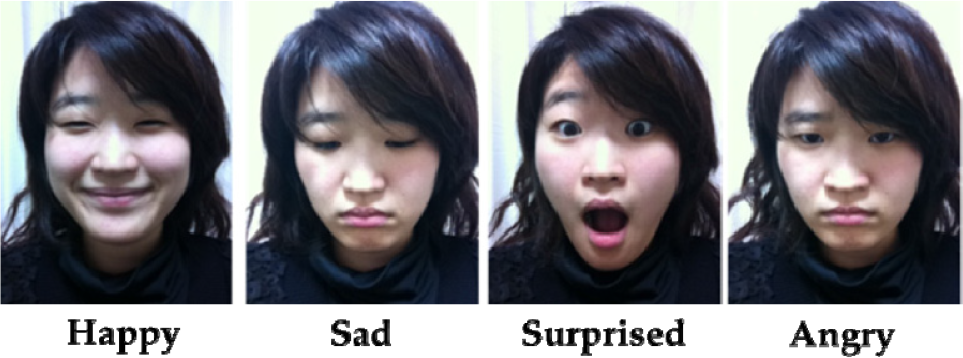
The human prompter: happy, sad, surprised and angry face

The robot prompter: happy, sad, surprised and angry face
Each trial contained three parts: 2 verbal phases and a phase that combined verbal and visual interaction and comprised a small talk and a facial expression game. The verbal phases were used for evaluating the children's responses to verbal cues and the third phase was used for assessing the effect of the robot on the children's interaction behaviour. Each trial began with a small preparatory talk that included a few neutral phrases and questions such as: “Nice to meet you”, “Did you have lunch?”, etc. During the facial expression game the prompter suggested to the child that they exhibit 4 facial expressions: happy, sad, surprised and angry face. After playing the facial expression game, children were involved in a new small talk game with the prompter. For each child, the order of the tests with the robot and with the human experimenter was selected randomly.
All trials were observed by the experimenter in real-time. The following items were measured by the first author during the experiments:
Eye contact of the child with the prompter,
Child's response to the verbal cues from the prompter,
Facial expression game score.
The scores for eye contact and response to verbal messages were evaluated by using a 4 point scale (1 = very poor, 2 = poor, 3 = good, 4 = very good).
For the facial expression game, each response was scored with a “1” and scored with a “0” for absence of response. The total score for the facial expression game was calculated by summing up each score from the 4 tasks: happy, sad, surprised and angry face.
3.3. Results
In this study we observed 3 typical cases, as described below:
Case 1 H is a 12 year old girl, extremely quiet and reserved, who usually avoids eye contact with others. In the trial with the human prompter she seemed distracted and didn't even look at the experimenter while she talked to her for the first time. H remained silent until the end of the trial and didn't speak at all. In a trial with the robot prompter, a few moments after she met the ifbot, she tried to touch the robot's face and was looking at upside of ifbot's head for a while. However, when the ifbot started a conversation with her, she almost didn't respond and turned her face in the other direction. At the moment when the ifbot raised its arms, she responded to the facial expression game and answered some questions with Yes/No.
Case 2 O is an 11 year old boy who was more active than the other participants. His session started with the experiment with the ifbot. When O was introduced to the ifbot he was very excited and interested in the robot. He was good at making the facial expression game and talking with the ifbot until the moment when he didn't respond to a question that had exactly the same meaning as the previous question from the robot. From that moment he got distracted. The experiment with the experimenter ended very quickly and wasn't completed. He seemed to realize that the experiment with the experimenter would follow the same method as the trial with the robot and kept saying that the experimenter is not a robot.
Case 3 Y is an 8 year old boy, who is active and usually talks to himself. At the beginning of the experiment with the robot, Y stayed at a distance from it, but when the ifbot started to move, he got closer to the ifbot and started to explore its face and even touched ifbot's arm several times. He didn't make eye-contact with the ifbot, even in the moments when he was talking to it. After some time, Y lost interest to the ifbot and started to talk to himself again. In the experiment with the human prompter, Y was sitting very close to the experimenter but he didn't make eye contact and was talking to himself. He continued to talk to himself when the facial expression game started.
Similar to the children described in the above cases, with another 3 participants (who usually avoided interacting with other people) they also showed significant interest in the communication robot.
Trends in All Participants
The scores from each experiment for all participants are shown in Table 1.
From the experiments with the ifbot robot and human experimenter (mean values)

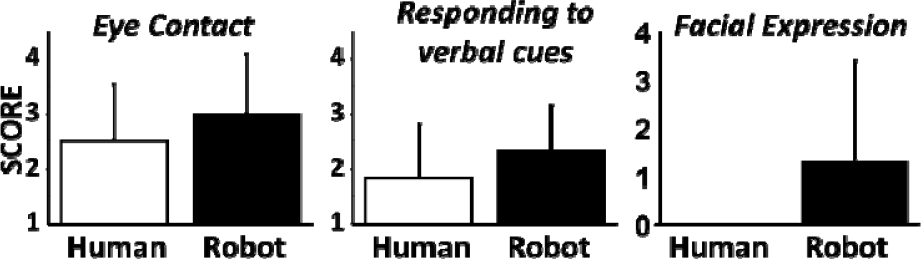
The mean of eye contact (M = 3.0), responding to verbal cues (M =2.3) and facial expression game score (M = 1.3) in the experiment with the robot are higher than those with the human (M eye contact = 2.5, M responding verbal cues= 1.8, M facial expression game = 0)
The results from the trials showed that autistic children demonstrated more efficient interaction with the ifbot robot than with the human experimenter. As shown in figure 4, the results of the experiment for evaluation the response to verbal cues demonstrated that children followed the verbal instructions of the robot and demonstrated higher levels of response. Furthermore, the score from the facial expression game shows that children achieved better results in the facial expression test when they were instructed by the robot. These results indicate the positive effect of the therapeutic robot on the verbal communication abilities of children with low-functioning autism.
4. Conclusion
The present research explores the robot features that can illicit better responses from children with autism in robot-assisted therapy. Based on Study 1, we concluded that “face” and “movement of a limb” are the important features for the designing of efficient robots for training facial expressions in autistic children. In this study no significant relationships were found between these factors, face and movement of a limb, and other aspects of the communication skills. In addition, Study 2 showed that robots with verbal functions have better efficiency and should be considered in the design of robots for autism therapy. As reported in many previous studies, the experiments that include children with autism are usually limited to a small number of participants because of the sensitivity of such children and their low-level of engagement in similar experiments. In addition to that, the behaviour of the children with autism varies significantly from child to child. One of the purposes of the present paper is to add new results to the findings in other similar papers published previously and in this way to contribute to a more precise understanding on the communication problem of autistic children. In our view, the reported results represent an initial step towards the exploration of the adequate design of a robot for autistic children. Future studies on the current topic with analysis of a larger data collection within the whole spectrum from low-functioning autism to high-functioning autism will be needed for validation of these findings for general use.
Footnotes
5. Acknowledgments
We would like to thank Toru Yoshikawa M.D in Nagoya University Hospital and TSUBOMINOKAI, a part of the Autism Society of Japan.