




Abstract
The present paper a finite element implementation of a model of the arterial blood flow through the carotid artery with the effects of magnetic to considering fluid–wall interactions are investigated. The Navier–Stokes equations are used as the governing equations for the blood flow while an elastic compliant model is used for the arterial wall. The reduced one dimensional model solves the momentum and continuity equations in compliant tubes so as to reproduce the propagation of the pressure pulse in the arterial model. The obtained results adequately reproduce the general flow patterns reported in the literature. The results obtained in the investigation are in reasonably good agreement with experimental findings existing in the literature. The effects of a magnetic field have been used to control the flow, which may be useful in certain hypertension cases, etc.
1. Introduction
One of the leading causes of deaths in the world is due to heart related diseases. The heart diseases mainly occur due to temporary deficiency of oxygen or blood supply to the heart. This deficiency may be due to a constriction or obstruction in the blood supply to that part; the constriction involves the deposition of some fatty substances like cholesterol, cellular waste product, calcium, etc. Boesiger st al. [6] used magnetic resonance imaging (MRI) to study arterial homodynamics. This stenosis disturbs the flow of blood from its normal state which leads to the development of atherosclerosis. The atherosclerosis may cause the heart attack. Hemodynamic simulation studies have been frequently used to gain a better understanding of functional, diagnostic and therapeutic aspects of blood flow. These simulations employed compartmental representations or branching tube models of arterial trees as their geometrical substrate [1],[24][26], as well as localized multidimensional models have been often implemented to study arterial flow in more fine, detailed aspects. The study of the flow in the carotid artery bifurcation is of great clinical interest with respect to both, the genesis and the diagnostics of atherosclerotic diseases. It is well-known that the flow separation zone of the carotid sinus has the propensity to develop atherosclerotic plaques. In this sense, the local haemodynamic structure is intimately related to atherogenesis onset and progress [2]. Consequently, a more deep understanding and better descriptions of the flow structure in that region would be of greatest importance to the early detection of stenoses. Low shear stress regions are associated with the development of stenotics plaques. Despite the importance of chemical and physiological factors, the localized atherosclerotic lesions must be related to the local flow conditions as the other factor may be considered in a well mixed condition, i.e., uniformly distributed along the vessels. Several local three-dimensional (3D) in-vitro and computational flow models have been implemented, revealing the complex flow structure in the sinus district. Bharadvaj et. al.[28][29], defined a standard geometry of the carotid bifurcation (an average over 57 actual geometries from different subjects) and conducted stationary studies of the internal carotid blood flow. They found a region of low velocities near the non-dividing wall that extend with increasing Reynolds number, correspondingly, the opposite region showed large axial velocities and shear stresses, results that were confirmed by Rindt et. al[4], using experimental and computational stationary models. Ku and Giddens[5][7] observed a similar process in 3D models during the accelerating period of the diastole and the existence of velocities disturbances during the decelerating phase and at the onset of the diastole. Some similar experiments have been conducted in compliant models [14],[3]. To conduct focused numerical and in vitro realistic experiments of such a district as the carotid bifurcation, special attention must be paid to the boundary conditions applied to the model. As the pressure differences between inlet and outlet boundaries are only a small percentage of the systolic-diastolic pulse amplitude, this impose the problem of accurately determine the pressure, a condition that is often impossible to reach in practice. In this way, small errors in the imposed pressure could lead to great departure of the velocities from the real values. Conversely, if the flow is imposed as boundary conditions, negligible variations on these values could conduct to exaggerated low o high pressures in the analyzed segment. Accurate enough measures of those variables are very difficult or very costly to obtain simultaneously at the inflow and outflow regions for the entire cardiac period, even more in a noninvasive manner. This in turn, leads to implement models of the whole arterial tree in order to avoid artificial boundaries in the vicinity of the analyzed zone To conduct focused numerical and in vitro realistic experiments of such a district as the carotid bifurcation, special attention must be paid to the boundary conditions applied to the model. As the pressure differences between inlet and outlet boundaries are only a small percentage of the systolic-diastolic pulse amplitude, this impose the problem of accurately determine the pressure, a condition that is often impossible to reach in practice. In this way, small errors in the imposed pressure could lead to great departure of the velocities from the real values. Conversely, if the flow is imposed as boundary conditions, negligible variations on these values could conduct to exaggerated low o high pressures in the analyzed segment. Accurate enough measures of those variables are very difficult or very costly to obtain simultaneously at the inflow and outflow regions for the entire cardiac period, even more in a noninvasive manner. This in turn, leads to implement models of the whole arterial tree in order to avoid artificial boundaries in the vicinity of the analyzed zone. Recently, the coupling and integration of models with different dimensionality have been analyzed by Quarteroni et al.[16][21] linking together lumped models with 3D models of the arterial tree. The authors of the present work has proposed an alternative approach to coupling models of non-matching dimensionality and used them to implement a model of stenoses in the common carotid [12]. Here we implement a 3D finite element model of the carotid bifurcation on a standard geometry as proposed in [28][29] coupled with a 1D model of the rest of the arterial tree. Sharma et al. [13] made a mathematical analysis of blood flow through arteries using finite element Galerkin approaches. Sharma et al. [17] studied a MHD flow in stenosed artery using finite difference technique. A multiphase kinetic theory for the computation of viscosity of red blood cells and their migration from vessel walls has been discussed by Huang et al. [19]. In the above mentioned studies, no attempt has been made to study the effect of magnetic field on stenosis under porous medium together Gupta [18]. Kumar and Saket [20] investigated reliability of convective diffusion process in stenosis blood vessels. Nikparto and Firoozabadi [23] studied numerical study on effects of Newtonian and Non-newtonian blood flow on local hemodynamics in a multi-layer carotid artery Bifurcation.
2. Mathematical Model
2.1 Governing equations
In the present investigation we assume a complete model of the arterial tree have been developed with a three-dimensional model of the carotid bifurcation embedded in a reduced one dimensional Navier-Stokes equations considering compliant arterial walls for the rest of the arterial tree. The governing equations for the one dimensional portion of the model result in the following set of nonlinear hyperbolic equations

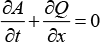

where A is the artery cross sectional area, u the axial velocity (ũ) the corresponding mean value); x the axial coordinate, P the mean pressure, ρ the blood density, Δ2Δx = 0, τ0 the viscous shear stress acting on the arterial wall with fr a Darcy friction factor (in this work a fully developed parabolic velocity profile is considered). A closure equation is implemented relating the pressure to the cross sectional area:

A linear relationship between P and R is considered, being R de radius, E an effective Young modulus, h the thickness of the arterial wall and the subscript “o” denotes quantities evaluated at the reference pressure Po.
The former system of partial differential equations is discretized using a Galerkin's Least-Squares method for the normal equations of the hyperbolic system [12].
The local three dimensional fluid dynamics has described using the three dimensional time-dependent Navier-Stokes equations for incompressible Newtonian fluids where an Alternating Linear Euler method was implemented in order to take into account deformability of the domain as the arterial walls were considered as compliant tubes:

div u =0

where
Alternating Linear Euler formulation, p is the pressure;  Δ × is the displacement vector of the moving domain from its reference configuration
  ρ and μ stand for the constant fluid density and the dynamic viscosity, respectively.

where δn is the displacement of the arterial wall in the normal direction of the surface (
2.2 Numerical Method
For the numerical solution of the three dimensional flow problem the finite element method was applied: the approximation makes use of P1-P1 bubble tetrahedral elements with linear enriched interpolation functions for the velocity vector field and linear pressure[15]
The equations are solved using the finite element SUPG (Standard Upwind-Petrov Galearkin) method with implicit Euler backward differences for the time derivatives and Picard iteration for the non-linear convection terms. The solution of the time-dependent three dimensional Navier-Stokes equations is performed in two sub-steps: in the first one, the bubble degrees of freedom are eliminated by direct substitution, and in the second one, those unknowns are updated as necessary for the evaluation of the second member of the set of equations at the following time step. The deformation of the domain is accounted through a Laplace equation for the displacement of the mesh –again, tetrahedral linear elements are used- where the boundary displacements at the arterial wall are given by the first of Eq. (7). Flow velocity patterns were calculated for an anatomically inspired carotid artery bifurcation model [27][28] as shown in Figure 1, the three dimensional mesh exposed in Figure 2 has 14159 nodes and 71732 tetrahedral elements.

Three Dimensional Carotid Bifurcation of Geometry Model
Three Dimensional of Finite Element Method mesh – Tetrahedral elements
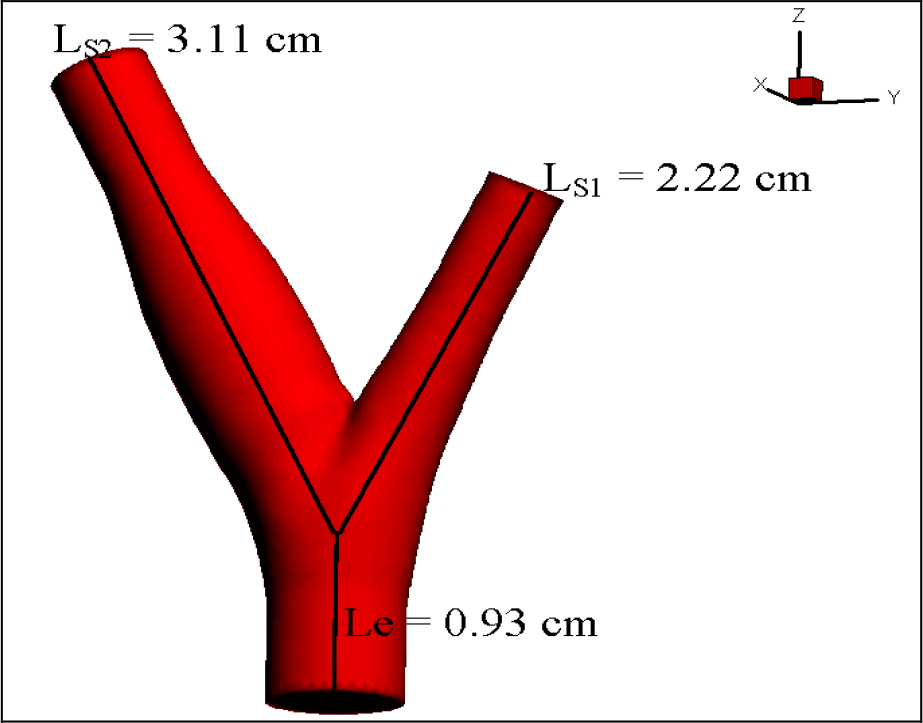
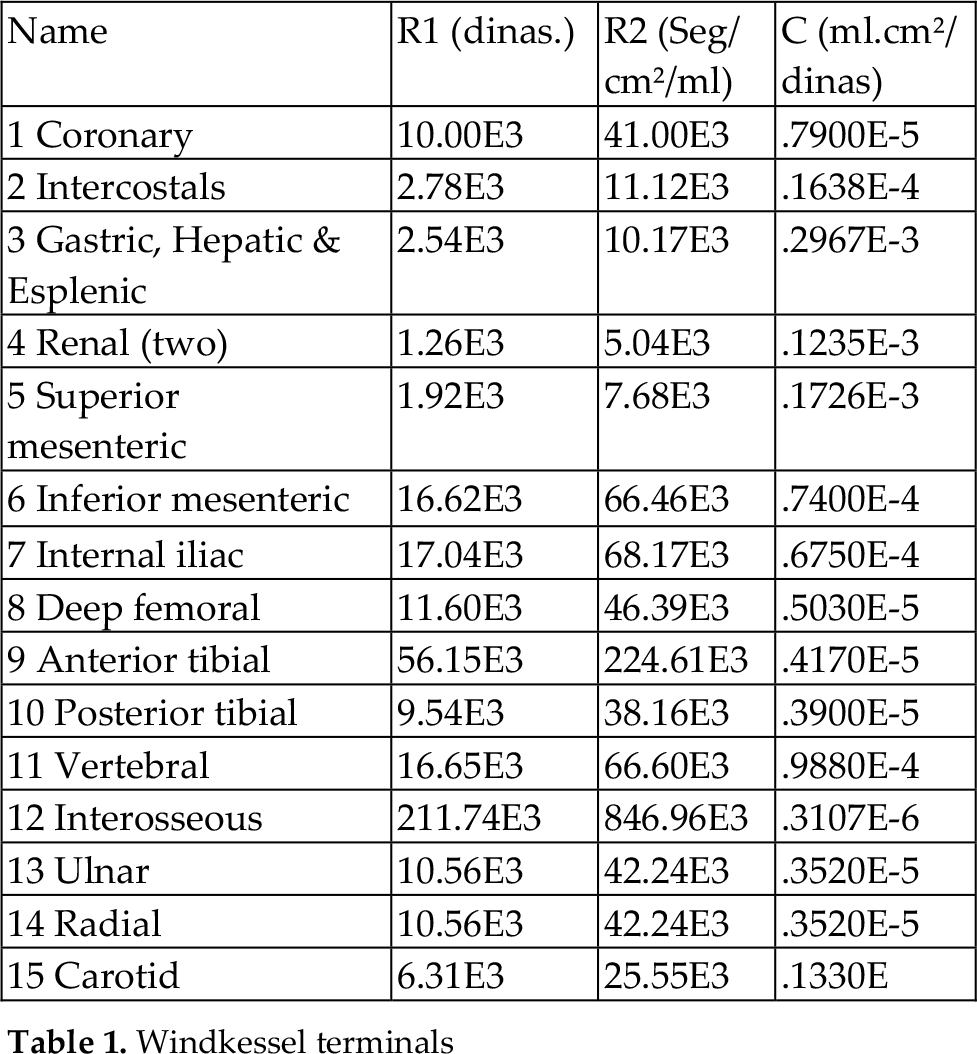
The one-dimensional model was described in Urquiza[12] discretized with a mesh displaying 686 nodes with three degrees of freedom (A, P, Q) per node and 642 elements. The inlet boundary condition describing the heart input flow was obtained from [22] and has a period T=0.8sec. The model is complemented with lumped “Windkessel” representations of the peripheral beds. The geometry and other parameters involved are shown in Figure 3.
Windkessel terminals

Volume difference between systole and diastole.
The whole model was computationally implemented in a numerical framework[11] that allows to easily integrate different kinds of elements as “plug and play” without modifying the main program, i.e., the programmer only must to provide the elemental matrices and to organize the input in such a way that all run together. The systems of algebraic equations are solved by Gauss –Siedal mehod.
Geometrical and Rheological values of Arterial Segments.

3 Results
Here we present some illustrative plots at selected times. In general, the flow has a very complex and unsteady structure showing an early back flow due to the inversion of the pressure gradient at the peak of the systole (Figure 4). A considerable deformation of the artery volume can be observed in Figure 3 where volume differences during diastole (red shaded) and systole (black wire frame) are displayed.

Normal Stress during systole at t = 5.0E-2 sec. -Inverse pressure gradient
As can be seen in Figure 5 a zone of low velocities near the non-divider wall of the carotid sin sinus is observed and contrariwise, a high velocity region is displayed near the divider wall. These results are in well agreement with those obtained experimentally and numerically in references [8][28][29][14]. Detailed inspection of the computational results displays the general characteristics occurring in the carotid sinus, a period with reverse axial flow starts at the peak systole and remains until the beginning of diastole.

Velocity profile during systole
4. Conclusions
A mathematical model that face the problem of simulating compliant three dimensional arterial districts coupled with a one dimensional model of the rest of the arterial tree has investigated. The resulting scheme has shown excellent capabilities to deal with considerable domain deformations while preserving the computational efficiency. The numerical results of the blood flow field for the carotid artery with magnetic effect are in general good agreement with those reported previously in the literature for both experimental and numerical cases. Our investigation may be helpful for the medical practitioners and Bio-mathematicians to understand the flow of blood in the presence of magnetic effects. The results are interpreted in the context of blood in the carotid arteries keeping the magnetic effects in view. The outcomes of investigation done may be useful for the treatment of hypertension patients through magnetic therapy.