




Abstract
Abstract This case study is the result of a project conducted on behalf of a company that uses its own returnable containers to transport purchased parts from suppliers. The objective of this project was to develop a proposal to enable the company to more effectively track and manage its returnable containers. The research activities in support of this project included (1) the analysis and documentation of the physical flow and the information flow associated with the containers and (2) the investigation of new technologies to improve the automatic identification and tracking of containers. This paper explains the automatic identification technologies and important criteria for selection. A companion paper details the flow of information and containers within the logistics chain, and it identifies areas for improving the management of the containers.
Keywords
1. Introduction
More companies are replacing disposable packaging materials, pallets, and shipping packaging and containers with returnable-type reusable ones to protect the environment and to reduce costs (Jansen, R. & Krabs, A., 1999; Motorola, 2010). Cost savings result from reducing disposal costs and eliminating the purchase of one-time use packaging materials, pallets, and containers. In addition to good environmental practices, the use and management of returnable containers has become a mission-critical issue for modern manufacturers due to the greater adoption of kanban and JIT-based supply chains (Rosenau, W. et al., 1996). However, managing the returnable containers poses many challenges and has contributed to increased operational and transportation costs in a number of instances. Therefore, efficient methods are needed to track and manage the flow of returnable containers to avoid significant raise in logistics costs (Hanebeck, C. & Lunani, M., 2008).
Twede (2003) identifies some of the problems and challenges associated with managing returnable containers such as containers being routinely misdirected, lost, and rarely tracked in system-wide information systems. The majority of case studies and literature reviewed identified the lack of visibility as the major contributors to ineffective management of returnable containers (Dempsey, M., 2003; Hanebeck, C. & Lunani, M., 2008; Haplin, V., 2000). One key ingredient for improving the visibility of containers throughout the supply chain is the use of automatic identification (AutoID) technology. Using AutoID systems to track returnable containers can improve the return on investment by lowering operating expenses including transportation costs. Identifying returnable containers and tracking them is essential to good management and provides the information business can use to improve returns and recoveries (InSync Software, 2010). However, to exploit the full benefits of an AutoID technology, it is essential that the physical flow of the containers as well as the information flow is thoroughly understood, characterized, and analyzed. Such analysis can then lead to proposals, including proper AutoID technology, which can address the logistics difficulties experienced by the particular company.
2. Automatic Identification and Tracking Technologies
An extensive review of the literature, including case studies, provided a solid foundation for evaluating the suitability of different AutoID technologies, for management of returnable containers. The technologies that were researched including bar code, passive RFID, active RFID, and Wi-Fi tags technologies are used to increase productivity and reducing human error by automating some of the information processing tasks. An economic analysis was also performed for each of these AutoID technologies. The Global Positioning System (GPS) was also analyzed, but the current technology was found not to be a viable alternative for indoor facilities.
2.1. Barcode
Since the early 1960s, one of the most frequently used AutoID technologies for tracking and identification has been the barcode. Today, barcodes are commonly used in grocery stores, retail businesses, industrial facilities, warehouses, shipping companies, pharmaceutical companies, and many other places. There are several different types of barcode standards, known as symbologies, are used for different purposes (Association for Automatic Identification and Mobility, 2009). The information imbedded in a barcode can includes numbers, letters, symbols, or various combinations of all of them. A scanner is used to read the barcode, and a computer system records or updates the information. The stored information can become available in different forms as defined by the user.
There are many benefits of using a barcode system (Intermec, 2009). Using the Internet, and enabled by media such as electronic file transfer, or bar code technology, companies can more effectively track, control, recover, and secure returnable shipping assets during their entire lifecycle (Vertigo, 2009). Barcode system is a mature technology and most US companies have the required infrastructure to support implementing a barcode system for the purpose of container tracking and improving the visibility of the containers through automatically identifying, tracking, and recording container use. Through use of barcode systems, specific location identification capabilities can also be achieved allowing for accurately locating the assets, in this case, returnable containers. Affordable wireless, handheld scanners are easy to use and give users the freedom to move around the facility. Most scanners include audio/visual features that enable the users to visibly see and audibly hear that the scans are registered successfully. Barcode systems offer relatively accurate identification rates and have a low misread ratio (Meiser, G., Reimche, J. & Winkelman, B., 2008).
Many companies already use a barcode system to track information such as, among other things, inventory, labor hours, and job status. Therefore, the integration of features and necessary hardware for managing returnable containers would be very feasible and relatively easy to implement. Barcode technology is also more economical when compared to other AutoID technologies. Many vendors offer asset management kits that could be used to track containers. The kits include software, mobile data terminals, scanners, and barcode printers. The software has the capability to identify the product, location, department, maintenance, purchasing information, warranty, depreciation, and other user-defined fields.
On the other hand, disadvantages also exist with a barcode system. Because each individual asset must be manually scanned, the process can become very tedious and time-consuming, causing employees who scan large volumes of inventory to become fatigued and susceptible to error. Another disadvantage is that the barcodes must be accessible (i.e., visible and reachable) to be scanned. If the barcode is not easily accessible, the container may need to be moved, resulting in wasted time. Finally, barcode systems do not provide for real-time automatic locating of the assets, and damage to the barcode could cause it to be unreadable (McCathie, L., 2004). A summary of the advantages and disadvantages of using barcode technology is shown in Table 1.
Barcode Technology Summary

2.2. Passive RFID Technology
RFID (Radio-Frequency Identification) technology dates back to World War II, when the British put radio transponders in Allied aircraft to enable early radar system crews to distinguish them from enemy airplanes (Newitz, A., 2006). RFID offers two types of tags with different technologies: active and passive.
Passive RFID systems consist of a reader, a tag, and a computer (Sorrells, P., 2002). The tag is made up of an antenna coil and electronic chip. Passive RFID tags have no internal power source such as batteries. They derive their electrical power for transmitting signals from time-varying radio frequency (RF) waves generated by the reader. This RF signal is referred to as a carrier signal because it creates AC voltage when it passes the antenna coil. This voltage provides the power supply to the tag (Chawla, V. & Sam Ha, D., 2007). The information stored in the tag is transmitted back to the reader, which is called backscattering. The backscattering signal provides all information for the tag to be fully identified. Passive RFID either reflects energy from the reader or absorbs and temporarily stores a small amount of energy to generate its own response. The communication read range for passive RFID is three meters or less, in which hundreds of tags can be read by a single reader.
The readers have the ability to simultaneously read 20 tags moving at 3 mph or less. The passive tags are capable of storing 128 bytes of information.
There are a number of other technical issues associated with RFID technology that must be considered when selecting it for some usability applications. For example, the frequency characteristics of RFID systems including low frequency (LF), high frequency (HF), ultra high frequency (UHF), and microwave need to be addressed properly; otherwise, the technology can cause compatibility issues between shippers and receivers (Savi Technologies, 2002). Several countries worldwide use different frequencies and standards than the United States, making it difficult to conduct global tracking. Also, in the past, passive RFID tags located near metal and wet surfaces have been difficult to read. In such cases, the tags can be read easier with low frequency systems, but those greatly reduce the communication read range to less than 0.5 meters. Consequently, modified passive tags that can be read on metal containers and racks are now available (Chawla, V. & Sam Ha, D., 2007).
Passive RFID does not have sensing capabilities, so it is only usable in cases that do not involve collecting data (e.g., temperature). Passive RFID only gives a snapshot of nearby assets at a given time. Due to the short communication read range of only three meters, passive tags should be used when the movement of assets is consistent and controlled. For example, passive tags are commonly used in security applications in retail and department stores to prevent the theft of clothing and small electronics (Ferrer, G., Dew, N. & Apte, U., 2010). For such applications, the tags have to pass through a predefined path where RFID readers can detect, decode, and transmit the RF signals from the tags.
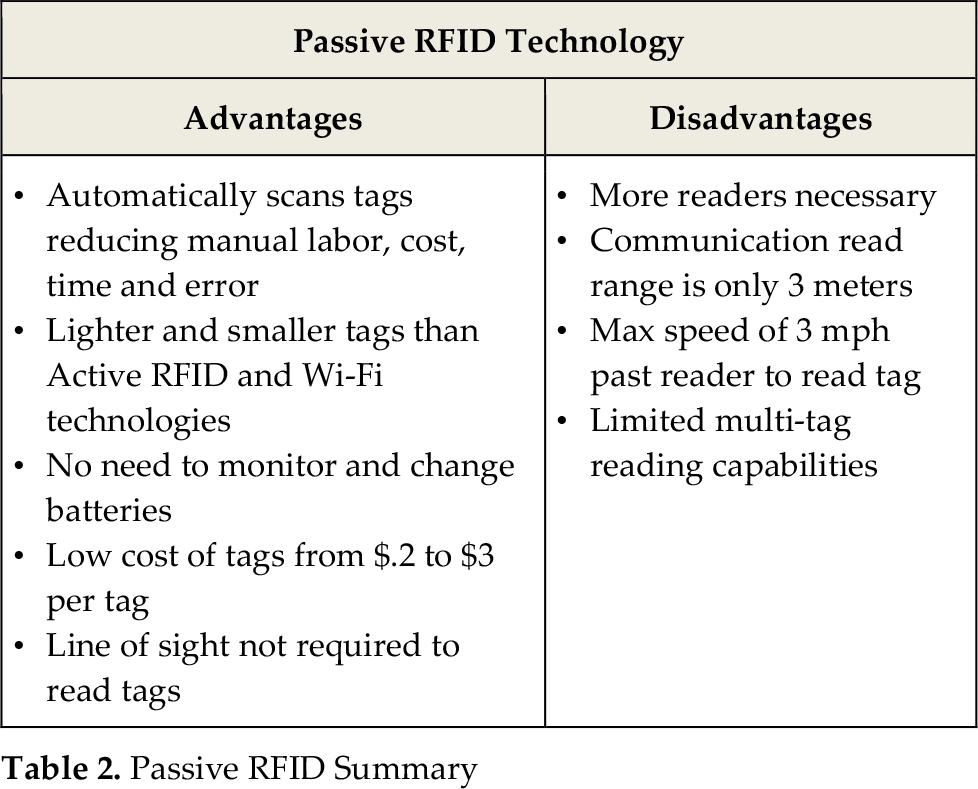
One advantages of passive RFID technology for managing containers is that, unlike the barcode technology, it does not require the reader or scanner to see or contact the tag. When the tag crosses the path of a reader, the information is automatically interpreted (Intermec, 2007). This aspect of RFID greatly reduces manual labor, time, cost, and human error. Also, passive tags do not need a power source, which eliminates the need to monitor and replace batteries and allows the tags to be lighter and smaller than active RFID tags. At a cost of approximately $0.20 to $3, passive RFID tags are considerably less expensive than the tags for active RFID (Krishnamurthy, V., 2007).
There are a number of disadvantages associated with passive RFID that have been identified by Shah and Murtaza (2008) and Su et.al, (2007). Since the tag does not have its own power source, passive RFID requires very strong signals from the reader to operate. Thus more readers placed throughout a facility may be necessary to increase reading capabilities, resulting in higher costs. Also, the signal strength returned from the tag is constrained to very low levels due to limited energy. These two issues may affect the accuracy of the readings if some of the passive tags are not identified. The limited read range also requires assets to move along predetermined paths. A speed of 3 mph or less is required for a tag to be read as it passes a reader, so passive RFID systems have a limited multi-tag reading capability. If large quantities of tags pass the reader at the same time, the reader will have difficulty reading all the tags and may miss some, which will lead to faulty tracking data and other issues. A summary of the advantages and disadvantages of the passive RFID system is shown in Table 2.
Passive RFID Summary
2.3. Active RFID
Savi Technologies (2002) and Harmon (2009) provide detailed information about active RFID and the advantages this technology offers. An active RFID system includes a reader, tags, and a computer. Active RFID tags have a unique, embedded DC battery power source that allows the RFID tag to continuously send out a stronger signal that can be received by a reader up to 100 meters away (Tesoriero, R., et. al, 2008). Compared to passive, active RFID's signal frequency is faster, enabling the information from the tag to be read at a much faster rate and allowing thousands of tags to be read by a single reader. Active RFID readers have the ability to read 20 tags simultaneously traveling at more than 100 mph (Ni, L., et al, 2004). The embedded battery, on the other hand, increases the cost of the individual tags
An active RFID system is part of a real-time location system (RTLS) that is capable of continually monitoring assets and personnel. The signals from an active RFID tag can also be translated into a location. A minimum of three readers within 100 meters of the tag are required to determine the location. Since the tag sends out its signal in a circular pattern from its location, each reader receives different signal strengths, depending on its distance from the tag. The signals received by the readers can then be used to calculate the location of the tag and container (Ni, L., et al, 2004; Harmon, C., 2009).
Active RFID tags are also capable of restricting access so that a user must to use a password to view the information that is stored on the tag. Passive RFID tags do not have this capability; thus, the information can be read by anyone with a reader. The memory capacity on the active RFID tags is about 1,000 times greater than a passive RFID tag and can be used to hold alphanumeric characters (Savi Technologies, 2002). Active RFID tags can also trigger an alarm if the asset and tag have moved outside of its designated area or safe zone, which is very useful when the asset is of high value or if personnel are not allowed to enter or leave a certain area. Hospitals or construction sites would be ideal places where this feature would be very helpful because of the high value of both people and construction equipment (Wang, S., et. al, 2006; Atkin, B. & Leiringer, R., 2006).
Active RFID tags have a read/write capability that allows the users to make changes to the data stored on the tag. Passive RFID tags do not have this capability, so the initial information is programmed onto the tags are permanent. Active RFID tags can also have sensing capabilities that allow them to collect data related to temperature, pressure, etc. (Zebra Technologies Corporation, 2007). This capability, although not very useful for all applications, is very useful for food and perishable items, pharmaceuticals, and hospital transfusions.
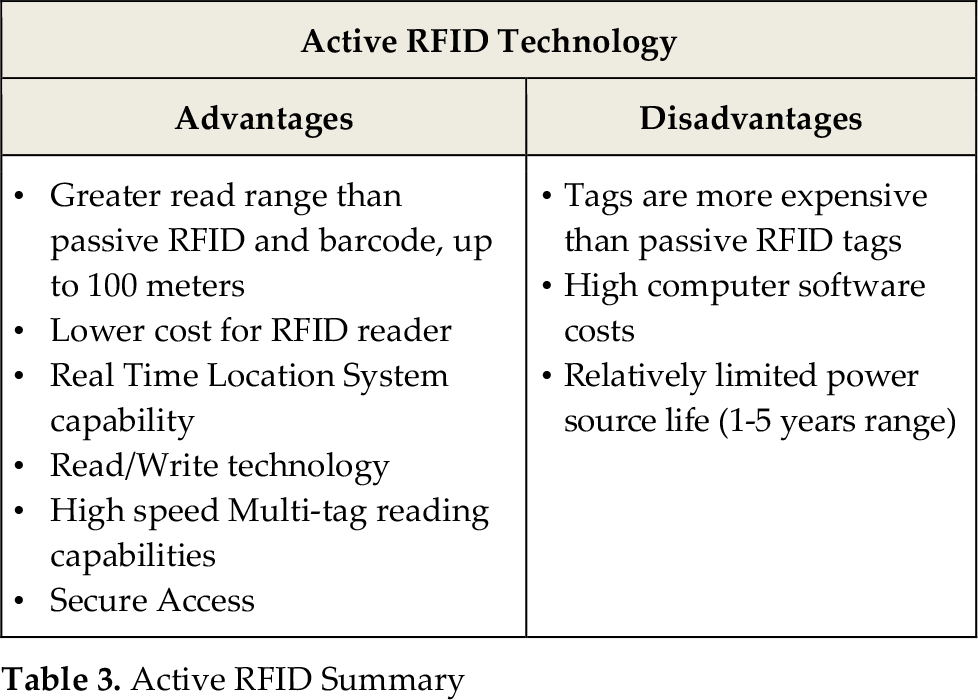
Another consideration is that active RFID tags can be read by less expensive readers than the type required for passive RFID tags. The embedded power source on the active tag sends out a signal that can be received by a lower-powered reader, which reduces the cost of active RFID readers compared to the cost of passive readers. On the other hand, the embedded power source increases the cost of the tag from $20 to $150 (Krishnamurthy, V., 2007), and a battery lasts only about five years. Replacement costs can be reduced if tags are not subject to harsh usage and environmental conditions because the batteries can be replaced instead of the entire tag.
Implementing an active RFID system in a facility will have very limited or no impact on the layout and routing of the material. The degree of the impact will be determined by the number of access points (i.e., the number of receivers in the facility) and what information the company wants to record. The higher the number of access points, the more freely the material and containers can flow. Harmon (2009) and Intermec (2007) offer extensive information about passive and active RFID, hardware/software, and regulatory issues related to frequencies used. A summary of advantages and disadvantages of the active RFID system is shown in Table 3.
Active RFID Summary
2.4. Wi-Fi
A Wi-Fi based real-time locating system (RTLS) is capable of continually monitoring assets and personnel. This technology comprises a combination of active tags or client devices, access points, and location applications that together provide a periodically updated estimate of the location of the client devices within a known environment (Redpine Signals Company, 2009). The tags that are attached to assets are read continuously and automatically. The tags can be read wherever a Wi-Fi signal is present, translating into real-time locating. Identifying precise tag locations and coordinate positions is possible with this technology and the appropriate software applications.
Wi-Fi tags are powered by small batteries with an average battery life of five years or more. The battery life is dependent of the scan rate; the more frequent the scan rate the shorter the battery life. Wi-Fi tags work by communicating with Wi-Fi technology involving, in particular an 802.11 Wi-Fi infrastructure. The technology uses 14 different frequency channels, but not all of them work worldwide (Broadband Wireless Exchange Magazine, 2009; Ross, J., 2003).
Wi-Fi technology has the ability to track thousands of tags simultaneously. An existing Wi-Fi infrastructure can be utilized to reduce initial investment costs and to incorporate an RTLS that is already widely used and relatively inexpensive. The Wi-Fi technology can be used for many applications other than strictly tracking purposes. Broadband Wireless Exchange Magazine (2009) provides extensive information about Wi-Fi technology and applications.
Unlike the barcode and passive RFID, no intervention or controlled path is needed to determine asset locations. If the Wi-Fi coverage is dense, there is no need to change business processes to accommodate communication read ranges. Operations would be able to continue as they are done currently. If there are limited Wi-Fi access points, the signal strength density could be weaker, resulting in a slight impact on business processes.
Similar to active RFID, Wi-Fi tags can have sensing capabilities that allow them to collect data related to the temperature and pressure of products. This attribute may not be particularly significant to all users, but the technology can be helpful when constant monitoring of some environmental conditions is necessary.
The costs associated with all necessary hardware and software to implement a Wi-Fi system are directly related to the number of assets being tracked. When compared to other AutoID technologies studied, the cost of the Wi-Fi can be relatively high for a large number of assets. At the time of this writing, the cost of batteries to power the tags was about $50 each, but one of the references predicted that prices could drop in the future (RFID Update, 2007). A summary of the advantages and disadvantages of Wi-Fi systems is shown in Table 4.
Wi-Fi Summary

2.5. GPS
A Global Positioning System (GPS) is a type of RTLS technology that is very useful for tracking vehicles, but GPS is not an appropriate technology for tracking hundreds or thousands of tags in a fixed space, especially indoors (ABIresearch, 2004; Regberg, M., 2007). The indoor spaces are out of reach of the GPS satellites, so the use of this technology at this point in time is not suitable for tracking of returnable containers that are occasionally stored indoors.
3. Case Study Overview and Research Activities
This case study paper is the result of a project conducted on behalf of a company, hereon referred to as Midwest Assembly and Manufacturing or MAAN. The company's operations include component manufacturing, painting, and assembling products. The company also purchases a relatively large percentage of components and major assemblies that are needed to support final assembly operations. Due to poor tracking of the containers, the company has been experiencing lost containers and occasional production disruptions at its facility and at the supplier sites.
MAAN operates on a make-to-order basis and offers a wide range of options for its products. The company's operations include component manufacturing, painting, and assembling products. MAAN purchases some of the needed components and major assemblies from suppliers. To facilitate parts ordering, MAAN uses a Computerized Supplier Network or MCSN that is accessed by the suppliers. Many of these suppliers use MAAN's returnable containers to ship their products to MAAN's manufacturing site and warehouses.
Without a system for identifying and tracking containers and a means to hold suppliers accountable, MAAN loses thousands of dollars every year to replace lost and damaged containers. In addition, poor management of the flow of containers through the supply chain occasionally slows and even halts production at MAAN and creates storage problems and excessive material handling at the suppliers' sites. MAAN also uses the services of a third-party logistics (3PL) company to provide logistics, warehousing, and less-than-truckload (LTL) and truckload services. The 3PL has a facility in the immediate vicinity of MAAN and assists in storing empty containers and scheduling them to be shipped back to the suppliers.
3.1. Case Research Activities
The research activities to address problems associated with the management of returnable containers at MAAN are summarized in Table 5. The major focus of the companion paper is a macro-level approach to improving returnable container management at MAAN (Maleki, R., and Reimche, J., 2010). An analysis of the current system for handling returnable containers through the logistics chain and researching the information flow among MAAN, the 3PL, and suppliers, has identified a number of problems including poor communication and lack of supplier liability. Other problems identified are lost containers, inadequate supply of available containers, difficulty locating and identifying containers, inaccurate container inventory, shipment of incorrect containers, and the inability to track container costs. Also highlighted in the companion paper is the impact of the problems on all three locations: MAAN, the 3PL, and the suppliers.
Project Research Activities

Three recommendations were made to address the challenges of managing returnable containers at MAAN: (1) improve the current communication and information flow, (2) ensure supplier liability, and (3) implement technology to identify and track the containers.
The coverage of AutoID as an aid for the identification and tracking of containers, however, is very brief in the companion paper. This paper provides an analysis of AutoID technologies as well as the criteria used for recommending a technology that can enable MAAN to better manage its returnable containers. Individually each of the recommendations has the potential to improve the management of the returnable container system. As a whole the recommendations provide the greatest impact on the system, providing MAAN and its suppliers, as well as the 3PL, with better visibility and tracking of the containers throughout the supply chain.
3.2. AutoID Technology Summary and Comparison
Key features of AutoID technologies that can improve the management of MAAN's returnable containers are illustrated in Table 6. Table 7 is a summary of the circumstances under which the different AutoID technologies studied would be suitable for use by MAAN. The preliminary research on the suitability of the different AutoID technologies took into consideration the number of returnable containers in the system as well as container traffic flow at MAAN and its 3PL. The estimate showed that there are about 3,000 containers in the system with an average daily flow of 250 containers through MAAN. The corresponding flow for the 3PL is 150 containers. AutoID technologies could improve the management of returnable containers and would allow for the inventory of containers and their locations to be updated continuously, and information could be gathered on the number of containers that were fabricated, scrapped, and lost, allowing MAAN to track costs associated with building and maintaining containers.
AutoID Technologies Summary
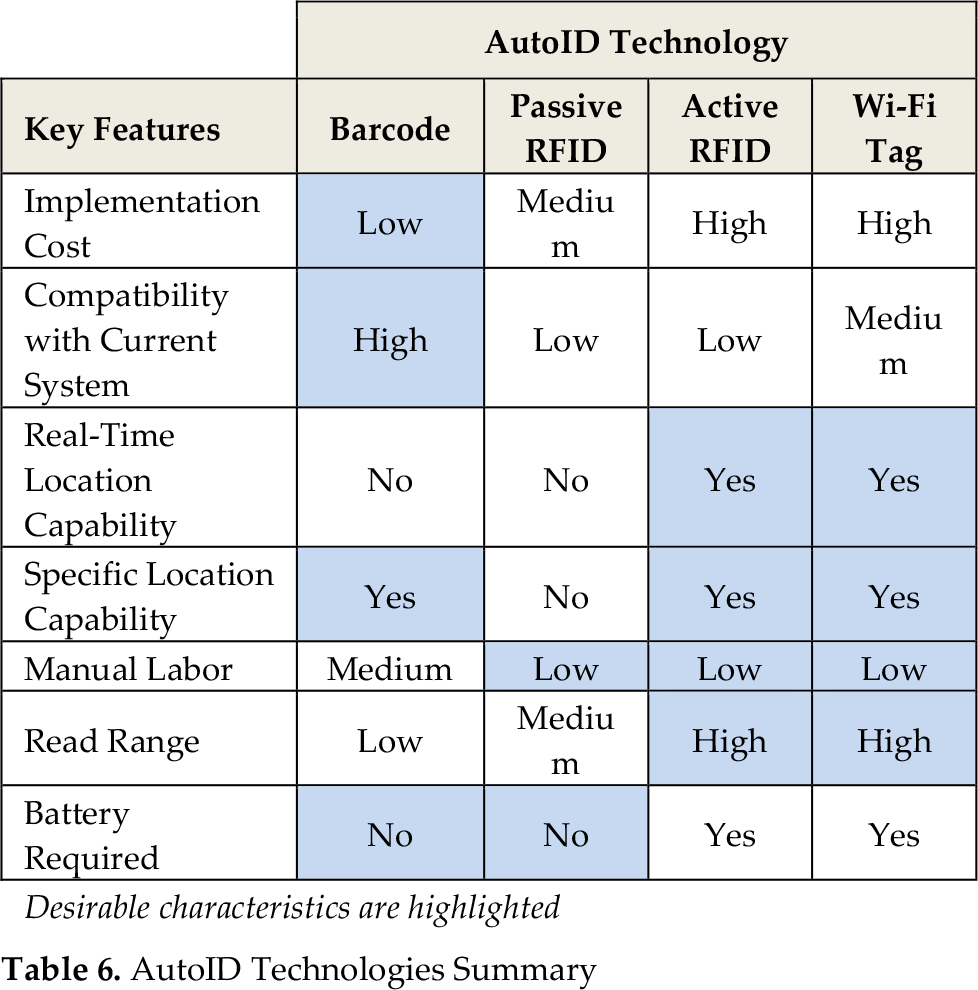
Desirable characteristics are highlighted
AutoID Technology Preferences

4. Economic Analysis
Each of the four recommended AutoID technologies have unique associated costs. The summary of the economic analysis for each technology is shown in tables 8 through 11. Fig. 1 compares the potential annual savings of each technology, and Fig. 2 compares the five-year savings. The economic analysis was based on the following estimates and assumptions:
Average life of returnable containers = 5 years
Average cost of a returnable container = $1,000
Estimated number of containers in the system = 3,000
Estimated number of containers lost every year = 150
Estimated number of containers in and out of MAAN during 2007 = 65,000
Cost Analysis Summary for Barcode System

Cost Analysis Summary for Passive RFID

Cost Analysis Summary for Active RFID

Cost Analysis Summary for Wi-Fi System


Potential Annual Savings Comparison for AutoID Technologies

Five-Year Savings Comparison for AutoID Technologies
When necessary, the research included collecting and developing time standards. All calculations were made for five years. Annual and cumulative savings do not take the time value of money into consideration.
Based on the research and analysis of the current system at MAAN, the capabilities and compatibilities of different AutoID technologies, and the economic analysis, a barcode system offers the best option. Currently, MAAN uses a barcode system to track inventory, labor hours, and job status. Therefore, the integration of barcode system features and necessary hardware for managing returnable containers would be very feasible. The MAAN partner facilities and vendors also use the barcode technology. This is an added advantage that allows for a system-wide tracking of returnable containers.
The analysis shows that the barcode system will have the shortest payback period (Fig. 1) and the best overall annual savings (Fig. 2). The passive, active, and Wi-Fi systems will eliminate the manual labor needed to scan the containers, but the annual expenses for each of the systems are greater than the labor required by the barcode system. The labor cost for scanning barcodes is almost negligible compared to the amount saved per year. Barcode technology is appropriate for MAAN because its capabilities are sufficient to address the needs of the company. Based on the feedback received from the company's IT department, the existing barcode system and software can be modified with relative ease and low cost to incorporate the changes required for container tracking.
5. Summary and Conclusions
This paper and a companion paper (Maleki, R. & Reimche, J., 2010) reflect a research project done on behalf of a manufacturing company that was experiencing difficulties in tracking and managing its returnable containers. The company's inability to effectively track the containers has negatively impacted the company, its logistics provider, and its suppliers. As part of the research project, the current systems of handling and distributing containers were documented and analyzed. From the analysis, a number of problems and their relationship to the company, the logistics provider, and the suppliers were identified. The overarching problem was inadequate visibility of the containers throughout the logistics chain.
The main focus of this paper was on researching and documenting the capabilities of AutoID technologies to improve the visibility of the returnable containers throughout the supply chain. Five technologies for automatic identification and tracking were considered: barcode, passive RFID, active RFID, Wi-Fi, and GPS. Due to its inability to track indoor assets, GPS was ruled out during the initial stages of analysis. The final conclusion is that barcode system technology offers features sufficient to address the needs of the company, including a low implementation cost, compatibility with the current system, relatively low requirements for manual labor, and ease of integration with current inventory system.
The results and research work and recommendations made in the companion paper and the recommendations made in this paper could (1) minimize the total number of containers in the logistics chain, leading to a significant savings, (2) improve the suppliers' delivery, (3) reduce handling costs generated by repeated handling of the products, (4) reduce transportation costs, and (5) reduce occasional shutdowns caused by shortages of parts. These recommendations, however, are only the first steps in the process of improving the management of returnable containers. More work needs to be done studying and analyzing the requirements at the suppliers and the company's logistics provider.