




Abstract
Background
Phosphogypsum is a waste by-product during the production of phosphoric acid. It not only occupies landfill, but also pollutes the environment, which becomes an important factor restricting the sustainable development of the phosphate fertilizer industry. Research into cast-in-situ phosphogypsum will greatly promote the comprehensive utilization of stored phosphogypsum. The aim of this study was to clarify the mechanical properties of phosphogypsum.
Methods
Stress-strain relationships of cast-in-situ phosphogypsum were investigated through axial compressive experiments, and seismic performance of cast-in-situ phosphogypsum walls and aerated-concrete masonry walls were simulated based on the experimental results and using finite element analysis.
Results
The results showed that the stress-strain relationship fitted into a polynomial equation. Moreover, the displacement ductility index and the energy dissipation index of cast-in-situ phosphogypsum wall were 6.587 and 3.425, respectively.
Conclusions
The stress-strain relationship for earthquake-resistant performance of cast-in-situ phosphogypsum walls is better than that of aerated-concrete masonry walls. The curve of stress-strain relationship and the evaluation of earthquake-resistant performance provide theoretical support for the application of cast-in-situ phosphogypsum in building walls.
Introduction
Phosphogypsum (PG) is a waste by-product during the production of phosphoric acid. About 5 tons of PG are generated per ton of phosphoric acid. With the rapid development of the phosphate fertilizer industry, global productions of PG are more than 150 million tons every year (1). In China, PG productions exceeded 80 million tons in the year 2015 (2). In the engineering construction industry, PG can replace natural gypsum to produce gypsum boards (3–4–5–6), blocks (7, 8), plasters (9–10–11–12), binders (13, 14), retarders (15, 16) and so on. Unfortunately, only about 15% of PG is utilized, and the majority of the remainder has to be stored in landfill (17). PG not only occupies landfill, but also pollutes the environment, and thus becomes an important factor restricting the sustainable development of the phosphate fertilizer industry. Therefore, an approach for the large-scale utilization of PG is needed.
To solve this problem, Luo et al (18) and Zhang et al (19) proposed cast-in-situ PG. They measured the cubic compressive strength and prismatic compressive strength through axial compressive testing (18, 19). The stress-strain relationship of cast-in-situ PG and the seismic behavior of cast-in-situ PG walls are the theoretical premise of the application in engineering construction. However, there is not enough research about it. Cast-in-situ PG walls can improve construction speeds and reduce construction costs. Importantly, research into cast-in-situ PG will greatly promote the comprehensive utilization of stored PG.
In this work, experiments to evaluate the stress-strain relationship of standard prismatic specimens of cast-in-situ PG were conducted. Stress-strain relationship curves were drawn based on the experimental results. Further, the seismic performance of different wall systems was simulated. Overall, this study investigated the application of cast-in-situ PG in walls, with respect to improving their seismic performance.
Methods
Stress-strain relationship experiments
Experimental components
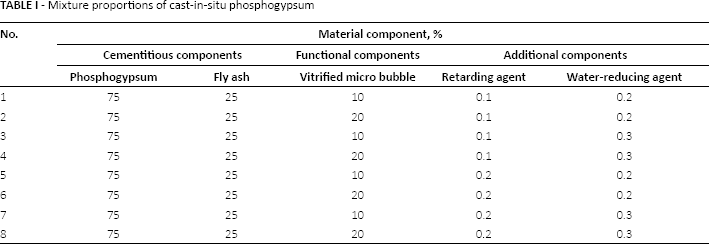
According to different proportions of cementitious, functional and additional components, 8 groups of standard prismatic specimens of cast-in-situ PG were designed. PG and fly ash were the main cementitious components. Vitrified micro bubble was the main functional component, which can reduce the density and improve the insulation properties of hardenite. Protein-based retarding agent and melamine-based water-reducing agent were added to increase the setting and hardening time, and improve the strength of the hardenite. PG, fly ash and vitrified micro bubble were acquired from Hubei Yihua, Wuhan Yangluo and Henan Xinhua, respectively. The mixture proportions of cast-in-situ PG are shown in Table I. In Table I the total proportion of cementitious components is shown as 100%. The proportions of other components were designed according to the proportions of cementitious components. There were 3 specimens for each mix.
Mixture proportions of cast-in-situ phosphogypsum
Experimental methods
The experiment was conducted in the structural vibration laboratory of Wuhan University according to standard test methods for evaluating the mechanical properties of ordinary concrete. The specimens were first aligned with the center of pressure plate of the experimental machine, and then the strain gauges were pasted on 2 adjacent sides of the specimen. Transversal strain gauges were used for confirming the centering of specimen. The longitudinal load was applied by a universal press, and the speed was controlled at 0.3-0.5 MPa/s. The strain value was read by the static-resistance strain gauge. The strain values were recorded at intervals of 5 kN. The strain gauge arrangements are shown in Figure 1.
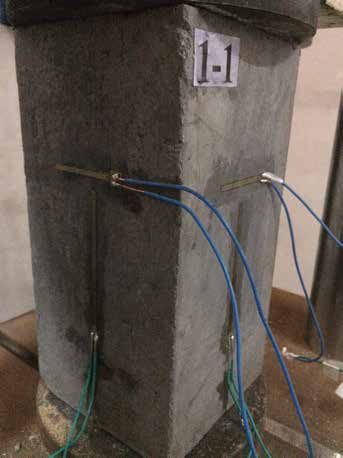
Strain gauge arrangements.
Experimental results and analysis
The measurements of the stress-strain curves are presented in Figure 2A–H. It can be seen from the figures that the curves of the different groups are basically the same. The strain increases with the increase in stress, and the curve tends to be a gentle one. The specimen is destroyed when the strain reaches the ultimate strain. The peak stress of cast-in-situ PG was about 1.4 MPa to 3.4 MPa. Strain data are a bit unstable because of the fragility of the cast-in-situ PG.
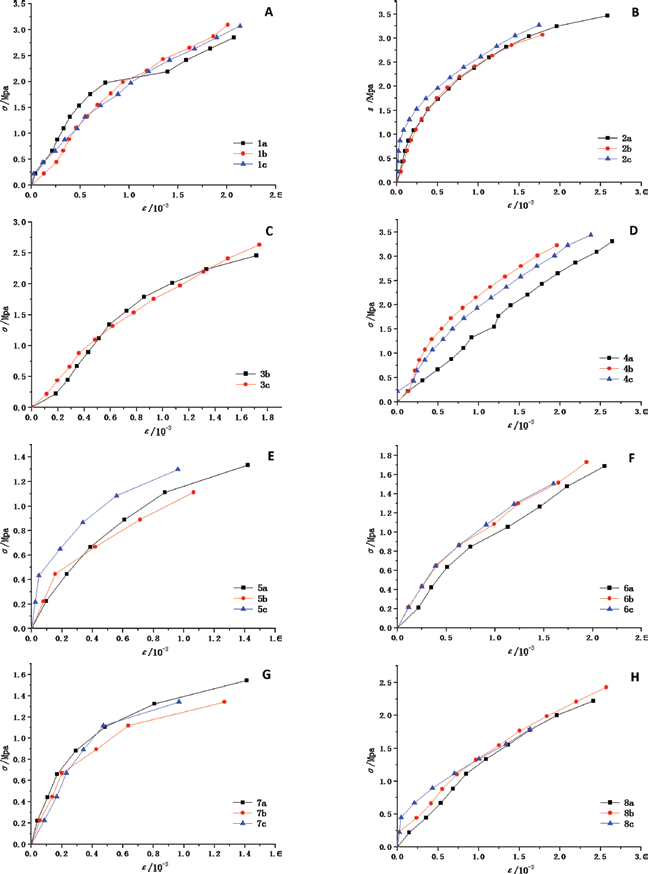
Experimental stress-strain curves. (
Fitting curves
According to the principle of the least squares method, the curves of the stress-strain relationship of cast-in-situ PG are generated. A polynomial model and trigonometric function model were used to fit the curves, which are more suitable for the actual measurements of stress-strain curves. The y-axis and x-axis were the normalized coordinates of stress and strain, respectively. The boundary conditions of the model were: y(0) = 0, y(1) = 1, y’(1) = 0.
Referring to the basic models of the stress-stain relationship of concrete, the polynomial (Eq. [1]) and trigonometric (Eq. [2]) models were


All experimental values for the 8 groups (24 specimens) were used for fitting the stress-strain relation. According to the experimental results for stress and strain, the curve of the cast-in-situ PG was fitted using the data analysis software Matlab, under the assumptions of the boundary conditions and basic models. Fitting curves of polynomial and trigonometric functions are presented in Figures 3 and 4.
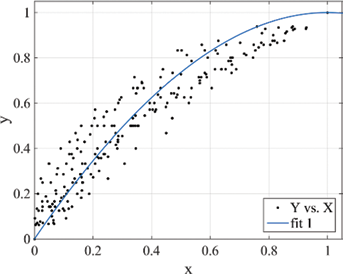
Polynomial fitting curve of stress-strain.
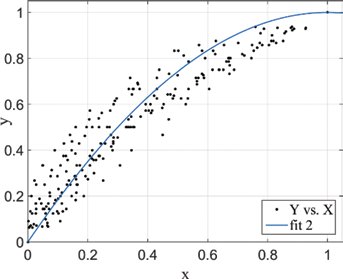
Trigonometric fitting curve of stress-strain.
The equations for the fitting curves of polynomial and trigonometric functions are shown in Equations [3] and [4]. The optimization coefficients were 0.9225 and 0.9218, respectively. The fitting curve of the polynomial function was more accurate.


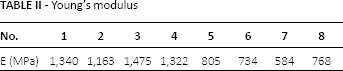
Young's modulus is the ratio of stress increment and strain increment in the process of deformation, which reflects the stiffness of the object. Linear regression analysis was conducted with the experimental values 0.2ε0≤ε0≤0.8ε0 (ε0 represents the ultimate strain), and Young's modulus was determined by the slope of the linear regression. Young's modulus is presented in Table II. The mean Young's modulus was about 1,000 MPa.
Young's modulus
Seismic performance simulations
Simulation models
A single frame wall was established for the seismic performance simulation. Column size was 0.5 × 0.5 × 3.5 m. Beam size was 0.7 × 0.7 × 5.9 m. Wall size was 2.8 × 4.0 × 0.2 m. C35 was adopted for the concrete of the column and beam. Longitudinal reinforcement was HRB400, and stirrup was HPB300. A cast-in-situ PG wall and aerated-concrete masonry wall were adopted, respectively. An overall modeling method was used in the simulation of walls. C3D8I was adopted as the element of the cast-in-situ wall, masonry wall and concrete components. T3D2 was adopted for reinforcement. The contact surfaces between wall and concrete components had binding constraints.
Simulation methods
The simulation of the seismic performance was based on the fitting curve of the stress-strain relationship. The seismic performance of the wall was analyzed for stress distributions, hysteresis curves, skeleton curves, displacement ductility index and energy dissipation index. A polynomial model was used for the stress-strain relationship. In the simulation, low-cyclic loading was applied on the end of the beam.
Results
Simulation results and analysis
Stress distributions
The stress distributions of cast-in-situ PG wall and aerated-concrete masonry wall are presented in Figures 5 and 6 respectively. As shown in the figures, the stress distribution of the cast-in-situ PG wall was more uniform, while stress concentration appeared in the mortar joint of aerated-concrete masonry wall. This showed that the cast-in-situ PG wall had good overall performance.
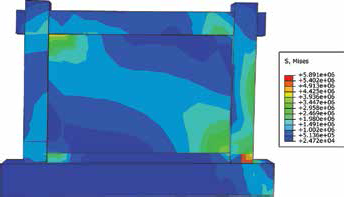
Stress distribution of cast-in-situ phosphogypsum wall.
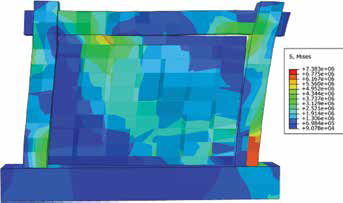
Stress distribution of aerated-concrete masonry wall.
Hysteresis curves
A hysteretic curve is a force-displacement curve, which reflects the seismic performance of energy dissipation and displacement ductility. The hysteretic curves for the cast-in-situ phosphogypsum wall and aerated-concrete masonry wall are presented in Figures 7 and 8 respectively. The hysteretic curve of the cast-in-situ PG wall is plump, and that of aerated-concrete masonry wall is pinched, which reflects the fact that the energy dissipation performance of the cast-in-situ PG was initially better.
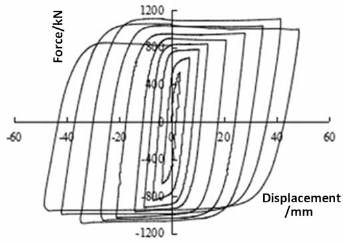
Hysteresis curves of cast-in-situ phosphogypsum wall.
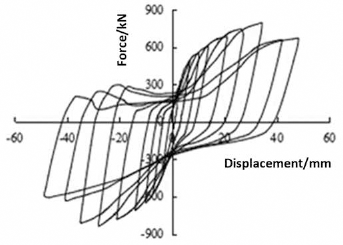
Hysteresis curves of aerated-concrete masonry wall.
Skeleton curves
A skeleton curve is the peak load ligature of the hysteretic curve, which reflects yield load and ultimate load more directly. The skeleton curves are presented in Figures 9 and 10. As shown in Figure 9 the curve declines smoothly when the load reaches the peak. However, the curve declines quickly in Figure 10. This phenomenon shows that the ductility of cast-in-situ PG was better.
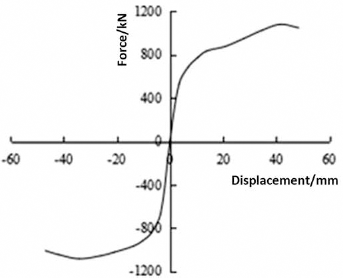
Skeleton curve of cast-in-situ phosphogypsum wall.
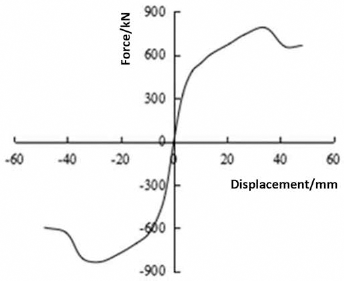
Skeleton curve of aerated-concrete masonry wall.
Displacement ductility and energy dissipation index
Displacement ductility index and energy dissipation index are often used to evaluate seismic performance qualitatively. The displacement ductility index (μ) is the ratio of the ultimate displacement and the equivalent yield displacement. The energy dissipation index (E) is the ratio of the energy consumption and the potential energy at the maximum amplitude in a loading cycle. The indexes can be calculated with Equations [5] and [6], based on the Specification for Seismic Test[ing] of Buildings (JGJ/T 101-2015). In the equations, xu represents the ultimate displacement, and xy represents the equivalent yielding displacement.


S is obtained through the last cycle of the hysteresis curve. The characteristic points of the hysteresis curve are presented in Figure 11.
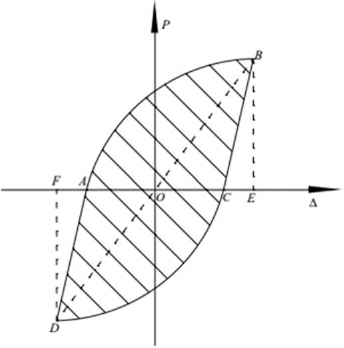
Characteristic points of hysteresis curve.
The displacement ductility index and the energy dissipation index of the cast-in-situ PG wall were 6.587 and 3.425, respectively, and those of the aerated-concrete masonry wall were 3.425 and 1.620. This showed that the displacement ductility and energy dissipation of the cast-in-situ PG were better. The earthquake-resistant performance of the cast-in-situ PG wall was better than that of the aerated-concrete masonry wall.
Discussion
In this paper, experiments to test the axial compression of cast-in-situ PG with different mix proportions were conducted, and the seismic performances of cast-in-situ PG wall and aerated-concrete masonry wall were simulated according to the fitting curve of the stress-strain relationship. The following conclusions can be drawn:
The fitting curve of the stress-strain relationship for cast-in-situ PG is y = 1.889x - 0.778x2 - 0.111x3, which is more accurate than trigonometric fitting curve. Young's modulus is about 1,000 MPa.
The hysteresis curve of cast-in-situ PG wall is plump, and the displacement ductility and energy dissipation of cast-in-situ PG are 6.587 and 3.425, respectively. A cast-in-situ PG wall has better earthquake-resistant performance. The obtainments of the stress-strain relationship and the evaluation of earthquake-resistant performance provide theoretical support for the application of cast-in-situ PG in the walls of buildings.
Footnotes
Financial support: This study was supported by the program “Effective Utilization Technology and Industrialization of Low-Cost and Large-Scale of Phosphogypsum (2014ACC015)” provided by Science and Technology Department of Hubei Province and the “Crane Meritocrat (Urban Construction) Plan (20161j0013)” provided by Wuhan Urban and Rural Construction Committee.
Conflict of interest: None of the authors has any financial interest related to this study to disclose.