




Abstract
Background
This study aimed to evaluate the effects of microwave irradiation on the physical and mechanical properties of poly(methyl methacrylate) (PMMA) provisional resins.
Methods
Twenty bars and 20 disc-shaped specimens were fabricated for each selected provisional restorative material (Dencor and Duralay). Test groups were subjected to microwave irradiation (3 minutes at 600 W) after polymerization. Bar specimens were subjected to a flexural strength test. Disc-shaped specimens were used to evaluate microhardness. Backscattered Raman spectroscopy was employed for each group to define the degree of conversion of the monomer/polymer. The frequency bands corresponding to C = C and C = O groups were used to determine the conversion of methyl methacrylate (MMA) monomers into polymers. Glass transition temperature was determined using a differential scanning calorimeter.
Results
Microwave irradiation of both tested autopolymerizing PMMA provisional materials resulted in a statistically significant increase in microhardness, degree of conversion and glass transition temperature values. Also, the results demonstrated a significant increase in flexural strength after postpolymerization microwave irradiation for the Dencor specimens.
Conclusions
It is concluded that mechanical and physical properties are positively influenced by microwave irradiation.
Keywords
Introduction
Provisional restorations are vital components for ensuring successful and predictable fixed prosthodontic approaches. Their integrity must be preserved during the treatment phase to provide function, comfort, aesthetics, phonetics, periodontal tissue protection, maintenance of a stable interarch relationship and occlusion (1). Due to the highly mechanical requirements of withstanding masticatory forces, any method that would increase the strength of provisional materials is to be desired.
Some amount of monomer remains unreacted at the completion of the polymerization reaction of all kinds of acrylic resins (2). The unreacted residual monomer negatively influences the mechanical properties of the polymers (3). Autopolymerizing poly(methyl methacrylate) (PMMA) resin remains the most commonly used material for provisional restorations. The inherent weakness of autopolymerizing acrylic resins arises from their higher residual monomer content due to the low degree of conversion (DC) reached by a chemical activator (4). Therefore, determination of the DC is a substantial component in the investigation of acrylic resins. The DC may be directly assessed by Raman spectroscopy and Fourier transform infrared spectroscopy. Although infrared spectroscopy is the most sensitive technique due to detection of the C = C stretching vibration before and after polymerization, it is time-consuming and costly (5). Raman spectroscopy is a crucial instrument for the characterization of the structure and dynamics of polymeric-based materials (6). The principal advantage of Raman spectroscopy is the absence of specific sample preparation requirements. It is a nondestructive technique, and samples can be used as fabricated. The band at 1,640 cm-1 is designated as C = C vibration in Raman spectroscopy, and the alterations in intensity before and after polymerization are used to compute the DC.
The glass transition temperature (Tg) defines the temperature at which the amorphous phase of the polymer is converted to rubbery and glassy consistencies. A provisional restoration might be subjected to temperatures beyond this critical value during polishing or disinfection procedures. Tg is related to the DC of an acrylic resin, since the Tg is directly related to the molecular weight and is decreased by the plasticizing effect of the residual monomers (7).
While hardness is used to predict wear resistance and polishability, flexural strength (FS) characterizes the ability to resist the deformation and fracture of materials. Therefore, the FS of provisional materials is crucial, particularly in the presence of parafunctional habits, or where a long-span prosthesis is planned (8).
Although some studies have demonstrated that the strengthening of denture base relining materials could be achieved by postpolymerization microwave (MW) irradiation, the DC remains unstudied (4, 9, 10). Moreover, the effects of MW irradiation after polymerization, on provisional restorative materials have not been investigated. Therefore, the purpose of this study was to determine the effects of MW postpolymerization treatment on the FS, Knoop hardness, DC and Tg of 2 different poly (methyl methacrylate)-based provisional acrylic resins. The hypothesis tested was that the FS, hardness, DC and Tg of the PMMA-based provisional materials would be improved by postpolymerization MW irradiation.
Methods
Two types of provisional restorative materials were selected for the present investigation (Tab. I): Dencor and Duralay. For each material, 20 bars (64 × 10 × 3.3 mm) and 20 disc-shaped specimens (5-mm diameter) were fabricated in customized stainless steel and silicone molds, respectively, as recommended by the International Organization for Standardization (ISO 1567) (11). The provisional resin materials were measured and mixed according to the manufacturers’ recommendations. The resin was injected into the corresponding molds, and a glass plate was placed over the material with 10 kg of constant pressure. The molds were stored at 37°C for 30 minutes before the removal of the specimens. The specimens were examined for the presence of air bubbles, and defective specimens were excluded from the study. The accuracy of the dimensions was verified with a digital micrometer with a 0.02-mm tolerance, and specimens were randomly divided into 2 groups (n = 10). To randomize the specimens, each specimen was assigned a number, and prior to MW irradiation, a number was randomly drawn. While the control group specimens remained untreated, the test group specimens were subjected to MW irradiation in a domestic MW oven (MB-315ML; LG Electronics Ltd., AM, Brazil) on a turntable at 600 W power for 3 minutes (9). Following polymerization procedures, all specimens were stored in distilled water at 37°C for 48 ± 2 hours.
Provisional materials evaluated in this study
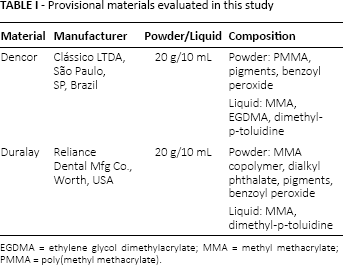
EGDMA = ethylene glycol dimethylacrylate; MMA = methyl methacrylate; PMMA = poly(methyl methacrylate).
At the end of the storage period, the specimens were washed under running water and air-dried. Bar specimens were subjected to a FS test using a universal testing machine (DL2000; EMIC, Parana, Brazil) with a 5 mm/min crosshead speed and a 50-mm span (11). The maximum load employed on the specimens was recorded, and FS values were calculated. The disc-shaped specimens were used to determine the Knoop hardness number (KHN) by a digital microhardness tester (HMV-2; Shimadzu Corp., Tokyo, Japan) with a 25-gf load and a 10-second dwell time. Five readings per specimen were carried out, and the mean value was recorded as the KHN of the specimen.
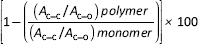
Backscattered Raman spectroscopy was employed on 6 randomly selected specimens for each group to define the DC of monomer to polymer. The equipment used in the Raman microspectroscopy consisted of a 10-mW HeNe laser (632.8 nm) as the excitation source and a detection system with a Dilor microscope and a Super Notch Plus filter (Kaiser Optical Systems Inc., Ann Arbor, MI, USA). The scattered light was collimated and collected by an imaging lens system, dispersed by a Jobin-Ivon (Edison, NJ, USA) spectrometer and recorded using a liquid-nitrogen-cooled charge-coupled device camera (EG&G; Princeton Applied Research, Princeton, NJ, USA). The signal was recorded onto specific software connected to the system. The Raman spectra of the monomers were used as the reference because they contain 100% unreacted C = C bonds. The C = O bonds were used as internal reference because they are not affected by the polymerization process and remain constant in monomer and polymer. The frequency bands corresponding to C = C (1,650 cm-1) and C = O (1,750 cm-1) groups were used to determine the conversion of methyl methacrylate (MMA) monomers into polymers, since, following complete polymerization, the first peak should be absent from the spectra while the second should remain visible. Since it was difficult to compare the intensity of bands directly, the ratio between the area (A) of the C = C peak and the area of the C = O peak was used as the reference. Thus, the DC was calculated according to the equation:
The Tg was determined (n = 6) using a DSC-4 (Perkin Elmer, Beaconsfield, UK) differential scanning calorimeter. The samples, weighing approximately 10 mg, were inserted into aluminum capsules and exposed to temperatures between 40°C and 200°C, at a rate of 10°C/min. Tg was determined in the second heating cycle.
The obtained data were evaluated with the statistical package SPSS version 15.0 (IBM, Armonk, NY, USA) using ANOVA and Tukey tests. Differences between means were considered significant for p values ≤0.05.
Results
The FS, microhardness, DC and Tg mean values and standard deviations of the specimen groups, along with the statistical significances, are presented in Table II. MW irradiation of the autopolymerizing PMMA provisional materials with an ethylene glycol dimethylacrylate (EGDMA) crosslinking agent content (Dencor) and without a crosslinking agent (Duralay) resulted in a statistically significant increase of KHN vs. control (16.80 ± 1.05 vs. 12.65 ± 0.36; and 14.63 ± 0.23 vs. 12.89 ± 0.59, respectively); DC vs. control (91.33% ± 2.30% vs. 66.66% ± 6.11%; and 70.66% ± 1.15% vs. 65.33% ± 2.61%, respectively) and Tg vs. control (102.5 ± 3.86 vs. 81.35 ± 5.64; and 86.54 ± 1.11 vs. 80.56 ± 3.36, respectively) values after MW irradiation, compared with the control groups. Also, the results demonstrated a significant increase in FS after postpolymerization MW irradiation for the Dencor specimens (65.36 ± 3.28) compared with the control group specimens (58.08 ± 4.50) (p = 0.012). Although a slight increase in FS for the Duralay specimens was detected after postpolymerization MW irradiation (57.71 ± 3.96), no statistical significance was found in comparison with the control group specimens (53.08 ± 3.13) (p = 0.690).
Flexural strength, hardness, degree of conversion and glass transition temperatures for experimental groups
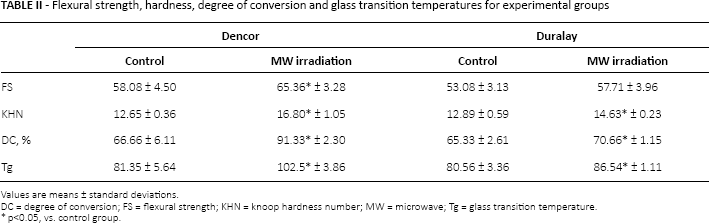
Values are means ± standard deviations.
DC = degree of conversion; FS = flexural strength; KHN = knoop hardness number; MW = microwave; Tg = glass transition temperature.
p<0.05, vs. control group.
Typical backscattered Raman spectra recorded for the Dencor and Duralay provisional restorative materials are shown in Figures 1 and 2, respectively. Each spectrum reveals a scattering Raman peak at 1,650 cm-1 which corresponds to the C = C groups. The scattering peak at 1,750 cm-1 arises from the C = O groups. Figures 1 and 2 show that the intensity of the Raman peaks in the area that corresponds to C = C bonds was reduced in the MW irradiated groups compared with the untreated specimens for all tested provisional materials.
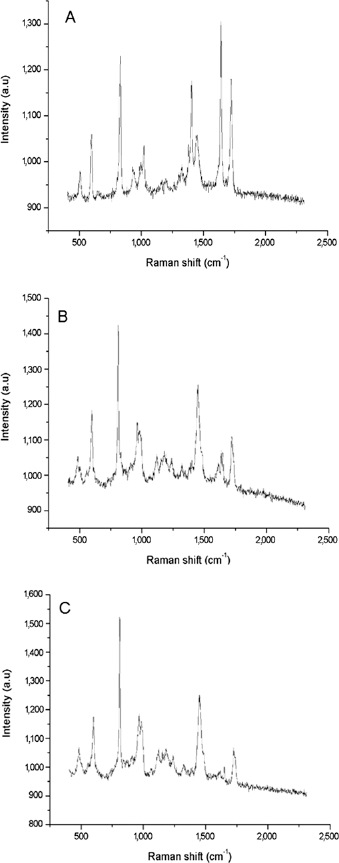
Raman spectra of Dencor: (
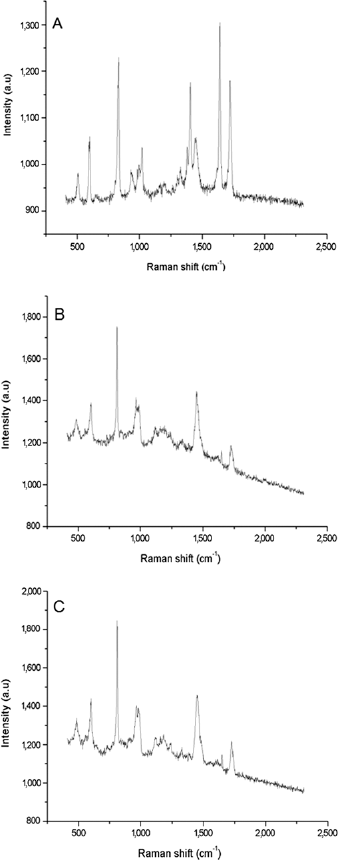
Raman spectra of Duralay: (
Discussion
This study proposed a new approach to enhancing the mechanical and physical properties of PMMA provisional resins. Strengthening of provisional restorations is very important because they are often required to function intraorally for extended periods of time while maintaining their integrity.
In this study, we used 2 basic types of PMMA-based provisional restorative materials. A conventional provisional autopolymerizing acrylic resin (Dencor) is basically composed of PMMA polymers with EGDMA as a crosslinking agent, in contrast to Duralay resin, which does not have a crosslinking agent in its composition and contains dialkyl phthalate as a plasticizer. It could be argued that due to the absence of crosslinking agents in its composition, Duralay acrylic resin might have a denser polymeric structure.
The FS test and Knoop hardness test were used together in this study to investigate the mechanical properties of the tested materials. These crucial mechanical characteristics of acrylic resins are heavily influenced by the acquired conversion level during polymerization. The DC and Tg tests were carried out by Raman spectroscopy and differential scanning calorimetry, respectively, to study the physical properties of the tested materials and to help understand possible alterations in mechanical behavior.
Based on the present results, the hypothesis that the FS, hardness, DC and Tg of the PMMA-based provisional materials could be improved by postpolymerization MW irradiation was verified. According to the data obtained, postpolymerization MW-irradiated PMMA provisional resins exhibited superior mechanical and physical properties compared with untreated resins.
The comparisons with controls of 2 MW-irradiated PMMA-based provisional restorative material (Dencor and Duralay) specimens revealed significantly increased hardness, DC and Tg values in the 2 MW-irradiated materials. Higher FS values were demonstrated after MW irradiation. However, for the Dencor test group only, the increase was statistically significant. These findings are in agreement with several reports from researchers who have studied the MW irradiation of denture base or hard reline materials (4, 9, 10, 12–13–14). Similarly, Blagojevic and Murphy demonstrated that postpolymerization MW treatment of an autopolymerizing reline resin for 3 minutes at 600 W decreased residual monomer content and improved mechanical properties (9). Polar MMA molecules align themselves with the electrical field generated by the microwaves, and they vibrate at the same frequency as this electrical field, inducing numerous collisions which cause the material to heat up (15). As the generated heat propagates, the polymerization reaction advances, and unreacted MMA molecules construct covalent bonds among themselves and form polymeric macromolecules (15, 16). The detected significant increase in DC for both materials points to considerably lower residual monomer content after MW irradiation. The lower residual monomer incorporation within the specimens explains the observed superior mechanical properties in the test groups. The results indicated that the DC of Dencor specimens was increased dramatically which resulted in a further increase in Tg and mechanical properties. The observed difference between improvement levels in the DC may be attributed to the differences in the chemical composition of the provisional acrylic resins (Tab. I).
A possible explanation for the increase in the hardness values detected for both Dencor and Duralay provisional materials may be the fact that the amount of unreacted monomer in the polymerized provisional resin was reduced by further MW irradiation. The aforementioned plasticizing effect of the residual monomer negatively influences the polymer interchain bonds and facilitates the deformation of the material under load (3, 17). Also, the presence of residual monomer in acrylic resins generates a decrease in the Tg of the material. A lower Tg value indicates a lower DC monomer/polymer (18). Future studies should adopt the approaches of intraoral environment simulation to evaluate the mechanical response of MW-irradiated provisional acrylic resins. Furthermore, investigation of the dimensional stability and surface properties may help to understand the influence of MW irradiation on provisional acrylics. A similar approach can be adopted for other types of polymeric materials such as PMMA-based provisional resins. Within the limitations of this in vitro study, the following conclusions were reached: (i) Postpolymerization MW irradiation caused a significant increase in the DC and Tg of the PMMA-based provisional resins. (ii) The hardness of both materials was significantly increased after MW irradiation. FS increase was significant for the Dencor provisional material. In other words, the physical and mechanical properties of PMMA-based provisional restorative materials might be positively influenced by MW irradiation following polymerization. The results might encourage clinicians to use MW irradiation for the reinforcement of autopolymerizing provisional materials to withstand masticatory forces especially in mechanically challenging situations.
Footnotes
Acknowledgement
The authors sincerely thank Dr. Cesar L. Petzhold (Department of Organic Chemistry, Institute of Chemistry, Universidade Federal do Rio Grande do Sul, Brazil) and Dr. Vicente C. B. Leitune (Department of Conservative Dentistry, Universidade Federal do Rio Grande do Sul, Brazil) for their valuable help in conducting the experiments.
Financial support: No grants or funding have been received for this study.
Conflict of interest: The authors declare that they have no conflicts of interest.