




Abstract
Infections associated with the use of intraocular, periocular, or orbital implants are associated with an increase in both morbidity and in the costs of ophthalmological surgery. This is due to an increased number of visits and the need for additional treatments, at a time when some conventional therapies are losing their efficacy, or even hospitalization. To avoid such consequences, the first step should be to prevent the biomaterials that form implants from being colonized by various microorganisms, either intraoperatively or postoperatively. To this end, several lines of research have emerged that aim at equipping implants with antimicrobial properties, some of which are described in this review.
Introduction
Ophthalmology is the discipline responsible for the diagnosis, treatment, and prevention of diseases affecting the eyeball and its adnexa: eyelids, orbit, and lacrimal system (1). In this field, biomaterials are consistently used in implantable devices such as intraocular lenses, orbital prostheses, or lacrimal stents. One of the main complications associated with medical implants is infection derived from the colonization of the biomaterials by microorganisms. As happens in other fields, infections associated with the use of intraocular, periocular, or orbital implants represent an increase both in morbidity (2) and in the costs derived from the clinical procedures (3). These result from an increased number of ophthalmological surgeries, visits, and the need for additional treatment or even hospitalization.
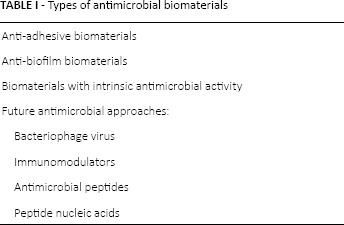
The purpose of this review is to describe different approaches to equip biomaterials with antimicrobial properties, that is, by decreasing the adhesiveness of the microorganisms to the materials (anti-adhesive biomaterials), interfering with the biofilm synthesis (anti-biofilm biomaterials), using intrinsic antimicrobial activity biomaterials, or applying new approaches based on peptides, nucleic acids, immunomodulators or virus (Tab. I). The review considers journal articles published between 2003 and 2014 sourced through the following databases: Medline, PubMed and Web of Knowledge. Various text combinations were used as a search strategy for the following terms: antimicrobial, anti-infective, eye, ophthalmology, implant, and biomaterials.
Types of antimicrobial biomaterials
Anti-adhesive biomaterials
The adhesion process of the microorganism to the biomaterial is determined by the interaction established between the elements that comprise the cover of the former and surface of the latter (4). Among the proposals that aim to prevent infection when interfering with the normal adhesion process are those that alter the surface characteristics of biomaterials, in other words, their chemical composition, topography, charge, and hydrophobicity. An example of this approach is surface molecules added to the biomaterial. They alter its initial chemical composition and are thereby able to compete with the adhesiveness of the pathogen. Likewise, they may alter the hydrophobicity of the compound. In this regard, Parsons et al (5) coated intraocular lenses equivalent to those implanted during cataract surgery with porphyrin (a photosensitizing agent), which increased their hydrophilicity and achieved a reduction of up to 99% in the adhesion rate of germs such as Staphylococcus epidermidis to the surface of the lenses.
Anti-biofilm biomaterials
One of the most crucial factors in the progression of infections associated with biomaterials is the presence of biofilms (6), that is, aggregates of microorganisms coated by an extracellular matrix (ECM) consisting of elements produced by the infectious agents and by the host itself. Such a formation enables adhesion of the microorganisms between each other and to those with different surfaces, giving them high resistance to both the immune system of the host organism and to antimicrobial agents and currently available disinfectants (7). In the case of antibiotics, the loss of efficacy seems to be determined by the existence of a gradient of oxygen in biofilms (8) that reduces their activity or even the capacity of the ECM to inactivate them.
The recurrent nature of infections associated with biofilms is determined largely by the existence of so-called quiescent cells (9). Such cells are capable of entering into a state of latency, which enables their survival when the concentration of antibiotic is high. By contrast, when the drug concentration decreases, they experience a reactivation process aimed at a restoration of the initial number of microorganisms, which is reflected in a rise in infection.
Anti-biofilm biomaterials are based on the addition of substances to the materials that interfere with some of the metabolic pathways responsible for the formation of the biofilm, such as:N-acetylcysteine, which alters the exopolysaccharide expression in the biofilm (10); dispersin B, which causes its disintegration (11); and DNase I that acts by degrading the extracellular DNA integrated into biofilms (12). In the last 5 years, other research groups have developed novel compounds that also interfere with biofilm synthesis. In their study, Behlau et al (13) evaluated the biocompatibility and anti-biofilm activity of the polyethyleneimine covalently bound to biomaterials comprising the Boston keratoprosthesis, an artificial cornea that is implanted when the expected success rate for conventional transplantation is reduced. By electronic and confocal microscopy, they demonstrated its inhibitory action on Staphylococcus aureus biofilms, showing no toxicity or other adverse effects following implantation in rabbits.
Among the drawbacks of this model, we can highlight a spectrum that has limited action due to the fact that each species shows different metabolic regulation mechanisms and sometimes a nonexclusive action on the pathogen. This is the case of proteolytic enzymes such as trypsin and proteinase K, which apart from affecting the microorganism, could induce the breakdown of the ECM of the host subject. Similarly, a action circumscribed only to biofilms would have limited efficacy, although the combination with other mechanisms (e.g., antibiotics) should show a synergistic effect. In this regard, Darouiche et al. (14) confirmed in vitro that the combination of triclosan plus dispersin B used in the coating of catheters causes a broad-spectrum synergistic action that is prolonged in time. Also in in vitro studies, Mansouri et al (15) demonstrated significant antimicrobial activity on gram positives and gram negatives for N-acetylcysteine coated and levofloxacin-impregnated catheters.
Biomaterials with intrinsic antimicrobial activity
This approach is based on the addition of molecules with antimicrobial action to the structure of a polymer, either during the manufacturing process (integrating them into the matrix that forms the polymer) or when this process has concluded (usually in the form of a coating). Among the substances with antimicrobial capacity, it is worth mentioning metals such as silver or zinc, and biopolymers such as chitosan or antibiotics.
Metals
The antibacterial power of silver has been widely documented (16), although the exact mechanism causing it is not known. It is believed that it may derive from the inactivation of essential enzymes for the respiratory chain of the pathogen or by the generation of hydroxyl radicals (17) that, in turn, would cause damage to the pathogen. With regard to the above, Yang et al (18) included silver particles in amounts of 300 ppm to 700 ppm in a PMMA (polymethylmethacrylate) resin used to make an ocular prosthesis. Then, they assessed and compared the growth of different microorganisms (Streptococcus pneumoniae, S aureus, Pseudomonas aeruginosa and Escherichia coli) on the surface of materials containing these particles and the surface of others that did not (controls). The results showed antimicrobial activity between 4.8 and 6.2 times higher in materials that contained silver particles compared to controls, with a reduction of up to 99.9% of the bacterial load of the former.
An alternative strategy consists of the deposit assisted by the radiofrequency of metals such as copper, silver, or zinc on the different substrates that are able to form the cover of the implant: polymers, alumina, silica, etc. Based on this design, Ferraris et al (19) incorporated silver particles into a silica matrix, recording the antimicrobial action of the compound regardless of the substrate covered. However, both designs have a major drawback: the particles contained in the biomaterial can have a toxic effect on the surrounding tissues of the implanted organism following the release of ionic forms and their diffusion towards these tissues (20). One possible solution to that drawback would be to increase the stability of the compound by various techniques such as sulfidation. Thus, the amount of ions released is reduced, and ultimately, the toxicity associated with it is also decreased (21).
Biopolymers
Chitosans are polycationic polymers derived from chitin. On the one hand, those with a high molecular weight are unable to cross cell membranes. Therefore, they arrang themselves to form films that make the exchange of nutrients necessary for the microorganisms difficult. On the other, those of a lower molecular weight can cross them and establish links with the genetic material of the pathogen, thus interfering with the normal encoding process (22).
Antibiotics
Regarding to this approach, Garty et al (23) assessed the feasibility and efficacy in the prevention of postsurgical infections from a device, capable of releasing an antibiotic and adapted to intraocular lenses implanted in a cataract surgery model performed on rabbits. To this end, they established 2 groups: 1 experimental group, in which intraocular lenses were implanted with the aforementioned devices, and the other, a control group in which a standard cataract surgery was performed with lens implantation, without such devices,. Later, they inoculated the bacteria at intraocular level in both groups. The results showed a fulminant intraocular infection in the control group subjects, while the experimental group developed an early infection that reversed after 2 weeks. In this latter group, a sufficient antibiotic concentration to develop an antibacterial action was also recorded for 4 weeks. Meanwhile, Kakisu et al (24) impregnated soft contact lenses with various quinolones (moxifloxacin and gatifloxacin), evaluating the release profile of the drug, the concentration achieved at the level of various ocular structures (cornea, crystalline lens, and aqueous humor), and their possible antibacterial activity, all in a rabbit model. The results showed a sustained release of antibiotic from the contact lenses during the first 3 days. Similarly, the pharmacological concentrations achieved were higher in both the cornea and the aqueous humor compared to those achieved with standard eye-drop formulation, without assessing bacterial growth in the treated group. Similarly, Shaw et al (25) demonstrated the ability of intraocular lenses used in regular clinical practice to absorb and subsequently release antibiotics in sufficient quantity to reach the appropriate minimum inhibitory concentration for the majority of germs responsible for postsurgical intraocular infections. Furthermore, Lipnitzki et al (26) confirmed greater persistence, at intraocular level, of drugs released from the impregnated lenses compared to those directly administered into the anterior chamber (intracamerals), characterized by an early pharmacological peak and reduced clearance time.
Future antimicrobial approaches
In parallel with the current ongoing studies evaluating the efficacy and safety of new biomaterials, many others have presented novel antimicrobial approaches that are still in the development stage and that could find future clinical applications in the field of ophthalmology. Among such approaches, we can highlight the following.
Bacteriophage virus
Bacteriophage viruses are capable of inducing the death of a bacteria after infecting it. Similar to what happens with other viruses, the bacteriophages begin the infection process by binding to specific receptors present on the cover of the pathogen. Then, they undergo a process of replication within the bacteria to eventually cause its death. The interest in these viruses as a potential weapon in the fight against infections associated with implants is recent, although some written works from the the early twentieth century had already highlighted their antimicrobial potential. Different studies, both in vitro (27) and in vivo (28), demonstrated their ability to reduce biofilm formation in strains of S aureus, as well as decreasing the total number of bacteria that comprise the colony. However, this approach has a limited antibacterial spectrum due to its high action specificity.
Immunomodulators
Rather than fighting against pathogens responsible for the colonization, like the majority of strategies previously outlined in this review, immunomoderators are intended to enhance the immune response of the host subject, Chemokines (chemotactic cytokines) form a group of substances with the capacity to regulate cellular traffic, within which specific subtypes, such as monocyte chemoattractant protein 1 (MCP-1) or interleukin 12 (IL-12), are included. MCP-1 is a potent recruiter of macrophages (29), whereas IL-12 induces the secretion of other cytokines such as interferon-γ (INF-γ). In a model developed in rats, Li et al (30) assessed nanostructured systems that included MCP-1 and IL-12 and were used in coating Kirschner wires for the treatment of open fractures. Their results showed a reduction of infections caused by S aureus in the wires coated with either cytokine compared to controls. Once again, the main limitation of this model resides in the possible adverse effects caused on the host subject if an immune response is triggered in the absence of infection.
Antimicrobial peptides (AMP)
AMPs are endogenous polypeptides integrated into the innate immune system of multicellular organisms, produced in response to the presence of potentially pathogenic microorganisms (31). AMPs possess a broad action spectrum as they are effective against gram positives, gram negatives, yeasts, and viruses. In addition, AMP are active against bacteria resistant to conventional therapies due to their low susceptibility to the possible modes of adaptation that these could develop. The mechanism of action most frequently observed is the induction of the lysis of the pathogen membrane. The drawbacks are their lability, the high dependency of their activity on environmental conditions, and their high production costs. Among the proposed solutions to such problems is the modification of the terminal regions to increase the degree of stability or a reduction in the size of the polypeptide while preserving the amino acids responsible for the activity, with subsequent reduction in the manufacturing process. In their model, Shukla et al (32) incorporated ponericin G1, an AMP highly active against S aureus, into a hydrodegradable multilayer polymer. Their results confirmed a sustained release of AMP from the film into the environment for a period of 10 days, preventing adhesion of Staphylococcus to the polymer. Furthermore, the compound was biocompatible with various cells involved in the healing process, such as fibroblasts NIH 3T or venous endothelial cells isolated from human umbilical cord. Meanwhile, Tan et al (33) added the SESB2V antimicrobial peptide to the coating of a titanium substrate, recording a significant reduction in the proliferation of E. coli and Bacillus cereus on its surface. Considering that this element is frequently used in the manufacture of keratoprosthesis, the author supported a possible future application of AMP in the prevention of infections associated with this device.
Peptide nucleic acids (PNA)
PNAs are synthetic analogs that mimic the natural genetic material. PNAs have the ability to bind both DNA and RNA (34). Furthermore, they have no electrical charge. This property enables lower repulsion forces between the PNA and DNA oligonucleotides compared to those recorded between natural oligonucleotides, creating a more intense hybridization and stable process for the former. Likewise, they have a higher binding specificity to those of native oligonucleotides as a result of their greater sensitivity to the discordance between bases. These chemical and structural properties enable specific action treatments to be designed and aimed at genetic material (35), whether it be DNA or RNA, promoting the inhibition of bacterial growth when interfering with the gene expression processes (36). With regard to the above, Ghosal et al (37) used PNA conjugated to antisense peptides as antimicrobial agents against P aeruginosa. To this end, they designed PNAs that acted specifically on 2 different genes of this bacterium: ftsZ (essential for the cell division process) and acpP (involved in the synthesis of fatty acids). The results showed a decrease in survival of the pathogen following its exposure to the peptides conjugated to the oligonucleotides.
Conclusions
Infections associated with the use of intraocular, periocular, or orbital implants involve an increase in both morbidity and in the costs of surgery. This, added to the loss of efficacy of conventional therapies such as antibiotics, require the development of alternative treatments to combat them. Among the new approaches, we highlight biomaterials with antimicrobial activity, as there are numerous studies that support the preclinical efficacy of many of these designs. However, the infectious process is multifactorial by nature, as it is influenced by variables not only related to the pathogen, but also to the host or to the environment. This fact determines the need for additional studies with a multidisciplinary approach that enable a greater understanding of infections and, hence, the acquisition of new biomaterials with a real clinical application.
Footnotes
Financial support: The authors have not received any financial support.
Conflict of interest: None of the authors has any conflicts of interest associated with this article.