




Abstract
Background
Compliance mismatch between native artery and a prosthetic graft used for infrainguinal bypass is said to be a factor for graft failure. The aim of this study was to develop a technique for measuring the compliance of collagen-coated polyethylene terephthalate (PET) vascular prostheses and to analyze the influence of several key properties on the elastic behavior of the grafts.
Methods
Compliance testing was performed on 3 prostheses with and without internal compliant membrane (ICM). The principle of this test was to study the dimensional changes of prostheses submitted to internal pressure from 30 to 240 mm Hg at intervals of predetermined values.
Results
We demonstrated that the ICM created links with the inner surface of the crimps and considerably modified the graft behavior when submitted to internal pressure. The results showed that compliance properties were dependent on the wall thickness and the crimping geometry of textile vascular prostheses. Mechanical analysis predicts the circumferential tensile behavior of these arterial grafts and validates tests for measuring compliance.
Introduction
Although synthetic prostheses made of polyethylene terephthalate (PET) have been most commonly used as material in the field of arterial replacement, failures or in vivo dysfunction of these grafts have been reported (1-4). Therefore, efforts are needed to optimize the production of prostheses for patients' safety. Indeed, anastomotic aneurysm formation is a complication inducing dysfunction of these substitutes and morbidity for the patient (5, 6). This complication is related to the textile structure and often results from a difference in compliance between a native artery and a prosthetic graft (7-10). Stewart and Lyman (11) demonstrated that compliance mismatch disturbed blood circulation, leading to positive and negative gradients in the concentration profile at the distal anastomosis. It was seen that when the graft and artery radii were compared at zero pressure and at mean arterial pressure, low wall shear stresses were only observed in the former case. Thus, the distal intimal hyperplasia seen in noncompliant grafts may be caused partly by decreased wall shear stress, and partly by concentration gradients of dissolved chemicals affecting chemotaxis of cells. In fact, compliance mismatch produces flow disturbance and increases mechanical stress near anastomic sites in flow models (10, 12-15). In addition, compliance mismatch causes stress concentration phenomena at the graft and host vessel suturing position and may induce vessel tissue overgrowth or vessel hyperplasia formation (7, 16, 17).
Compliance is an index of conformity of the blood vessel to blood pressure waves, and has been conveniently defined as the vessel wall distensibility in relation to pressure pulses (18). Several methods of compliance measurement have been reported, most of which are for the measurement of radial compliance (19, 20). Wang et al reported that growth of the separation zone at the toe anastomosis may be related to longitudinal compliance (21), and Shu and Hwang demonstrated that longitudinal compliance alone can affect blood flow at the distal anastomosis of a bypass graft (22). Therefore, it is important that the 3 different kinds of compliance (radial, longitudinal and volumetric) of a vascular graft must be determined.
The first objective of this study was to develop a device to investigate the radial, longitudinal and volumetric compliance of arterial prostheses without internal compliant membrane (ICM), while the standard method uses an ICM (23, 24). However, any such process of measurement to be developed should consider essential experimental conditions and environmental prostheses in the human body. A second objective was to analyze the influence of several key properties (wall thickness and crimping geometry) on the elastic behavior of the graft. Various tests were performed to determine the circumferential tensile behavior and fabric properties of the prostheses.
Materials and Methods
Vascular grafts
We studied 3 types of 8-mm nominal diameter PET collagen-coated prostheses (PH, PC and PHT) that are commercially available. All were warp knitted structures with different wall thickness values and crimping geometry (Tab. I). Knit fabric structure of 3 prostheses was Indeforma (Fig. 1). The prosthesis PH has a helical crimping geometry, but the prosthesis PC has a circular crimping geometry. The prosthesis PHT has a helical crimping geometry and a relatively thin wall.
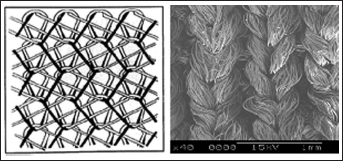
Indeforma knitted structure and scanning electron microscopy (SEM) micrograph of prostheses.
CHARACTERISTICS OF PROSTHESES STUDIED
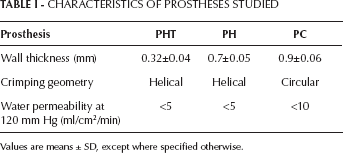
Values are means ± SD, except where specified otherwise.
The prostheses thickness was evaluated by using the compression and thickness device of Kawabata system. This test and the test of water permeability were completed in accordance with the standard ISO 7189 Cardiovascular Implants – Tubular Vascular Prostheses (25).
Tensile tests
The circumferential tensile tests were carried out in accordance with the standard ISO 7189 Cardiovascular Implants – Tubular Vascular Prostheses (25). Five samples from the same prosthesis material were tested (different locations) by using a Adamel Lhomargy dynamometer (MTS/20) controlled by the software Test Works 4. The device consists of 2 stainless steel plate assemblies, one for clamping in the upper and the other in the lower jaws of the tensile tester (Fig. 2). A graft specimen was cut carefully to a given length (16 mm), and placed over the 2 smooth hemi-cylinders held in holes of the arms extending from the plates. The specimen was then stretched to a given value of peak force and the load-elongation data were collected (26, 27). The speed of the movable jaws is 100 mm min−1. The breaking force per unit length of specimen Fcr (25-27) can be calculated by the expression:
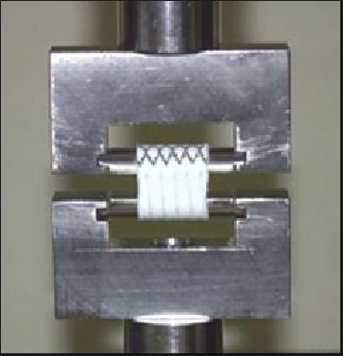
Tensile tests on tubular samples: Adamel Lhomargy dynamometer device for holding sample.

where Fr is the breaking strength and L0 is the initial length of the specimen.
The expansion of the specimen under tensile circumferential (Dilat.c) (26, 27) is defined by:

where D0 is the initial diameter of the cylinder at rest, P0 and Pt represent its perimeters before starting and at a time t of the test, respectively. Et is the distance between the clips at a time t.
All tests were performed in controlled conditions of temperature (21°C ± 1°C) and humidity (65% ± 2% RH) (28).
Flow circuit and compliance testing
The experimental device (Fig. 3) was composed of a compressor, a water reservoir, a compliance tank in which the sample is fixed and a pressure sensor located at the first end of the sample. The value of the pressure of water ejected within the sample was displayed continuously. The tubular graft sample was cannulated at both ends. One end was connected to a support to which a pressure bottle containing water was attached. The second end was closed by an obturator centered on a metal rod allowing free graft elongation during pressurization. The tests were conducted while the sample was immersed in water maintained at 37°C.
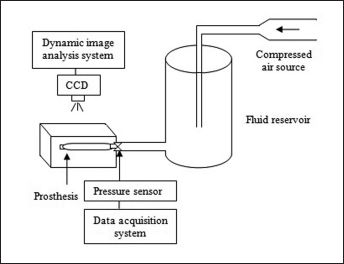
Schematic diagram of the experimental device for prosthesis compliance measurements.
Samples of 10-cm length were preconditioned prior to compliance testing by slow inflation to 30 mm Hg followed by holding this pressure for 1 minute. Thus 30 mm Hg was the reference pressure in this study. The prosthesis was then subjected to various pressures (from 30 to 240 mm Hg: 30-45-60-75-90-105-120-135-160-180-200-220-240) corresponding to the physiological pressure exerted on the artery wall during the cardiac cycle. With the help of image analysis, the changes in the dimensions of prosthesis were analyzed. In practice, for each pressure value, 4 positions in the sample corresponding to 4 angles of rotation (0°, 90°, 180° and 270°) were analyzed, since prostheses did not have a perfectly circular section. For each pressure and position, 2 pictures were taken with a video camera (Stingray; Allied Vision Technologies, Germany). These images were then processed by Image JV.1.43n software. A small program was written to process the images in the same way. This program identifies the prosthesis outer contour which allows the location of any given point by its coordinates. Using Microsoft Excel, we can identify dimensions and deformations of prostheses such as the longitudinal elongation and the maximum, minimum and mean external diameter. Five samples were tested for each kind of prosthesis to check reproducibility.
We performed tests on samples with and without ICM to determine the effect of the ICM. In the tests with ICM, a thin low modulus impervious balloon of a diameter (10 mm) greater than that of the graft was inserted in the graft.
Compliance Measurements and Statistical Methods
Compliance is a structural property of the vessel, biological or prosthetic, which is a measure of the capacity for distension of a structure under physiological blood pressure. This property is analogous to elasticity in the colloquial sense of the word (29). Thus, a properly compliant vascular graft is one which, through its “elasticity,” conserves the kinetic energy of pulsatile flow. It also represents an index that is associated with the graft's capability of increasing in volume under a given internal pressure (18, 30). The compliance (CX) is expressed by a percentage change in dimension (relative to its value at 30 mm Hg) divided by change in pressure (ΔP = P – 30) of liquid ejected (31). The expression is as follows:

where X = R (mean external radius in mm), L (length in mm) or V (volume in mm3, V = π × R2 × L) and ΔX is the change in dimension, ΔX (mm3) = Xp – X30, where Xp is the dimension at a specified pressure and X30 is the reference dimension at 30 mm Hg.
If we have the values of Rp, R30, Lp, L30 and ΔP, we can calculate the values of 3 compliances (radial CR, longitudinal CL and volumetric CV) with the help of the given expression.
The radial, longitudinal and volumetric compliance values of prostheses with a balloon were statistically compared with those without a balloon using 1-way analysis of variance (significance level = 0.05), with Minitab® v.15 software.
Results
Compliance study
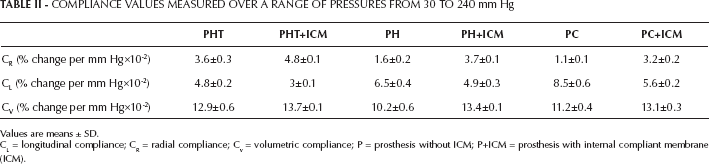
The tests were carried out on 3 different prostheses. Table II summarizes the radial, longitudinal and volumetric compliance values of prostheses with and without ICM.
COMPLIANCE VALUES MEASURED OVER A RANGE OF PRESSURES FROM 30 TO 240 mm Hg
Values are means ± SD.
CL = longitudinal compliance; CR = radial compliance; Cv = volumetric compliance; P = prosthesis without ICM; P+ICM = prosthesis with internal compliant membrane (ICM).
Figure 4 illustrates the variation of the external diameter of the balloon versus the applied pressure. This diameter seems to follow an exponential law (Eq. 4).
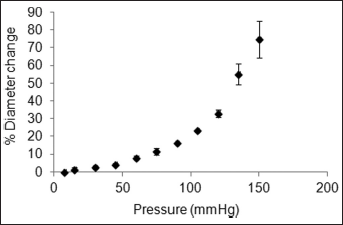
Changes in membrane external diameters.

where e is the thickness of the balloon, R0 and RP represent reference radius and radius at a specified pressure P, respectively.
From 120 mm Hg, the diameter of the balloon increased significantly. The mechanical behavior of the balloon revealed that this thin elastomeric tube has notably low Young's modulus (E=0.59±0.07 MPa; obtained from Eq. 4) and high yield strain compared with other materials.
The variation of radial compliance for the 3 prostheses with and without ICM is shown in Figure 5. The graph shows that the diameters of prostheses with or without ICM were almost the same for the lower values of pressure (<140 mm Hg). Thus in this area, the ICM did not have a significant influence on the test. In contrast, for values of pressure higher than 140 mm Hg, the diameter of the prostheses with ICM seemed more important than those without ICM. It is clear that the more the thickness of the prosthesis was increased, the more the difference between the compliance values with and without ICM was important. These results prove that the difference in diameter with and without ICM depends on the prosthesis wall thickness (32, 33).
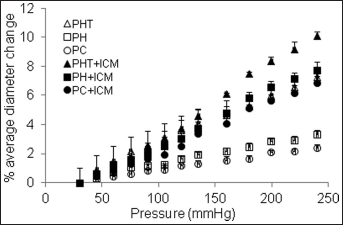
Changes in mean external diameters of prostheses. ICM = internal compliant membrane.
To examine the inflation of the graft during compliance testing, the variation of the external diameters of the prosthesis PH was plotted versus the pressure (Fig. 6; we have reported only the case of the PH prosthesis, the other prostheses PHT and PC had the same trend). As the mean external diameter represents the arithmetic mean of minimum and maximum external diameters, the increase in this diameter was influenced by the increase in the minimum diameter than that of the maximum diameter.
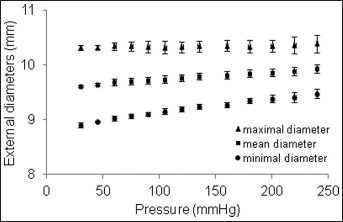
Changes in external diameters of prosthesis PH without internal compliant membrane (ICM).
The variation of the mean external diameters for the various positions of the prosthesis PH is shown in Figure 7. It is clear that the prosthesis was not perfectly circular before or after the application of pressure. That is why it was interesting to study the 4 positions of rotation of the prosthesis to determine a correct average value of the diameter.
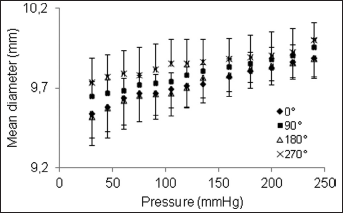
Variation of mean external diameters according to position of prosthesis PH without internal compliant membrane (ICM).
The variation of the percentage length change for the 3 prostheses versus the pressure is shown in Figure 8. This graph shows that the presence of the ICM prevented the prosthesis from stretching in the longitudinal direction.
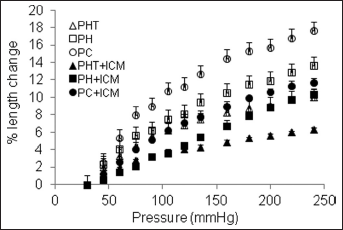
Changes in elongation of prostheses. ICM = internal compliant membrane.
Figure 9 illustrates the variation of percentage volume change for the 3 prostheses with and without ICM. The volume change for the lower values of pressure (<140 mm Hg) was more important in the case of the test without ICM than those with ICM. It appears that the transverse longitudinal coupling of the ICM with the prosthesis prevents it from stretching freely and limits crimping.
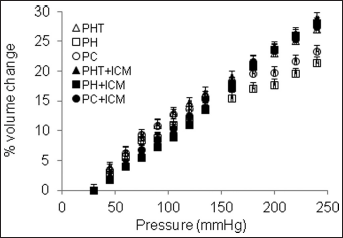
Changes in volume of prostheses. ICM = internal compliant membrane.
Analysis of variance revealed highly significant variance in compliance exhibited by prostheses with ICM and prostheses without ICM. Table III summarizes the outcomes of variance analysis that compared, for a range of pressures (30-240 mm Hg), the radial, longitudinal and volumetric compliance index values. There were significant differences between the longitudinal compliance values of the 3 prostheses with and without ICM. Comparing radial compliance of vascular grafts with and without ICM, a significant difference was observed in prostheses PH and PC.
OUTCOME OF ANALYSIS OF VARIANCE COMPARISON OF COMPLIANCE OF PROSTHESES WITH VS. WITHOUT ICM, USING 1-WAY ANALYSIS OF VARIANCE (SIGNIFICANCE LEVEL = 0.05)
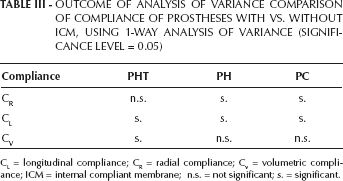
CL = longitudinal compliance; CR = radial compliance; Cv = volumetric compliance; ICM = internal compliant membrane; n.s. = not significant; s. = significant.
Tensile properties
A general comparison of the stress–strain behaviors is shown in Figure 10. This circumferential tensile test showed that the curves for PHT and PC prostheses had a sigmoid shape. However, the prosthesis PH had a J-shaped curve. This form reflects the fact that the structure was rearranged under stress and thus the sigmoidal behavior of the fibers was masked (34). Thus, the presence of a coating can also affect the mechanical behavior of implants.
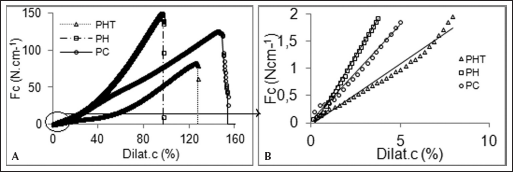
Circumferential tensile test: (
Discussion
Arteries do not merely convey blood from one part of the circulation to another. Their elastic structure allows the energy-efficient transmission of pulsatile blood flow, the simultaneous damping of excessive pressure fluctuations and the matching of the impedance characteristics of the proximal arterial tree to distal branches (35). Commercially available prosthetic vascular grafts do not reproduce these favorable characteristics. Development of a compliant vascular graft remains elusive.
Attempts to fabricate compliant vascular prostheses have involved elastomeric materials such as polyurethane (PUR) (36, 37) and silicone rubber (38). However, compliant grafts must by necessity be biostable, as is the case with PET (or Dacron) and expanded polytetrafluoroethylene (ePTFE), if they are to be considered safe for clinical use (1-4, 39).
Previous studies have shown that tests for measuring compliance properties were carried out on prostheses with compliant balloons (23, 24). In the present work, compliance tests were performed on samples with and without ICMs to determine the effect of the ICM on the mechanical behavior of vascular prostheses. We have demonstrated that the transverse longitudinal coupling of the ICM with the prosthesis prevents it from stretching and limits crimping. Additionally, analysis of variance revealed highly significant variance in compliance exhibited by prostheses with ICM and prostheses without ICM. So the ICM, when submitted to internal pressure, modified considerably the behavior of the graft.
Considering the significant influence of the ICM in the above results and for better simulation of the in vivo clinical environment, we only need to be interested in the tests of compliance of the prostheses without ICM. The elastic behavior of the 3 prostheses was measured over a range of pressures from 30 to 240 mm Hg. It was important that 3 different kinds of compliance (radial, longitudinal and volumetric) of a vascular graft were determined.
It is evident that textile vascular grafts can be differentiated on the basis of many factors: the material (PET, ePTFE, PUR, etc.), the textile fabric structure (woven, warp or weft knitted), the compaction process (type of fixation and porosity), the crimping geometry (circular or helical) and the coating process. Our objective was to analyze the effects of wall thickness and crimping geometry on compliance properties of PET vascular prostheses, which is the most commonly used material in the field of arterial replacement. The goal was therefore to optimize the manufacturing process to develop a compliant vascular graft.
The radial compliance results confirmed the importance of the wall thickness effect on prosthesis behavior. It is noted that the prosthesis PHT was more compliant in diameter, whereas the prosthesis PC was the least compliant. The mean external diameter of the prosthesis PHT, without ICM, increased by 0.7 mm with an internal pressure between 30 and 240 mm Hg. Thus, low wall thickness of PHT makes it more deformable and less resistant to pressure (32, 33). Despite a significant increase in its diameter (CR=4.1±0.4% per mm Hgx10−2 for a pressure range 30-100 mm Hg), it remained less compliant in comparison with a healthy human artery (40) (CR=8.0±5.9% per mm Hgx10−2 for a pressure range 30-100 mm Hg) and with a compliant poly(carbonate) polyurethane graft (40) (CR=8.1±0.4% per mm Hgx10−2 for a pressure range 30-100 mm Hg). The compliance value for the prosthesis PHT without ICM was 2.03±0.38% per mm Hgx10−2 (between 80 and 120 mm Hg); this value was the same with Dacron® (10) (1.9±0.3% per mm Hgx10−2) and Goretex® (10) (1.6±0.2% per mm Hgx10−2), but it is still lower than the compliance value for the electrospun silk fibroin tube (24) (3.51±0.42% per mm Hgx10−2).
During compliance testing, the passage of the liquid inside the prosthesis can be pushed on the valleys rather than on the crests. It is noted that the pressure and the difference between maximum and minimum diameters are inversely proportional to each other. It is clear that the increase in pressure reduces the amplitude of crimping. These facts establish that the crimping is obtained by compression of textile meshes which are unfolded due to the effect of pressure.
Longitudinal compliance analyses showed that a very rapid elongation occurs in prostheses, as soon as the pressure was increased. As the pressure increased, the rate of increase in elongation was reduced. It was also noted that the prosthesis PC stretched more than the other grafts as a result of the pressure wave. The prosthesis PC (with circular crimps) had many spirals, which is why it was easier to stretch. On the other hand, the prostheses PHT and PH (with helical crimps) had only 1 spiral, thus making them difficult to stretch. This reveals that crimping geometry affects the elongation of prostheses when they are subjected to pressure.
The tests for measuring volumetric compliance showed a slight difference between the 3 prostheses. As shown in Fig. 9, the variation of percentage volume change for the prostheses without ICM, revealed that the prosthesis PHT was slightly more compliant than the others. Referring to Fig. 5 and 8, the prosthesis PHT showed more swelling than elongation, while the reverse was true for prostheses PH and PC. Therefore, it is important that the 3 different kinds of compliance are considered separately. So, the effects of construction and processing factors on prosthesis properties are not linear and consequently not simple to predict (41, 42).
The mechanical behavior of the 3 prostheses was evaluated. Previous studies have focused on parameters such as breaking strength and elongation at rupture (34, 43). But as a matter of fact in the human body, a prosthesis is subjected to a relatively far lower stress from blood pressure. So, it would be wise to judge the behavior of prostheses just at the beginning of the circumferential tensile test, which represents the working zone of the prosthesis. In this zone, it was clear that the prosthesis PHT expanded more than the other prostheses (Fig. 10b). This finding confirms the results found previously showing that the prosthesis PHT is the most compliant in diameter.
Conclusions
This study was conducted to investigate the compliance properties of vascular prostheses. An experimental device was developed for the purpose. The results demonstrated that the ICM creates links with the inner surface of crimps and considerably modifies the graft behavior when submitted to internal pressure. A significant difference between compliance values of the vascular prostheses tested and those of healthy human arteries was illustrated. The elastic properties of vascular grafts are affected by many factors related to test method and prosthesis such as wall thickness and crimping geometry. Mechanical analysis allows us to predict the circumferential tensile behavior of these arterial grafts, and to validate tests for measuring compliance.
In conclusion, the technique of compliance measurement using the hydrostatic force method provides a valuable tool to differentiate the 3 categories of compliance: radial, longitudinal and volumetric.