




Abstract
Purpose
The aim of this study was to evaluate the shear bond strength (SBS) of conventional and self-adhering flowable resin composites on the dentin surfaces of primary and permanent teeth and to evaluate the effect of the application of an adhesive system under self-adhering flowable resin composite on SBS.
Methods
Prepared permanent and primary tooth dentin surfaces were randomly distributed into 3 groups according to application protocols as follows: group 1: Vertise Flow; group 2: OptiBond + Filtek Ultimate; and group 3: OptiBond + Vertise Flow. A universal testing machine was used to measure SBS of prepared specimens, and data were analyzed using 1-way ANOVA and Tukey test.
Results
Statistically significant differences were observed among all groups for primary and permanent teeth (P<0.05). The highest values were observed in group 2, followed by group 3, in both permanent and primary teeth. SBSs of all groups were significantly higher for permanent teeth than for primary teeth (P<0.05).
Conclusion
Although SBS values of Vertise Flow groups were lower than those for conventional flowable resin composite groups, with further developments in material technology, self-adhering materials could be promising materials especially for pediatric dentistry.
Introduction
Flowable composites resins – i.e., resin composite formulations with greater fluidity – were first introduced in late 1996 (1) and are characterized by lower filler loading and a higher proportion of diluent monomers (2). The reduction in viscosity was initially achieved by reducing the filler content while retaining the same small particle size of conventional hybrid composites (3).
Flowable composites have been suggested for use as filling material in low-stress applications and in situations where access is difficult or good penetration is required, such as: with amalgam, composite or crown margin repair; pit and fissure sealing; preventive resin restoration; air abrasion cavity preparation; cavity lining; porcelain repair; enamel defect repair; incisal edge repair in anterior sites; and small Class III and Class V restorations (1).
Because conventional flowable resin composites do not have adhesive properties per se, the use of a dental bonding system is necessary (4). Self-etch adhesive systems have been gaining in popularity, mainly due to their simplified handling (4-7). While these systems have been shown to have a number of clinical advantages, additional research is still needed to determine the etching potential and bonding durability of self-etch adhesives in different clinical situations (5, 8-10). Recently, a revolutionary new category of composites has emerged that combines the properties of self-adhesion and flowability. Vertise Flow (Kerr Dental, Orange, CA, USA) is one of a number of innovative resin-based materials defined as “self-adhering resin composites” (11). With restoratives in this category, the etching, priming and bonding steps normally required to bond a resin composite to dentin and enamel are eliminated (12). Given the simplification of the bonding procedure, flowable composites may have lower failure rates than traditional composites, since fewer errors related to technical procedures may be expected.
The clinical success of flowable composite depends on the ability of the material to adhere to the dental surface (11); however, little information is available regarding the bond strengths of self-adhering flowable composites. Therefore, this study aimed to evaluate and compare the shear bond strength (SBS) on primary and permanent tooth dentin surfaces, of a conventional flowable resin composite and a self-adhering flowable resin composite used with or without an underlying self-adhesive system. The present study investigated 3 matters: (i) the SBS values of self-adhering flowable resin composite would be as high as those of conventional flowable resin composite; (ii) the use of a self-adhesive system would not affect the SBS of self-adhering flowable resin composite; and (iii) the SBS of self-adhering flowable resin composite in primary teeth would be equivalent to that obtained in permanent teeth.
Materials and Methods
Materials
Two commercial flowable composites (Vertise Flow; Kerr Dental, Orange, CA, USA; and Filtek Ultimate; 3M/ESPE, St. Paul, MN, USA) and 1 adhesive (OptiBond All-In-One; Kerr Dental, Orange, CA, USA) were used in this study. All materials were applied according to the manufacturers' instructions (Tab. I).
MATERIALS USED IN STUDY
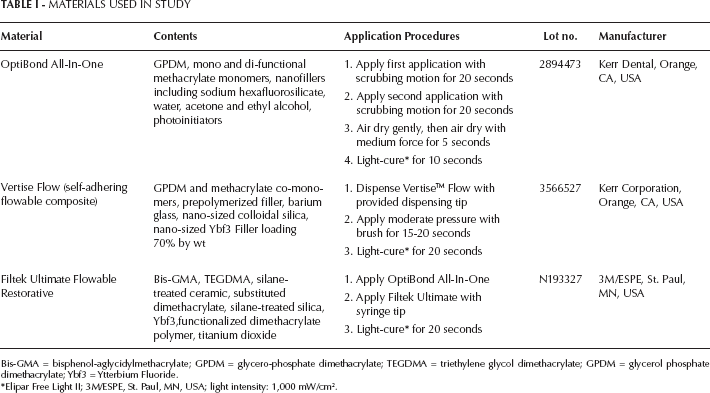
Bis-GMA = bisphenol-aglycidylmethacrylate; GPDM = glycero-phosphate dimethacrylate; TEGDMA = triethylene glycol dimethacrylate; GPDM = glycerol phosphate dimethacrylate; Ybf3 = Ytterbium Fluoride.
Elipar Free Light II; 3M/ESPE, St. Paul, MN, USA; light intensity: 1,000 mW/cm2.
Preparation of dentin specimens
Sixty freshly extracted human molar teeth (30 primary and 30 permanent) were used in the study. Following extraction, teeth were cleaned with pumice to remove any surface debris or contaminants and were stored in 0.1% thymol solution at room temperature prior to the experiment.
Occlusal surfaces were ground under running water using a polishing machine until flat dentinal surfaces were exposed. Specimens were embedded in self-curing acrylic resin in cylindrical rubber molds, with the occlusal bonding site facing the bottom of the mold. To obtain uniform smear layers, dentin surfaces were ground with 600-grit silicon carbide paper (Phoenix Beta, Buehler, Germany). To maintain hydration, dentin specimens were placed in a tray containing water and stored in an incubator at 37°C for 24 hours before bonding.
Both permanent and primary tooth specimens were randomly divided into 3 groups of 10 specimens each, according to application protocols, as follows: group 1: Vertise Flow; group 2: OptiBond and Filtek Ultimate; and group 3: OptiBond and Vertise Flow.
A 2-mm-high cylindrical polyethylene tube with an internal diameter of approximately 2 mm was placed on the dentin surface of each specimen. Flowable resin composite was injected into the tube and polymerized for 20 seconds using an LED curing unit (Elipar Free Light II; 3M/ESPE, St. Paul, MN, USA; light intensity: 1,000 mW/cm2). Specimens were then stored in 100% relative humidity at 37°C for 24 hours. Tubes were removed with a sharp blade, and specimens were examined for defects under a light stereomicroscope at ×10 magnification. Specimens were then thermocycled between 5°C and 55°C for 500 cycles using a dwell time of 10 seconds and a transfer time of 30 seconds between each bath. Specimens that failed before SBS testing were recorded as pretest failures and included (as 0 MPa) in calculating mean values for further statistical analysis.
SBS testing
Following thermocycling, specimens were secured in the holder of a universal testing machine (Lloyd LRX; Lloyd Instruments, Fareham, Hants, UK) and sheared with a knife-edge blade at a crosshead speed of 1.0 mm/min (Fig. 1). SBS was calculated in MPa by dividing the peak load at failure with the specimen surface area.
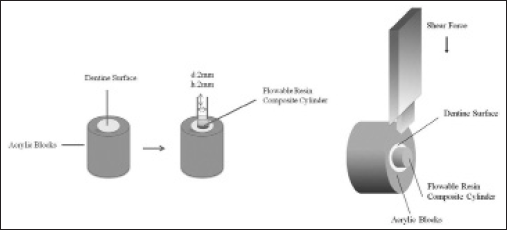
Schematic depiction of preparation for shear bond testing.
SBS values were analyzed using 1-way ANOVA. Multiple comparisons were performed using the Tukey test, with a significance level set at 0.05. Statistical analysis was performed using SPSS for Windows, version 12.0.1 (SPSS Inc, Chicago, IL, USA).
Results
Means and standard deviations of SBS values are given in Table II. The highest mean SBS value was recorded for group 2 in permanent teeth (35.7±2.9 MPa), whereas the lowest value was recorded for group 1 in primary teeth (4.1±2.3 MPa).
SHEAR BOND STRENGTH FOR EACH GROUP (NUMBER OF PRETEST FAILURES/NUMBER OF SPECIMENS)
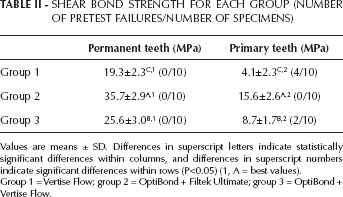
Values are means ± SD. Differences in superscript letters indicate statistically significant differences within columns, and differences in superscript numbers indicate significant differences within rows (P<0.05) (1, A = best values).
Group 1 = Vertise Flow; group 2 = OptiBond + Filtek Ultimate; group 3 = OptiBond + Vertise Flow.
For both permanent and primary teeth, differences in SBS values of all groups were statistically significant (P<0.05), and group 2 had a mean SBS that was significantly higher than that of groups 1 and 3 (P<0.05). In addition, SBS values of group 3 were significantly higher than the SBS values of group 1 for both primary and permanent teeth (P<0.05). All groups showed significantly higher SBS values with permanent teeth than with primary teeth (P<0.05).
Discussion
Given the numerous clinical applications for which flowable materials are being used, it is important that dentists have adequate comparative information to allow them to select the material with the most appropriate properties for any particular use (13). Recently, there has been increased interest in self-adhering flowable composite technology. In a current study, Rengo et al (14) showed that the microleakage scores of self-adhering flowable resin composite in dentin interfaces were higher than those of enamel interfaces. Moreover, they suggested that phosphoric acid etching of dentin had a negative effect on the quality of the seal when using the self-adhering flowable resin composite in Class V cavities. In another study, the findings of Goracci et al (15) indicated that the SBS of orthodontic brackets bonded with Vertise Flow was lower than that of Transbond XT Paste after thermocycling. In addition, Vertise Flow was recently tested in vitro for water sorption–related phenomena (16, 17). Moreover, laboratory and clinical studies are ongoing to assess the performance of Vertise Flow as a restorative material (11, 18-20). Nevertheless, little information is available regarding the bond strengths of self-adhering flowable composites to primary and permanent tooth dentin surfaces. Therefore, this laboratory study aimed to clarify whether or not bond strengths of self-adhering flowable resin composites are as high as those of conventional flowable composites on primary and permanent tooth dentin surfaces.
The importance of laboratory tests in assessing the properties of new dental materials cannot be downplayed. Some new materials may be stronger and bond better to tooth substrates than currently available materials, and laboratory evaluation provides the first means of assessing differences in material properties (21, 22). Bond strength assessment is the most common laboratory test used in evaluating the adhesive properties of restorative materials and has become a well-recognized method for assessing material performance in the laboratory (23-25). In this study, SBS testing was used to compare the adhesive properties of self-adhering flowable resin composites and conventional flowable composite on both primary and permanent tooth dentin surfaces.
According to the manufacturers, Vertise Flow bonds to tooth surfaces in 2 ways. The primary bonding mechanism consists of a chemical interaction between the calcium ions in tooth and the functional phosphate groups in the GPDM monomers found in the resin material, whereas the secondary bonding mechanism consists of a micromechanical etching of the tooth facilitated by the low (1.9) pH of the resin material, which is similar to that of numerous self-etching materials (12).
The present study found the mean SBS of conventional flowable resin composite to be higher than that of Vertise Flow for both permanent and primary teeth (P<0.05). Thus, the first null hypothesis was rejected. The lower bond strength of Vertise Flow may be attributed to the incorporation of a bonding agent into the resin material, causing incomplete infiltration of adhesive into demineralized dentin, ineffective sealing of dentin tubules, degradation of exposed collagen and degradation of the resin material (26).
Simplification of handling has increased the popularity of the combined use of conventional flowable resin composites and self-etch adhesive systems (4). Although this approach has been said to be more user-friendly and less technique-sensitive (4, 5), concerns have been raised about the bonding effectiveness of self-etch adhesives, especially in terms of durability, which may vary with the material composition of the adhesive (7, 27, 28). The present study used OptiBond All-in-One as the self-etch adhesive system because the same adhesive technology is incorporated into the Vertise Flow composite.
According to the study's findings, the use of a bonding agent significantly increased the SBS values of Vertise Flow to both permanent and primary tooth dentin (P<0.05). Thus, the second null hypothesis was also rejected. Although the bonded surfaces were not examined using advanced screening techniques, the use of Vertise Flow in conjunction with a self-etch adhesive is thought to have secured a more appropriate dentin surface for bonding. However, the use of a bonding agent that is more acidic than the one used in this study needs to be evaluated to ensure over-etching does not occur as a result.
The results presented in this laboratory study showed that the SBS of self-adhering flowable resin composite in primary teeth was lower than that in permanent teeth. Therefore, the third null hypothesis was also rejected. The mechanism of bonding to enamel and dentin is based on an exchange process in which minerals removed from dental hard tissue are replaced by resin monomers that are micromechanically interlocked in the porosities created upon polymerization (28, 29). However, several differences exist in the chemical composition and micromorphology of primary and permanent tooth dentin. Whereas primary tooth peritubular dentin is thicker than that of permanent teeth, permanent tooth dentin is more highly mineralized than that of primary teeth. Micromorphological analysis has shown the lower density and smaller diameter of dentinal tubules in primary dentin to make it less permeable than permanent dentin (30-32). These differences between primary and permanent dentin may explain the lower SBS values found in primary teeth in comparison with permanent teeth for all of the materials tested in the present study. In accordance with these data, the use of Vertise Flow in primary tooth dentin was found to be questionable; however, it can be considered as an alternative material for different clinical situations such as for a pit and fissure sealant, repair of enamel defects, blocking of an undercut, minor occlusal build-ups in nonstress-bearing areas, base/liner in Class I and II restorations and incisal abrasions.
Conclusion
Within the limitations of the present study, the self-adhering flowable resin composite Vertise Flow was found to have lower bond strength values than conventional flowable resin composite for both primary and permanent dentin. Further clinical trials are required to confirm the data obtained from this laboratory study and to evaluate the new self-adhering flowable composites under clinical situations in pediatric dentistry.
Footnotes
Financial support: None.
Conflict of interest: None.