






Abstract
Repetitive negative thinking (RNT) has been identified as a key maintaining process of emotional difficulties. However, the consequences of repetitive thinking may depend on whether negative thoughts or feelings are processed in an abstract, evaluative mode, or in a concrete, process-focused mode. In recent years an increasing number of studies has also explored the effect of processing mode in relation to positive events, yielding inconsistent results. So far, the studies using positive material have not examined the interaction between trait rumination and processing mode. Consequently, the purpose of this study was to further explore the effects of abstract vs. concrete mode of processing on positive affect and negative affect in the context of a success task in a sample scoring high on trait rumination. 62 participants were randomly assigned to abstract vs. concrete processing training prior to a success task. The results showed that positive affect increased whereas negative affect and state RNT decreased after the success task in both groups. However, abstract vs. concrete processing did not have an effect on outcome. The findings indicate that processing mode does not influence outcome in the context of a success task.
Introduction
Repetitive thinking about current concerns, past experiences or future worries has been identified as a key maintaining process of emotional difficulties such as depression and anxiety disorders (Ehring & Watkins, 2008). However, the consequences of repetitive thinking may depend on whether negative thoughts or feelings are processed in an abstract, evaluative mode, or in a concrete, process-focused mode (Watkins, 2008). An abstract processing mode implies adopting an analytical and evaluative thinking style, which infers that individuals keep on dwelling on “the causes, meanings, and consequences” of symptoms and feelings; in other words, the person is focusing on
Previous studies indeed found evidence that abstract processing of negative experiences has adverse effects, especially in individuals with high levels of trait rumination (Moberly & Watkins, 2006; Rimes & Watkins, 2005; Watkins, 2004; Watkins & Baracaia, 2001). In two studies it was demonstrated that processing an induced failure in an abstract mode led to increased negative affect (Watkins, 2004) and decreased positive affect (Moberly & Watkins, 2006), but only in individuals with high levels of trait rumination. Neither processing mode, nor trait rumination in itself was significantly related to changes in affect after failure, but only the interaction between the two predicted a negative outcome.
In recent years an increasing number of studies has also explored the effect of processing mode in relation to positive events (Hetherington & Moulds, 2013; Werner-Seidler & Moulds, 2012). Regarding the effect of processing mode in relation to positive material, two competing hypotheses have been proposed. The first hypothesis states that concrete processing of positive material elicits vivid and detailed sensory features of the positive event or memory, increasing its affective impact (Werner-Seidler & Moulds, 2012). On the other hand, it has been hypothesized that abstract processing of positive events is more adaptive because it can lead to positive elaborations and generalization of the event, instead of interpreting it as an isolated experience (Marigold, Holmes & Ross, 2007; Nelis et al., 2015).
Studies exploring the effects of abstract versus concrete processing of positive material (e.g. success induction or retrieval of positive memories) have yielded inconsistent results. Two studies found that concrete processing of positive memories had stronger mood effects than abstract processing; only a concrete processing mode led to higher positive affect in healthy volunteers (Nelis et al., 2015 [study 1]) or less negative affect in (formerly) depressed individuals (Werner-Seidler & Moulds, 2012). Marigold and colleagues (2007) on the other hand found that individuals with low self-esteem profited most from processing a compliment in an abstract mode. Other studies did not find a differential effect of abstract versus concrete processing of positive material on mood (Hetherington & Moulds, 2013; Hetherington & Moulds, 2015; Nelis et al., 2015 [study 2]; Werner-Seidler & Moulds, 2014).
As noted above, studies using negative material specifically found effects of processing mode in participants scoring high on trait rumination, whereas participants with low levels of rumination were not affected by the processing mode manipulation. So far, the studies using positive material have not examined the interaction between trait rumination and processing mode. Nelis et al. (2015) and Hetherington & Moulds (2013 & 2015) did study the interaction of processing mode with depressive status or dysphoria, but these did not appear to moderate the processing mode induction.
The present study was set up to further examine the influence of processing mode in the context of positive material. Following Hetherington and Moulds (2013) we used a success induction to create a positive experience. However, we restricted our sample to participants scoring high on repetitive negative thinking (RNT) because based on the finding from the studies using negative material one would expect these participants to be most sensitive to the manipulation of processing mode. RNT encompasses both rumination and worry and may be appropriate to use in healthy volunteers. Consequently, the purpose of the study was to explore the effects of abstract vs. concrete mode of processing on positive affect and negative affect in the context of a success task. Although not entirely consistent, most evidence so far suggests that a concrete processing mode may be generally more adaptive, i.e. also when processing positive events. We therefore hypothesized that concrete processing of positive material would lead to a larger increase in positive affect after receiving success feedback compared to abstract processing. State RNT was used as an additional outcome measure. In sum, the main aim of the present study was to examine whether focusing on
Method
Participants
Figure 1 displays the recruitment process. University students were recruited via information during lectures, e-mail, and advertisements at information boards. The inclusion criteria were: (1) ability to speak and understand Swedish, (2) ≥ 18 years old, and (3) high level of repetitive negative thinking (RNT) defined as scores in the clinical range on the Perseverative Thinking Questionnaire (PTQ ≥ 36). This cut-off was chosen because patients diagnosed with depression and/or an anxiety disorder have been found to score on a similar level (depression:

Recruitment process and reasons for exclusion.
Material and measures
Repetitive negative thinking
The Perseverative Thinking Questionnaire (PTQ; Ehring et al., 2011) was used to assess RNT. The PTQ was developed for assessing dysfunctional RNT, without focusing on the abstract feature of the construct. The PTQ consists of 15 statements (e.g. “Thoughts intrude into my mind”). In the original version of the scale, which was used during screening, responders are asked to rate how they
Positive and negative affect
The 20-items version of the Positive and Negative Affect Schedule (PANAS; Watson, Clark, & Tellegen, 1988) was used to assess positive and negative affect. This measure consists of 10 descriptors of positive mood (e.g. “alert”) and 10 descriptors of negative mood (e.g. “irritable”). Responders rate to what extent they experience each descriptor on a five-point scale (1 = very slightly or not at all; 5 = extremely). The PANAS is widely used, and has shown good psychometric properties (Crawford & Henry, 2004). In the present study, the internal consistency was good pre training (α = .85), post training (α = .90), and post induction (α = .87).
Mode of processing training
The processing training aimed at teaching the participants abstract vs. concrete mode of processing (based on Dennis, Astell, & Dritschel, 2012; Moberly & Watkins, 2006; Watkins et al., 2008). The experiment leader described 12 scenarios (6 positive and 6 negative), and the participants read the same text on a computer screen. In the abstract condition group, the participants were instructed to think about causes, meanings and implications of each scenario, followed by one minute of writing to answer three questions aimed at enhancing abstract processing (e.g. “What will the consequences be?”). In the concrete condition group, the participants were instructed to focus on concrete, specific and visual details in each scenario, followed by one minute of writing to answer three questions aimed at enhancing concrete processing (e.g. “What details did you notice?”).
Success task
10 computerized exercises from the Wechsler Adult
Intelligence Scale (WAIS-IV; subtests Matrix Reasoning and Visual Puzzles) were used for the success task. The procedure was based on Moberley and Watkins (2006), who used the Remote Associates Test (RAT; McFarlin & Blascovich, 1984) to induce negative mood. Translating the RAT to Swedish resulted in language confusions which made it impossible to use. Consequently, we developed another method, based on tasks from the WAIS-IV-TR. These tasks were chosen because similarly to the RAT, there are no obvious answers, and it is difficult for the responders to reveal if their answers are correct. In the current experiment, the participants were told: “You will be given a test designed to measure aspects of creativity. Although brief, the test is highly correlated with measures of creative intelligence. Creative intelligence is important in many areas of life and is associated with innovative thinking, improved problem-solving ability, future career, and school performance.” When all exercises were completed, the participants received feedback that they got 7 out of 10 correct answers, and that their performance was better than 79% of the general population. Hence, our success task was based on earlier methods, but the specific details were new, and we explored the effects in two pilot studies. In the first pilot study (n = 10), two of the participants revealed the purpose of the task, which lead to minor adjustments. Firstly, the feedback was changed from verbal to computerized, and secondly, the time limit was set to 15 minutes for all exercises instead of 1.5 minutes for each exercise, as the participants experienced the first time limit as stressful, increasing the risk for mistakes due to time pressure. In the second pilot study (n = 5), none of the participants revealed the purpose of the task, and they reported it as enhancing positive mood.
Manipulation checks
The effect of the processing training was checked by randomly selecting 20% of all written answers (in total 70 answers), and letting two independent raters rate the extent to which the participants’ written answers were abstract and evaluative vs. distinct and focused on concrete details on a four-point scale (1 = not at all; 4 = very much). The participants rated how colorful and vivid their current thoughts were after training on a nine-point scale (1 = not at all colorful and vivid; 9 = very colorful and vivid). Based on Moberley and Watkins (2006), the levels of self-focus after the training phase was assessed to check that the different condition groups did not get different levels of self-focus. Answers were given on a nine-point scale (1 = not at all focused on myself; 9 = very focused on myself).
Procedure
The procedure was tested in two pilot studies (
Results
Background variables
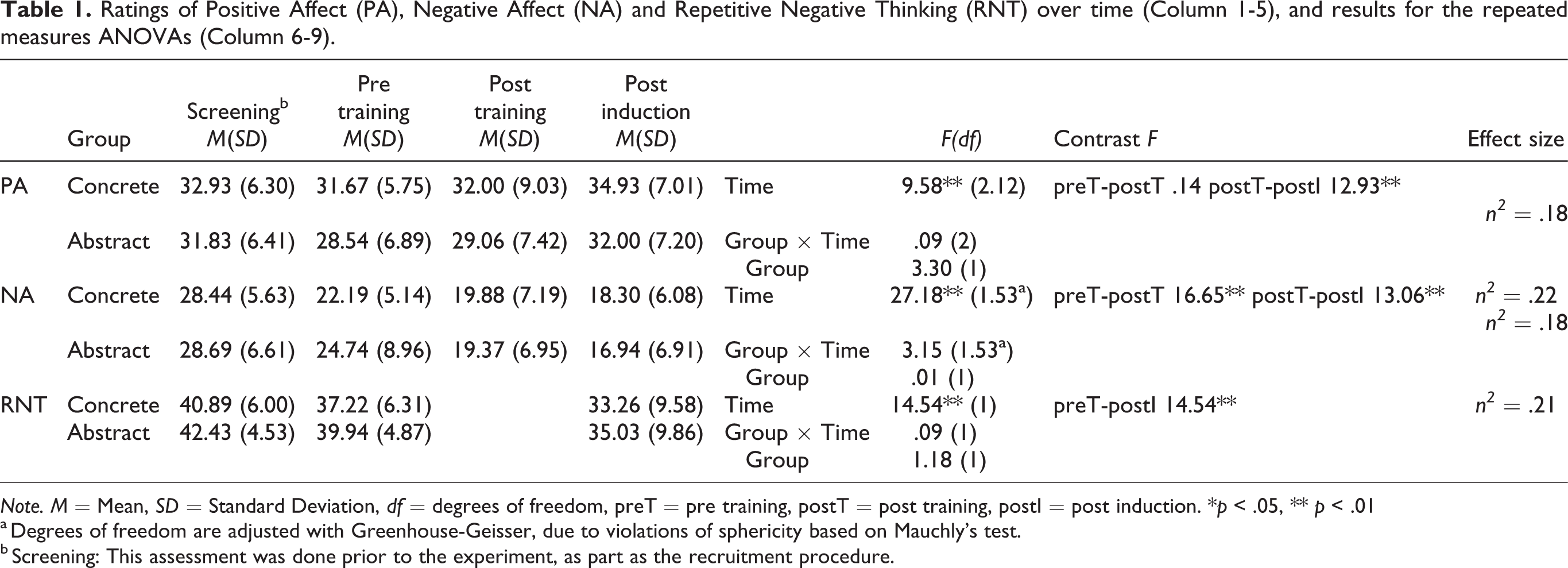
Ratings of positive affect (PA), negative affect (NA), and repetitive negative thinking (RNT) at screening are displayed in table 1. Independent t-tests showed that there were no significant differences between the groups on PA
Ratings of Positive Affect (PA), Negative Affect (NA) and Repetitive Negative Thinking (RNT) over time (Column 1-5), and results for the repeated measures ANOVAs (Column 6-9).
a Degrees of freedom are adjusted with Greenhouse-Geisser, due to violations of sphericity based on Mauchly’s test.
b Screening: This assessment was done prior to the experiment, as part as the recruitment procedure.
Manipulation checks
Independent t-tests showed that the independent raters rated the participants’ answers as more concrete in the concrete condition group (
There was a non-significant trend that the participants rated their thoughts as more colorful and vivid in the concrete condition group (
There was no significant difference between the groups on self-focus after the training phase
Effects of abstract and concrete processing on PA and NA
To test the effects of mode of processing on PA resp. NA, two separate 2 (Group: abstract vs. concrete condition) × 3 (Time: pre training, post training, post induction) repeated measures ANOVAs were conducted, with post hoc pairwise comparisons (Contrast
Post hoc tests showed no effect on PA from pre training to post training, but a significant increase in PA post induction, which means that PA increased in both groups after the positive induction. Post hoc tests showed that NA decreased significantly from pre training to post training and from post training to post induction in both groups.
Effects of abstract and concrete processing on RNT
To test the effects of mode of processing on state RNT, a 2 (Group: abstract vs. concrete condition) × 2 (Time: pre training, post induction) repeated measures ANOVA was conducted. The results are displayed in table 1.
There was a significant main effect of time with a large effect size. There was no main effect of group (
Discussion
The aim of this study was to examine the effects of abstract vs. concrete mode of processing on positive affect, negative affect and repetitive negative thinking (RNT) in the context of a success task. We hypothesized that concrete processing of positive material would lead to a larger increase in positive affect after receiving success feedback as compared to abstract processing. Because previous studies using negative material showed that especially people with high levels of trait rumination were susceptible to the processing mode manipulation (Moberly & Watkins, 2006; Watkins 2004), the current study only included participants with high levels of RNT, a concept closely related to rumination. In addition, we explored whether a concrete processing mode manipulation could reduce repetitive thinking tendencies (i.e. state RNT).
The manipulation check indicated that the processing training worked as intended. Also the success task seemed to work, as positive affect increased in both groups after the success task, although this was not a formal manipulation check and one should take inconsideration that the groups had already been trained in abstract vs. concrete processing by then. The levels of negative affect and RNT decreased during the whole experiment in both groups. However, there were no differences between the groups, implying that the mode of processing did not influence outcome after a success task in individuals with high levels of RNT at screening.
Our results replicate two earlier studies that found that abstract vs. concrete mode of processing did not differentially affect mood after a success induction (Hetherington & Moulds, 2013) or after positive memory recall (Hetherington & Moulds, 2015) in a non-clinical sample. In these studies, both high and low dysphoric students were included, and the effects were similar for both groups. On the other hand, there are also studies showing differential effects of concrete vs. abstract processing of positive memories on mood (Nelis et al., 2015 [study 1]; Werner-Seidler & Moulds, 2012). The current study included participants with clinically relevant levels of trait RNT in an attempt to optimize the chance of finding an effect of processing mode. However, again, no differential effects of abstract versus concrete processing of positive material were observed. Taken together, our findings add to the support for the hypothesis that processing mode does not have consequences for the affective impact of a positive experience in terms of a success task.
The findings should be considered in relation to the increasing evidence for processing mode as being important when dealing with negative material, where an abstract processing mode has been associated with reduced levels of positive affect and impaired problem solving ability (Rimes & Watkins, 2005; Watkins, 2004; Watkins & Baracaia, 2001). This has been explained by the
The success task we used in the current study has not been used before, which may raise questions about its applicability. Hetherington and Moulds (2013) used the easy version of the RAT to induce positive mood. Translating the RAT into Swedish resulted in language confusions which made it unsuitable to use. Consequently, we developed another method to induce positive mood, based on tasks from the WAIS-IV-TR. These tasks were chosen because of their similarity with the RAT. There are no obvious answers in this task, and it is difficult for the responders to determine whether their answers are correct. Hence, our success task was based on earlier methods, but the specific details were new. We explored the effects of our mood induction in two pilot studies, which supported its applicability.
There are limitations to keep in mind when considering the current findings. Firstly, although the participants were screened on RNT, the results cannot be generalized to a clinical setting since the participants were university students and presumably quite well-functioning. An important aspect to note is that participants were selected on basis of levels of RNT at screening, assessing it as a relatively stable variable (i.e. trait). However, as levels of RNT may fluctuate, for instance throughout treatment (Ehring & Watkins, 2008), one might consider it as being more temporarily and possible to change (i.e. state). Taking this into consideration, we slightly adapted the instructions for the measure (the Perseverative Thinking Questionnaire, PTQ), and used it throughout the experiment as an outcome measure. However, the use of PTQ as a state measure is not part of the standard procedure, and may raise questions around validity. A related limitation is that, although we selected individuals who were scoring high on trait RNT, the screening took place 2 to 8 weeks prior to the experiment. In fact, their scorings of state RNT at the pre training assessment indicate that there might have been a small decrease in levels of RNT between the screening and the actual experiment.
Another limitation in the current study is that even though the manipulation check of the processing training indicated that it indeed worked to induce different types of processing mode, it is unclear for how long the effects of training lasted. Additionally, the sample size in the abstract condition group was limited (
Footnotes
Declaration of conflicting interests
The author(s) declared no potential conflicts of interest with respect to the research, authorship, and/or publication of this article.
Funding
The author(s) received no financial support for the research, authorship, and/or publication of this article.