






Abstract
Introduction
Although tobacco is the leading preventable cause of the death among adults in India, the general public including tobacco users has little awareness about possible consequences of tobacco use. One way of bringing more awareness is to place more information on tobacco products in the form of pictorial warnings. Strong pictorial warnings were mandated by the Indian government but were diluted later on. The question that needs to be investigated whether general public in India needs pictorial warnings on tobacco products and how the warnings would look like?
Material and Method
A survey of 712 individuals was conducted in Mumbai and Thane. A structured questionnaire was designed and data were collected by trained field investigators. The questionnaire contains several questions on awareness of health warnings on tobacco products, opinion on strength of the warnings and on delays in implementing warnings.
Results
Among 712 respondents, 89.9% were aware about health warning messages on cigarettes pack. 88.5% of people were strongly agreed for strengthening the pictorial health warnings. Strong pictorial health warnings would make 23.2% male tobacco users thinking to quit smoking and 33.1% never tobacco users will think twice before starting smoking.
Conclusion
Positive response was shown by general population for implementation of pictorial warnings on tobacco products. Majority of the people were strongly agreed for strong pictorial warnings which were diluted by government notifications in year 2008.
Introduction
Estimated 100 million deaths were caused by tobacco in the 20th century. If current trends continue, there will be up to one billion deaths in the 21st century. Unchecked, tobacco-related deaths will increase to more than eight million a year by 2030, and 80% of those deaths will occur in the developing world. 1 Most people are unaware about the extent of harm that tobacco can cause. Being one of the major preventable causes of many diseases, 2 it is very important to convey information about the harmful effects of tobacco use to people. Effective warnings on packaging of tobacco products can be a very strong and cost effective way of health warning communication. Pictorial warning depicting the harmful effects of tobacco use are helpful in communicating risks and can bring about behavioral changes like quitting and reducing the tobacco consumption. 3 Health warnings on tobacco packages that combine text and pictures are one of the most cost-effective ways to increase public awareness of the serious health risks of tobacco use and to reduce tobacco consumption. 4 As far as India is concerned, implementation of the pictorial warnings has taken a rather long time and was to be enforced on May 31, 2009. 5
Given the background, a study was conducted to determine the opinion of general public towards implementation of pictorial warnings in India. The study gathers views of people regarding, whether or not it is essential to have pictorial warnings on tobacco packs, as well as opinion on how soon the pictorial warnings should be displayed on the tobacco packs and whether the current proposed health warning could be improved to convey the specific message such as cancer, a health outcome of tobacco use.
Material and Methods
A questionnaire was designed and structured to collect data on socio-demographic details, tobacco use, awareness on pictorial warnings and support for implementation of pictorial warnings on cigarette packs. The current study applied a convenience sampling method to select the respondents. Field investigators were trained to administer the questionnaire and were instructed to show the cigarette packs with strong pictorial warnings and those proposed by the Government while interviewing the participants (Fig. 1).
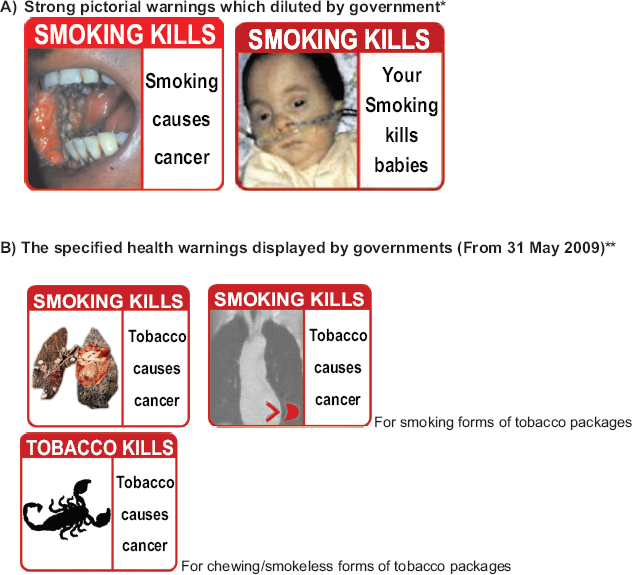
Pictorial Health Warnings (India).
The survey includes sample size of 712 individuals above 15 years from different locations in Mumbai and Thane that included 3 colleges (295 students were interviewed). A prior permission was obtained from college authorities for interviewing the students in the campuses. The study was a part of project Advocacy Forum for Tobacco Control (AFTC), approved by Healis-IRB-Epidemiological. House to house interviews were conducted face-to-face with individuals from households. Participatory informed consent was obtained from all the participants at a time of recruitment.
For analysis of data SPSS software was used. The data for men and women were analyzed separately. Responses were compared between data from ever tobacco user and never tobacco user. Significance of differences was tested by chi-square test. We have used uni-variate and bi-variate analysis and calculated percentages using SPSS. Each categorize are mutually exclusive.
Results
Amongst the 712 participants, 64.5% were males and 36.5% were females. 32.3% were in the age group of 15–20 years, 19% and 21.5% were in the age group of 20–25 years and 25–35 years respectively and 6.0% were above 55 years. Of the total 712 sample, 70.2% were never tobacco user, 28.2% were current tobacco user (13.3% are current smokeless tobacco user and 10.4% are current smokers and 4.5% were current mixed users), whereas only 1.6% was past tobacco users (Table 1).
Demographics of subject.

Overall 89.6% of people were aware about health warnings messages on cigarettes packs. 88.5% of people were strongly agreed to strengthen the pictorial health warnings proposed by government to depict very serious disease like cancer, caused by tobacco use. Strong health warnings (Fig. 1-A) on cigarette packs made, 23.2% male tobacco users to think of quitting smoking and 36.7% to think of reducing. 33.1% never tobacco user will think twice before starting smoking. In addition to this, 11.6% never tobacco users and 7.7% ever tobacco users will think whether to smoke before opening the pack (Table 2).
Findings about pictorial health warnings and its implementation.
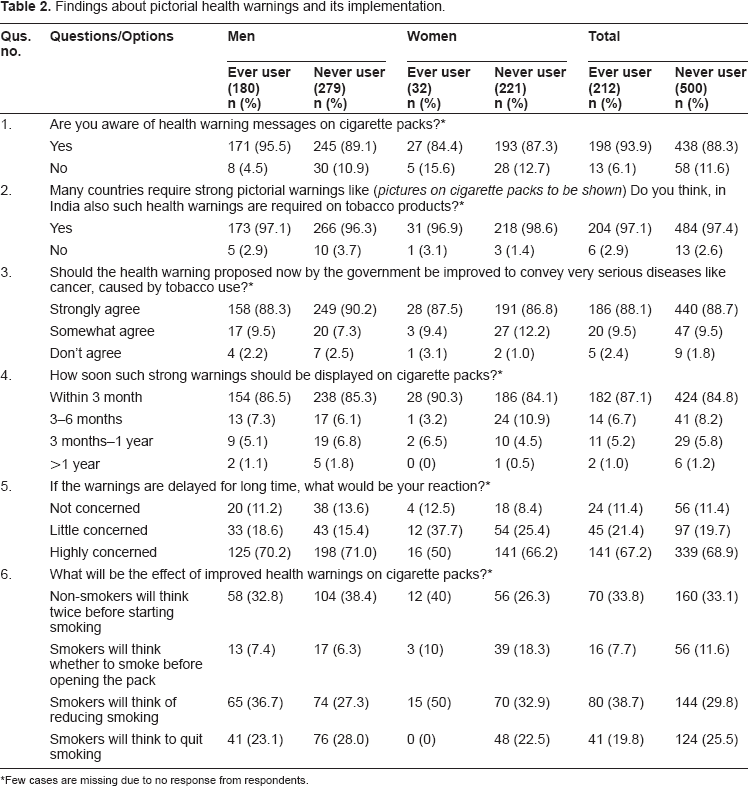
Few cases are missing due to no response from respondents.
Discussion
Mandatory health warnings on cigarettes pack are an effective way to inform smokers about harmful effects of tobacco use, motivate them to quit smoking and discourage the non smokers to start smoking. Ever tobacco users were (93.9%) more aware about text health warnings than never tobacco user (88.3%). Text warning that was only in English language “SMOKING IS INJURIOUS TO YOUR HEALTH ” was not as effective as pictorial health warning. India consists of a large number of illiterate populations, which can't understand English. The text warning given on the packs was not so clear and visible which was another cause of ineffectiveness of the text warnings in English.
Many countries now have implemented effective pack warnings on tobacco packs. These health warnings are more effective as definite and impact messenger of ill effect of smoking on health. 6 Pictorial warnings may overcome the problem of illiteracy. Study conducted in four countries suggests that more prominent health warnings are associated with greater levels of awareness and perceived effectiveness among smokers] 7 . As per WHO says, Effective warning labels should be large, clear, rotating, cover at least 50% of the total tobacco pack and consist of both text and graphic images. In present study, 97.3% people were in favor of those pictorial warnings on tobacco products.
India signed the WHO Framework Convention on Tobacco Control on September 10, 2003. It was ratified on February 5, 2004. 8 In July 2006 the government issues a notification of the specific pictures (Fig. 1-A) to be used by tobacco companies within seven months. Tobacco companies seek more preparation time. The government extends time to June 2007. Pictorial warnings notified by government during 2006 and 2007 9 mandated that cigarette and beedi packs should carry pictorial warnings like depictions of cancer or a child dying due to the effects of passive smoking therefore it needed to covers the 50 percent of both surfaces of tobacco package (Fig. 1-A). The court sets a deadline of December 1, 2007 for pictorial warnings to be implemented. Again in December 2007, the court allows the government another extension till March 17, 2008. In March 2008 government notification stated that, pictures would be either of a lung or a scorpion (Fig. 1-B). The size of the pictorial warnings would be 40 percent of the package. The date was extended to November 30, 2008, a deadline announced in national and regional newspapers in a full page advertisement. But in the last week of November the health minister extended the deadline to May 31, 2009. Thus it was postponed for the seventh time.10,11 Current warnings which have appeared on tobacco packs are weak, ineffective and will not perform the crucial role of informing users and saving lives. They also do not meet the minimum requirement of 30% as stipulated by the Framework Convention on Tobacco Control. 12 Evidence shows that unpleasant, threatening pictures of tobacco related health effects, such as a cancerous lung or an amputated leg, capture attention and induce tobacco avoidance. 13 Unfortunately, currently notified Indian warnings are not as per WHO's recommended best practices and may not bring about the desired impact. 14 Compared to these previous pictures were larger and more effective as per international practices. In the present study both the pictures (In Fig. 1) were shown to the participants at the time of data collection. Survey indicated, 88.5% people had strongly agreed for strengthen health warnings to convey serious disease like cancer. 85.5% opinion that, there should be no delay (more than 3 months) for display warnings on cigarette packs.
Conclusion
Overall there was a positive response from the general population for implementation of pictorial warnings on cigarette packs. It is also clear from the results that, majority of them strongly agree that the pictorial warnings proposed by government of India should be improvised to convey the right message to the public. Most of them have expressed high concern for delayed implementation of the law on pictorial warnings.
Conflict of Interest
No.
Footnotes
Acknowledgment
We would like to acknowledge International Union against Tuberculosis and Lung Diseases for funding Advocacy forum for Tobacco Control (AFTC) under which this study was carried out.