






Abstract
Bacterial biofilms are highly resistant to common antibacterial treatments, and several physiological explanations have been offered to explain the recalcitrant nature of bacterial biofilms. Herein, a biophysical aspect of biofilm recalcitrance is being reported on. While engineering structures are often overdesigned with a factor of safety (FOS) usually under 10, experimental measurements of biofilm cohesive strength suggest that the FOS is on the order of thousands. In other words, bacterial biofilms appear to be designed to withstand extreme forces rather than typical or average loads. In scenarios requiring the removal or control of unwanted biofilms, this emphasizes the importance of considering strategies for structurally weakening the biofilms in conjunction with bacterial inactivation.
Keywords
Introduction
Biofilms are sessile communities of bacteria housed in a self-produced adhesive matrix consisting of extracellular polymeric substances (EPS), including polysaccharides, proteins, lipids, and DNA. Bacterial biofilms inhabit niches from water distribution system pipes to human lungs.1,2 Microorganisms in biofilms and biofilms themselves are highly persistent despite the efforts to eradicate them with antimicrobials (eg, antibiotics and chlorine) and physical removal (eg, brushing, scraping, flushing, and coughing).
Over the years, several physiological explanations have been offered to possibly explain the remarkable recalcitrance of bacterial biofilms. Some of the suggested mechanisms include diffusion limitation, microscale chemical gradients, existence of altered chemical microenvironments, and existence of recalcitrant bacterial phenotypes within the biofilm.3,4 Recently, some researchers have also attributed biofilm resistance to the presence of sack-like structures within the biofilm EPS. 5 These unusual structures, made up of lipids, contain (or hide) several bacterial cells in a separate enclosure within the EPS. However, further work is needed to demonstrate the occurrence of these lipid sacks and to elucidate their specific antibiotic resistance characteristics, if any. In general, more specific investigations are needed to clearly understand the individual or collective role of these suggested physiological mechanisms in biofilm resistance and recalcitrance.
Surprisingly, apart from these physiological explanations, there has been very little focus on the biophysical aspects of biofilm persistence in natural and engineered environments. Shaw et al 6 was perhaps the first to highlight biofilm viscoelastic properties as a biofilm survival mechanism. In a recent review article, Stewart 7 also highlighted biofilm mechanical properties as a likely basis for the tenacity of biofilm-induced infections in the human body. Nevertheless, this particular aspect of biofilm recalcitrance has received very little attention, and the link between biophysical measurements and biofilm recalcitrance has not been widely explored. This is somewhat surprising given the considerable efforts and progress that have been made toward measurement and understanding of biofilm mechanical properties in the past decade.8,9 In this experimental study, a key biofilm mechanical property (cohesive strength) is being presented as a primary biophysical mechanism that enables the biofilms to withstand mechanical stresses and physical assaults, and thus, contributing toward overall biofilm recalcitrance.
Materials and Methods
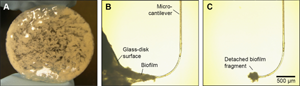
Biofilm mechanical properties. The biofilm mechanical property data for
(
Because multispecies biofilms are frequently encountered in engineered systems (eg, drinking water treatment plants, distribution systems, and wastewater treatment plants) and various natural environments (rivers and streams), additional data for multispecies biofilms were obtained for this study. Mississippi river water (MRW) was selected as a convenient and natural source for a multispecies bacterial inoculum used to cultivate multispecies laboratory biofilms.
For the MRW biofilm, a water sample was collected from the Mississippi River in Minneapolis, MN, filtered (5 μm filter, Millipore) to remove algae and larger particles, and cultured in R2A media on a shaker table at 37°C for 48 hours to obtain optical density at 600 nm of 0.9. Biofilms were grown from this inoculum in a rotating disk reactor, as described previously. 11 R2A medium was fed at a flow rate of 2.5 mL/minute, which resulted in a hydraulic residence time of 96 minutes, and biofilm-coated coupons were removed after 6 days of growth. Subsequently, mechanical testing was performed using the microcantilever method as described previously. 10
Fluid shear calculations on rotating disks. The fluid shear stress (τ), acting on a clean biofilm coupon during growth, was estimated using the equation for a smooth disk rotating in an infinite fluid:

Here the shear stress (τ) is a function of viscosity of the surrounding fluid (ν), the density of the fluid (ρ), the rotational speed of the disk (ω)), and radial distance from the center of the disk (
Results and Discussion
From the above experiments, average (mean ± standard error) cohesive strength values for
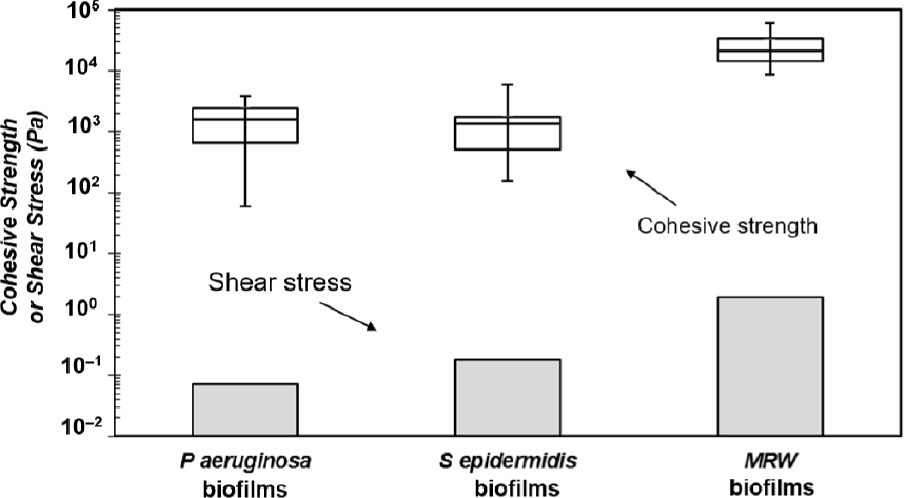
Box and whisker plots showing the minimum value, the 25th percentile, the median, the 75th percentile, and the maxima for cohesive strength of
Engineering designs of structures such as bridges and buildings incorporate a factor of safety (FOS). 13 The FOS is defined as a ratio of the structural strength (eg, of the building or bridge) to that of the applied loads. A biofilm FOS was calculated by taking the ratio of the measured cohesive strength to the estimated fluid shear stress. From the data in this study, the biofilm FOS values ranged from 330 to 55,000. The ability to compare biofilm FOS values with those from other research groups is limited because there are few reports on biofilm strength in the literature, and the tested biofilms are not usually grown under defined shear conditions (thus hindering the calculation of shear stress during growth). However, our results are in agreement with a previous report by Möhle et al (FOS = 200–1,100) who used fluid dynamic gauging to determine biofilm cohesive strength. 14
Typically, FOS values employed by engineers for the design of buildings and other structures are <10. 13 Thus, these high biofilm FOS values are certainly surprising and seem counter-intuitive, because interspecies competition in nature dictates that organisms function at or near optimum efficiency to occupy a given niche. 15 Increasing EPS density to increase cohesive strength diverts resources that could be used for growth (ie, reproduction) or energy storage.
On the other hand, it is also possible that the actual forces experienced by the biofilm during growth, such as the local forces resulting from the biofilm surface morphology (ie, roughness) or dynamic forces during reactor startup and maintenance activities, far exceed the shear stress estimated as described earlier. Specifically, as a biofilm structure protrudes off the substratum into the flow regime, viscous forces increase dramatically and pressure forces (which are zero on the clean substratum) also begin to appear, thus adding to the net local shear stress. For example, Manz et al
16
reported that local shear stresses were up to an order of magnitude greater than the estimated average stress. Nevertheless, even with an order of magnitude correction to our estimated stresses, the FOS values are still quite high (33–5,500). Thus, it appears that bacterial biofilms are
Finally, it could also be argued that the strength of the biofilm matrix is not dictated by the applied fluid shear but is merely coincidental because the EPS composition and density are dictated by other purposes such as serving as a defense from biocides
17
or as a cache of stored food.18,19 If this were the case, one would not expect the strength to increase with fluid shear. Nevertheless, correlations between strength and the fluid shear experienced by the biofilm during growth have been reported in the literature.20–22 This indicates that higher shear conditions actually
Our findings offer a possible explanation for the persistence of biofilms in nature and medicine. For example, shear forces in the bronchial tubes of patients with cystic fibrosis (CF) need to exceed the strength of the resident
Shear stresses in natural/engineered systems where biofilms are routinely encountered.
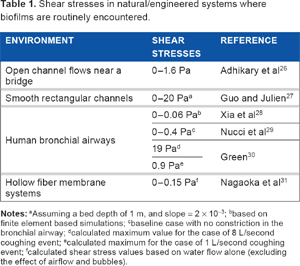
based on finite element based simulations;
baseline case with no constriction in the bronchial airway;
calculated maximum value for the case of 8 L/second coughing event;
calculated maximum for the case of 1 L/second coughing event;
calculated shear stress values based on water flow alone (excluding the effect of airflow and bubbles).
Conclusion
In conclusion, attempting to simply kill bacteria (ie, antimicrobial treatment) is often insufficient when dealing with biofilms. Weakening the biofilm to promote detachment followed by washout or subsequent biocidal inactivation of the detached biomass is another perhaps more effective approach to dealing with this problem that should be considered.24,25
Footnotes
Author Contributions
Conceived and designed the experiments: SA and RMH. Analyzed the data and wrote the first draft of the manuscript: SA. Contributed to the writing of the manuscript: SA, RMH and PSS. Agree with manuscript results and conclusions: SA, RMH, PSS. Jointly developed the structure and arguments for the paper: SA, RMH and PSS. Made critical revisions and approved final version: SA, RMH and PSS. All authors reviewed and approved of the final manuscript.