






Abstract
The human hepatic lipase (LIPC) gene encodes hepatic lipase, an enzyme involved in lipoprotein metabolism and regulation. Therefore, variants in LIPC gene may influence plasma lipoprotein levels. In this study, the association of LIPC C-514T and G-250A polymorphisms with plasma lipid profiles in 348 young Jordanians was investigated. Genotyping of C-514T and G-250A was performed by polymerase chain reaction and subsequent digestion with DraI and NiaIII restriction enzymes, respectively, while Roche analyzer was used to determine plasma total cholesterol, triglycerides, low-and high-density lipoprotein. The G-250 and C-514 alleles were most abundant in Jordanians with 79 and 80% frequencies, respectively. Additionally, no difference was found in the lipid–lipoprotein profile between the different genotype groups of C-514T or G-250A polymorphisms, even when males and females were examined separately (P ≫ 0.05). In young Jordanian adults, the examined LIPC polymorphisms seem to play a limited role in determining the lipid profile.
Introduction
Hepatic lipase (HL) is an enzyme synthesized and secreted into the Disse space where it binds to the surface of sinusoidal endothelial cells and the external surface of microvilli of parenchymal cells. 1 The enzyme is involved in lipid metabolism including triglycerides (TG), and high-density lipoprotein (HDL), intermediate-density lipoprotein (IDL), low-density lipoprotein (LDL), and very low-density lipoprotein (VLDL). 2 In addition, HL can metabolize TG and phospholipid in all types of lipoprotein. However, the activity of HL is predominant in the metabolism of IDL into LDL and the switch of large, buoyant HDL2 to small dense HDL3. 3 In the liver, HL also catalyzes the degradation of chylomicron remnants and acts as a ligand to assist in hepatic uptake of lipoprotein into cells. 3 In animals, mice deficient in HL possess high levels of HDL with mild hyperlipidemia and show significant decreases in the uptake of chylomicron remnant by their liver cells. 4 In humans, subjects with HL deficiency are characterized by elevated levels of HDL and TG. 5
The human HL gene (LIPC) is located on the long arm of chromosome 15. The gene spans ~60 kb of DNA, with nine exons and encodes a glycoprotein of 449 amino acids with a molecular weight of about 65 kDa. 6 Several studies have shown that single nucleotide polymorphisms (SNPs) in the LIPC gene influence plasma HDL levels. The T allele of the C-514T SNP and A allele of G-250A SNP are associated with lower HL activity and higher HDL levels in healthy subjects.7–13 Both C-514T and G-250A SNPs are associated with cardiovascular diseases (CVDs).14–18
The distribution and clinical significance of LIPC C-514T and G-250A polymorphisms have been extensively investigated among the Europeans, Asians, and Americans, 12,13,15,17,19–25 while they are still widely unknown among Arabs. Therefore, in this study, LIPC C-514T and G-250A polymorphisms and association with plasma lipid profile in young Jordanians were investigated.
Methods
Subjects
Young (18–22 years) Jordanian male and female students were invited to participate in the study using wall advertisements in the Jordan University of Science and Technology (JUST). Participants with chronic diseases or those currently using medications were excluded from the study. After comprehensive explanation of the proposed study, approvals were obtained from all subjects as required by the Institutional Review Board of JUST. A questionnaire was used to collect general and demographic information from subjects.
Lipid profile assays and body mass index calculation
Blood samples were collected in the morning after overnight fasting in EDTA tubes. The tubes were centrifuged and plasma samples were stored in small aliquots at -80°C until used. Total cholesterol, HDL, LDL, and TG were measured in plasma using the Roche Analyzer and Roche reagents (Roche Diagnostics, Basel, Switzerland). Height and weight were used to determine body mass index (BMI) of subjects. 26 The waist circumference was not included in the analysis because data regarding this parameter were not available.
Genotyping of LIPC gene polymorphisms
Genomic DNA was isolated from blood samples using Promega kit (Madison, WI, USA). The LIPC G-250A and C-514T polymorphisms were genotyped by polymerase chain reaction (PCR) and subsequent treatment with DraI and NiaIII (Fermentas, Germany) restriction enzymes, respectively.7,22 The set of primers for amplification of G-250A was: forward (5'-CCTA CCCC GACC TTTG GCAG-3') and reverse (5'-GGGG TCCA GGCT TTCT TGG-3'), and for amplification of C-514T was: forward (5'-TCAC TTGG CAAG GGCA TCTT TG-3') and reverse (5'-GGTC GGGG TAGG TGGC TTCC A-3'). The PCR conditions and cycling were as follows: initial denaturation at 95°C for four minutes, followed by 35 cycles of 94°C for 30 seconds, annealing at 55°C (C-514T) and 64°C (G-250A) for 60 seconds, and extension at 72°C for 60 seconds, and final extension at 72°C for five minutes. The PCR products digestion conditions were as previously described.7,22 Visualization of amplified PCR sequences and restricted fragments was performed using 2% agarose electrophoresis followed by staining using ethidium bromide. As a negative control, a PCR without genomic DNA was included in every experiment.
Statistical analysis
The obtained data were analyzed using version 21.0 SPSS software (SPSS Inc., Chicago, IL, USA). Values were presented as means + standard deviation (SD) for continuous variables and as numbers or percentages for other variables. ANOVA was used to examine the differences in polymorphisms of LIPC G-250A or C-514T for genders joined and separated. Power analysis was performed online with OSSE software (http://osse.bii.a-star.edu.sg/index.php). For a sample size of 348 cases, the power exceeded 60%. For all analysis, P < 0.05 was considered significant.
Results
After the screening process, 348 unrelated students matched the study selection criteria out of the 400 responded to the advertisements. The participants’ average age was 20.7 ± 1.7 years and BMI was 28.7 ± 4.7, while the percentage of female participants was 61.
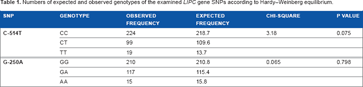
Numbers of expected and observed genotypes of the examined LIPC gene SNPs according to Hardy–Weinberg equilibrium.
Lipid profile and BMI of study subjects according to the LIPC gane SNPs.
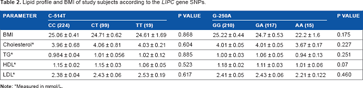
Measured in mmol/L.
Lipid profile and BMI of male study subjects according to the LIPC gene SNPs.
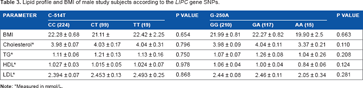
Measured in mmol/L.
Lipid profile and BMI of female study subjects according to the LIPC gene SNPs.
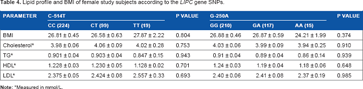
Measured in mmol/L.
Discussion
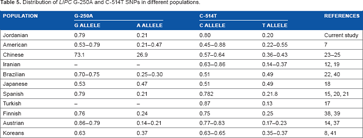
This study was to examine the interaction of LIPC gene polymorphisms with lipid–lipoprotein profile and BMI in young Jordanian adults. The main findings of this study were that -250G and -514C alleles were more abundant among Jordanians than -250A and -514T. Additionally, no associations of LIPC gene polymorphisms were found with any of the lipid–lipoprotein components or BMI, even when these relationships were examined according to gender.
In human, LIPC gene encodes HL enzyme that is involved in the metabolism and regulation of plasma lipoprotein with well-documented clinical importance of G-250A and C-514T SNPs in LIPC gene. The C-514T SNP is associated with coronary artery disease,17,18 nonalcoholic fatty liver, 27 and myocardial infarction. 16 Similarly, the G-250A polymorphism has been found to be associated with type 2 diabetes,25,28 peripheral arterial disease,14,15 and postprandial lipemic response. 29 The common link between these diseases and G-250A and C-514T polymorphisms could be because of their impact on HL activity. The T allele of the C-514T SNP and A allele of G-250A SNP are associated with lower HL activity and higher HDL levels in the body.7–13 This involvement has been reported in many populations including Austrians, Finnish, Spanish, and Turkish; however, it is less apparent in Japanese, Iranians, Chinese, Koreans, Americans, and Brazilians. The lack of association found in this study suggests limited modulation of G-250A and C-514T polymorphisms to lipid profile in young male and female Jordanian adults. The discrepancy with other populations might be because of environmental factors including exercise, smoking, and diet. For instance, exercise plays a protective role against CVDs as it favorably influences plasma cholesterol profiles, especially HDL. Vice versa, smoking increases total cholesterol and LDL, and decreases HDL.30,31 In fact, a study by Zhang et al, 32 showed that the impact of C-514T polymorphism on HDL levels were modulated by consumption of saturated fat and obesity. Furthermore, a recent study by Hu et al, 33 showed no effect of LIPC variants on lipid profile; however, it was important after six days of high-carbohydrate diet consumption. Similarly, no association of LIPC polymorphisms with CVDs was observed in Iranian, 19 Chinese, 24 and American. 16 The discrepancy between the current and previous reports might be because the examined sample is apparently healthy young adults. Therefore, future studies should consider examining LIPC polymorphisms in clinical populations including elderly with and without diseases. In addition, the clinical significance of the examined polymorphisms might be population specific because of genetic background and environmental factors. Therefore, genetic factors should not be overlooked as they are estimated to account for less than 40% of the interindividual variation in lipid profile.20,34–36
Distribution of LIPC G-250A and C-514T SNPs in different populations.
In this study, only two polymorphisms in LIPC gene were examined. However, other LIPC gene variants, such as C-480T, are associated with lipid profile and CVDs. 42 In addition, environmental factors such as diet might modulate the effects of examined polymorphisms on lipid profile. Examining the clinical significance, impact on lipid profile, and interaction with environmental factors of all LIPC variants among Jordanians are recommended in future studies.
In conclusion, this study reports, for the first time, the distribution and the clinical significance of two LIPC polymorphisms in an Arabic population. Additionally, no differences in lipid–lipoprotein profile were found between LIPC C-514T and G-250A genotype groups, even when males and females were examined separately. Since in this study we did not control for smoking, diet, and exercise, additional investigations are warranted.
Abbreviations
cardiovascular disease;
high density lipoproteins;
intermediate density lipoproteins;
low density lipoproteins;
human hepatic lipase gene.
Author Contributions
Conceived and designed the experiments: OK, MG, and MA. Data collection and testing: OK, KA, MA, and FA. Analyzed the data: OK, MA, FA, and KA. Wrote the first draft of the manuscript: OK and MG. Contributed to the writing of the manuscript: KA, MA, and FA. All authors reviewed and approved the final manuscript.
Footnotes
Acknowledgments
The authors thank Miss Lubna Tinawia and Miss Rawan Hamad for their technical efforts.
As a requirement of publication the authors have provided signed confirmation of their compliance with ethical and legal obligations including but not limited to compliance with ICMJE authorship and competing interests guidelines, that the article is neither under consideration for publication nor published elsewhere, of their compliance with legal and ethical guidelines concerning human and animal research participants (if applicable), and that permission has been obtained for reproduction of any copyrighted material. This article was subject to blind, independent, expert peer review. The reviewers reported no competing interests.