




Abstract
Probiotics are living micro-organism preparations which can vigorously inhibit the probable pathogens colonization in the gut microbial ecology. Current experiment was designed to investigate the efficacy of imported probiotic species compared with the indigenous probiotics species on the oxidative stress, enzymes, and hormones in animal model. Thirty Albino rats were equally divided into three groups with 10 rats (n = 10) in each group as Control (C), supplemented with imported probiotic species (IP), and supplemented with indigenous probiotics species (InP) for 21 days under controlled environment. The evaluation of treatments was done by testing the serum oxidative stress markers, liver enzymes (Aspartate transaminase and Alanine aminotransferase), lipid profile, and hormonal dynamics including Lutinizing hormone (LH), follicular stimulating hormone (FSH), and growth hormone (GH) in albino male rats. Results revealed that use of indigenous probiotic species significantly (p < 0.05) reduces the oxidative stress and improves the antioxidant capacity; liver enzymes, total cholesterol, and LDL-Cholesterol were also reduced significantly (p < 0.05) in InP as compared to IP group. Moreover, results of hormones including LH, FSH, and GH explored that indigenous probiotics have significant (p < 0.05) potential to improve these hormones as compared to imported probiotics. Although, it could be concluded that InP have beneficial role in preventing the body from oxidative stress as well as in improving the blood parameters but comprehensive studies are required to investigate the detail gut ecology of the indigenous species which will definitely a strong support in preparing a more suitable local probiotic supplement.
Introduction
Probiotics are reported to have immune boosting, antioxidant, and growth promoting role in various animal models and humans.1,2 Various bacteria isolated from fermented milk (kefir) have been previously reported to have antihyperlipidemic, hypoglycemic, and antioxidant effects. 3 Lactobacillus and Bifidobacteria are particularly reported to compete rather inhibit the colonization of pathogenic bacteria in gastrointestinal tract (GIT) by hindrance of enterocyte pathogenic receptors. 4 Lactobacillus acidophilus is well reported to produce antimicrobial proteins like Lactacin B which is also active against some food borne pathogens.5,6 Similarly, bifidoacterium strains typically produce bifidocin A and B that has activity against gram positive bacteria.7,8
Probiotics in a metabolically active state can accomplish certain probiotic functions like synthesis of short chain fatty acids, competition for essential nutrients, and secretion of antimicrobial compounds and enzymes. 9 The adaptation of probiotics species is well dependent on their tendencies to GIT conditions (gastric acid of bile), adherence capabilities to GIT mucosa, competition with the pathogenic bacteria for colonization.10,11 Probiotics have numerous beneficial effects as discussed before but they cannot be attributed in a generalized manner because these effects tend to be strain specific. Even within species the efficacy of the probiotic bacteria could be variable among various strains. 12 Though gut environment like acidity and substrate limitation directly influence the activity of microorganisms and strain balance in the GIT. 13 However, interaction between the probiotic bacteria including the antagonism, competition for substrate, and symbiosis in multi strain probiotic also plays an important role in their colonization and efficacy as supplement. 14
The probiotics which are used in the various foods, their preparations are of imported origin and during process of import their mal-storage may lead to loss in viability of microbes which can lead to the loss of microbial activity and ultimately the failure of probiotic efficacy. In addition to that the imported nature of microbes could also be a miss-match with natural micro-flora prevailing in the local animal species as well as humans in Pakistan. So, current study was designed with the hypothesis to test the locally isolated probiotic species with a multi strain probiotic which was imported in nature regarding various biochemical and endocrine markers in albino rats.
Materials and methods
Sample size calculation
For the calculation of sample size in current study online available software was used. The power analysis was applied and the calculation was done using the ClinCalc.com calculator for sample size calculation with confidence interval of 95%. 15 Because microorganisms were used as probiotics so only 30 subjects were included in current study as compatibly of selected microbes was not cleared with intestinal flora of selected animal model.
Animal grouping and handling
Current study was conducted in the albino male rats reared at the Animal Experimental House, Department of Physiology, Government College University, Faisalabad, Pakistan. Thirty rats of age about 8 weeks with average weight 145 ± 6.3 g were randomly divided into three groups with 10 rats in each group and trial was completed in 3 weeks (21 days). Control (C: administrated normal diet) (n = 10), IP: Supplemented with Imported Probiotic (1 mg 10 ml−1 in drinking water daily for 21 days, Viability was 1 × 10⁴ CFU·L−1) and InP: Supplemented with Indigenous Probiotic (1 mg·10 ml−1 yogurt containing Lactobacillus acidophilus and Bifidobacterium bifidum in drinking water daily for 21 days, Viability was 1 × 10⁶ CFU·L−1). The detailed composition of these probiotics has been presented in the Table 1. The composition of feed used throughout the trial is presented in Table 2 and average diet consumption was 48 g/kg/rat/day in all the groups. The temperature of the experiment station was maintained at 25°C ± 2°C throughout the experiment with 12/12 h light and dark cycle, respectively.
Composition of the indigenous and imported probiotic.

Composition of diet offered to the rats in all the groups.

Calcium: 35%; Folic acid: 0.2%; Copper sulphate: 0.03%; Vitamin A: 200,000 IU; Phosphorus: 32%; Iron: 0.89%; Selenium: 0.08%; Vitamin D: 96,000 IU; Sodium: 9.44%; Manganese: 0.39%; Cobalt: 0.39%; Vitamin E: 350 IU; Magnesium: 8.64%; Zinc: 0.22%; Potassium iodide: 0.87%; Vitamin B: 0.6% (Vitamin B1: 350 IU, Vitamin B2: 85,000 IU, Vitamin B6: 67,000 IU, Vitamin B12: 350 IU).
Results
Oxidative stress and liver enzymes
The present study results showed that indigenous probiotic significantly (p

(a) Total oxidant status (TOS; μmol/l H2O2 Equiv.) in control (C), imported probiotic fed (IP), and indigenous probiotic fed (InP) group rats and (b) total antioxidant capacity (TAC; mmol/l Trolox Equiv.) in control (C), imported probiotic fed (IP), and indigenous probiotic fed (InP) group rats.
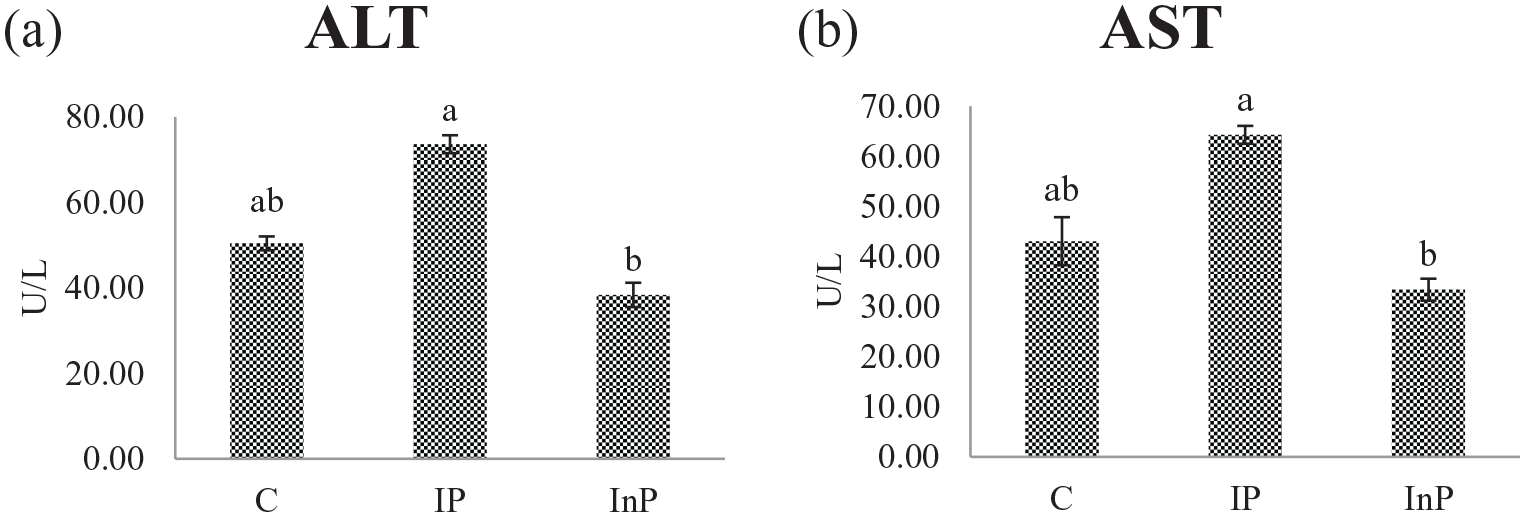
(a) Alanine aminotransferase (ALT; U/l) in control (C), imported probiotic fed (IP), and indigenous probiotic fed (InP) group rats and (b) aspartate aminotransferase (AST; U/l) in control (C), imported probiotic fed (IP), and indigenous probiotic fed (InP) group rats.
Lipid profile
Total cholesterol was decreased (p ⩽ 0.05) in InP group as compared to IP but that decrease was non-significant from the control group (Figure 3(a)). However, Triglycerides found reduced (p ⩽ 0.05) in C group as compared to IP and InP groups (Figure 3(b)). The HDL-Cholesterol was improved in IP group as compared to the InP group. On the other hand, LDL-Cholesterol was found decreased (p ⩽ 0.05) in InP group as compared to IP (Figure 3(c) and (d)).
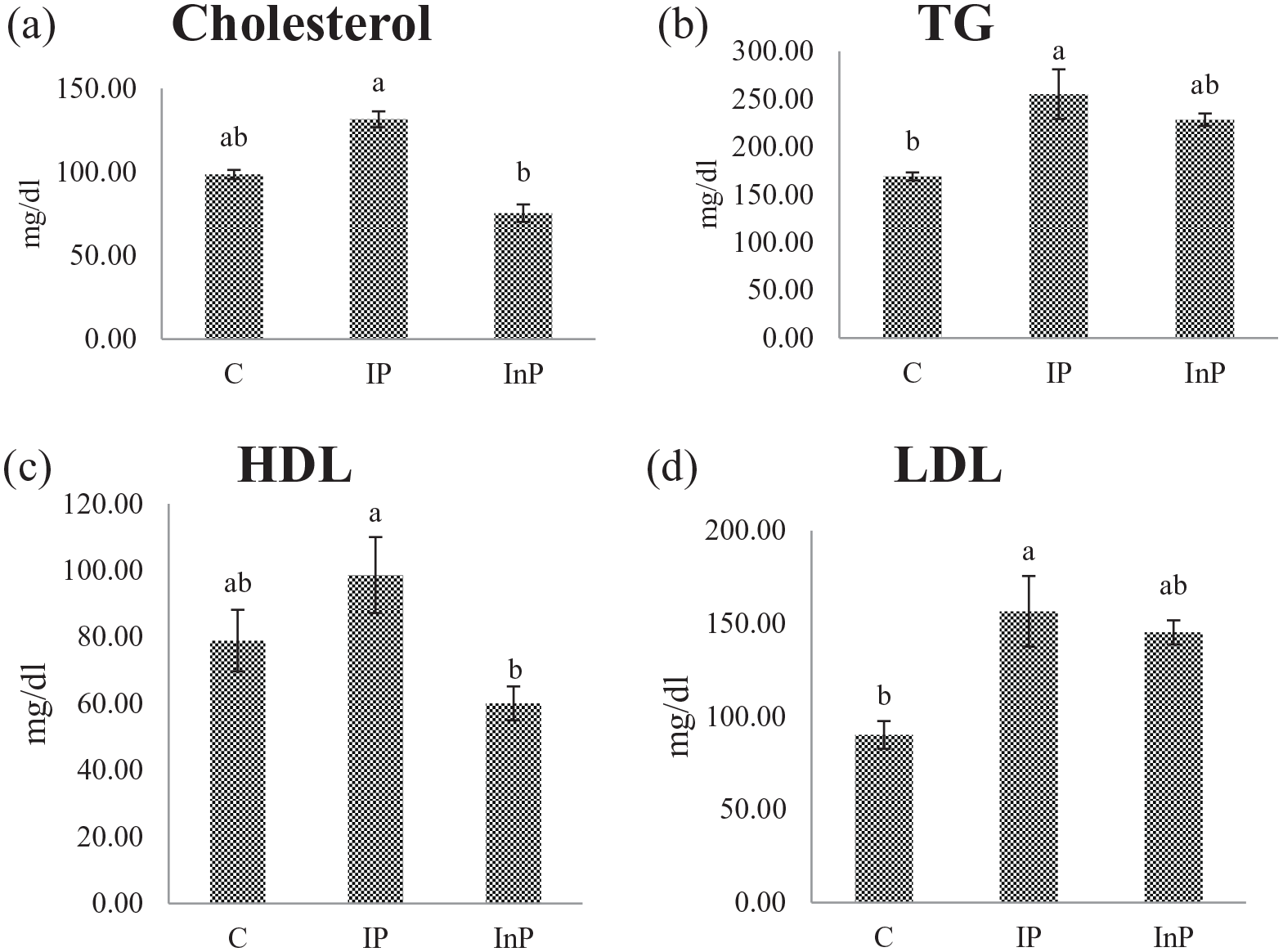
(a) total cholesterol (mg/dl) in control (C), imported probiotic fed (IP), and indigenous probiotic fed (InP) group rats, (b) triglyceride (mg/dl) in control (C), imported probiotic fed (IP), and indigenous probiotic fed (InP) group rats, (c) high density lipoprotein (mg/dl) in control (C), imported probiotic fed (IP), and indigenous probiotic fed (InP) group rats, and (d) low density lipoprotein (mg/dl) in control (C), imported probiotic fed (IP), and indigenous probiotic fed (InP) group rats.
LH, FSH, and growth hormones
In the hormonal dynamics LH found to be increased (p ⩽ 0.05) in IP at 7th and 14th day from the other groups which then decreased (p ⩽ 0.05) at end of experiment (21st day) from other groups (Figure 4(a)). The FSH was decreased (p ⩽ 0.05) in IP and InP as compared to C at 7th and 21st day. It was increased (p ⩽ 0.05) in IP as compared to other groups at day 14. However, FSH was increased (p ⩽ 0.05) in the InP group as compared to the IP at the 21st day (Figure 4(b)). Growth hormone increased (p ⩽ 0.05) in InP as compared to C and IP at 14th day and still high (p ⩽ 0.05) from IP at 21st day of experiment, however it was found high in IP at day 7 from the other groups (Figure 4(c)).

(a) Leutinizing hormone (IU/l) in control (C), imported probiotic fed (IP), and indigenous probiotic fed (InP) group rats, (b) follicle stimulating hormone (IU/ml) in control (C), imported probiotic fed (IP), and indigenous probiotic fed (InP) group rats, and (c) growth hormone (mIU/l) in control (C), imported probiotic fed (IP), and indigenous probiotic fed (InP) group rats.
Discussion
Probiotics are a combination of live nonpathogenic microorganisms, when it is given in suitable quantities can bring microbial balance especially in the digestive tract. Various studies have reported that probiotics play a role in combating various diseases including diabetes and other metabolic disorders by improving the overall individual’s health status, modulating the free radicals, and gut microbiota. 3 Beneficial effects of the various probiotic strains which depends upon their colonization, viability, and localization. This variation is directly dependent upon the particular strain even the specie is same. 12 The effectiveness of probiotic strains relies on viability of microbes in the different environments and the conditions they will encounter during manufacture, transportation, and storage. In the GIT, viability of the microbes greatly influences by the low pH, bile, and gastric acids, so, to with stand these odd conditions for the microbes defines their successful colonization in the GIT. 20 In the present study, probiotic effects on the oxidative stress were explored. For this purpose, thirty albino rats were divided into three groups, that is, control, InP, and IP. TOS decreased significantly (p < 0.05) in the InP group as compared to other two groups. The TAC was improved (p < 0.05) in InP as compared to the IP group, which shows a better antioxidant response as compared to imported probiotic. In a study, Ejtahed et al. 21 concluded that the probiotic improved antioxidant status along with lowering the blood glucose levels. In this study, researcher explored the effects of yogurt on the oxidative stress in type 2 diabetic patients. Probiotics produce their antioxidant effect by inhibiting the peroxidation of linoleic acid and by scavenging the superoxide ion and hydroxyl ions. 22 Zhang et al. 22 isolated two Lactobacillus strains from yogurt and tested for their antioxidant properties. The results showed that both the species possess good antioxidant properties by inhibiting the peroxidation of linoleic acid and by scavenging the superoxide ion and hydroxyl ions. In a study conducted by Athari Nik Azm et al. 23 probiotics (Bifidobacterium lactis, Lactobacillus acidophilus, B. longum, and L. fermentum) increased the malondialdehyde levels and superoxide dismutase activity. Probiotics also have role in improving the oxidative stress in women with gestational diabetes mellitus. 24 Lactobacillus delbrueckii supplementation in splenectomies rats for 7 days shows a reduction in the lipid peroxidation in serum. 25 Amaretti et al. 26 tested 34 strains of lactic acid bacteria present in probiotics in vitro for their antioxidant properties. After having positive results, these strains were used to prepare a potentially active probiotic which was administered in rats for 18 days. The analysis of plasma antioxidant activity, reactive oxygen molecules, and glutathione concentration revealed that these strains effectively reduced the oxidative stress. 26 El-Khadragy et al. 27 treated the Schistosomal cercariae infected rats with yogurt and revealed that yogurt decreased the oxidative stress, lipid peroxidation, and on the other hand also increased the antioxidant enzymes. Yogurt also repressed the hepatic apoptosis which showed the caspases-3 expression level decreased in liver.
The bacteria present in the probiotics possess good hepatoprotective effects reported by improvement in the liver enzymes and lipid profile. In the present study total cholesterol was decreased (p < 0.05) in InP group as compared to IP whereas the Triglyceride, LDL, and HDL levels are increased in the IP group as compared to InP group. Moreover, ALT and AST decreased significantly (p < 0.05) in the InP as compared to IP group. The lowering of cholesterol, ALT and AST was similar to the study conducted previously by Salahuddin et al. 28 on giving curd as a probiotic in mice. They concluded that cholesterol, ALT, and AST was decreased by increasing the dose of probiotic as compared to control group. The results of Liver enzymes are also similar to the study of Sohail et al. 29 who reported that supplementation of probiotics had significant impact on AST and ALT values. In another study, probiotics improved the cholesterol level, liver morphology, and gut morphology in the obese mice. 30 Ngongang et al. 31 used yogurt as a probiotic to treat the serum cholesterol level in hypercholesterolemic rats which indicate a decrease in total cholesterol, ALT and AST levels in the group which received yogurt. Nami et al. 32 revealed the Lactobacillus plantarum YS5, strains separated from homemade yogurt that significantly decreased the cholesterol level in the rats. The production of gonadotropins increases when probiotic is given in the diet of rats as shown in our study. LH found to be increased (p < 0.05) at seventh day from the other groups which than decreased (p < 0.05) at end of experiment (21st day). The FSH was non-significantly (p > 0.05) different till seventh day of experiment which later on at day 21 increased significantly (p < 0.05) in C group as compared to others. These results are similar to the study of Sultan and Abdul-Rahman. 33 in which the probiotic was supplemented to two groups of rats in a dose 10 and 20 mg/kg body weight respectively, which significantly increased the serum LH and FSH levels in both treatment groups as compared to control. This increase in the hormones may be due to modulation of gut microflora involved in enhanced production of vitamin C which ultimately reduces the production of corticosterone from adrenal cortex due to the inhibition of hydroxylase enzyme. 34 Since there is inverse relationship between gonadotropins and corticosterone, so this might be the reason for increase in the FSH. Takeuchi et al. 35 also described a positive correlation between LH and FSH levels in their study, so that both LH and FSH levels increased parallel in their study. Rashad et al. 36 revealed that probiotics also proved helpful to improve the clinical symptoms, hormonal and inflammatory biomarkers in the polycystic ovarian syndrome women. The growth hormone was found increased in InP in the latter half of the experiment as compared to other two groups. In a previous report it was observed that imported probiotics didn’t show any significant response rather after their supplementation size of somatotrophs and their nucleus decreased as compared to the high protein supplemented egg laying hens. 37 Previous literature and some field reports were showing that probiotics were failed to give the promising results as the international literature shows. The imported probiotics particularly failed to make their market in the local pharmaceutical industries. However internationally researchers and field practitioners strongly recommend the probiotic supplementation as a significant health booster and alternate to antibiotic therapy. Similarly, many research reports endorsed the idea to promote the use of indigenously harvested probiotics to overcome the problem of gut microbial variation pertaining to geographical differences. 38
Limitations of research and future prospective
InP was used in current study to evaluate its impact on oxidatative status, liver enzymes, lipid profile, and selected hormones in albino rats. Although, significant results were obtained on comparing with control groups but there were some limitations before using clinically. As the microorganisms were used so limited experimental arrangements were kept for very small time period of 21 days. Furthermore, rats as animal model was used so the beneficially impact of InP on human being could not be predicted with 100% confidence because we could not overlooked the difference between two species. However, from current study we could predict that locally prepared probiotics have many health promoting effects so trial on large scale in animals with many more health related investigations may be carried out then to be promoted in clinics in human subject under strict control conditions.
Conclusion
Probiotics are a combination of living non-pathogenic microorganisms, when it is given in suitable quantities can bring microbial balance especially in the digestive tract. The results of the current study also revealed the multiple health benefits evaluated by measuring the stress markers, liver profile, and hormones levels in albino male rats. In addition, it was also noticeable that indigenous probiotics comprised of only Lactobacilli and Bifidobacterium species while the imported probiotics comprises many different species which also showed simplicity of indigenous probiotics over imported. Before consumption of indigenous probiotics at large or commercial scale it is required to determine the gut ecology of the local population to make strong recommendation for the use of these probiotic species as supplement in local population to improve the health status.
Footnotes
Acknowledgements
I acknowledge all authors who contribute in research as well as preparing article
Declaration of conflicting interests
The author(s) declared no potential conflicts of interest with respect to the research, authorship, and/or publication of this article.
Funding
The author(s) received no financial support for the research, authorship, and/or publication of this article.
Ethics approval
Members of the Institutional Review Board GC University Faisalabad have evaluated and approved the current research proposal (Ref. No. GCUF/ERC/130).
Animal welfare
The present study followed international and Government College University institutional guidelines for humane animal treatment and complied with relevant legislation.
