






Abstract
This study was conducted to assess the current knowledge, attitude, and perception of Nigerian ophthalmologists toward neuro-ophthalmology; identify barriers to the uptake of neuro-ophthalmology as a desired subspecialty; and make recommendations to improve interest in neuro-ophthalmology training. This was a cross-sectional survey of ophthalmology consultants and trainees from the six geopolitical zones of Nigeria, who were attending a national ophthalmology conference. All consenting respondents voluntarily completed a validated self-administered questionnaire. There were 107 respondents comprising 56 males and 51 females. Majority (54.2%) of respondents were aged 40 years and younger. Almost half (47.8%) worked at tertiary level, public health institutions. Only 10.3% worked in private practice. Neuro-ophthalmology exposure was short and occurred mainly during residency (65.7%), while 15% had no exposure at all. Most (80.4%) indicated only nominal interest in neuro-ophthalmology, while only 4.6% indicated a desire to specialize in the field. Financial constraint was the main obstacle to the pursuit of subspecialty training. A total of 86% of respondents admitted that full (34%) or partial (52%) Funding would motivate them to pursue the training. Among respondents desiring part sponsorship, more than half were willing to augment such sponsorship with personal funds. In conclusion, career interest in neuro-ophthalmology is very low among Nigerian ophthalmologists. Late and limited exposure to neuro-ophthalmology during medical training may be contributing factors. Early exposure to neuro-ophthalmology during medical school rotations, coupled with the provision of sponsored subspecialty training opportunities, will serve to increase enrollment in the field.
Keywords
Introduction
Nigeria is Africa's most populous black nation. A total of 300 ophthalmologists serve a population of over 150 million Nigerians. Ophthalmology in Nigeria has undergone a radical change in the last decade as subspecialty-based ophthalmology was introduced in 2005. Prior to 2005, ophthalmology in Nigeria was taught and practiced as a comprehensive specialty with little, if any, tendency toward subspecialization. While subspecialties such as retina, glaucoma, anterior segment, and community ophthalmology have enjoyed a ready market of numerous patients and generous public and professional awareness and interest, including support through sponsored training of fellows, neuro-ophthalmology remains undersubscribed and poorly funded in comparison. There are no local neuro-ophthalmology training programs (fellowships), and training has to be sought outside the country, often at high cost. Other well-established subspecialty groups are inaugurating local subspecialty fellowship training programs. However, there is a need to develop strategies to increase interest and enrollment in neuro-ophthalmology to prevent an imminent human resource crisis in the field.
Following a visit by the International Council of Ophthalmology in 2005, the standard of training and practice of ophthalmology has undergone significant improvement with their continued support. 1 Subspecialty interest groups were introduced through the Ophthalmological Society of Nigeria Congress, and these subsequently fostered the birth of subspecialty training and practice in Nigeria. 1 While some subspecialties have enjoyed a ready market of numerous patients and generous public and professional awareness and interest, such as cataract surgery, glaucoma, community ophthalmology, cornea, and anterior segment, some emerging subspecialties are faced not only with the challenges of developing human resource capacity but also with the need to generate interest and relevance in the face of multiple competing demands for limited government and institutional resources.
Neuro-ophthalmology is the subspecialty of ophthalmology that deals with visual disturbances resulting from brain, nervous system, or optic nerve disease. 2 It is often poorly defined in scope, and many neuro-ophthalmologists are called upon to perform diagnostic functions with limited opportunity for surgical intervention. 3 Neuro-ophthalmology faces unique challenges such as long patient encounters requiring detailed and varied history taking and examination, expensive investigations, and limited surgical intervention. Yet, good visual outcome is not always assured. In many settings, the neuro-ophthalmologist is also responsible for providing ophthalmological review for systemic medical conditions, eg, thyroid eye disease. As ophthalmologists are primarily surgeons at heart, there is a need to generate interest and improve awareness in the field of neuro-ophthalmology, in order to attract trainees into the subspecialty.
In a recent survey of ophthalmology knowledge among medical interns at a major teaching hospital in Nigeria, it was observed that over 90% of respondents had good exposure in cornea/external eye, lens/cataract, and glaucoma at undergraduate level, while almost half of them reported inadequate exposure in neuro-ophthalmology (45.7%). 4 Furthermore, in a survey of pre-residency Nigerian medical graduates at the primary examination level of the Postgraduate Medical College, Eze et al 5 observed that majority (97.2%) had chosen their desired medical specialty within five years of graduating from medical school, and this choice was most often stimulated by personal interest in the subject/specialty (66.6%). Many studies have shown that the degree, and timing of exposure, that students or trainees have in a particular field of medicine can have a significant impact on their potential career choice in future.6–15 It therefore stands to reason that in order to increase interest and future subspecialization in neuro-ophthalmology, one of the strategies would be to introduce neuro-ophthalmology concepts and exposure early in medical training. 16 However, to design a successful strategic approach, it is necessary to first determine and define other potential motivators and detractors, which may influence the choice of neuro-ophthalmology as a desirable specialty in the Nigerian environment. 17 This study was therefore designed to evaluate the current disposition of Nigerian ophthalmologists to the field of neuro-ophthalmology and then to propose strategies to generate interest and improve awareness of neuro-ophthalmology as a subspecialty, in order to attract trainees into the field.
Objectives
The specific objectives of this research were to assess the current knowledge, attitude, and perceptions of Nigerian ophthalmologists toward neuro-ophthalmology and to determine how these influenced their career preference for other subspecialties, over a choice of neuro-ophthalmology. In addition, the study proposed to identify barriers faced by ophthalmologists interested in neuro-ophthalmology and to recommend potential strategies to increase interest and awareness of the neuro-ophthalmology subspecialty, with the goal of attracting more trainees into the field in future. This research was carried out following the principles of the Declaration of Helsinki.
Methods
Validated self-administered structured questionnaires were distributed among ophthalmologists from various parts of Nigeria, attending the Annual Congress of the Ophthalmological Society of Nigeria. The respondents were ophthalmology consultants and residents who voluntarily consented to participate in the survey. Information obtained included the following: bio data, educational and professional background, and other demographics. Detailed information was also obtained on the nature and duration of exposure to neuro-ophthalmology and other subspecialties encountered during medical training. The questionnaire also explored the expression of individual interest in obtaining further training in neuro-ophthalmology. In addition, potential barriers to the pursuit of neuro-ophthalmology subspecialty training were examined. Finally, we reviewed participants’ knowledge and perceptions of the relevance, functions, and responsibilities of the neuro-ophthalmologist.
Results
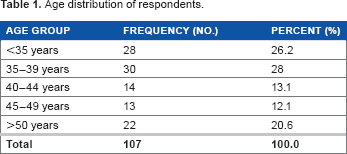
There were 107 respondents comprising 52.3% males and 47.7% females. Age distribution is shown in Table 1. Most respondents (54.2%) were younger than 40 years of age and attended federal universities (78.5%). Almost half (47.6%) worked in tertiary-level health facilities, 41.1% worked at secondary level, and 10.3% worked in private hospitals.
Age distribution of respondents.
Population distribution
Ophthalmologists were represented from all six Nigerian geopolitical zones. Respondents lived and worked in 25 of the 36 states of the federation with the highest population (21.5%) from Lagos state.
Education
Twenty-one different medical schools were represented, comprising 15 federal, 3 foreign, 2 private, and 1 state-owned institutions. Majority (74.8%) possessed a minimum of the primary medical degree alone, while 11.3% had a master's degree and 5.6% had a PhD in addition to their first degree in medicine.
Working experience in the field of medicine
Majority (50.5%) had between 5–9 (29%) years and 10–14 (21.5%) years of experience.
Professional experience in ophthalmology
More than half (54.2%) had completed the professional fellowship in ophthalmology while 10.1% held a diploma in ophthalmology, and the remainder were residents in training.
Exposure to neuro-ophthalmology in training
About 79.4% had some form of exposure to neuro-ophthalmology at various levels of their professional training. Of these, 65.7% had the exposure only during residency. Figure 1 shows the distribution of exposure to neuro-ophthalmology, among respondents, at various levels. The duration of exposure to neuro-ophthalmology was very short in up to 43% of respondents, while 15% had no exposure at all. Table 2 shows the rating of neuro-ophthalmology exposure by respondents. Majority had less than three months of exposure.

Various levels of exposure to neuro-ophthalmology among 107 respondents.
Respondent's rating of neuro-ophthalmology exposure during training.

Attitude and commitment toward neuro-ophthalmology
Majority (80.4%) indicated only nominal interest in acquiring additional knowledge in neuro-ophthalmology. Of this proportion, 55.2% desired the knowledge to improve their knowledge or clinical practice (patient care). Reasons for interest in additional neuro-ophthalmology knowledge are given in Figure 2. Notably, only 4.6% indicated a desire to subspecialize in the field of neuro-ophthalmology. The desired time commitment toward neuro-ophthalmology subspecialty training, among these 86 respondents, is shown in Figure 3. Of the 86 respondents who indicated interest in acquiring further knowledge in the field of neuro-ophthalmology, majority (50%) are willing to commit between one and six months into such training, while about one-third (31.4%) are willing to commit more than six months to neuro-ophthalmology specialty. However, very few were willing to commit one year or more to neuro-ophthalmology training.

Pattern of exposure to various subspecialties in ophthalmology at different levels of medical education among Nigerian ophthalmologists.

Reasons why respondents indicated any level of interest in neuro-ophthalmology.
Financial commitment toward neuro-ophthalmology training
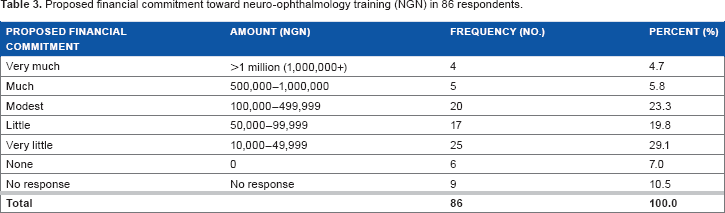
Of the 86 respondents who indicated an interest in neuro-ophthalmology training, most respondents (48.8%) were willing to commit less than 100,000 N, ie, less than US$ 625, into such training, although only 17.4% were unwilling to commit any money at all, into acquiring skills in the discipline. Table 3 shows the intended financial commitment of the 86 interested respondents. Majority (29.1%) were inclined to commit between 10,000 and 50,000 NGN (~US$ 62.5–312.5) to the acquisition of further training in neuro-ophthalmology. However, only 7% were unwilling to commit any funds at all to the pursuit of further knowledge in the subspecialty.
Proposed financial commitment toward neuro-ophthalmology training (NGN) in 86 respondents.
Potential influence of Funding
When asked whether they would be interested in pursuing neuro-ophthalmology subspecialty training if Funding was provided, 86% of respondents expressed an interest in pursuing neuro-ophthalmology training with at least some level of sponsorship. While 34% would be influenced by full sponsorship, at least half (52%) were willing to accept part sponsorship. Only 14% did not show any interest in neuro-ophthalmology subspecialty even if provided for free. Among the respondents who welcomed part sponsorship, more than half (54%) would be willing to augment sponsorship with personal funds. Only 16% would rely on an employer or seek an additional sponsor to provide the balance.
Barriers to neuro-ophthalmology subspecialization
Figure 4 illustrates the barriers that respondents perceived as obstacles to their pursuit of neuro-ophthalmology subspecialty training. Financial constraint was the single most prominent obstacle. Other perceived limitations include poor future prospects in the field, lack of time (busy schedule), and poor prospect for visual recovery among patients (poor outcomes).

Proposed time commitment of respondents toward neuro-ophthalmology training.

Perceived barriers against the pursuit of neuro-ophthalmology subspecialty training among respondents.
Perceptions of neuro-ophthalmology
A total of 74% of respondents are in support of subspecialization in ophthalmology and only 19.6% believe ophthalmology should not be further subdivided into subspecialties. Majority believe that subspecialization will improve practice of ophthalmology in Nigeria and that the superspecialist does have a role in Nigerian medical environment. Less than 4% believe that the subspecialist ophthalmologist is handicapped in dealing with cases outside their field of subspecialization.
Correlation with gender
Responses were cross-tabulated with gender and tested for significance. More than 80% of both male and female respondents support further subspecialization, after residency training. However, less than one in four males and one in five females believe that ophthalmology should remain a general specialty (P = 0.147). This was not statistically significant. A higher proportion of male ophthalmologists (75%) disagreed with the notion that neuro-ophthalmology attracts poor remuneration when compared with females (52.9%). This difference was statistically significant (P = 0.006). Likewise, more males (87.5%) also disagreed with the notion that there is no room for the “super-specialist” in the Nigerian medical environment, when compared with females (60.8%). This difference was also statistically significant (P = 0.004).
In summary, majority of Nigerian ophthalmologists rate their exposure in neuro-ophthalmology, low–very low, and express nominal interest in acquiring further knowledge in neuro-ophthalmology, but are not motivated to commit significant time or financial resources for obtaining further training. However, majority of Nigerian ophthalmologists do support subspecialty training and practice in ophthalmology. Respondents expressed the opinion that full or part sponsorship for training may be an incentive to encourage interest in neuro-ophthalmology.
Discussion
Neuro-ophthalmology is a relatively new subspecialty in Africa, though it is well established in the developed world. However, it is facing reduced trainee enrollment and a potential human resource crisis worldwide. 3 In Nigeria, relative to other subspecialties in ophthalmology, neuro-ophthalmology is also undersubscribed. This survey of Nigerian ophthalmologists was conducted to assess the disposition of Nigerian ophthalmologists toward neuro-ophthalmology as a desirable field of subspecialization and to explore the knowledge, attitude, and perceptions behind the low patronage/interest in this field. Frohman and McDonnell alluded to a potential human resource crisis in neuro-ophthalmology in U.S.A. based on unpublished data from a North American Neuroophthalmology Society (NANOS) survey of enrollment trends in U.S. Ophthalmology Fellowship training programs, which showed a deficit in the annual number of neuro-ophthalmology trainees compared with estimated requirements. 3 Based on unpublished historical data, reflecting the pattern of utilization of ophthalmic services, NANOS estimated that the U.S. needed to train an average of 10–14 neuro-ophthalmologists annually, to make up for an attrition rate of 5–7 full-time equivalent (FTE) clinical neuro-ophthalmologists per year. However, statistics showed that only an average of five FTE neuro-ophthalmologists were being produced per year. 3 While estimated manpower requirements, in neuro-ophthalmology, have not been calculated for Nigeria, this survey demonstrated a similar trend, as Nigerian ophthalmologists reported very little interest in pursuing a subspecialty career in neuro-ophthalmology. This low interest may be related to lack of adequate exposure to neuro-ophthalmology as a subspecialty of ophthalmology. While exposure to ophthalmology, in general, is often limited during undergraduate medical training in Nigeria, medical students get acquainted with anterior segment disorders, eg, cataract, cases of glaucoma, and retinal disorders (Fig. 2). This may account for the higher levels of interest expressed by the respondents in these subspecialties when compared with neuro-ophthalmology. Studies have consistently shown that specialties introduced early in an individual's career path have a significant impact on future career choice. Hauer et al 18 demonstrated, in a survey of fourth year medical students, that desired lifestyle, educational experience/exposure, and experience in patient care, all had a major impact on career choice. Exposure to internal medicine at undergraduate/medical school level had a positive influence on career choice in favor of internal medicine. Similarly, Lane et al 12 and Kolasinski et al 11 demonstrated, in nephrology and rheumatology, respectively, that medical school exposure to these respective specialties strongly influenced future career choice among students. In addition, Kolasinski et al 11 observed that majority of rheumatology fellows had their initial clinical exposure in their second and third year of medical school and >75% reinforced their choice for rheumatology during internship or residency. These observations were corroborated in a recent systematic review. 19 In a survey of graduating ophthalmology residents in U.S.A., Gedde et al reported a trend toward subspecialization but also observed a low inclination toward neuro-ophthalmology. Only 0.7% of Gedde et al's respondents indicated an interest in neuro-ophthalmology subspecialty, 20 which is similar to the low interest recorded in this survey. The higher proportion of respondents in this Nigerian survey (4.6%) may reflect the fact that subspecialization is currently being actively promoted. Other factors, which influenced residents’ specialty choice, were prestige among colleagues, as well as working in an urban area or university environment. He also observed that career choice was often made early in training. 20 It therefore stands to reason that early and positive introduction of neuro-ophthalmology in the medical student curriculum should have a positive impact on enrollment into the specialty in future. Eze and Boniface surveyed medical interns in Enugu and reported that over 90% had good exposure in cornea/external eye, lens/cataract, and glaucoma at undergraduate level, while almost half (45.7%) reported inadequate exposure in neuro-ophthalmology. 5 Similarly, 43% of respondents in this study reported limited exposure (Table 2). Economic prospects also influence career choices as shown by Harris et al 21 in Spain. In times of economic hardship, job prospects outweigh other factors on the decision to pursue a specialty. Nigeria is currently undergoing severe economic challenges, and as such, individuals are more likely to consider the market value of their skills, when selecting an area of subspecialization in ophthalmology. Up to 10% of respondents in this survey, highlighted limited job opportunities as a barrier to the pursuit of neuro-ophthalmology. In addition, this may explain why, despite the apparently high interest in neuro-ophthalmology, many respondents were unwilling to commit significant time or resources to the training. A similar trend was observed among ophthalmology trainees in United States. 3 Nevertheless, when a decision to pursue a career in ophthalmology is made, there seems to be a strong commitment to it. 22 Therefore, maintaining commitment to ophthalmology or its subspecialties, such as neuro-ophthalmology, is not the challenge, but rather stimulating the initial interest is the vital first step.
Adeboye et al 23 observed that 68% of graduating medical students in Ilorin found ophthalmology interesting but only 5% would make it a first choice as a career, leading to the conclusion that failure to reinforce the interest generated during the posting leads to this interest waning over time. Many medical schools expose students to ophthalmology for an average of four weeks or less, and during this period, little or no reference is made to neuro-ophthalmology. However, neuro-ophthalmology is relevant to general medicine, pediatrics, neurology, neurosurgery, radiology, and ophthalmology. Early exposure to concepts in neuro-ophthalmology such as the recognition of abnormal pupillary responses, optic neuropathy, cranial nerve weakness, nystagmus, and squint/strabismus in all of these specialties of medicine will serve to ignite and maintain interest in neuro-ophthalmology. Optic neuropathy and cranial nerve paresis are common presentations of central nervous system pathology, which can be easily recognized when purposefully sought. Medical students can be taught to complement any physical examination for headache, with a brief neuro-ophthalmic evaluation consisting of a pupillary examination, ocular motility, and ophthalmoscopy, in any specialty they find themselves. They can also be introduced to pattern recognition on Humphrey or Octopus visual field (standard automated perimetry) printouts to complement neuroimaging in patients with intracranial tumors. While the students may not be expected to learn the diagnostic intricacies of localization in neuro-ophthalmology, exposure to patients with these signs and symptoms will add to their clinical experience, stimulate interest, and ultimately sharpen their clinical acumen. The main barrier to neuro-ophthalmology subspecialization was the lack of sponsored training opportunities. Therefore, providing funded positions for short-term fellowships in neuro-ophthalmology should simultaneously tackle the barriers of financial and time constraints while also generating interest in neuro-ophthalmology as a prospective career option. This approach has been suggested by Swanchak et al 16 as a means of increasing interest in geriatrics. Collaborative partnerships between individual institutions in developed countries, and single or multiple institutions in less developed countries, can be established for the purpose of skills exchange and mutual benefit. This is called Twinning. 24 This way, institutions with well-developed neuro-ophthalmology programs can support fledgling programs in developing countries by encouraging short-term exchange programs for faculties and trainees in the adopted twin or sister institution. The government and other international stakeholders such as the International Council of Ophthalmology (ICO) or International Neuroophthalmology Society can assist by providing linkages, training, research, or travel grants and regulating the institutional contracts.
Finally, gender issues, which make the pursuit of subspecialty training less appealing to women, need to be addressed.25,26 In Nigeria, these difficulties may be related to the greater burden placed by society on female professionals, who have to meet domestic responsibilities, cope with traditional social roles, and meet stipulated career goals with little or no support from their male counterparts. Greater flexibility in training opportunities and working conditions may alleviate this pressure on women and increase enrollment.
Limitations
This survey represents the views of a cross section of ophthalmologists attending the Annual National Congress of Nigerian Ophthalmologists. Majority of these ophthalmologists were working at secondary- or tertiary-level centers and teaching hospitals and, as such, had a generally positive disposition toward subspecialization in ophthalmology. However, this may not represent the views of majority of self-employed ophthalmologists or those in private practice.
Future Direction
A longitudinal study comparing the effect of twinning and provision of short-term fellowships on the development of neuro-ophthalmology in Nigeria is recommended.
Author Contributions
Conceived and designed the experiments: OAO. Analyzed the data: OAO. Wrote the first draft of the manuscript: OAO. Contributed to the writing of the manuscript: OAO. Agreed with manuscript results and conclusions: OAO. Developed the structure and arguments for the paper: OAO. Made critical revisions and approved the final version: OAO. The author reviewed and approved the final manuscript.
Footnotes
Acknowledgments
Many thanks to Dr. D. M. Dairo of the Department of Epidemiology and Medical Statistics, College of Medicine, University of Ibadan, who helped to validate the study questionnaire. Appreciation also goes to Mr. Isreal Olasunkanmi of the Department of Education, Education Technology Unit, University of Ibadan, who helped with the design of the questionnaire.