






Abstract
Introduction
Support for the development of enterprise skills in medical education exists from the perspectives of educators, researchers, and healthcare leaders. However, literature is limited evaluating the understanding of medical students about these skills. This study aimed to determine whether medical students valued gaining enterprise skills within the course and those skills that they identified and recognized contributed to enterprise practice in subsequent training.
Methodology
Quantitative and qualitative evaluations were undertaken for over three years. Students completed end-of-course evaluations (n = 895) in 2011 and 2012, responding to closed questions utilizing a Likert scale. Subsequent qualitative reflections were collected by interviews one year later with nine students and eight supervisors.
Results
Immediately after course completion, students gave positive feedback, identifying the development of independent learning, creativity, and reflection, as these enterprise skills were most valued. However, in subsequent reflection one year later, they were unable to transfer the acquired knowledge and identify the examples of enterprise around them in their later experiences and had mixed beliefs about its value in medicine.
Conclusion
Enterprise skills need to be revisited explicitly throughout the medical curriculum, with authentic real-life examples, to sustain students' understanding about the role of enterprise in medicine.
Keywords
Introduction
Enterprise education includes training on specific skills, such as knowledge acquisition and innovative attributes and behavior, to explore, adapt, develop, manage, and lead in the changing environments of life. 1
The term enterprise can be used in both its narrow and broad definitions. 1 In its narrowest definition, enterprise can be regarded as solely business entrepreneurialism involving the creation and development of a business by an entrepreneur. 2 However, taken more broadly, enterprise involves exercising specific skills, such as knowledge acquisition and innovative attributes and behavior, to explore, adapt, develop, manage, and lead in the changing environments of life. 1
Enterprise skills include research and analysis, communication, creativity, networking, financial literacy, leadership, negotiation, and management. 3 The term enterprise skills is closely related to generic skills (often referred to as graduate attributes or transferable skills), which are defined as a set of skills required to strive and succeed in different ventures of life. 4 These skills have been integrated at all levels of education in the UK since 19985,6 and particularly emphasized for science graduates 7 as well as medical students.8,9
There are numerous driving factors for embedding the role of enterprise skills in the medical curriculum (Table 1). The economic crisis has resulted in increased pressure on healthcare systems to produce adaptable graduates for the changing needs of future healthcare delivery.10–14
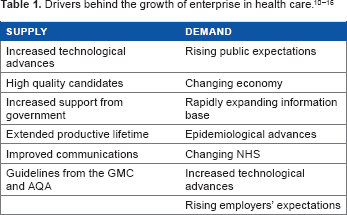
There are also implications on effective healthcare provision with enhanced value for money; as an example, the UK National Health Service aims to save £20 billion through efficient savings by 2015 15 while creating quality improvement in health care.
The advancements in healthcare technology, through tools and expanding information base, have both facilitated the growth of and put more demand on resources. 16
It is increasingly recognized by educators, researchers, and healthcare leaders that enterprise skills are an important component within undergraduate medical training, so as to enable the future doctors to embrace wider aspects of their role, including being change agents, competent resource managers, and promoters of evidence-based policies.17–21 Many professional bodies10,22,23 have recognized the need for the attainment of enterprise skills and called for an increase in its training, with good quality and authentic and contextualized training in these skills.
Amid these recommendations, however, there is limited literature evaluating the medical students' perspectives about enterprise and the component skills. A recent qualitative study explored the attitudes of medical students toward two specific enterprise skills—leadership and management 24 —and found that they valued attaining these skills, especially when explicitly related to the clinical context and taught with real-life examples.
The purpose of this study was, thus, to determine the impact of a specific teaching block, where enterprise skills were explicitly embedded, and the perception of their tutors toward the students' approach to enterprise. This intended as a pilot study on the feasibility of explicitly including enterprise skill training within the course and then to identify whether medical students recognized and valued the role of including explicit enterprise training within the curriculum and for their future careers. Of particular relevance, we aimed additionally to explore the longer term impact of such teaching on the recognition of enterprise and whether the students were able to identify the skills in practice in their subsequent clinical work.
Methods
This study was conducted at a research intensive higher education institution (HEI) in the UK using a mixed-methods approach to produce both quantitative and qualitative results. Mixed-methods research utilizes a pragmatism perspective to provide a fuller picture of an observed phenomenon. It allows inquiry to be purposeful and situated in context. Within this evaluation, the duality is appropriately utilizing the quantitative evaluation immediately after the module completion and directed qualitative exploration of transference into clinical practice after a period of time has elapsed. 25 A two-week elective (student selected component (SSC)) is incorporated into the course for second-year and third-year students, ie, midway through a five-year course. This provides students an opportunity to explore the chosen topics led by a supervisor with both specific expertise and interest in the designated area or topic being offered. 26 Supervisors come from a variety of backgrounds, not only medical, and include business developers, authors, and police officers, and thus, topics on offer range from those with a focus on not only healthcare but also wider aspects, from learning basic language skills to exploring local community groups. 27 Enterprise skills development, including time management, communication, leadership, and presentation, was explicitly included as a common requirement across all topics. The supervisors received specific training and support on how to embed and teach enterprise skills within this specific course component. Assessment includes a reflective diary in addition to a written report or presentation reflecting the topic area. The written work explicitly requires the consideration of skills acquired around enterprise learning and is included within explicitly articulated assessment criteria, provided before choosing the topic, and within course information documentation.
Data collection occurred for over three years. Quantitative data were collected from two cohorts in 2010 and 2011 from end-of-course questionnaires. Anonymous completion on the final day achieved return rates of 90% in 2010 (n = 475 students) and 79% in 2011 (n = 420 students). An independent administrator administered the questionnaire and entered data into a spread sheet.
The questionnaire was designed by the central SSC course management team and differed slightly between the two years; the survey items used in each year are shown in Table 2. Twenty closed questions were included, of which the majority related to the overall SSC evaluation, for example, specific organization aspects and resource accessibility. Five questions were included that were specifically relevant to the evaluation of enterprise aspects of the course. Students expressed their responses on a 4-point Likert scale in 2010 using anchoring descriptors of 1 = strongly disagree, 2 = disagree, 3 = agree, and 4 = strongly agree. In 2011, an additional point for no preference was added (1 = strongly disagree, 2 = disagree, 3 = neither agree nor disagree, 4 = agree, and 5 = strongly agree). The language in questionnaire items was not identical between 2010 and 2011 although while requesting feedback on similar aspects, thus, the results were grouped as a theme. The results of each year were given using a Likert-scale score, with mean and standard deviation calculated to determine the variance of distribution. Students omitting an answer to individual questionnaire items were still included in the study, but their results were excluded from the affected theme. Statistical comparisons between the two years were not undertaken; it is not possible to predict how the 2011 neither agree nor disagree midcategory would have responded; thus, we have restricted evaluation to the proportion of students responding positively (agree and strongly agree).
Phrasing of questions resulting in agreed-upon themes for questionnaire data analysis.

One year later, a randomly selected sample of nine participants from both cohorts who had completed the questionnaire was interviewed as a follow-up. Eight SSC supervisors were additionally interviewed, all of whom had been tutoring the SSC for the duration of the study and were responsible for assessing the student competency in enterprise skills. Supervisor interviews thus provided an independent observational view of student attitudes during the SSC. The interviews were all conducted by Sharul Dube (SD) and were semi-structured with open-ended questions designed to follow up on student's questionnaire responses and ongoing reflection of enterprise education. Prompts were used in a consistent manner. Analysis coding was verified using all authors.
The interviews were audio recorded and transcribed. Coding of the interviews comprised SU for supervisors and ST for students. Gender and interview number were identified; thus as an example, a female supervisor interviewed fifth was assigned SUF5. Qualitative data were analyzed using a content analysis approach and categorized into the following three overarching themes: student awareness of enterprise, students' perception of its role, and the specific skills valued. The number of participants was considered adequate as all result categories became saturated and no new data were forthcoming. The gender ratio (ie, F/M) for the interviews was representative of the medical school target population (5:4 for students and 5:3 for supervisors).
Results
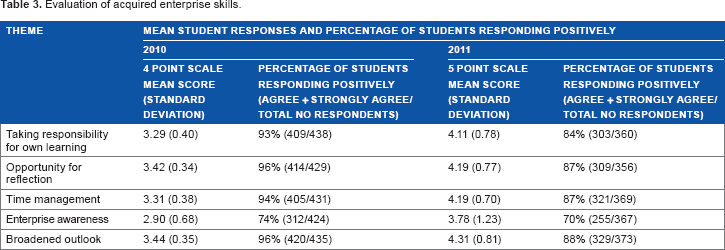
Quantitative analysis of the questionnaire completed immediately after the SSC by the students identified that for both cohorts, 84–96% of students considered that they had developed enterprise skills and 88–96% of them expressed views that this experience had helped them achieve a broadened outlook. All mean values on the Likert scale were above the midpoint (see Table 3).
Evaluation of acquired enterprise skills.
Supervisors who had led these attachments and assessed the students were asked about their perceptions of the students' attitudes and recognition of enterprise as a concept and as a specific skill area for development. They described a lack of awareness about enterprise in the students before starting the SSC. They also described that students appeared initially hesitant about their specific chosen topic content and the underpinning enterprise skills objectives. However, all supervisors considered that the students had ultimately engaged enthusiastically within their attachments:
About a quarter or third of them understand it and the rest seem to sort of go along with it (SUM3)
Many students feel very uncomfortable initially (SUF8)
Having people understand what enterprise is [difficult] (SUF4)
Yes they are [enthusiastic], it seems to be a popular topic (SUM2)
It's a long process; I think we are trying to change a mind-set so we need to be prepared to plug at it over a few years (SUM3)
They come and they are enthusiastic (SUF7).
Supervisors identified challenges in helping students to advance in their understanding of the role of enterprise skills, both within their current undergraduate career and as a key part of their future roles as effective practicing clinicians. The supervisors articulated that the inclusion of enterprise skills transparently within this SSC teaching block was a new way of learning for the students and, thus, had consequential uncertainty, for both themselves as supervisors and for the students. However, despite expressed concerns about the challenges, all supervisors felt that the students achieved the learning objectives of this teaching block:
[Students] are very uncertain … it's almost as though it's a nuisance to them, they don't get [enterprise] (SUM3)
They have to take responsibility for their own learning and those who have learnt to rely on lecture notes and spoon-feeding get a necessary shock (SUF8)
A lot of [students] did really well … I was very impressed (SUF4)
I think people want to be directed (SUM2)
I don't find it an easy subject to teach (SUM3)
Each student achieves [the SSC outcomes] in their own way (SUF8)
The most important thing is to give examples, that is what the students want (SUM1).
Supervisors emphasized their understanding of the value for students and for the impact on getting the most out of such elective-type learning, particularly around enhancing creative thinking and idea generation skills among other enterprise skills. It is important, however, to state that none of the supervisors considered that commercial or business awareness was an appropriate skill to learn in this stage of the undergraduate medical training, and this had been particularly discussed during the supervisor training prior to the attachments:
Students expand their creativity (SUF7)
Why should they be commercially aware … perhaps in the future doctors need to have commercial awareness … but [not] in second or third year (SUF4)
I think these skills are important … networking, idea generation and creative thinking, leadership, negotiation and management (SUF6).
The longer term impact on the students of this experience of enterprise skill development was explored in the interviews one year after the course completion. Qualitative analysis of their perception of application and recognition of enterprise skills in their subsequent experiences and observations within clinical practice was mixed:
These skills are useful to be well rounded clinicians (STM2)
Enterprise skills are important to shape you (STM1)
[It gives] exposure to wider aspects of medicine (STF7)
A bit of a waste of time (STM4)
It wasn't particularly useful (STF5).
Students were asked about the specific skills they considered they had developed in the elective attachment (SSC) undertaken over a year previously. They frequently and consistently highlighted those skills of idea generation and creativity. No student articulated that they had learned commercial or business-type skills:
It would be useful to learn more about NHS (the health service) as a business (STM1)
Idea generation and creative thinking skills (STF3)
Leadership, negotiation, idea generation and creative thinking skills (STF6).
Discussion
This study aimed to explore the usefulness of enterprise skills perceived by the medical students after the inclusion of explicit enterprise skill learning opportunities within a short elective attachment (SSC) midway through their undergraduate training. The majority of students reported their enhanced end-of-course perceptions and awareness of enterprise and enterprise skills. This supports the underpinning educational premise that including explicit intended outcomes and feedback through the assessed requirements even within a diverse elective module would increase the awareness of enterprise and its composite skills as an accessible concept for medical students at this stage of their training. 28 However, variance in quantitative evaluation by the students on their recognition of enterprise skill development would indicate greater diversity in opinion on their increased enterprise awareness. This may reflect the different topics being studied by the students during this teaching attachment, and thus, learning developed and articulated in dissimilar ways. The element of choice, considered strength of this elective type of course opportunity (SSC), will inevitably present a lack of uniformity in education delivery, and students will differ both in prior experience in extracurricular activities and in how they access and develop from different curricular opportunities.
University advisory bodies stipulate that enterprise education should focus on equipping students with a combination of enterprise awareness, entrepreneurial mind-set, and capability, which are all required to achieve entrepreneurial effectiveness. 29 Embedding enterprise skills as a common thread across such an elective attachment within which students selected their specific attachment was intended to ensure some uniformity around exposure to the concept of enterprise skills and their importance. Being able to select topics for study allows students an opportunity to select and adapt the educational experience based on their needs, and this is an essential element for a successful enterprise education program. 30 Qualitative analysis of the supervisors' interviews identified the importance of ensuring clear and authentic examples of enterprise within medicine are provided and can be extrapolated from the experiences provided within whatever topic has been explored in such elective attachments. This explicit teaching helps improve patient care 31 and encourages students to actively seek out enterprising opportunities. This supports previous evidence that students appreciate being taught with real-life examples. 24
Immediate postcourse evaluation demonstrated positive feedback and recognition of enterprise skills and attitudinal development. In interviews, supervisors articulated that students were receptive and cooperative during their attachment and achieved the set objectives, as demonstrated within the assessed reflective journals. This is consistent with previous research articulating that students appreciate enterprise education. 32 Specific enterprise-related skills receive positive feedback, including the development of independent learning and enhanced time management. Reflecting on experiences in a constructive way was also emphasized, and this is of course a key tool for self-improvement. 33 Creative thinking skills were frequently stated as a useful skill, described as unique to this attachment, in comparison to the perceptions of other for formalized and structured areas within an undergraduate medical course. Students stated that they were made aware of innovations conceived outside of medicine within the topics covered within their specific attachment and that they were relevant to their future practice as clinicians, consistent with the broader definition of enterprise. 1 These enterprise skills underpinning the innovations they had been exposed to also align with the core purpose of optional choices within undergraduate training, ie, to provide opportunities to students to extend their experiences beyond the core medical curriculum. 26 Development of such skills is vital to initiate entrepreneurial capability that students can nurture in the future and utilize many of the effective entrepreneurial areas important for future practice.
Despite the fact that over 80% of these students recognized the development of enterprise skills on completion of the course, mixed views were expressed by the students when interviewed about the value of this attachment a year later. The student interviewees were unable to articulate examples of enterprise they had observed or become aware of in their subsequent training, which would have included a range of different clinical experiences. This suggests that the exposure to enterprise learning they had received at this midpoint stage of their undergraduate training appeared to have had limited impact and had not been sufficiently transferable to enhance recognition. This may reflect that the examples they had been exposed to may not be sufficiently relevant, explicit, or even perceived as authentic for the profession, and enterprise awareness thus may not have been embedded. Or, was it simply too early in their training?
The supervisors' views reflected their perceptions of students' initial uncertainty and ambivalence around the relevance of learning about enterprise. A reason for this uncertainty may be because expectations for them as “change agents to improve health care” are not being effectively articulated 20 and they are unaware of the drivers behind its growth (Table 1). It could also be that this responsibility is too abstract and far into the future to be fully acknowledged midway through undergraduate training. The responsibility for enhancing the authenticity and importance of this lies with the medical school through the teaching staff. 20
Further research may indicate more effective approaches to embed and develop such enterprise and aligned skills within the curriculum and enhance the impact of such learning on subsequent recognition in clinical practice. Students did not consider that they had learned commercial or business skills, and only one expressed a keen interest in learning about the health service as a business. None of the supervisors believed that these skills were relevant, and one stated that learning these skills is relevant only after graduation. This is contrary to Cox's recommendation to teaching health economic principles to medical students to produce commercially aware graduates. 10 Educational innovations to enhance students' understanding of the relevance of enterprise skills to medical practice, as illustrated by the students describing enterprise in its narrow definition, 1 ie, as a commercial activity, and lack of acknowledgement of its beneficial role in effective health care need to be evaluated.
The role of enterprise in medicine is well recognized and valued by researchers, leaders, and educators. However, little is known about the awareness and attitudes of students regarding enterprise. This study has demonstrated that exposure within a short course early in undergraduate training has provided the majority of students with an early understanding of enterprise skills with independent learning, creativity, and reflection skills, which were most valued. The apparent lack of longer term impact on this cohort and within their subsequent learning environment poses reflection and challenges around transference. While this study has identified some valuable outcomes, it is acknowledged that data collected immediately after the educational experience were conveniently grouped into themes and had been collected in slightly different formats between the two years. This may have led to interpretation bias; attempts to minimize bias included independent data entry by an administrator into a spreadsheet and analytical discussion among the research team to reach the agreement of categories. Other methodological limitations include the potential for variability in the learner experience from both supervisor and attachment content variability (despite training). Subject sampling for qualitative interviews was random and saturation achieved, but remains a selected sample. Further research on practicing doctors may provide additional insight into how best to translate enterprise practice into education and on transferability of skill development into entrepreneurial individuals in practice.
the known aspects in this area are as follows:
Enterprise education may be regarded as an essential component within undergraduate medical training to ensure development of effective future entrepreneurial practitioners.
Creativity, leadership, and management underpin enterprise education in healthcare practice, especially when contextually related and examples are authentic.
This research additionally includes the following:
This paper indicates that explicit teaching using authentic and realistic examples are important for students to recognize and value enterprise.
Students value enterprise skills relating to independent learning, reflection, and creative thinking.
Supervisors training undergraduates in enterprise skills find that students are unsure at first, but approach their learning experiences enthusiastically.
Are graduates able to apply the enterprise skills they learn in a practical and effective way?
Notes on Contributors
Sharul Dube, MBChB Hons, is a foundation year doctor at St James University Hospital, Leeds, UK. She undertook this research as part of a self-designed module during her undergraduate degree. She has cultivated an interest in the role of enterprise in medical education and intends to pursue this in her career.
Sarah Underwood, BSc Hons, PhD, is an associate professor of Enterprise at the Leeds Enterprise Centre, University of Leeds, UK. Her academic work focuses on how to embed enterprise education into discipline-specific HEI curriculum, enabling student development of key transferable skills and a more entrepreneurial mind-set.
Deborah Murdoch-Eaton, MBBS, MD, FRCPCH, is the Dean of Medical Education in The Medical School, University of Sheffield, UK. Her academic interests focus on developing students' potential and individuality, generic skill development, and the role of feedback in the development of learning skills.
Ethical Approval
The Leeds University Research Ethics Committee granted ethical approval for this study, and data were collected in line with RCUK guidance. Participants gave written, informed consent to participate in the interviews involved in the study. Completion of the questionnaires was approved as written consent.
Author Contributions
Conceived and designed the experiments: SD, SU, DME. Analyzed the data: SD, SU, DME. Wrote the first draft of the manuscript: SD, SU, DME. Contributed to the writing of the manuscript: SD, SU, DME. Agree with manuscript results and conclusions: SD, SU, DME. Jointly developed the structure and arguments for the paper: SD, SU, DME. Made critical revisions and approved final version: SD, SU, DME. All authors reviewed and approved of the final manuscript.
Footnotes
Acknowledgment
We would like to thank Claire Davies, the SSC administrator.