






Abstract
The present study was designed to investigate the effect of once daily for 7-day (subchronic treatment) dosing of histamine H3 receptor antagonists, ciproxifan (CPX) (3 mg/kg, i.p.), and clobenpropit (CBP) (15 mg/kg, i.p), including clozapine (CLZ) (3.0 mg/kg, i.p.) and chlorpromazine (CPZ) (3.0 mg/kg, i.p.), the atypical and typical antipsychotic, respectively, on MK-801(0.2 mg/kg, i.p.)-induced locomotor activity, and dopamine and histamine levels in rats. Dopamine and histamine levels were measured in striatum and hypothalamus, respectively, of rat brain. Atypical and typical antipsychotics were used to serve as clinically relevant reference agents to compare the effects of the H3 receptor antagonists. MK-801-induced increase of horizontal activity was reduced with CPX and CBP. The attenuation of MK-801-induced locomotor hyperactivity produced by CPX and CBP was comparable to CLZ and CPZ. MK-801 raised dopamine levels in the striatum, which was reduced in rats pretreated with CPX and CBP. CPZ also lowered striatal dopamine levels, though the decrease was less robust compared to CLZ, CPX and CBP. MK-801 increased histamine content although to a lesser degree. Subchronic treatment with CPX and CBP exhibited further increase in histamine levels in the hypothalamus compared to the MK-801 treatment alone. Histamine H3 receptor agonist, R-OC methylhistamine (10 mg/kg, i.p.) counteracted the effects of CPX and CBP. In conclusion, the subchronic dosing of CPX/CBP suggests some antipsychotic-like activities as CPX/CBP counteracts the modulatory effects of MK-801 on dopamine and histamine levels and prevents MK-801-induced hyperlocomotor behaviors.
Introduction
Animal models based on the blockade of N-methyl-D-aspartate receptor (NMDAR) have been extensively used to mimic psychoses in laboratory conditions. 1 The involvement of dopamine in the pathophysiology of schizophrenia is well known, as dopamine D2 receptor antagonists are known to treat positive symptoms of schizophrenia. However, altered dopamine levels or dopamine receptors were not generally observed upon postmortem examination of the brains from schizophrenic patients. NMDAR is a major glutamate receptor subtype, which plays an important role in several processes, including motor activity, learning, and memory processes, as well as cortical plasticity and maturation. Evidences from both animal models and human studies have implicated a dysfunction of NMDARs both in disease progression and symptoms of schizophrenia. 2 9 Mice with reduced NMDAR were reported to express behaviors related to schizophrenia. 4 Administration of phencyclidine (PCP), NMDAR antagonist, was reported to closely mimic schizophrenia. 2 Two other noncompetitive antagonists of NMDAR, ketamine and MK-801, were also reported to produce schizophrenia-like behaviors in animals and exacerbate symptoms in patients. 3 Furthermore, Mice with reduced NMDAR expression display schizophrenia-like behaviors and systemic MK-801 administration elicits symptoms of psychosis such as hyperlocomotion, disruption of prepulse inhibition, impaired performance in learning and memory tasks, and decreased performance in social behavior tasks.4,5 In rodents, systemic MK-801 administration results in a variety of schizophrenia-like behaviors, including hyperlocomotion, disruption of prepulse inhibition, impaired performance in learning and memory tasks, and decreased social behaviors. 3 In addition, MK-801 induces ataxia, head weaving, body rolling, and stereotyped motor patterns, 8 and a single application of MK-801 is well known to induce psychosis-like behaviors. 7 10 Such behavioral syndromes have been used to model schizophrenia-like effects of NMDA antagonism. In particular, NMDA antagonist-induced hyperlocomotion has been used to compare the effects of typical and atypical antipsychotics as well as many other antipsychotic drugs with a variety of mechanisms of action (eg metabotropic glutamate receptors-2, glycine transporter-1, etc).4,5 Histamine has been reported as a neurotransmitter and neuromodulator in mammalian brain and plays an important role in memory, cognition, emotions, and sleep regulation.11,12 Alterations in the histaminergic system have been reported in several brain disorders, including schizophrenia, and have a significant role in their pathophysiology. Histamine neurons originate from the cell bodies in the tuberomammillary nucleus (TMN) of the posterior hypothalamus and innervate brain areas such as cerebral cortex, thalamus, hippocampus, amygdala, cerebellum, brain stem, and spinal cord. 13 15 Histamine mediates its response in the brain via four histamine receptors: Hj–-H4.14,15 H1 and H2 receptors are expressed both peripherally (in the immune system) and in the central nervous system (CNS). H4 receptors were recently detected in the brain but they are mainly expressed in the immune system. 16 Histamine H3 receptors were reported as presynaptic autoreceptors on histamine neurons controlling the synthesis and release of histamine, 17 and as heteroreceptors on nonhistaminergic neurons they modulate the release of several key neurotransmitters. 17 19 H3 receptors are expressed nearly exclusive in the CNS, and are widely distributed across the brain; the highest densities of H3 receptors are present in the striatum, hippocampus, and cerebral cortex. 18 20 Additionally, because of H3 receptor's predominant expression in the CNS, they may be selectively targeted to cause fewer peripheral side effects, and may reduce weight caused by olanzapine. 21
In our previous study, we reported that the acute administration of ciproxifan (CPX) (3.0 mg/kg, i.p.) and clobenpropit (CBP) (15 mg/kg, i.p.) attenuate MK-801-induced schizophrenia-like behaviors and studies reported antipsychotic activities of histamine H3 receptor antagonists. 22 27 Some studies reported that H3 receptor antagonists lack antipsychotic-like activities and increase the motor effects of MK-801 in rats,28,29 and that positive symptoms could not be treated with the acute administration of H3 antagonist and require treatment for a long time and antipsychotic efficacy with antipsychotic medications start to develop only after several days of treatment. 30 Therefore, we intended to explore whether subchronic dose of H3 antagonists CPX/CBP augments the antischizophrenic effect of acute administration as previously reported by us. Thus, we aimed to extend the findings of our previous study by looking at the subchronic dosing (once daily for 7 days) with H3 receptor antagonists for their antischizophrenic-like activities in MK-801-induced schizophrenia-like behaviors, and histamine and dopamine levels in the hypothalamus and striatum of mice brain.
Materials and Methods
Animals
The study was carried out on Wistar albino, 12-week-old male rats weighing 150–200 g, procured from the Central Animal House Facility of Hamdard University. Rats were kept in a group of six animals per cage and maintained under standard conditions at 20°C and 50–55% humidity in a natural light and dark cycle, with free access to food and water, and housed in a CPCSEA (Committee for the Purpose of Control and Supervision of Experiments on Animals) approved animal house facility of Jamia Hamdard. The experimental protocol was approved by the Institutional Animal Ethics Committee (IAEC Protocol No 456). Utmost care was taken to ensure that animals were treated in the most humane and ethically acceptable manner. Animals were brought to the experimental room and allowed one-week acclimation period to adjust to the new housing, food, water, noises, smells, and light cycle before being used in experiments.
Study design
The experimental groups were divided into 12 groups; each group consisting of six rats. Group I: vehicle; Group II: CPX; Group III: CBP; Group IV: R-α-methylhistamine (RAMH); Group V: MK-801; Group VI: CPX+MK-801; Group VII: CBP+MK-801; Group VIII: RAMH+MK-801; Group IX: clozapine (CLZ)+MK-801; Group X: chlorpromazine (CPZ)+MK-801; Group XI: CPX+RAMH+MK-801; and XII: CBP+RAMH+MK-801.
Drugs and treatment
All the drugs used in the experimental study were procured from Sigma Chemicals Co.. Drug solutions were made in normal saline (0.9% NaCl). All the drugs were administered intraperitoneally, and drug solutions were freshly made on the same day of the experiment. The drug solutions were administered in volume of 1 mL/kg. In this study, we induced locomotor activity with MK-801 dose of 0.2 mg/kg, intraperitoneally similar to what was used in our prior study. 15 Higher doses (greater than 0.5 mg/kg) were reported to produce a typical motor syndrome characterized by head weaving, body rolling, ataxia, and salivation. 22 Hence, we restricted the dose of MK-801 to 0.2 mg/kg, which did not produce these motor effects which could confound the interpretation of test results. The test drugs, CPX, CBP, CLZ, and CPZ, were administered once daily for 7 days to respective groups and administered between 9:00 and 10:00 AM. After 24 hours of the last day of dosing, RAMH (10 mg/kg, i.p.) and MK-801 were administered 15 minutes and 10 minutes, respectively, before the open-field test. 22
Open-field activity
It was performed in open field consisting of an acrylic box (40.6 × 40.6 × 40.6 cm) fitted with two photobeam frames (16 beams/dimensions; 2.5 cm between beams; Coulbourn Instruments). The lower frame (2.5 cm above the arena floor) recorded horizontal locomotor activity while the upper frame (15 cm above the floor) recorded rearing. Open-field chamber was connected to software (TruScan 2.0 version; Coulbourn Instruments), which recorded the beam breaks (100 milliseconds sampling rate). The locomotor activity was monitored for a period of 20 minutes beginning 10 minutes after the injection of MK-801. CPX (3 mg/kg, i.p.), CBP (15 mg/kg, i.p.), CLZ (3 mg/kg, i.p.), and CPZ (3 mg/kg, i.p.) were administered once daily for 7 days. The dose of drugs chosen in this study is based on reported studies. 22
After 24 hours following the last dosing with test drugs, rats were brought to the test room from the animal housing facility and kept for half an hour in the home cage for habituation. They were then individually placed in the open-field chamber for another half an hour prior to the recording of locomotor test.
Liquid chromatography-tandem mass spectrometry estimation of brain striatal dopamine and hypothalamic histamine content in rat
The estimation of dopamine and histamine was done using liquid chromatography-tandem mass spectrometry (LC-MS-MS) technique with modification of the previous method by Su et al. 31 Following behavioral testing, rats were sacrificed by the cervical dislocation using ether anesthesia. Brains were quickly harvested and placed on ice. The right and left striata, including hypothalamus were dissected and quickly frozen on dry ice, and then stored at –80°C freezer until analysis. The limits of the hypothalamus for dissection were the optic chiasma at the anterior border, the mammillary bodies at the posterior border, and, on both lateral sides, the hypothalamic sulci. The tissue was finally cut dorsally at 2 mm from the ventral face.
Striatum/hypothalamus was homogenized in ice-cold methanol (1 g brain tissue in 4 mL of methanol) after being weighed precisely. One milliliter of homogenate was pipetted out into 1.5 mL conical plastic centrifuge tube and centrifuged at 14,000 rpm for 20 minutes. Then the supernatant was evaporated to dryness by vacuum freeze-drying. The dry residue was then reconstituted with 300 μL deionized water and vortex mixed for 10 seconds and added 300 μL chloroform–isopropanol (100:30, v/v). After vortex mixed for two minutes, the mixture was centrifuged at 3,000 rpm for another five minutes. The upper aqueous layer was injected into LC-MS/MS. The sample volume injected was 10 μL for both dopamine and histamine.
Calibration standards and control samples
Calibration samples were prepared in deionized water by adding standard solutions corresponding to a blank and various calibration concentrations ranging 0.3–1250 ng/mL for dopamine and 0.5–100 ng/mL for histamine were prepared. Control samples were prepared from a mixed brain tissue homogenate. LC-MS/MS analyses were carried out on a 4000 QTRAP LC-MS/MS System (AB sciex) with a hybrid triple quadruple/linear ion trap mass spectrometer (AB sciex) equipped with pressure ion. The analytes were separated on a thermo C-18 column (4.6 mm, 5 mL, SN: 1245575T, thermo electron corporation, USA) with column temperature at ambient temperature. The mobile phase was 0.05% formic acid-acetonitrile (92:8, v/v) for the determination of dopamine. The flow rate was 0.8 mL/min and the post-column splitting ratio was 4:1. The dopamine was obtained by pressure ion in the positive ion mode.
Statistical significance
The data were expressed as mean (± standard error of mean [SEM]). Results were analyzed by one-way analysis of variance (ANOVA), and P-values <0.01 were considered significant. The comparison was predefined and made only against the vehicle and MK-801-treated groups.
Results
The effect of subchronic dosing of CPX and CBP on MK 801-induced locomotor activity in rats
Rats treated subchronically with CPX or CBP exhibited a significant reduction of hyperlocomotor activities induced by a single-dose administration of MK-801 (0.2 mg/kg, i.p.). The horizontal activity increased from 2086.5 ± 249.69 cm to 10577.10 ± 249.69 cm [(P< 0.01) F = 131.91(11,60)] following MK-801 administration. Rats treated subchronically with CPX or CBP showed a significant (CPX: P < 0.01; CBP: P < 0.01) reduction in hyperlocomotor activity induced by MK-801 (3103.18 ± 255.02 cm and 3260.03 ± 147.96 cm, respectively). The increased hyperlocomotor activity induced by MK-801 was also reduced (3342.72 ± 213.30 cm and 4462.42 ± 219.60 cm, respectively) significantly (CLZ: P < 0.01; CPZ: P < 0.01) following administration of CLZ (3.0 mg/kg, i.p.) or CPZ (3.0 mg/kg, i.p.). The protective effects of the administration of both the H3 antagonists were decreased P < 0.05) in RAMH (10 mg/kg, i.p.) pretreated groups. The MK-801-induced increase in horizontal activity was aggravated P < 0.05) following concurrent administration of RAMH and MK-801 (Fig. 1).

The effect of subchronic dosing of histamine H3 receptor-ligands on MK 801-induced locomotor hyperactivity in rats.
The per se effects of subchronic dosing of CPX and CBP used in this study showed no influence on locomotor activity.
The effect of subchronic dosing of CPX and CBP on dopamine and histamine levels in rats
The administration of MK-801 (0.2 mg/kg, i.p.) caused elevation P < 0.05) of the striatal dopamine level in comparison to vehicle-treated group. In CPX (3.0 mg/kg, i.p.) and CBP (15 mg/kg, i.p.) pretreated groups, there was a reduction P < 0.05; [F = 16.84(11,60]) in MK-801-induced increase in the striatal dopamine levels, which was recorded as 2580.31 ± 219.80 ng/g-tissue and 2593.54 ± 283.44 ng/g-tissue, respectively. The administration of CLZ or CPZ (3.0 mg/kg, i.p.) also reduced P < 0.05) the increased striatal dopamine level induced by MK-801. The reduction in striatal dopamine level mediated by CLZ or CPZ was comparable to the reduction produced by CPX or CBP administration. The decrease of striatal dopamine level mediated by the administration of CPX and CBP further tended to elevate P < 0.05) in RAMH (10 mg/kg, i.p.) pretreated group when compared with CPX+MK-801 and CBP+MK-801 groups, respectively (Figs. 2 and 3).
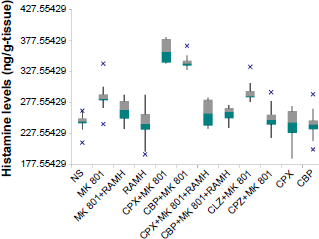
The effect of subchronic dosing of histamine H3 receptor-ligands on brain histamine level in MK 801 treated rats.

The effect of subchronic dosing of histamine H3 receptor-ligands on brain dopamine level in MK 801 treated rats.
The administration of MK-801 (0.2 mg/kg, i.p.) increased the hypothalamic histamine level. Subchronic dosing of CPX and CBP exhibited further increase of histamine level in the hypothalamus compared to MK-801 alone. The administration of CLZ [P < 0.05; F = 8.162(11,60)] increased the hypothalamic histamine level in comparison to the vehicle control group, and CPZ (3.0 mg/kg, i.p.) decreased the histamine levels in comparison to the MK-801 treatment group.
Treatment with RAMH (10 mg/kg, i.p.), in the CPX+MK-801+RAMH or CBP+RAMH+MK-801 treatment group, tended to reverse P < 0.05) the increase of the histamine levels mediated by CPX or CBP administration in the CPX+MK-801 or CBP+MK-801 treatment group. The administration of CPX or CBP per se had no influence on either dopamine or histamine levels in the striatum and hypothalamus, respectively. The MS-MS scan of daughter ion of dopamine was recorded at m/z = 154 (Fig. 4). The MS-MS scan of daughter ion of histamine was recorded at m/z = 111 [M+ +H] (Fig. 5).

MS-MS scan of dopamine.
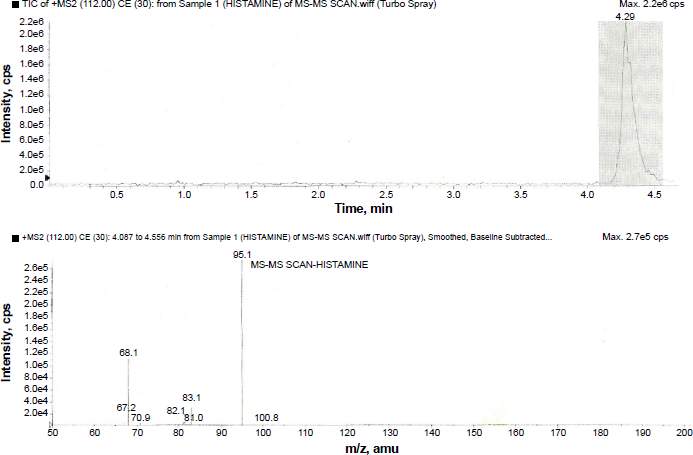
MS-MS-SCAN of histamine.
Discussion
Histamine H3 antagonists have been investigated on several dimensions of animal behaviors for antipsychotic-like activities, and preclinical studies have demonstrated antipsychotic-like effects with H3 antagonists, suggesting histamine H3 receptor antagonists to be a novel class of antipsychotic agents.15,22–27,32–40 However, studies reporting antipsychotic procognitive effects of H3 receptor antagonists/inverse agonists were mostly inconclusive and indirect, and failed to demonstrate appreciable clinical efficacy, eg ABT-288 and MK-0249, in psychosis.36,37
Administration of MK-801 in rats produced schizophrenia-like behaviors as observed from the increase of horizontal activity and total movements in rats. The potent and selective H3 receptor agonist, RAMH, antagonized most of the pharmacological effects observed with H3 antagonists. Mimicking the whole of the human psychotic behaviors in animal models of schizophrenia have posed challenges, particularly the negative symptoms of schizophrenia as its pathophysiology remains less well understood compared to the positive symptoms of the schizophrenia. Furthermore, most of the psychiatric disorders are very heterogeneous in nature and have diverse causality leading to a similar disease symptomatology allowing a syndromic diagnosis. Psychotic symptoms, such as hallucinations, obsessions, delusions, and guilt, are some of the unique symptoms of schizophrenia occurring in human, which can only be inferred with significant limitations in animal models. 37 Therefore, there continues to be lack of novel antipsychotic agents for a complete remission of schizophrenic symptoms. We selected MK-801-induced hyperlocomotion for studying the efficacy of the subchronic dosing of CPX/CBP for this study as evidence suggests existence of a functional interaction between glutamate and dopamine systems, 41 which has been linked to schizophrenia pathophysiology, and the MK-801-induced behavioral activation represents a valid model for detecting potential therapeutic agents having antischizophrenic activities. 42
In our previous study, we reported pharmacological-induced models with relevance to schizophrenia with acute administration of H3 receptor antagonists CPX and CBP 22 The finding of the present study with subchronic administration of CPX and CBP did not yield much difference, suggesting that the sensitivity of MK-801-induced hyperlocomotion to detect antipsychotic-like activity is comparable regardless of the acute or subchronic administration of the histamine H3 antagonists.
In the present study, we noted a decrease in the MK-801-induced hyperlocomotor response in the open field in rats pretreated with the subchronic doses of CPX (3.0 mg/kg) and CBP (15 mg/kg). It has been reported that NMDA antagonists, including PCP, ketamine, and MK-801, increase the dopamine metabolism and release in several brain regions in rodents.43,44 In addition, in the present study, we also observed an increase in dopamine level in the striatum of mouse treated with MK-801, leading to hyperlocomotor responses. 45 In contradiction with the finding of our study, in 1991, Liljequist et al, reported that “there was an increase in the rate of disappearance of dopamine by the administration of MK-801, 0.2 mg/kg i.p., in the striatum and in the limbic forebrain of mice, whereas the rate of disappearance of noradrenaline remained unchanged in the limbic forebrain and in the hippocampus”. 8 The authors concluded that there might be facilitation of the dopaminergic mechanisms by MK-801 through an indirect (perhaps by reducing glutamatergic activity) rather than a direct effect on dopamine neurons. However, later studies supported the finding of our study showing increased dopamine release in the striatum. In 1996, in an in vivo microdialysis study, Miller and Abercrombie reported that MK-801 (0.2 or 0.5 mg/kg, i.p.) significantly increased spontaneous dopamine release in the striatum, whereas treatment with vehicle elicited no change. 46 The increase in striatal dopamine by MK-801 could be a result of the disinhibition of a tonic inhibitory influence of NMDA receptor producing increased neuronal firing of dopamine in substantia nigra pars compacta, and increased neuronal firing of dopamine in the midbrain. 46 In the same year, Mathe et al reported that administration of MK-801 at 0.1 and 0.3 mg/kg, subcutaneously, significantly increased dopamine levels and its metabolites in the nucleus accumbens of freely moving rats. 47 Histamine H3 receptors are reported to colocalize in different neuronal populations and controls striatal dopaminergic and glutamatergic transmission. 32 Acute application of H3 antagonists has been reported to increase the dopamine release in the prefrontal cortex (PFC) and accumbens, but do not affect dopamine levels in the striatum. 48 52 However, the present study showed that CPX/CBP application reduced the MK-801-induced dopamine release. It is known that increased dopaminergic tone in PFC results in negative symptoms and cognitive deficits in schizophrenia. It may be assumed that subchronic dosing of CPX/CBP increased the dopamine release in PFC and at the same time reduced dopamine in the striatum indicating that H3 antagonists may be effective in negative symptoms and cognitive deficits of schizophrenia. It was further reported that MK-801-induced modulation of locomotor activity and stereotyped behavior could be abolished or diminished by the depletion of dopamine from neuronal stores or by the pretreatment with reserpine, α-methyl-p-tyrosine, and administration of dopamine receptor antagonists, indicating that the major behavioral effects of MK-801 were dopamine dependent. 53 In a study, increased extracellular concentrations of dopamine including norepinephrine and serotonin were reported in the nucleus accumbens following systemic treatment of MK-801. 54 In another study, increased extracellular level of dopamine, and other neurotransmitter such as GABA, glutamate, serotonin, and acetylcholine were reported in the frontal area of rats and monkeys following systemic treatment with PCP.1,54,55 Attenuation of the locomotor hyperactivity in rats, pretreated with subchronic doses of CPX/CBP, not only results from the blockade of dopamine receptor but also occurs through a complex interplay of several neurotransmitters including histamine, GABA, and glutamate in the brain leading to the inhibition of locomotor hyperactivity. 55 57 It has been reported that TMN projections in PFC but not in striatum express H3 autoreceptors, 57 and the application of CPX/CBP might differentially regulate the mesocortical, mesolimbic, and nigrostriatal dopamine pathways. 55 This may presumably be as a result of the increased release of histamine by H3 neurons resulting from the blockade of H3 autoreceptors. The present study has limitations that we did not study whether the application of CPX/CBP further influences the dopamine levels in nucleus accumbens or PFC in the presence of MK-801, and also this was just a minor study. Therefore, we propose further study which may highlight these mechanistic processes involving the effect of CPX/CBP on dopamine in the nucleus accumbens or PFC in the presence of MK-801. Histamine H3 receptors are present as a heteroreceptor on nonhistaminergic neurons and their activation has been reported to inhibit the synthesis and release of key neurotransmitters, including dopamine, norepinephrine, GABA, and acetylcholine, 32 and also histaminergic neuron expresses functional NMDARs. 56 The involvement of PFC in schizophrenia has been well studied. 58 Molina and colleagues reported the disruption of a synchronized action potential firing in the PFC of rat by the acute blockade of NMDAR. 59 One of the explanation of the efficacy of CPX and CBP in schizophrenia may be the facilitation of the synchronized firing of action potential in rat PFC. We noted an increase in the hypothalamic histamine level in rats treated with MK-801, and the subchronic dosing of CPX/d CBP tended to further raise the level of histamine in the hypothalamus in rats. Administration of MK-801 has been reported to increase the histamine turnover as indicated by the increase of histamine metabolite, tele-methylhistamine (t-MeHA), a biomarker of histamine turnover, in the cerebral cortex, striatum, hippocampus, and hypothalamus. 56 A recent report showed that the perfusion of the TMN with H3 receptor antagonist, ABT-239, increased histamine release from TMN, nucleus bacillus magnocellularis, and cortex, but not from the striatum or nucleus accumbens. 60 Intrahypothalamic perfusion of the histamine H3 receptor agonist, immepip, and the histamine H3 receptor antagonist, CBP, has been shown to decrease and increase in vivo histamine release from the anterior hypothalamic area. 61 Acute injections of NNC 38–1049, a selective histamine H3 antagonist, intraperitoneally were reported to significantly increase extracellular histamine concentrations in the hypothalamus. 62 Increase in the histamine neuron activity and lowering of psychotic symptoms by CPX may be up to some extent because of action at H3 autoreceptors, presynaptically. It was suggested that histaminergic neurons are not directly involved in the mechanisms producing psychotic symptoms but inhibit them in a compensatory manner. Such a compensatory mechanism would cause histamine neuron hyperactivity induced by psychotogenic drugs including NMDA-receptor antagonists. Drugs that enhance histamine neuron activity and display antipsychotic-like properties, such as H3 antagonists/inverse agonists and atypical neuroleptics, would facilitate the release of histamine in a compensatory manner.56,63 A convincing explanation still cannot be provided as to what caused the further release of histamine in the hypothalamus, and therefore, this study leaves scope for further study exploring this unresolved issue.
In 1990, Tiedtke and coworkers reported a study comparing typical and atypical antipsychotic drugs on MK-801-induced stereotypy in rats. They report that both typical and atypical antipsychotic drugs decrease stereotypy, but the typical ones exhibit greater reduction in stereotypy. This study indicated that some of the effectiveness of antipsychotic drugs may be mediated by an indirect effect at the NMDAR. 64 In the present study, CPX/CBP attenuated MK-801-induced increase in locomotor activity and changes in dopamine/histamine levels nearly similar to CLZ and better than CPZ. Furthermore, the finding of our study was concordant with the report that typical antipsychotic agents decrease histamine neuron activity, whereas atypical antipsychotic agents enhance histamine neurons. 65 Activities of CLZ have been attributed to H3 receptor antagonistic activity, 66 indicating that H3 receptor antagonists may possess some antipsychotic-like activities. However, the antipsychotic-like activities of histamine H3 antagonists have yet to be convincingly demonstrated, given conflicting preclinical and clinical findings.
In conclusion, the subchronic dosing of CPX/CBP suggests some antipsychotic-like activities as H3 antagonists, CPX/CBP, counteract the modulatory effects of MK-801 on dopamine and histamine levels and prevent MK-801-induced hyperlocomotor behaviors. However, further studies are warranted to study the precise role of CPX/CBP in animal models of schizophrenia using advanced research tools.
Author Contributions
Conceived and designed the experiments: DM, MA, KKP, and RK. Analyzed the data: DM, MA, and DG. Wrote the first draft of the manuscript: DM. Contributed to the writing of the manuscript: DM and KJ. Agree with manuscript results and conclusions: MA and KKP. Jointly developed the structure and arguments for the paper: DM and MA. Made critical revisions and approved final version: DM and MA. All authors reviewed and approved of the final manuscript.