






Abstract
The effect of exposure of male mice to a horizontal running wheel (Fast-Trac™) on conditioned place preference (CPP) and hyperlocomotion induced by methamphetamine (METH) was determined. In the first experiment eleven-week-old male ICR mice were divided into three groups and exposed to three different environments (housed individually with (group A) or without a running wheel (group B), or housed in a group of eight mice without a running wheel (group C)) for two weeks except during periods of CPP conditioning and testing procedures. Administration of METH (0.5 mg/kg, i.p.) every other day during three conditioning sessions, with saline conditioning sessions in the other compartment on alternate days (ie, saline/METH conditioning), induced a significant CPP, compared to saline/saline conditioning, in mice of groups A and C, but not B. The increased CPP for METH was significantly attenuated by additional 5-day (drug-free)-exposure to a running wheel in mice of group A (but not group C). In the second experiment, pre-exposure of another set of mice to a running wheel for three days did not affect a subsequent METH (1.0 mg/kg)- or saline-induced horizontal locomotion or rearing, compared with the locomotor activities observed in mice without an experience of a running wheel. These observations suggest that experience of a running wheel may selectively facilitate an attenuation of drug-seeking behavior.
Introduction
Methamphetamine (METH) is a major health problem worldwide, both in terms of addiction and adverse events associated with its use, but there remain no effective pharmacotherapies for treating METH abuse.1,2 The reinforcing properties of psychostimulants lead to drug seeking behavior that dominates the behavior of addicts. This behavior has been modeled in rodents using the conditioned place preference (CPP) paradigm that has been specially suggested to model drug seeking.3,4 The psychomotor stimulant and reinforcing effects of METH are considered to model aspects of METH abuse in humans.5,6 As the CPP paradigm may measure drug seeking behavior, it may be an effective paradigm to valuate medications for the treatment for METH abuse in humans.
We have shown that METH at a dose as low as 0.5 mg/kg (i.p.) causes a significant increase in CPP in mice raised under normal (social, eight mice per cage) housing conditions compared to a saline conditioned control group housed under similar conditions. 7 9 Using this animal model we have examined whether the METH's rewarding properties could be attenuated by pharmacological agents such as clorgyline (a monoamine oxidase-A inhibitor), topiramate (an anticonvulsant) and isoliquilitigenin (a licorice flavonoid), but positive results have not been obtained 7 9 while clorgyline and isoliquilitigenin attenuate METH-induced hyperlocomotion8,10 and topiramate is suggested to be effective for the treatment of cocaine dependence. 11 Aerobic exercise attenuates the reinforcing effects of cocaine in rats housed individually in a self-administration paradigm. 12 14 The effect of aerobic exercise on rewarding properties of METH has not been examined.
In the present study, mice were divided into three groups and were exposed to three different environments for two weeks beginning just prior to conditioned place preference testing: housed individually with (group A) or without a running wheel (group B), or housed in a group of eight mice without a running wheel (group C). On days 3–8 after housing the mice were exposed to METH (or saline) conditioning for CPP testing. Using this animal model we investigated the effect of exposure of mice to a running wheel, a form of aerobic exercise which is itself reinforcing, 15 18 on the development and extinction of METH-induced CPP.
Materials and Methods
Subjects
Male ICR mice (10 weeks old; Japan SLC, Shizuoka, Japan) were housed in groups of six (cage size: 37 × 22 × 15 cm; with fresh wood chips), in a temperature- (22°C ± 2°C) and humidity-controlled environment (50% ± 10%), under a 12 h light/dark cycle (lights on at 07:00) with food and water available ad libitum. Animal handling and care were conducted in accordance with the Guide for the Care and Use of Laboratory Animals (7th edition, Institute of Laboratory Animal Resources-National Research Council, National Academy Press, 1996), and all experiments were reviewed and approved by the Institutional Animal Research Committee of Hyogo College of Medicine. The mice were only used once (body weight on day 1: 38–48 g, n = 76 total) after one-week habituation in the facility.
Reagents
METH HCl was purchased from Dainippon Sumi-tomo Pharma Co., Ltd. (Osaka, Japan) and was dissolved in sterile saline (Otsuka Pharmaceutical Co., Ltd., Tokushima, Japan) and administered intraperitoneally (i.p.; injection volume: 0.1 mL/10 g). The dose of METH refers to the weight of the salt.
Test Protocol
Experiment 1: The effects of a running wheel on METH-induced CPP
Schedule of drug administration for experiment 1.
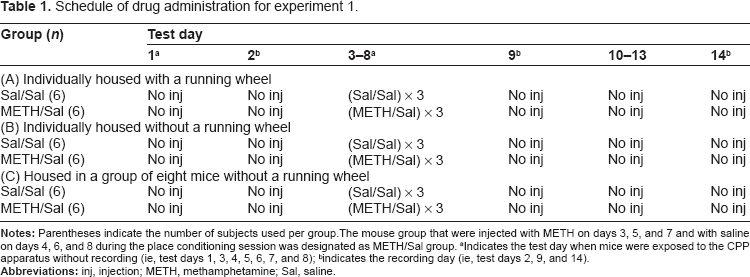
Notes: Parentheses indicate the number of subjects used per group. The mouse group that were injected with METH on days 3, 5, and 7 and with saline on days 4, 6, and 8 during the place conditioning session was designated as METH/Sal group.
Indicates the test day when mice were exposed to the CPP apparatus without recording (ie, test days 1, 3, 4, 5, 6, 7, and 8);
indicates the recording day (ie, test days 2, 9, and 14).
Abbreviations: inj, injection; METH, methamphetamine; Sal, saline.
On day 1, mice (n = 36) were weighed, randomly divided into three groups that were exposed to different housing conditions: individual housing with (group A, n = 12) or without a running wheel (group B, n = 12), or in a group of eight mice without a running wheel (group C, n = 12). Mice were exposed to the CPP boxes for habituation without any injection on days 1 and 2 with free access to the two compartments for 10 min, and then returned to their home cages. On day 2, preconditioning time in each compartment was collected, and the compartment in which the mouse stayed for a shorter time (the non-preferred compartment) was defined as the conditioning compartment. The mice of each housing group were divided into 2 conditioning groups (METH/Saline and Saline/Saline conditioning groups; n = 6 per group) equally to balance black/white compartment preference between groups. On days 3, 5 and 7, mice were injected with saline or 0.5 mg/kg METH (i.p.) and placed into the conditioning compartment (determined on day 2) for 20 min. On days 4, 6 and 8, all mice were injected (i.p.) with saline and placed into compartment oppo-site to the conditioning compartment for 20 min. On day 9 (post-conditioning), all mice were placed into the apparatus and allowed free access to the two compartments for 10 min. The difference in the time spent in the conditioning compartment between the post-conditioning (day 9) and pre-conditioning (day 2) sessions was analyzed for each treatment. On day 14 (after a 5-day drug-free period), the mice were placed into the apparatus and again allowed free access to both compartments for 10 min. The difference in the time spent in the conditioning compartment between the post-conditioning (day 14) and pre-conditioning (day 2) sessions was analyzed for each treatment. The experimental room was kept quiet, and all experiments were conducted between 8:30–12:00 h. All compartments were cleaned with 10% ethanol and wiped dry between sessions for each animal.
Experiment 2: The effects of a running wheel on METH- or saline-induced locomotion and rearing
Locomotor activity and rearing were measured according to the schedule shown in Table 2. On day 1 mice (n = 40) were randomly divided into two groups and were housed in two different environments (ie, individual with (n = 20) or without a running wheel (n = 20)). On day 4 the mice of each group were weighed and divided further into 2 drug treatment groups (single 1.0 mg/kg METH or saline injection group; n = 10 per group). Mice were injected with saline or 1.0 mg/kg METH and immediately placed individually into a locomotor testing apparatus described previously. 19 Briefly, the mice were placed in a transparent acrylic box (37× 24 × 27 cm) with an infrared sensor (Supermex®; Muromachi Kikai Co., Ltd., Tokyo, Japan) that detects thermal radiation from animals (to determine horizontal locomotion) and a beam sensor (to determine rearing; 24 cm wide, equipped at 7 cm height; Muromachi Kikai Co., Ltd.) in a quiet, ventilated chamber (53 × 45 × 45 cm) under an illumination of 130 lux.
Schedule of drug administration for experiment 2.
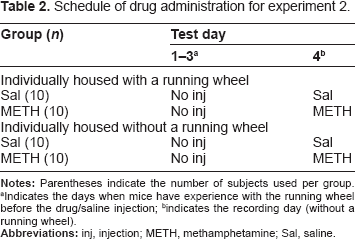
Notes: Parentheses indicate the number of subjects used per group.
indicates the days when mice have experience with the running wheel before the drug/saline injection;
indicates the recording day (without a running wheel).
Abbreviations: inj, injection; METH, methamphetamine; Sal, saline.
Statistics
Data are presented as mean ± the standard error of the mean (SEM). Statistical analysis was performed using mixed factor analysis of variance (ANOVA), with or without repeated measures as appropriate, followed by Bonferroni-Dunn post hoc analysis individual means for significant factors test (Statview 5.0 for Apple Macintosh, SAS Institute, Inc., Cary, NC, USA). Statistical significance was set at P < 0.05.
Results
Experiment 1: The effects of a running wheel on METH-induced CPP
Mice (n = 36) were randomly divided into three groups (A, B and C), and were exposed to three different environments (ie, housed individually with (group A, n = 12) or without a running wheel (group B, n = 12), or housed in a group of eight mice without a running wheel (group C, n = 12)).
Figure 1 shows the CPP for METH and the effects of a running wheel on CPP in mice, conducted according to the schedule shown in Table 1 (also see Experiment 1: The effects of a running wheel on METH-induced CPP). As shown in Figure 1A, on day 9 significant increases in the CPP were found in mice treated with METH, compared to control mice treated with saline (main conditioning effect, F(1,10) = 21.2, P < 0.0001). METH CPP did not differ between the housing groups (main group effect F(2,15) = 0.4, P = 0.69), indicating that there were no significant differences in the CPP scores for the saline/saline-conditioning group or saline/METH conditioning group. ANOVA also indicated no significant conditioning × group interaction (F(2,30) = 1.5, P = 0.24). Post-hoc comparisons of the significant drug effect found that CPP was significantly increased in mice treated with METH compared with the control mice treated with saline for housing groups A (ie, raised individually with a running wheel) (P < 0.05) and C (ie, raised in group of eight mice without a running wheel) (P < 0.05), but not B (ie, raised individually without a running wheel).
conditioned place preference (CPP) in mice for methamphetamine (METH) and the effect of 5-day-exposure to a running wheel. Place preference (ie, CPP score) was measured as the difference in the time spent in the compartment associated with saline (open column) or METH (0.5 mg/kg, i.p.) (closed column) between post-conditioning day 9 and pre-conditioning day 2 (
As shown in Figure 1B, on day 14 after a second exposure to the apparatus in the absence of METH the CPP had largely extinguished compared to the CPP observed on day 9 (main conditioning effect, F(2,10) = 0.35, P = 0.07; main group effect, F(2,15) = 0.3, P = 0.73). There was no significant conditioning × group interaction (F(2,30) = 0.9, P = 0.44). Therefore, there were no significant differences in the CPP scores for the saline/saline-conditioning group or saline/METH conditioning group. Extinction of CPP is readily apparent in the differences between CPP scores observed on days 14 and 9 shown in Figure 1C. METH-induced CPP scores were lower, as demonstrated by a main effect of conditioning group in the ANOVA (main conditioning effect, F(1,10) = 6.2, P < 0.05), but there was no overall significant group effect (F(2,15) = 1.2, P = 0.32), nor a significant conditioning × group interaction (F(2,30) = 1.0, P = 0.37). Nonetheless, as is obvious in Figure 1C, the decrease in the CPP score observed from day 9 to day 14 (ie, ΔCPP score) was much greater in mice of group A than the other two groups. Although it would be expected that this would be the case of group B, which did not show a significant CPP on day 9, group C also had reduced extinction. Thus post-hoc comparisons of the significant effect of conditioning group, found a significant difference in the reduction of CPP between days 9 and 14 in mice treated with METH compared with the saline control mice for group A (P < 0.05), but for groups B or C.
Experiment 2: The effects of a running wheel on METH- or saline-induced locomotion and rearing
Mice (n = 40) were randomly divided into two groups and were exposed to two different environments (ie, raised individually with (n = 20) or without a running wheel (n = 20) and housed for 3 days without injection. Figure 2 shows the time course of horizontal locomotion and rearing observed in mice immediately after a single injection (i.p.) of METH (1.0 mg/kg) or saline, according to the schedule shown in Table 2 (also see Experiment 2: The effects of a running wheel on METH- or saline-induced locomotion and rearing). In summary, pre-exposure of mice to a running wheel for 3 days did not affect subsequent horizontal locomotion (Fig. 2A) or vertical rearing (Fig. 2B) after vehicle injection or after a single METH challenge.
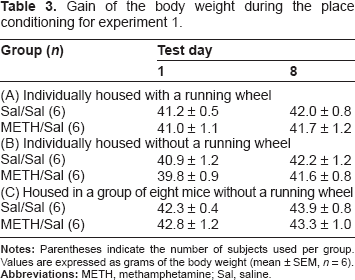
Effect of three-day-exposure to a running wheel on horizontal locomotion ( Gain of the body weight during the place conditioning for experiment 1. Notes: Parentheses indicate the number of subjects used per group. Values are expressed as grams of the body weight (mean ± SEM, n = 6). Abbreviations: METH, methamphetamine; Sal, saline.
Three-way repeated-measure ANOVA (Exposure to a running wheel × METH challenge × Time) applied to data shown in Figure 2A found significant main effects of METH challenge (F(1,36) = 89.9, P < 0.0001) and Time (F(17,648) = 58.8, P < 0.0001), but no significant main effect of Exposure to a running wheel (F(1,36) = 1.9, P = 0.17). This analysis also found a significant METH challenge × Time interaction (F(17,648) = 6.9, P < 0.0001), but no significant Exposure to a running wheel × Time (F(17,648) = 0.6, P = 0.92), Exposure to a running wheel × METH challenge (F(1,36) = 1.2, P = 0.28), or Exposure to a running wheel × METH challenge × Time interactions (F(17,648) = 0.4, P = 0.99).
Similarly, three-way repeated-measure ANOVA (Exposure to a running wheel × METH challenge × Time) applied to data shown in Figure 2B found significant main effects of METH challenge (F(1,36) = 40.6, P < 0.0001) and Time (F(17,648) = 31.6, P < 0.0001), but no significant main effect of Exposure to a running wheel (F(1,36) = 0.001, P = 0.97). This analysis also found a significant METH challenge × Time interaction (F(17,648) = 5.8, P < 0.0001), but no significant Exposure to a running wheel × Time (F(17,648) = 0.4, P = 0.98), Exposure to a running wheel × METH challenge (F(1,36) = 0.3, P = 0.62), or Exposure to a running wheel × METH challenge × Time interactions (F(17,648) = 0.2, P = 0.999).
Discussion
In the first experiment differences in METH CPP were found to result from differences in housing. In groups without a running wheel, those that were socially housed demonstrated a significant CPP (Fig. 1A, group C), while those that were isolated (individually housed) did not (Fig. 1A, group B). However, for individually housed mice, the addiction of a running wheel resulted in a significant METH CPP (Fig. 1A, group A). Repeated exposure to the testing apparatus a second time after an intervening 5-day drug-free period during which the running wheel was present for group A, but not groups B or C, resulted in extinction of METH-induced CPP in group A (Fig. 1C). Thus, although isolation appeared to impair METH-CPP, this effect was reinstated by the presence of a running wheel, and the experience appeared to enhance extinction compared to the socially housed mice (without a running wheel). These effects appeared to be limited to the reinforcing effects of METH. In the second experiment pre-exposure of another set of mice to a running wheel for 3 days did not affect either basal (saline) or METH-stimulated horizontal locomotion or vertical rearing (Fig. 2).
There might be several ways to interpret these effects. Natural reinforcers including aerobic exercise (ie, a running wheel) and social interaction (ie, group housing) may increase sensitivity to reinforcers. However, social interaction is not necessarily always a positive experience and certainly could produce aversive consequences as well as positive ones. Another consequence of exposure to natural rein-forces could be to accelerate the extinction of METH-induced conditioning in mice, although in that case one would have to suppose, based on the present data that aerobic exercise was more reinforcing than social interaction. Although this is the first report describing that experience with a running wheel selectively facilitates METH CPP, as well as extinction of METH CPP, the data are similar to reports that examined cocaine.12–14,20 In each of these experiments a running wheel decreased responding for cocaine reinforcement under low reinforcement conditions (eg, during the progress of a progressive ratio, extinction testing or reinstatement trials in which no primary rein-forcer was received). Although the situations are each slightly different, they all involve, to some degree or another, reduced responding over the course of the testing to lack of reinforcement, or progressively sparse reinforcement.
Both social isolation and environmental enrichment have been suggested to affect the rewarding effects of amphetamines, cocaine and other stimulants (for review of the effects of social isolation, 21 and for those of environmental enrichment 22 ). Isolation rearing produces a large leftward shift in the dose-response curve for cocaine self-administration such that acquisition of cocaine self-administration can be either increased or decreased depending, in part, upon the training dose used during acquisition.23,24 Although environmental enrichment has also been suggested to enhance some responses to amphetamine,25,26 it reduces a number of other effects including locomotor sensitization, intravenous self-administration and reinstatement, 27 29 and, importantly in the present context enhances extinction. 29 The effects of methamphetamine have not been examined after social isolation, but they were not found to be affected by environmental enrichment, 30 although it is important to note that the comparison here was between socially housed mice and socially housed mice in an enriched environment. In the present experiment, it appears that wheel- running has effects upon isolation-induced changes in responses to METH: the effects of wheel running in socially housed animals were not examined. It must be noted, however that in the studies discussed above social isolation and environmental enrichment were experiences for much longer periods of time, and at earlier ages, than in the present studies in which both the social isolation and enrichment, if wheel access is viewed in this manner, are experienced for much shorter periods of time. As noted by Hall 21 social isolation at different ages affects different types of social interaction, depending on the prevalent type of social interaction at that age, and has different consequences. Thus, it would appear that neural mechanisms responsible for establishing METH's rewarding properties may be suppressed by the individually housing condition in mice (ie, social isolation), even after a short period. However, this conclusion much be tentative until a fuller dose- response relationship is established as discussed above for the studies of isolation-rearing on cocaine self-administration.23,24
Another way to interpret the present findings would be that social isolation induces a depressive like state that is reversed by environmental enrichment (eg, wheel running). Such opposing effects of both social isolation (pro-depressive) and environmental enrichment (anti-depressive) have been identified.31,32 Although the environmental manipulations in these studies were both early and chronic, the effects of social isolation on models of depression may not require either early or chronic social isolation. 21 Thus, in the present experiments, social isolation may reduce responses to the reinforcing stimulus (anhedonia) that is reversed by enrichment (wheel running), resulting in reduced CPP for METH in group B which was individually housed without a running wheel for 14 days (Table 1) compared to group C, socially housed without a running wheel, and group A, isolation housed with a running wheel.
Finally, there is a possibility that housing conditions might affect metabolism of METH, resulting in the results of the present study. It is possible that group-housing or wheel-running could affect metabolism of METH, and therefore, some of the observed effects are due to the different effective dose of the drug or time of its action. This mechanism should not affect extinction from CPP, and the second experiment showing lack of effect of wheel running on locomotor effects of METH suggests that wheel running does not strongly affect levels of METH. However, it does not exclude that the effects of group-housing are through effects on metabolism or that the effects on METH-induced locomotor activation are not visible because the dose used in this experiment is higher and could be less susceptible to metabolic effects.
Interestingly, experience of a running wheel did not affect a subsequent saline- and METH-induced locomotion in mice (Fig. 2), suggesting that spontaneous locomotion and hyperlocomotion produced by the METH injection may be unaffected by the experience with a running wheel, whether the consequences are the result of increased aerobic exercise or “enrichment”, and that this manipulation may selectively facilitate an attenuation of drug-seeking behavior. Although supported by the data, this hypothesis requires fuller exploration, in terms of METH doses, duration of isolation and duration of wheel running. Nonetheless, as there are no effective medications for METH abuse,1,2 the present data would suggest that non-drug-associated, reinforcing activities such as aerobic exercise may be beneficial in the treatment of METH abuse.
Author Contributions
Conceived and designed the experiments: NK, JK, FSH, GRU, KW, HK, HT, TM. Analysed the data: NK, JK, FSH, KW, MT. Wrote the first draft of the manuscript: NK, JK, FSH, GRU, KW, HK, HT, MT. Contributed to the writing of the manuscript: NK, JK, FSH, GRU, KW, HK, HT, MT. Agree with manuscript results and conclusions: NK, JK, FSH, GRU, KW, HK, HT, MT. Jointly developed the structure and arguments for the paper: NK, JK, FSH, GRU, KW, HK, HT, MT. Made critical revisions and approved final version: NK, JK, FSH, GRU, KW, HK, HT, MT. All authors reviewed and approved of the final manuscript.
Funding
This research was supported, in part, by a Grant-in-Aid for Young Scientists (B) from the Ministry of Education, Culture, Sports, Science and Technology of Japan (No. 21790254 to NK), a Grant-in-Aid for Researchers, Hyogo College of Medicine (2011 to NK), and intramural funding from the National Institute on Drug Abuse, USA (GRU and FSH).
Competing Interests
Author(s) disclose no potential conflicts of interest.
Disclosures and Ethics
As a requirement of publication author(s) have provided to the publisher signed confirmation of compliance with legal and ethical obligations including but not limited to the following: authorship and contributorship, conflicts of interest, privacy and confidentiality and (where applicable) protection of human and animal research subjects. The authors have read and confirmed their agreement with the ICMJE authorship and conflict of interest criteria. The authors have also confirmed that this article is unique and not under consideration or published in any other publication, and that they have permission from rights holders to reproduce any copyrighted material. Any disclosures are made in this section. The external blind peer reviewers report no conflicts of interest.
Footnotes
Acknowledgments
The authors are grateful to Ms. A. Yoshioka of the Department of Pharmacology, Hyogo College of Medicine, for preparing the animal study proposal.