






Abstract
Aim
To assess serum Cu/Zn SOD (Superoxide Dismutase) concentration in children with ADHD and evaluate its possible relationship to Cu and Zn levels.
Subjects and methods
Serum from 22 children with ADHD and 20 healthy control children without ADHD and 19 autistic children without ADHD were tested for Cu/Zn SOD using ELISAs and levels of serum Cu and Zn using inductively-coupled plasma-mass spectrometry.
Results
Serum Cu/Zn SOD levels of ADHD children were significantly lower than age and gender matched healthy non-ADHD controls (
Discussion
These results suggest an association between Cu/Zn SOD serum levels and ADHD, particularly ADHD children with high serum copper.
Introduction
Attention deficit hyperactivity disorder (ADHD) is one of the most common childhood disorders and can continue through adolescence and adulthood. Symptoms include difficulty staying focused and paying attention, difficulty controlling behavior, and hyperactivity. 1
Molecular, genetic and pharmacological studies suggest the involvement of the dopaminergic, serotonergic and noradrenergic neurotransmitter systems in the pathogenesis of ADHD, and polymorphic variants in several genes involved in regulation of the dopamine, and related neurotransmitter pathways are reported to be associated with the disease.2–4
There are few studies evaluating the biochemical basis of ADHD. However, in 2008, Selek et al 5 found that adults with ADHD had high levels of the oxidant nitrous oxide, and low super oxide dismutase activities, suggesting an oxidative imbalance.
Copper, and zinc participate in SOD enzymatic mechanisms that protect against free radicals ad therefore serve an important adjunct role in oxidative balance. 12
Cu appears to have many important functional roles in the body that apparently relate to, among others, the maintenance of immune function, bone health and haemostasis. 9 The element is needed in trace amounts, but excess is toxic. It increases lipid peroxidation and depletes glutathione reserves, which makes the organism more vulnerable to other oxidative challenges. 10
Zinc to copper ratio is abnormally low in individuals with other disorders associated with hyperactivity, such as autism 13 and in boys with oppositional defiant disorder. 14 Low zinc may be associated with ADHD individuals 16 and has been directly related to low Cu/Zn SOD concentration. 15
Our study was designed to determine Cu/Zn SOD serum levels, and the relationship between these levels and copper and zinc concentration, in ADHD individuals.
Materials and Methods
ELISA to Measure Serum CU/ZN SOD (Bender Systems)
All reagents and specimens were equilibrated to room temperature before the assay was performed. A 1:51 dilution of the patient samples was prepared by mixing 10 μl of the patient's sera with 0.5 ml of Serum Diluent. One hundred microliters of calibrators (.08-2.5 ng/ml Cu/Zn SOD), serum diluent alone, and diluted patient samples were added to the appropriate microwells of a microculture plate (each well contained affinity purified polyclonal IgG to Cu/Zn SOD). Wells were incubated for 60 minutes (±5 min) at room temperature, then washed 4x with wash buffer. One hundred microliters of pre-diluter anti-human Cu/Zn SOD IgG conjugated with HRP was added to all microwells, incubated for 30 minutes (±5 min) at room temperature, then washed 4x with wash buffer. One hundred microliters of enzyme substrate was added to each microwell. After approximately 30 minutes at room temperature, the reaction was stopped by adding 50 μl of 1M sulfuric acid, then the wells were read at 450 nm with an ELISA reader (BioRad Laboratories, Inc., Hercules, CA, USA).
Copper and Zinc Serum Concentration
Copper and zinc plasma concentration was performed by LabCorp, Inc. (NAPERVILLE, IL 60563) using inductively-coupled plasma-mass spectrometry.
Subjects
Experimental
Serum from ADHD individuals (n = 22) was obtained from patients presenting at the Health Research Institute/Pfeiffer Treatment Center. Most of these children (median age 10.2 years; 17 male) were diagnosed using Connor's Parent or Teacher scale before presenting at Pfeiffer, and had no known co-morbidities.
Controls
Serum and medical history of controls (n = 20) were obtained from the Autism Genetic Resource Exchange—AGRE. a Through analysis of an extensive medical history and parental questionnaire provided by AGRE, it was established that none of these individuals had family history of ADHD or any other similar behavioral disorders. The controls were age and gender matched to experimental group (media age 12.8 years; 18 males).
The Autism Genetic Resource Exchange (AGRE) is the first collaborative gene bank for the study of autism spectrum disorders and one of the world's largest shared resources for the study of autism and related disorders, with a collection of over 900 well-characterized multiplex and simplex families made available to the greater scientific community. Founded by Cure Autism Now (CAN) in 1997, AGRE is currently funded by the National Institute of Mental Health (NIMH) and Autism Speaks (AS), which merged with CAN in 2006.
Serums
Experimental (Pfeiffer Treatment Center b ) and control (AGRE) serums were all morning draws and then treated in an identical fashion—frozen at -70C immediately after collection and cell/serum separation, then stored at -70C until thawed for use in ELISAs or sent to LabCorp for Cu and Zn analysis.
The Pfeiffer Treatment Center is a comprehensive treatment and research center, specializing in the care of children with neurological disorders, including ADHD.
Statistics
Inferential statistics were derived from t-test and odds ratios with 95% confidence intervals. ANOVA analysis was used to do an analysis of variance and multiple comparisons.
Results
Serum from 22 ADHD children, and 20 non-ADHD age/gender matched controls and 19 non-ADHD autistic age/gender matched controls was tested for Cu/Zn SOD plasma concentration using an ELISA (described above). Each assay was repeated two or more times, with multiple wells for each serum in each assay.
Serum Cu/Zn SOD levels of ADHD children were significantly lower than all non-ADHD controls ( Shows the Significant Difference Between Cu/Zn SOD Serum Levels in ADHD Individuals, Compared to Normal Healthy Controls. Shows the Relationship Between Cu/Zn SOD and Cu, Zn and Cu/Zn Levels in ADHD Individuals (n = 20). Cu/Zn SOD Levels were Significantly Lower when Accompanied by High Cu ( Shows the Relationship Between Cu/Zn SOD and Cu, Zn and Cu/Zn Levels in Non-ADHD Controls (Autistic) (n = 19). Cu/Zn SOD Levels were not Significantly Different when Accompanied by High Cu (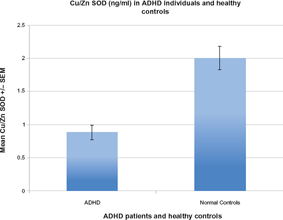


We did not find any significant difference between Cu/Zn SOD concentration and zinc levels or ratio of zinc to copper in experimental or control groups (Figs. 2 and 3).
Discussion
Oxidative stress has been implicated in the pathogenesis of a diverse group of disease states, and, because the brain has comparatively greater vulnerability to oxidative damage, may be a common pathogenic mechanism underlying many major psychiatric disorders.
A small number of studies have focused upon oxidative stress in humans with ADHD, demonstrating increased levels of 8-oxoguanine, 17 n-3 fatty acid oxidation, 18 urinary catecholamines, 19 glutathione, 20 and lower levels of long-chain polyunsaturated fatty acids. 21
Studies have also shown changes in antioxidant enzyme activities, particularly Cu/Zn SOD, following methylphenidate therapy. 22
Our preliminary data shows that ADHD individuals have significantly lower levels of serum Cu/Zn SOD and supports these previous findings.
Zinc and copper are essential trace elements and, as such, members of major subgroups of micronutrients that have attained prominence in human nutrition and health. Several studies have investigated the role of zinc in the etiology of ADHD and have suggested that zinc deficiency is associated with the pathophysiology of the disease.23– 25 Research has also demonstrated that zinc treatment may be efficacious for ADHD individuals. 26
Abnormal plasma levels of copper have also been found in hyperactive children. 27
This study suggests that high copper is associated with low Cu/Zn SOD levels in ADHD individuals. Recent studies have shown that ADHD individuals have lower dopamine activity in the caudate and limbic system, 31 as well as lower dopamine receptor levels in the midbrain and accumbens. 30 Since it has been suggested that high copper induces damage of dopaminergic neurons through destroying antioxidant defenses, such as lowering Cu/Zn SOD levels in rats,28, 29 we suggest that a similar mechanism may be involved in the etiology of ADHD.
Disclosure
This manuscript has been read and approved by the author. This paper is unique and is not under consideration by any other publication and has not been published elsewhere. The author and peer reviewers of this paper report no conflicts of interest. The author confirms that they have permission to reproduce any copyrighted material.