






Abstract
Three species of Mexican soft scales, Neolecanium leucaenae Cockerell, Toumeyella cerifera Ferris and T. sonorensis Cockerell and Parrott, are redescribed based on the adult females and are transferred to Neotoumeyella gen. nov. as N. leucaenae (Cockerell) comb. nov., N. cerifera (Ferris) comb. nov. and N. sonorensis (Cockerell and Parrott) comb. nov. Two new species, N. caliensis Kondo and Williams sp. nov. from Colombia and N. cephalanthi Kondo and Williams sp. nov. from the U.S.A, are described and illustrated based on the adult female. A key to the genera of New World Myzolecaniinae based on the adult female is provided. We designate lectotypes for N. leucaenae, T. cerifera and T. sonorensis.
The soft scales Neolecanium leucaenae Cockerell, Toumeyella cerifera Ferris and T. sonorensis Cockerell and Parrott fit into the Toumeyella-group as well as in the Myzolecaniinae, but the three species share some morphological features that differ from other taxa included in these groups (see diagnosis), thus, the new genus Neotoumeyella is here erected to accommodate the above three species plus two new species from the southeastern U.S.A and Colombia, South America.
The genera Neolecanium Parrot and Toumeyella Cockerell are currently included in the soft scale insect subfamily Myzolecaniinae (Hemiptera: Coccidae). The Myzolecaniinae was erected by Hodgson 1 to include species that lack a number of cuticular structures and have reduced appendages. Adult females of species in the subfamily are characterized by: (1) lack of dorsal tubular ducts and eyespots; (2) presence of anal plates with numerous setae on the dorsal surface; (3) particularly large spiracles, with broad bands of spiracular pores between the margin and spiracles; (4) ventral tubular ducts of one type, frequently restricted to each side of the genital opening; (5) bands of (often rather spinose) setae replacing the normal pairs of long prevulvar setae; (6) reduced legs with fine claw digitules; (7) reduced antennae; and (8) a short anal tube. 1 Hodgson 1 included 16 genera in the Myzolecaniinae: Akermes Cockerell, Alecanium Morrison, Alecanopsis Cockerell, Cribrolecanium Green, Cryptostigma Ferris, Cyclolecanium Morrison, Halococcus Takahashi, Houardia Marchal, Megasaissetia Cockerell, Myzolecanium Beccari, Neolecanium Parrott, Paractenochiton Takahashi, Pseudophilippia Cockerell, Richardiella Matile-Ferrero and Le Ruyet, Toumeyella Cockerell and Xenolecanium Takahashi. Later the Australian monotypic genus Torarchus Gullan and Stewart was added to the subfamily. 2 More recently, Kondo et al 3 suggested that Xenolecanium was a typical member of the tribe Paralecaniini of the subfamily Coccinae based on morphological features of the adult female and first-instar nymph.
Before Hodgson erected the Myzolecaniinae, Steinweden 4 postulated that species with reduced limbs formed a natural group, which he called the Toumeyella-group. Steinweden's 4 Toumeyella-group included Toumeyella, Neolecanium and Pseudophilippia. 5 The Toumeyella-group was defined mainly by the following features: (1) legs and antennae greatly reduced, but retaining their parts; (2) marginal and stigmatic setae small and inconspicuous or absent; (3) anal region with hypopygial setae; and (4) presence of quinquelocular pores in the perivulvar region. 5 Mesolecanium nigrofasciatum Pergande was later added to the Toumeyella-group, based on a morphological analysis of adult males.6,7 Hodgson 1 redescribed Mesolecanium nocturnum (Cockerel and Parrott), the type species of Mesolecanium, and thought that M. nigrofasciatum was not congeneric and that it might belong in his new subfamily Myzolecaniinae. According to Kondo and Williams, 8 the Toumeyella-group is composed of Akermes, Cyclolecanium, Megasaissetia, Neolecanium, Pseudophilippia and Toumeyella. Kondo and Williams 9 considered the genus Neolecanium to be a synonym of Toumeyella.
Kondo and Williams 8 pointed out differences between New World and Old World Myzolecaniinae and suggested that the subfamily is composed of several unrelated lineages. Members of the Myzolecaniinae are closely associated with ants that constantly tend, clean, protect and even transport them in exchange for honeydew. 1 The reduction and loss of many important features in the Myzolecaniinae may have resulted from multiple cases of parallel evolution in unrelated groups of coccids as a result of morphological adaptations to symbiotic associations with tending ants. 10
Solving the phylogenetic relationships of the Myzolecaniinae sensu Hodgson 1 was out of the scope of this study. Here we describe two new species in a new coccid genus in the Toumeyella-group and have tentatively included it in the Myzolecaniinae.
Materials and Methods
Slide-mounted specimens were examined under a compound microscope. In the descriptions, the body shape of the adult female is described both as unmounted and as mounted on a slide. “Unmounted” adult female refers to the insect's test, either alive or after preservation in alcohol. Body length and width of the adult female was measured in millimeters (mm) as mounted on the slide; other measurements are in microns (µm). Length was measured from the farthest point of the head to the posterior end of the body; width was the greatest width. The description of the adult female of the two new species is based on multiple slide-mounted specimens. The number of specimens studied for each description is represented as (n = number of specimens studied). The slide-mounting technique of Williams and Granara de Willink 11 was used. The material studied is represented by the number of slides and the number of specimens on each slide, e.g. 1(2) means 1 slide with 2 adult specimens. The growth stage and sex of the specimen is listed only for non-adult females. The depository in parentheses is given for each lot of material studied (see abbreviation of depositories below). Each drawing is a generalization of several specimens and was made with the assistance of a camera lucida attached to a Zeiss RA phase contrast compound microscope. A taxonomic key to the adult females of the coccid genera of Myzolecaniinae that occur in the New World was built based on characters of the adult female taken from published literature. Neolecanium was not included in the key as this genus is considered a synonym of Toumeyella. 9
Abbreviations for the depositories are as follows: The Auburn University Coccoidea Collection, Auburn, Alabama, U.S.A. (AUCC); the Bohart Museum of Entomology, Department of Entomology, University of California, Davis, California, USA (BME); the Natural History Museum, London, U.K. (BMNH); The National Museum of Natural History, Coccoidea Collection, Beltsville, Maryland, U.S.A. (USNM).
Taxonomy
Key to Genera of New World Myzolecaniinae Based on Adult females
(Characters taken from Hamon and Williams; 12 Hodgson; 1 Kondo and Williams; 10 Kondo et al 13 )
Anal plates located submedially; anterior spiracular pore band incomplete, not extending to margin, posterior spiracular pore band extending to margin; marginal setae cylindrical, peg-like Cyclolecanium Morrison – Anal plates not located submedially, usually found at about 1/5 of body length from posterior margin; anterior spiracular pore band complete, extending to margin or extending as far as posterior spiracular pore band; marginal setae variable, not peg-like 2
Stigmatic clefts deep; dorsal sclerotized plates associated with each spiracle Cryptostigma Ferris – Stigmatic clefts shallow or absent, or rarely deep; without dorsal sclerotized plates associated with each spiracle 3
Dorsal microducts around body margin conspicuously larger than rest of microducts on dorsum Octolecanium Kondo – Dorsal microducts around body margin not conspicuously larger than rest of microducts on dorsum 4
Large bilocular pores (probably macroducts), present in 1 or 2 small groups anterior to anal plates; marginal setae slender, sharply spinose, with tips mostly pointed, but some with lanceolate, or bifurcate apex, arranged in 1 or 2 rows, numerous (distance between each marginal seta less than half the length of a seta) Aztecalecanium Kondo and Williams – Groups of large bilocular pores or macroducts absent from area anterior to anal plates; marginal setae variable, arranged in 1 row, not as numerous (distance between each marginal seta more than the length of a seta 5
Discoidal pores absent; dorsum with dense pattern of invaginated bilocular microducts; stigmatic setae absent Pseudophilippia Cockerell – Discoidal pores present; dorsal microducts variable, generally without dense pattern of invaginated bilocular microducts; stigmatic setae present, rarely absent 6
Ventral tubular ducts absent Akermes Cockerell – Ventral tubular ducts present at least around perivulvar area 7
Ventral tubular ducts present at least in a submarginal band on abdominal region and reaching area around posterior spiracular pore band Neotoumeyella Kondo and Williams – Ventral tubular ducts not distributed as above 8
Ventral tubular ducts located around vulva and mediolaterally on abdomen; dorsal setae lanceolate; stigmatic clefts deep Megasaissetia Cockerell – Ventral tubular ducts located around vulva and often also on posterior abdominal segments, but absent mediolaterally on abdomen; dorsal setae generally sharply spinose, rarely lanceolate; stigmatic clefts shallow or absent Toumeyella Cockerell
Neotoumeyella, New Genus
Type species
Neolecanium leucaenae Cockerell, 1903. 14
Generic Description, Adult female
Body of adult female convex to globular, often irregular in outline, with a thin glassy test, or covered with a dull white waxy secretion. At least one species reported to produce an ovisac.

A) Neotoumeyella caliensis Kondo and Williams, adult female (center) and 3 nymphs (top right) in life. B) Neotoumeyella cephalanthi Kondo and Williams, adult female (center) and second-instar nymph (top left) in life. Photographs by T. Kondo.
Key to Species of Adult Females of Neotoumeyella, Gen. nov
Ventral tubular ducts of one type, scarce 2 – Ventral tubular ducts of more than one type, abundant 4
Ventral tubular ducts present around mouthparts and often antennae. Spiracular pore band broadening just before stigmatic areas (up to 30 pores wide). Anal ring with 6 setae. N. sonorensis, comb. nov. – Ventral tubular ducts not present around mouthparts and antennae. Spiracular pore band narrow throughout (2–6 pores wide) Anal ring with 10–12 setae 3
Multilocular pores abundant in mid-ventral region of mesothorax. Stigmatic setae subequal in length. Multilocular pores other than spiracular pores, each with 7–12 (mostly 10) loculi N. cephalanthi, sp. nov. – Multilocular pores absent from mid-ventral region of mesothorax. Stigmatic setae not subequal in length, median setae much longer than lateral setae. Multilocular pores other than spiracular pores, each with 5 or 6 (mostly 5) loculi N. caliensis, sp. nov.
Discoidal pores widespread over entire dorsum, except for a narrow submarginal band. Ventral tubular ducts present only up to area around posterior spiracular pore band. N. cerifera, comb. nov. – Discoidal pores present around anal plates and extending only to mid-dorsum. Ventral tubular ducts present submarginally up to area of anterior spiracular pore band N. leucaenae, comb. nov.
Neotoumeyella Leucaenae(Cockerell), New Combination(Fig. 2)
Neolecanium leucaenae Cockerell, 1903:46. 14
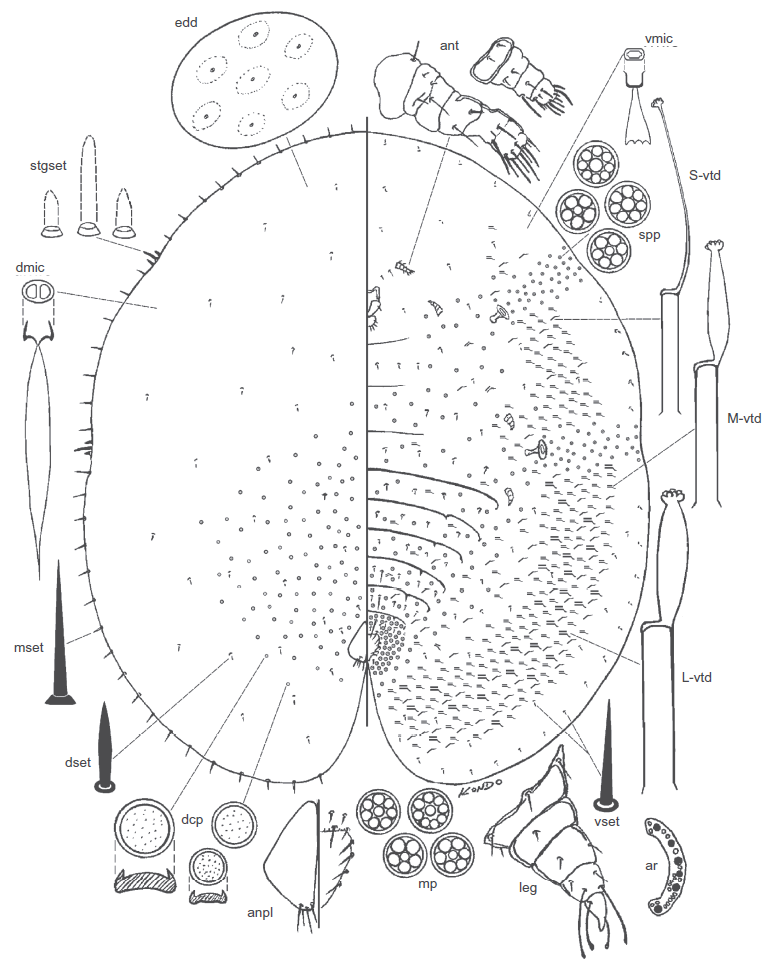
Neotoumeyella leucaenae (Cockerell), adult female.
Description of Type Species, Adult female
Neotoumeyella leucaenae is closest to N. cerifera, also collected in Mexico, but they can be easily separated by the combination of the following features (features of N. cerifera in parentheses): (i) discoidal pores present around anal plates and extending only to mid-dorsum (discoidal pores widespread over entire dorsum, except for a narrow submarginal band); (ii) ventral tubular ducts of 3 types (2 types); (iii) ventral tubular ducts present submarginally up to areas of anterior spiracular pore band (ventral tubular ducts present only up to area around posterior spiracular pore band); and (iv) multilocular pores present on mid-thoracic areas (multilocular pores absent on mid-thoracic areas). Judging by the presence of second-instar males, N. leucaenae apparently reproduces sexually.
Neotoumeyella Caliensis Kondo and Williams, Sp. Nov.(Figs. 1a and 3)
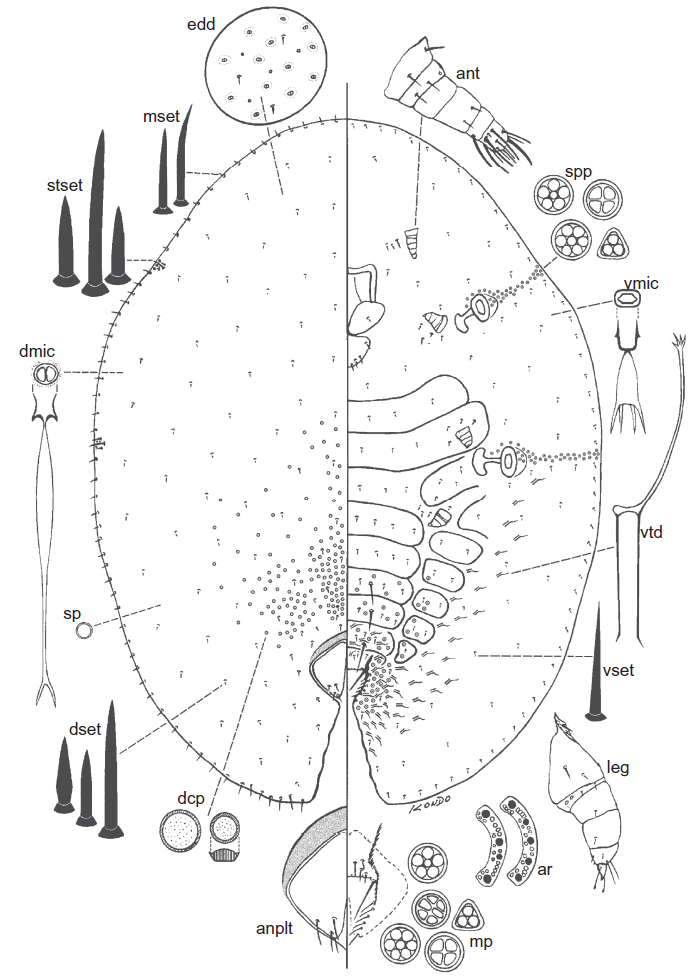
Neotoumeyella caliensis Kondo and Williams, adult female.
Description, Adult female
Neotoumeyella Cephalanthi Kondo and Williams, Sp. Nov.(Figs. 1b and 4)
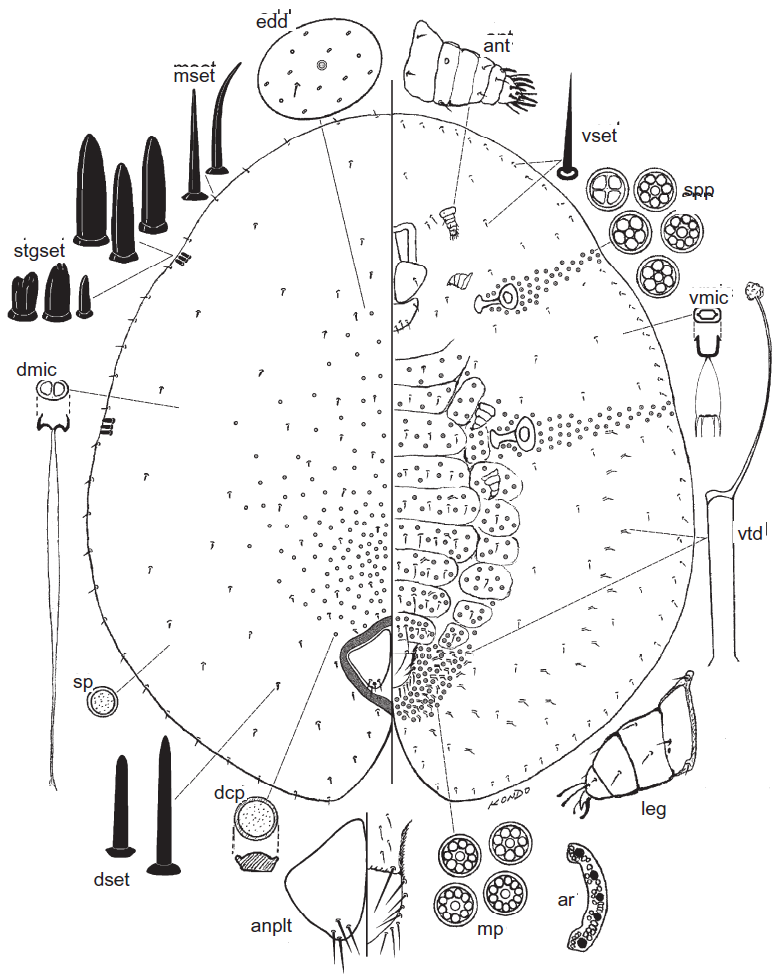
Neotoumeyella cephalanthi Kondo and Williams, adult female.
Description, Adult female
Neotoumeyella Cerifera(Ferris), New Combination(Fig. 5)

Neotoumeyella cerifera (Ferris), adult female.
Toumeyella cerifera Ferris, 1921:90. 15
Description, Adult female
Neotoumeyella Sonorensis(Cockerell and Parrott), New Combination(Fig. 6)
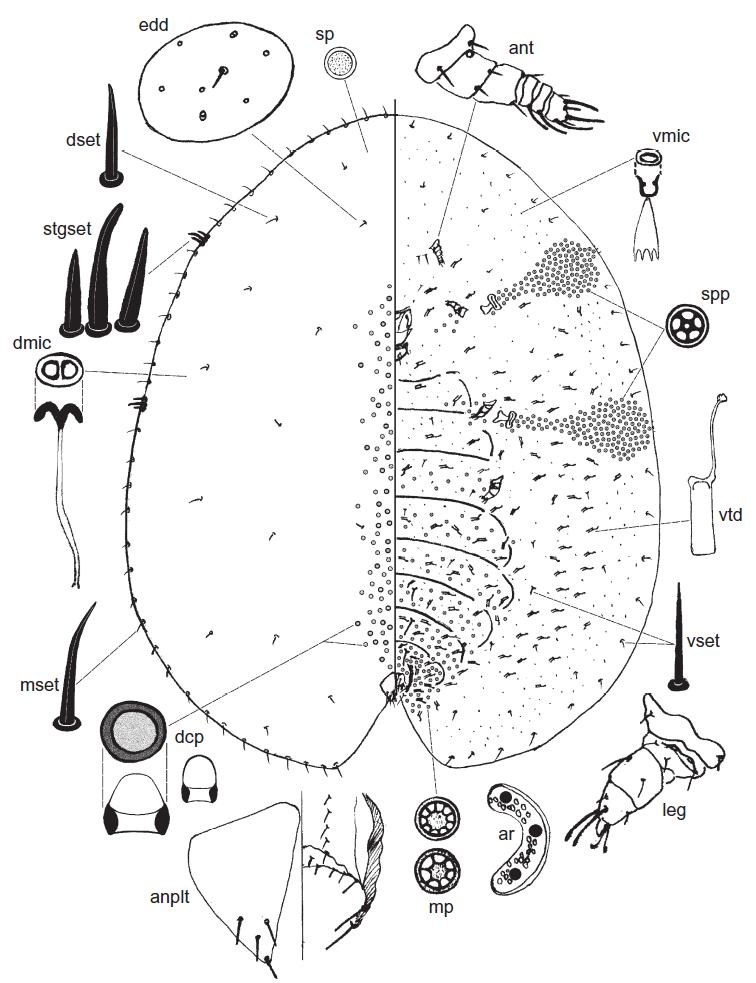
Neotoumeyella sonorensis (Cockerell and Parrott), adult female.
Lecanium sonorense Cockerell and Parrott, 1899:161. 16 Toumeyella sonorensis (Cockerell and Parrott), Cockerell, 1902:452. 17
Description, Adult female
Disclosure
The authors report no conflicts of interest.
Footnotes
Acknowledgements
The author thanks Dr. Penny Gullan (BME), Mrs. Debra Creel, Dr. Douglass Miller (USNM), and Dr. Jon Martin (BMNH) for the loan of specimens used in this study. Thanks also to anonymous reviewers whose comments helped improved the manuscript.