






Abstract
A new species of myrmecophilous soft scale in the genus Akermes Cockerell, collected in Colombia, is described and illustrated. Information on distribution, host plants and morphological variation is given. This is the first record of the genus Akermes in Colombia.
Introduction
Thirteen species distributed in Africa, Australia, Central America, India and South America are currently assigned to the genus Akermes (Ben-Dov et al. 2003). However, only A. bruneri Ckll., A. riograndensis Hempel, A. punctatus (Ckll.), A. townsendi (Ckll.), A. cordiae Morrison, and A. xylosma Granara de Willink are properly placed in the genus, with the remaining seven species either belonging to other phylogenetic groups or of an uncertain taxonomic position (Kondo 2003). In this study, we provide diagnostic characters of the genus Akermes, and describe a new species from Colombia.
The diagnostic characters of the genus Akermes can be summarized as follows: (i) body of adult female convex and globular, often heavily sclerotized at maturity; (ii) submarginal tubercles absent; (iii) preopercular pores present; (iv) sclerotic crescent around anal plates present or absent; (v) eyes absent; (vi) marginal setae present or absent; (vii) ventral disc-pores variable, with one or more central loculi; (viii) ventral tubular ducts absent; (ix) anal plate setae present, often numerous, restricted to posterior end of plates; (x) antennae and legs greatly reduced, with segments mostly indistinct or fused; (xi) antennae 1-5 segmented; (xii) spiracular setae 1-3 in number, extending slightly to deeply onto dorsal submargin (Kondo 2003).
The genus Akermes Cockerell, 1902 has been revised by Hodgson (1994), Granara de Willink (1999), and more recently by Kondo (2003). Hodgson (1994) included Akermes in the subfamily Myzolecaniinae (Coccidae), a group of myrmecophilous soft scales that share many morphological features adapted for a symbiotic life with ants. Based on a morphological study of the first-instar nymphs, Williams and Kondo (2002) noticed differences amongst the genera of Myzolecaniinae. In another study using a combination of adult female and first-instar nymph characters, Kondo and Williams (2002) indicated that the subfamily Myzolecaniinae appears to be composed of several unrelated lineages, and included Akermes in the Toumeyella-group.
The genus Akermes is strictly Neotropical in distribution with species found from México down to Argentina and Paraguay in southern South America. This is the first record of the genus Akermes in Colombia. One hundred seventy four species of scale insects (Hemiptera: Coccoidea) have been reported from Colombia, out of which 35 fall into the family Coccidae (Kondo 2001). With the addition of the new species herein presented, the list of soft scales in Colombia increases to 36 species.
Materials and Methods
The new species was collected in Cali, El Topacio, Buga, and Tulúa, in the Departamento del Valle, Colombia in 1999 and 2000. Both male and female insects in all developmental stages were collected and slide mounted. However, only the adult female and first-instar nymphs are described. Specimens were slide mounted according to the method discussed by Kosztarab (1996), and were studied under a Zeiss RA phase contrast compound microscope. Illustrations follow the typical style adopted for coccoids, with the dorsal side drawn on the left side and the ventral side drawn on the right side. Enlargements of important features were placed around, however, the enlargements are not in direct proportion to each other. Type specimens were designated from specimens collected in Cali and El Topacio. Specimens not included in the type series are listed in the section of “Other material studied”. Because some slides contain more than one specimen, the studied material is represented by the number of slides followed by the total number of specimens in parentheses, e.g., 2(3) meaning 2 slides and 3 specimens.
Abbreviations for the depositories are as follows: Auburn University Coccoidea Collection, Auburn University, Auburn, Alabama, U.S.A. [AUCC]; Bohart Museum of Entomology, Department of Entomology, University of California, Davis, California, U.S.A. [BME]; The Natural History Museum, London, England [BMNH], Colección de Insectos, Instituto de Ciencias Naturales, Universidad Nacional de Colombia, Bogotá D.C., Colombia [UNCB]; The National Museum of Natural History Coccoidea Collection, Beltsville, Maryland, U.S.A. [USNM]; and the Museo de Entomología, Universidad del Valle, Cali, Colombia [UVCO].
Akermes colombiensis sp.n., adult female
Diagnosis
The adult female of this species can be diagnosed by the following combination of characters: (i) discoidal pores abundant and often touching each other on area anterior to anal plates, with several scattered on mid-dorsum, fused pores often present; (ii) sclerotic crescent present around anal plates, crescent not incorporating discoidal pores; (iii) anal plates with 7-15 setae on dorsal surface; (iv) marginal setae sharply spinose and/or with apex gradually or abruptly tapering to a point; (v) spiracular setae 3 in number, found submarginally on dorsal surface; (vi) legs and antennae greatly reduced, with segmentation poorly defined; (vi) multilocular disc-pores (spiracular and perivulvar pores) with 4-7 loculi, mostly 5-locular; (vii) ventral tubular ducts absent.
Description. Adult female (Fig. 1)
Akermes colombiensis sp.n., first instar nymph (Fig. 2)
Diagnosis
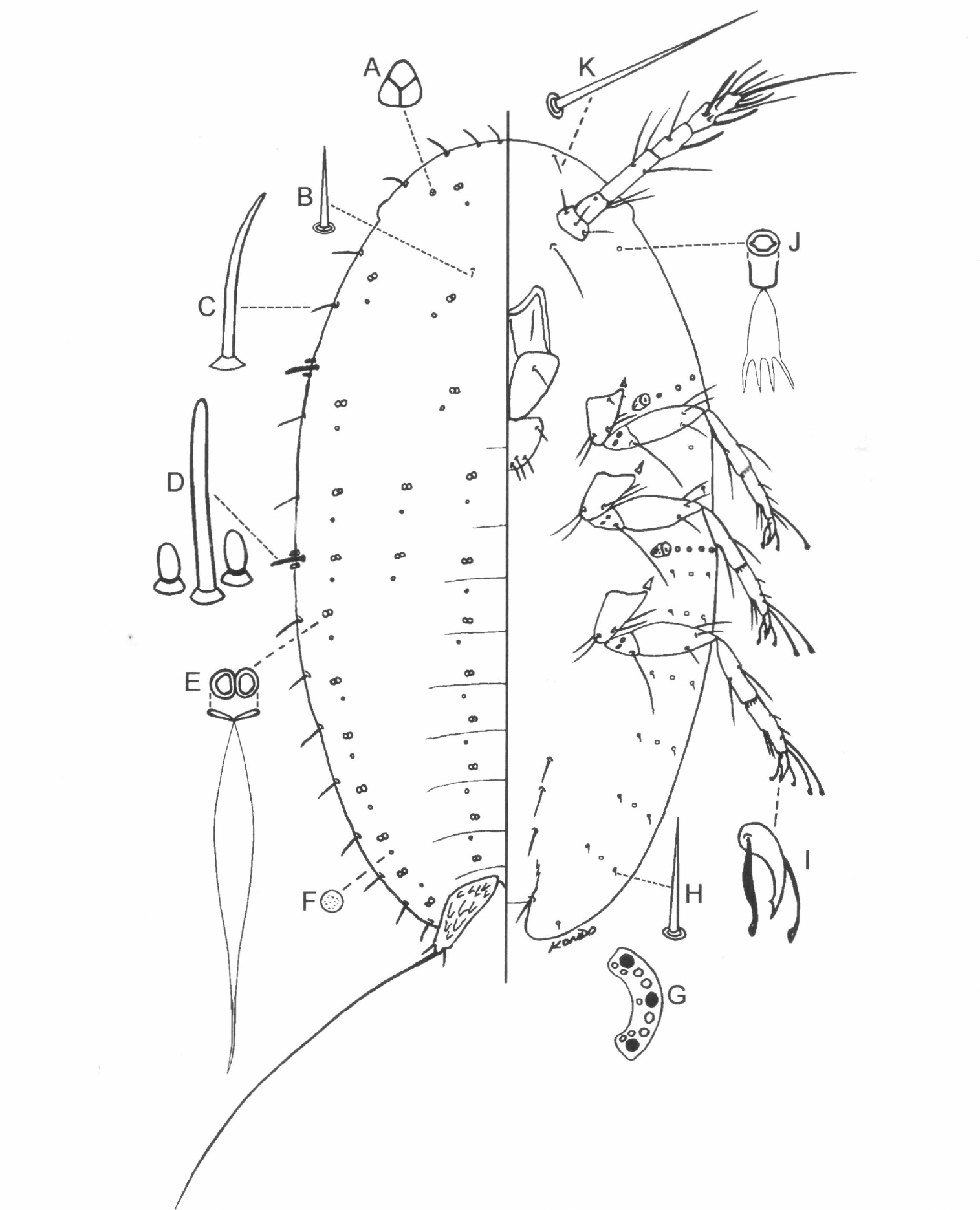
The first-instar nymphs of Akermes colombiensis sp.n. are characterized by the following combination of characters: (i) antennae 5-segmented; (ii) spiracular pores 4-locular; (iii) ventral submedian setae 3 pairs; (iv) claw with a denticle; (v) spiracular setae 3 in number, with median spiracular setae longest; (vi) a pair of dorsal setae present on head region; (vii) dorsal microducts appearing bilocular under high magnification, positioned submarginally and in 2 submedian longitudinal rows, with a pair of additional microducts between submarginal and submedian rows on area of mid-thoracic region; and (viii) a simple disc pore present near each dorsal microduct.
Description. First-instar nymph
Figure 1. Akermes colombiensis sp.n., adult female. A. Dorsal derm magnification. B. Marginal setae. C. Spiracular setae. D. Simple disc-pore. E. Dorsal microduct. F. Dorsal setae. G. Discoidal pore. H. Anal plates. I. Perivulvar pore. J. Anal ring (right half). K. Leg. L. Ventral seta. M. Ventral microduct. N. Spiracular pores. O. Antenna.
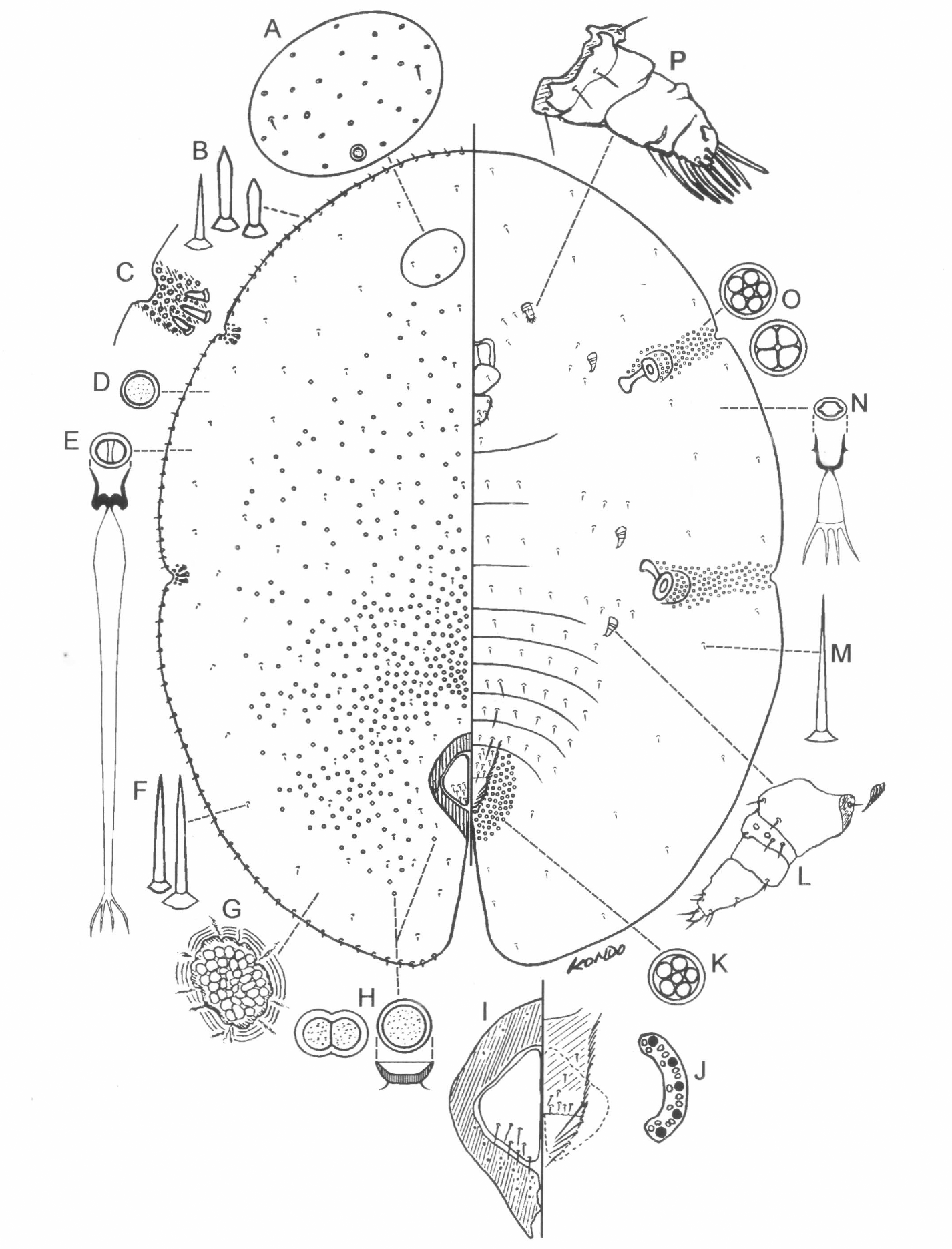
Figure 2. Akermes colombiensis sp.n., first-instar nymph. A. Trilocular pore. B. Dorsal seta. C. Marginal seta. D. Spiracular seta. E. Dorsal microduct. F. Simple disc pore. G. Anal ring (right half). H. Ventral submarginal seta. I. Claw. J. Spiracular pore. K. Ventral microduct. L. Ventral cephalic seta.
Distribution
Neotropical region: Colombia, Valle (Buga, Cali, El Topacio, Tulúa).
Host plants
Lauraceae: Ocotea sp., Persea americana Mill.; Melastomataceae: species undetermined, with purple flowers and similar to Tibouchina; Myrtaceae: Psidium guajava L.
Associated ants
Dolichoderinae: Azteca sp.; Formicinae: Myrmelachista sp.; Myrmicinae: Crematogaster sp.
Type Material
Adult female. HOLOTYPE: COLOMBIA. Valle. El Topacio. 13-dic-1999. Kondo, T., ex Melastomataceae, inside ant cartons of Myrmelachista sp., AL-093-2000: 1(1) [USNM]; PARATYPES: same data as holotype: 2(2) [AUCC], 1(1) [BME], 2(2) [UNCB], 2(2) [USNM]; COLOMBIA. Valle. El Topacio. 18-ago-1999. Kondo, T., ex Melastomataceae, inside ant cartons of Myrmelachista sp., AL-089-2000: 2(2) [AUCC], 2(2) [BME], 2(2) [UNCB], 2(2) [USNM], 4(5) [UVCO]; COLOMBIA. Valle. Cali. 18-Ago-1999. Kondo, T., ex guava, inside cartons of Azteca sp. ants, AL-094-2000: 3(3) AUCC, 3(3) [BME], 5(5) BMNH, 1(2) [UNCB], 4(4) [USNM], 1(1) [UVCO]. Males. AL-094-2000: 1(1) [AUCC], 1(1) [BME], 1(1) [UNCB], 3(3) [USNM]; Immature stages. Same data as holotype: 2(2) [AUCC], 1(1) [BME], 2(4) [UNCB], 4(5) [USNM], 1(1) [UVCO]; AL-089-2000: 7(7) [USNM]; AL-094-2000: 2(2) [AUCC], 2(2) [BME], 6(6) [BMNH], 2(2) [UNCB], 5(13) [USNM], 2(2) [UVCO].
Other material studied
Adult female. COLOMBIA. Valle. Tulúa. 18-ago-1999. Kondo, T., ex guava, inside cartons of Azteca sp. ants, AL-092-2000: 2(2) [AUCC], 2(2) [BME], 2(2) [UNCB], 6(6) [USNM], 2(2) UVCO; COLOMBIA. Valle. Buga. 12-dic-2000. Kondo, T., ex Ocotea sp., inside ant cartons of Azteca sp., AL-104-2000: 3(3) [USNM]; COLOMBIA. Valle. Buga. 12-ene-2000. Kondo, T., ex avocado, tended by Crematogaster sp., AL-105-2000: 2(2) [AUCC], 2(2) [BME], 3(3) [ΒΜΝΗ], 2(2) [UNCB], 5(5) [USNM], 2(2) [UVCO]. Males. AL-105-2000: 2(2). Immature stages. AL-092-2000: 3(7) [AUCC], 3(6) [BME], 3(3) [UNCB], 9(14) [USNM], 3(3) [UVCO]; AL-104-2000: 3(3) [AUCC], 3(3) [BME], 4(4) [BMNH], 2(3) [UNCB], 4(4) [USNM], 2(5) [UVCO]; AL-105-2000: 2(3) [AUCC], 2(3) [BME], 1(2) [BMNH], 1(2) [UNCB], 2(6) [USNM], 1(1) [UVCO].
Footnotes
Acknowledgements
We are thankful to Patricia Chacon for identifying the ants, to Philip Silverstone and Nestor Paz for their aid in the identification of plants, and Penny J. Gullan for kindly reviewing the manuscript.