






Abstract
Background
Cutaneous leishmaniasis (CL) is one of the health problems of many tropical and subtropical regions and is endemic in many parts of Iran especially. Cutaneous leishmaniasis not only is a health problem but also is a social and cultural problem in Iran. Education about health for high risk population seems to have a critical role in prevention of leishmaniasis and therefore evaluation of knowledge, attitude and performance are of importance. For the success of prevention and control programs of any disease, the most important prerequisite is community participation. Program implementers need to understand the disease-related knowledge, attitude, and practices (KAP) of the community, because these are the important determinants of community participation. There are no data from Iran focusing on these aspects, and thus this study presents the information on KAP related to cutaneous leishmaniasis (C.L) in Iran.
Methods
In this study 166 mothers that had at least one child with CL were studied. Data collection was performed using questionnaires that were designed by epidemiologist and were analyzed using SPSS software.
Results
The mean of KAP score was 15.7 ± 1.6 (range of 11.5–19). 48 mothers (28.9%) had weak KAP, 79 mothers (47.6%) had average KAP and 39 mothers (23.5%) had excellent KAP.
Conclusion
According to our results, about 28.9% the mothers had inappropriate KAP score about leishmaniasis highlighting the fact that at least one third of the Isfahan population needs practical education about combating with leishamaniasis. To close the gap between the knowledge and practice of the mothers, face to face education and use of instructional aides are recommended.
Background
Leishmaniasis is a disease that is caused by different species of leishmania protozoa and is transmitted by phlebotomies sand flies. 1 Leishmaniasis can be classified into 3 major groups including mucocutaneous and cutaneous and visceral.1,2
It is an endemic disease that be found in 88 countries in different continents including Latin America, Africa, Asia and South Europe. 1
Approximately 350 million people are at the risk of affection by this disease. The world prevalence of leishmaniasis is about 12 million people. The annual incidence of this disease is about 1.5 to 2 million people around the world. 3 About 90% of this population are located in 7 countries of Algeria, Afghanistan, Brazil, Peru, Iran, Saudi Arabia and Syria. 3
The causative agents of leishmaniasis in the old world are L. Major, L. Tropica and L. Aethiopica. 3 It can be clinically classified into 2 types of wet and dry types.3,4
Leishmaniasis is a zoonosis that is shared between human and dogs and rats and is transmitted by sandfly. 4
Education about health for high risk population seems to have a critical role in prevention of leishmaniasis and therefore evaluation of knowledge, attitude and performance are of importance. For the success of prevention and control programs of any disease, the most important prerequisite is community participation. Cooperation of the affected population is essential in the implementation and use of program activities. Program implementers need to understand the disease-related knowledge, attitude, and practices (KAP) of the community, because these are the important determinants of community participation. There are no data from Iran focusing on these aspects, and thus this study presents the information on KAP related to cutaneous leishmaniasis (C.L) in Iran. 5
Materials and Methods
This was a descriptional-analytic study that was performed in 2007–2008 in Skin Diseases and Leishmaniasis Research Centre (SDLRC), Isfahan, Iran.
Target population was the mothers of children who were affected by C.L. Cases were selected by systematic sampling from the mothers of children with active CL who were referred to SDLRC. The sample size was calculated to be 160, but for more validity, 166 cases were selected.
Data collection was performed using questionnaires that were designed by epidemiologist. To determine the validity of questionnaires, 50 questionnaires had been already filled out and the validity and reliability of them were controlled by using Cronbach's alpha statistical test. The value of Cronbach's alpha was calculated to be 82% and the correlation of questions (reliability) was calculated to be 91%.
The questionnaires included 31 questions and the maximum score was 20. The score less than 10 was regarded to be weak, score between 10–14.9 was regarded as average, score between 15–17.5 was regarded as appropriate and more than 17.5 was regarded as excellent.
To determine the attitude of the mothers, 14 questions were proposed and the maximum score of it was set to be 20. The score less than 15 was regarded to be weak, score between 15–17 was regarded as average and more than 17 was regarded as excellent.
To determine the performance of the mothers, 8 questions were proposed and the maximum score of it was set to be 20. The score less than 15 was regarded to be weak, score between 15–17 was regarded as average and more than 17 was regarded as excellent.
The mean of knowledge, attitude and performance score were calculated (the maximum score of 20) and the score of less than 15 was considered as weak KAP, 15–17 was regarded as appropriate KAP and more than 17 was considered as excellent.
The data were collected using SPSS ver 16.00 and statistical tests including Ki square test.
Results
In this study, 166 mothers of the children with CL were interviewed. 10 (6.2%) of these mothers were illiterate, 57 (35.4%) mothers had elementary school education, 28 mothers of affected children (17.4%) had high school education and 27 mothers of the children (16.8%) had higher education.
153 mothers (92.2%) had already been familiar with CL and 13 mothers of the children (7.8%) had never heard about leishmaniasis.
On the other hand, 114 (68.7%) mothers had positive family history of leishmaniasis and 52 mothers (31.3%) had negative family history.
Out of 153 mothers who were familiar with CL, 111 cases (72.5%) had positive family history of CL. The results of Ki-square analysis confirmed significant correlation between familiarity with lesihmaniasis and positive family history (P < 0.001).
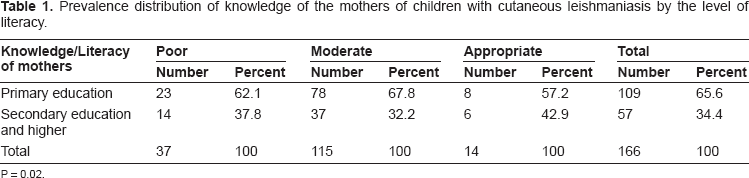
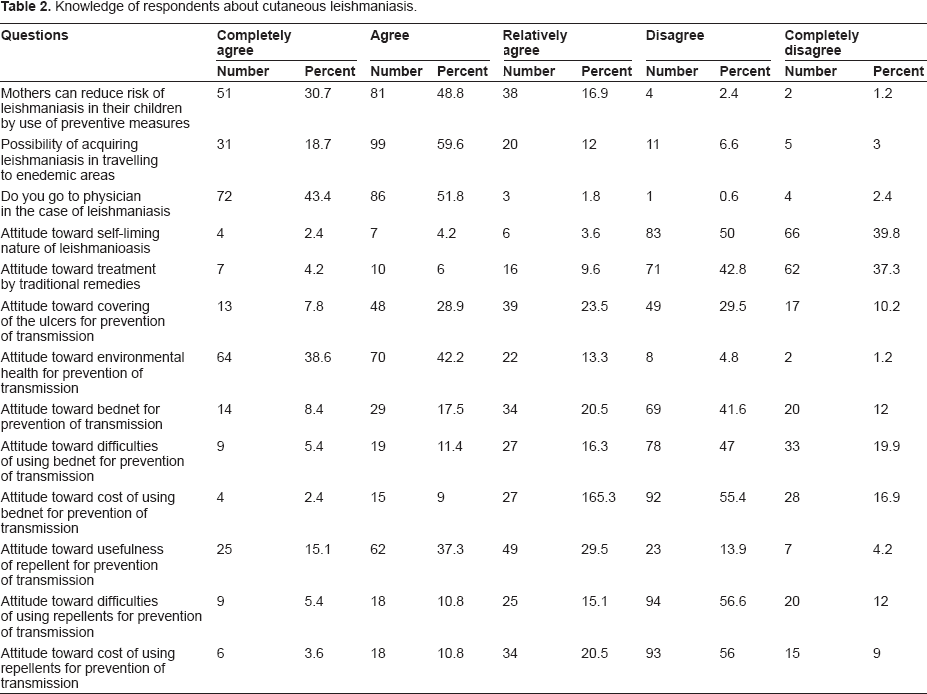
Figure 1 shows the degree of mothers' knowledge regarding leishmaniasis. The association between knowledge of mothers regarding leishmaniasis and the level of mothers education is shown in Table 1. There was no significant association between these 2 parameters using Ki-square analysis (P = 0.52). There was also no significant association between age group of the mothers and the knowledge regarding leishmanaisis (Table 2).
The degree of mother's knowledge regarding leishmaniasis. Prevalence distribution of knowledge of the mothers of children with cutaneous leishmaniasis by the level of literacy. Knowledge of respondents about cutaneous leishmaniasis.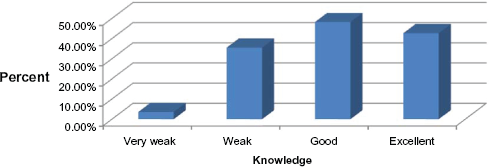
Mean age of the mothers who had high and low knowledge regarding leishmaniasis were 29.6 ± 6.7 and 30.4 ± 6, respectively but this difference was not significant statistically (P = 0.43).
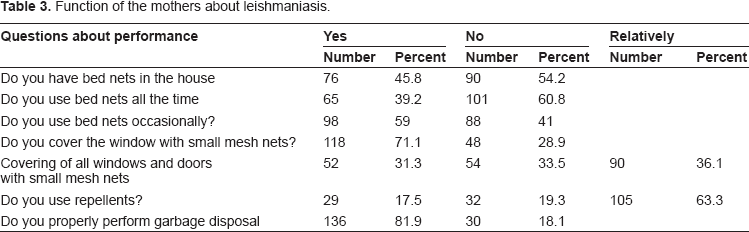
Function of the mothers about leishmaniasis.
89.8% of mothers had enough information regarding the ways of its transmission.
Mean of attitude score for all of the mothers was 15 ± 2 and 71 mothers (42.8%) had weak attitude, 83 mothers (50%) had average attitude and 12 mothers (7.2%) had excellent attitude.
Mean of mothers performance score was 16.6 ± 2.8. 54 mothers of affected children (32.5%) had weak performance, 52 mothers (31.3%) had average performance and 60 mothers of affected children (36.1%) had excellent performance.
The mean of KAP score was 15.7 ± 1.6 (range of 11.5–19) in the mothers. 48 mothers (28.9%) had weak KAP, 79 mothers (47.6%) had average KAP and 39 mothers (23.5%) had excellent KAP (Fig. 2).
Prevalence distribution of KAP score in mothers.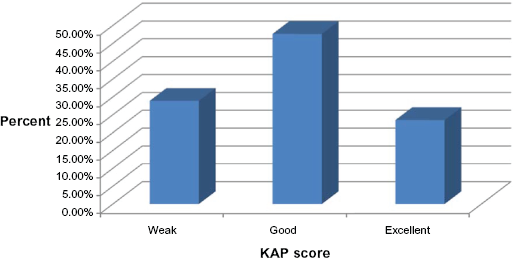
Discussion
In recent years, the role of active participation of individuals and communities for successful diseases control programs has gained much more attention. Many studies, therefore, are now focusing on the knowledge, attitude and practices of the target populations. In the current study, we evaluated the knowledge, attitude and practices of the Isfahan residents regarding cutaneous leishmaniasis.6–9
The results of our study showed that the majority of mothers of children with CL were either illiterate or had very low level of education. It can be concluded, therefore, that use of educational pamphlet probably, at least in this district, has no so much effect on prevention of leishmaniasis and use of other methods, such as direct face to face or home visit education may have higher impact.
On the other hand, our study showed that 40% of mothers had weak knowledge regarding leishmaniasis. Deficit of knowledge was especially prominent regarding subjects such as possibility of reinfection, leishmaniasis reservoir, time of transmission, sand fly characteristics, sand fly behavior, difference between rural and urban leishmaniasis, the ways of vector control and finally use of sand fly controlling methods such as use of insecticdes and repellent-impregnated bed nets.
All of these data highlights the fact that providing enough information to the high-risk families may have significant impact on the incidence of leishmaniais and these information must be provided by health care personnel that are in direct contact with such families.
In addition, our data showed that although 89.8% of mothers knew that sand fly is the vector of leishmaniasis, only 13.9% of them had enough information about characteristics of sandflies. This lack of knowledge can cause failure of preventive methods and making education about this vector crucial.
Regarding the level of literacy and the life style of the target group, it seems essential that a multidisciplinary approach should be performed to improve knowledge and attitude of the target population. Methods such as face to face education or practical instruction may be helpful in this regard.
32.5% of the mothers had inappropriate performance regarding C.L. Question about performance in this study were mainly about practical methods of controlling and combating leishamniasis. There was significant lack of knowledge regarding use of small mesh nets or repellents.
According to our results, about 28.9% the mothers had inappropriate KAP score about leishmaniasis highlighting the fact that at least one third of the Isfahan population needs practical education about combating with leishamaniasis. To close the gap between the knowledge and practice of the mothers, face to face education and use of instructional aides are recommended.
Footnotes
This manuscript has been read and approved by all authors. This paper is unique and is not under consideration by any other publication and has not been published elsewhere. The authors and peer reviewers of this paper report no conflicts of interest. The authors confirm that they have permission to reproduce any copyrighted material.