






Abstract
The M40 VSV recombinant was engineered to contain overlapping PTAP and PPxY L-domain motifs and flanking residues from the VP40 protein of Ebola virus. Replication of M40 in cell culture is virtually indistinguishable from that of control viruses. However, the presence of the Ebola PTAP motif in the M40 recombinant enabled this virus to interact with and recruit host Tsg101, which was packaged into M40 virions. In this brief report, we compared replication and the pathogenic profiles of M40 and the parental virus M51R in mice to determine whether the presence of the Ebola L-domains and flanking residues altered in vivo characteristics of the virus. Overall, the in vivo characteristics of M40 were similar to those of the parental M51R virus, indicating that the Ebola sequences did not alter pathogenesis of VSV in this small animal model of infection.
Introduction
Vesicular stomatitis virus (VSV) is the prototypic member of the Rhabdoviridae family of negative-sense RNA viruses. VSV is an arthropod-borne virus that causes sporadic outbreaks of disease in the United States in equine and bovine species, often characterized by the appearance of vesicular lesions resembling those induced by the foot-and-mouth disease virus.1–4 For many years, VSV has served as a surrogate virus for the expression of a heterologous virus or host proteins and/or sequences to better understand their biological function in the context of a virus infection, or as a vector system for vaccine development or targeting tumor cells.5–11 For example, we have used VSV as a surrogate virus to investigate the functions of late (L) budding domain motifs and flanking sequences from the VP40 matrix protein of Ebola virus.
12
Viral L-domain motifs have been well described as important components conserved within RNA virus matrix proteins that mediate recruitment of specific host proteins to facilitate efficient virus egress and dissemination.13–15 RNA viruses with L-domain containing matrix proteins include retroviruses, arenaviruses, rhabdoviruses, paramyxoviruses, henipaviruses, and filoviruses. L-domains consist of core consensus amino acid motifs such as PPxY, P(T/S)AP, YxxL, or FPIV (x = any amino acid), which dictate the cellular interacting partner. Importantly, PPxY motifs interact with WW-domain-containing proteins such as host E3 ubiquitin ligases (eg, neuronal precursor cell-expressed developmentally down-regulated 4; Nedd4), while P(T/S)AP motifs interact with tumor suppressor gene 101 (
Reverse-genetics techniques were used to engineer and recover a VSV recombinant termed M40, which expressed the L-domains and flanking sequences from Ebola virus VP40 (RVILPTAPPEYMEAI) in place of that normally present in the M protein of VSV (LGIAPPPYEEDT). 12 The M40 recombinant provided us with a powerful tool to study the functional role of the Ebola L-domain region in the context of a virus infection under BSL-2 conditions, without the technical challenges and limitations associated with experiments involving live Ebola virus. 12
Results from previous studies demonstrated that the Ebola VP40 L-domain region was indeed functional in mediating virus egress in the context of a VSV background. 12 For example, the M40 recombinant virus replicated to titers that were essentially identical to those of parental VSV controls, and mutations that disrupted the Ebola L-domain sequences resulted in VSV recombinants that were defective in host protein recruitment and subsequent egress from infected cells. 12 In addition, expression of the Ebola sequences did not result in any change in plaque size or in virus morphology as determined by electron microscopy. 12
Although the in vitro cell culture growth properties of the M40 recombinant virus were similar in general to those of parental VSV strains, the unique overlapping nature of the Ebola PTAP and PPxY L-domains did result in differences in the dependence on specific host proteins for efficient budding, as compared to that of a single PPPY motif of VSV. 12 In this report, we compared levels of virus replication and pathogenic phenotypes in mice infected with either recombinant M40 or a control virus of parental M51R. Despite small differences in the levels of virus replication in the lungs and brains of infected mice, and in the kinetics of animals that eventually succumbed to infection, overall findings indicate that replication and pathogenic profiles of recombinant M40 and parental M51R in vivo were comparable.
Methods
Viruses
VSV-M51R and recombinant M40 have been described previously Figure 1.12,16 M51R contains an arginine at amino acid position 51 within the M protein that disrupts the host shutoff function of the M protein. Recombinant M40 contains the overlapping L-domains and flanking residues from Ebola VP40 protein inserted in place of the PPPY L-domain and flanking residues of VSV M protein.
12
The M40 recombinant was generated using the M51R parental background. Both viruses were propagated in BHK-21 cell and titrated by standard plaque assay.
Diagram of the VSV genome showing an expansion of the 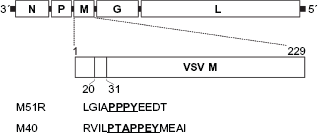
Pathogenicity in mice
Groups of eight 6-week-old female BALB/c mice were mock-infected with PBS, or infected intranasally with 10 7 pfu/mL of M51R or M40 as described previously. 17 Body weight measurements were recorded on a daily basis over a two week period while survival was monitored and plotted. At 2 days post-infection, three mice were sacrificed, and viral titers were determined from lung and brain homogenates of sacrificed animals using a standard plaque assay on BHK-21 cells. 12
Statistical Analyses
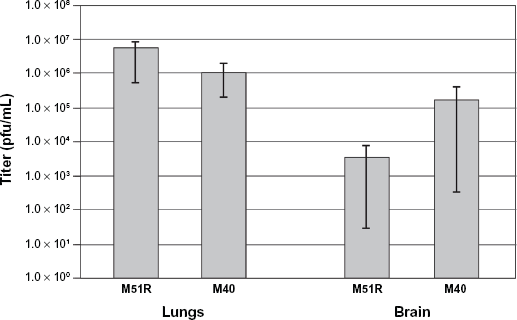
The data shown in Figure 2 were analyzed using a 1-way ANOVA, and data shown in Figure 3 were analyzed using a Graphs of weight change and survival in mice. (Top) The percentage weight change for mock-infected mice (PBS) and mice infected with either M51R or M40 viruses is shown. (Bottom) Survival curves over a two week period for mice that were mock-infected (PBS), or infected with M51R or M40 viruses are shown. Replication of M51R and M40 in lung and brain tissue of infected mice.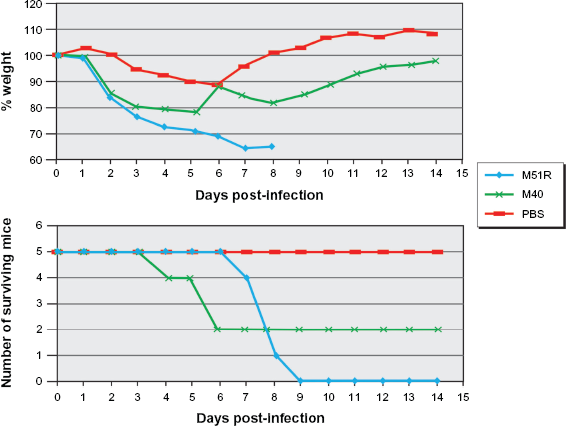
Results and Discussion
VSV M51R and recombinant M40
The amino acids comprising the L-domain region within the parental M51R virus and recombinant M40 are shown in Figure 1. In contrast to the single PPPY L-domain motif within the M protein of M51R, the M40 recombinant was engineered to possess both the PTAP and overlapping PPEY motif from the VP40 protein of Ebola virus. The presence of the PTAP motif enables the M40 virus to recruit host protein Tsg101, which contributes to efficient budding of this recombinant virus. 12 Thus, it was of interest to determine whether the presence of the PTAP motif and the Ebola sequences in general provided any replication advantage or modification of pathogenesis for the M40 recombinant in a mouse model of infection, compared to that of control virus M51R Fig. 1.
Pathogenicity of recombinant M40 in mice
Groups of eight 6-week old BALB/c mice were either mock-infected, or infected with recombinant M40 or the M51R control virus, and mice were assessed for weight loss, survival, and replication in lung and brain tissue. Mice were inoculated with 10
7
pfu of the indicated virus and body weight was recorded on a daily basis for a two-week period (Fig. 2). Mice infected with the parental M51R virus showed a steady progression of weight loss from day 2 through day 8 (Fig. 2). A statistically significant difference in weight loss was noted on day 6 post-infection (p.i.) between M51R and PBS control (
In correlation with body weight measurements, all mock-infected control animals survived for the 14-day period, whereas by day 9 p.i., all animals infected with the M51R virus succumbed to the infection (Fig. 2). Interestingly, several mice infected with the M40 recombinant virus succumbed more quickly to the infection compared to the rate of survival for animals infected with M51R (Fig. 2). For example, 3 of the 5 animals infected with the M40 recombinant succumbed to the infection by day 6 p.i., compared to only 1 of 5 animals infected with M51R (Fig. 2). However, eventually all 5 mice infected with M51R succumbed to the infection by day 9 p.i., whereas 2 of the 5 mice infected with the M40 recombinant survived through day 14 p.i. (Fig. 2). Thus, while the survival kinetics varied slightly between animals infected with M51R versus those infected with the M40 recombinant (not statistically significant), the presence of the Ebola virus VP40 sequences within the
Replication of recombinant M40 in mice
In addition to monitoring weight loss and survival, we also determined the level of virus replication in both lung and brain homogenates from animals infected with either M51R or the M40 recombinant. Three mice from each group were euthanized on day 2 p.i. for titration of the virus in both lung and brain tissues, using a standard plaque assay on BHK-21 cells (Fig. 3). The average titer for M51R in the lung was 5.6 × 10⁶ pfu/mL, and the average titer for M40 in the lung was 9.7 × 10⁵ pfu/mL (Fig. 3). More variation in viral titers was observed in brain samples, where the average titer for M51R was 3.2 × 10³ pfu/mL and the average titer for M40 was 1.6 × 10⁵ pfu/mL (Fig. 3).
The ability to detect VSV replication in the lungs and brains is typical in this small animal model of infection. The replication levels of the M40 recombinant virus observed in the lungs indicates that M40 does not possess an attenuated phenotype in mice. Moreover, detection of M40 replication in the brains of infected animals also supports a pathogenic phenotype for M40 similar to that observed for the parental control M51R virus. If the Ebola L-domain sequences were providing an overall replication (budding) advantage to M40 in infected mice, then we might have expected to observe significantly higher titers for M40 in the lungs and brains, and more severe mortality rates than the M51R parental control. Statistical analysis indicated that the differences in observed titers in the lungs and brains of mice infected with M51R and M40 were not statistically significant (
Conclusions
Overall, the data presented here indicate that the presence of Ebola VP40 L-domain sequences expressed within the M protein of VSV did not result in a major difference in the ability of the M40 recombinant to replicate and cause disease in a mouse model of infection, compared to that of the parental M51R strain. These in vivo data correlate well with previously published findings for the replication properties of the M40 recombinant in cell culture. 12 Thus, although the presence of different L-domain motifs does dictate the identity of specific host proteins recruited for virus budding, 12 the M40 L-domain does not appear to provide any obvious replication advantage to the virus in either in vitro 12 or in vivo (as found in this report) models for VSV infection. Interestingly, a recent report suggests that L-domain motifs for VSV may function in a cell type dependent manner. 18 Thus, it is possible that the M40 recombinant may possess enhanced or reduced replication and/or pathogenic potential in a specific cell type or animal/insect host that has not yet been identified.
Funding
Support for this study was provided in part by NIH grants AI46499 and AI090284 (R.N.H.). This study was supported in part by CIVIA, an NIAID-funded center (U19 AI62623) to investigate viral immune antagonism (A. G.-S.).
Author Contributions
Conceived and designed the experiments: T.I., E.C., A.G-S., and R.N.H. Analyzed the data: T.I., E.C., A.G-S., and R.N.H. Wrote the first draft of the manuscript: T.I. and R.N.H. Contributed to the writing of the manuscript: T.I., E.C., A.G-S., and R.N.H. Agree with manuscript results and conclusions: T.I., E.C., A.G-S., and R.N.H. Jointly developed the structure and arguments for the paper: T.I., E.C., A.G-S., and R.N.H. Made critical revisions and approved final version: T.I., E.C., A.G-S., and R.N.H. All authors reviewed and approved of the final manuscript.
Competing Interests
Author(s) disclose no potential conflicts of interest.
Footnotes
Acknowledgments
The authors would like to thank members of the Harty laboratory for critical comments on the manuscript, Shiho Irie for excellent technical assistance, and Deborah Argento for assistance in preparation of the figures.
As a requirement of publication author(s) have provided to the publisher signed confirmation of compliance with legal and ethical obligations including but not limited to the following: authorship and contributorship, conflicts of interest, privacy and confidentiality and (where applicable) protection of human and animal research subjects. The authors have read and confirmed their agreement with the ICMJE authorship and conflict of interest criteria. The authors have also confirmed that this article is unique and not under consideration or published in any other publication, and that they have permission from rights holders to reproduce any copyrighted material. Any disclosures are made in this section. The external blind peer reviewers report no conflicts of interest.