






Abstract
The purpose of this research was to study whether agricultural high school students' attitudes towards social support for consumers would improve with their involvement in a school lunch program for elementary and middle school pupils. A comparison of the pre- and post-intervention data revealed the food knowledge, production skills, and attitudes towards food production for children among students at the experimental and control schools. A pilot trial study was conducted that involved growing tomatoes and distributing a newsletter on school lunches to primary and middle school children. The study was implemented from April to October every year from 2006 to 2009. A total of 92 agricultural high school students and 20 controlled agricultural students participated during these four years. The evaluation survey comprised questions about food nutrition, food production, and access to health and nutritional support services. The students who worked in assisting the school lunch program exhibited increased knowledge and skills related to producing a newsletter on produce for consumers as compared to the control student group. The students' food knowledge and production skills showed a significant positive correlation with their attitudes towards assisting in the school lunch program. Therefore, the acquisition of knowledge and skills regarding the preparation of a newsletter on produce by agricultural high school students increased significantly through the experience of supporting a school lunch program.
Keywords
Introduction
Japanese agricultural high schools have been contributing to the training of local agricultural producers (farmers) by setting as an educational goal “an increased awareness on the part of producers of social support for consumers.”1,2 In addition, among the knowledge and skills that students must acquire to ensure the safety and quality of products, the curriculum guidelines of the Ministry of Education, Culture, Sports, Science and Technology include practical training that requires the students to conduct sales of products they have cultivated or processed at stores and school events. 3 Thus, agricultural school students learn the importance of working as a producer who develops consumer trust. 4 Furthermore, adolescence is considered the most dynamic developmental period during one's life span, and studying adolescent dietary patterns developed during this stage is important because such habits may continue into adulthood.5–7 However, very few previous studies on agricultural high school students have been conducted.
Considering that adolescents are our target population, we developed a pilot program at an agricultural high school in Japan to provide a portion of school lunches to elementary and middle school students using tomatoes produced by the agricultural high school students.8,9
Therefore, the aim of the research was to study whether agricultural high school students' awareness of food production as social support would increase as a result of assisting in a school lunch program for elementary and middle school pupils.
Method
Design of a school lunch program employing agricultural high school students
The study design was a comparison of the pre- and post-intervention data, which revealed the food knowledge, production skills, and attitudes towards food production for children among students at the experimental and control schools.
A program, which delivered school lunch meals that included tomatoes grown by students of an agricultural high school to elementary and middle school pupils, was initiated. At the same time, the high school students prepared school lunch newsletters that featured articles about their tomatoes. The target group was all twelfth-grade students in the school; the total number of participants was 92 twelfth-grade students enrolled at Hokkaido N Agricultural High School in Hokkaido, Japan from 2006 to 2009, and 20 twelfth-grade students enrolled at S Agricultural High School, the control school.
Figure 1 shows the program for agricultural high school students who were supporters for the school lunch program. The program consisted of 6 thematic study sessions for elementary and middle school pupils, conducted by the high school students themselves: 1st: cultivation and processing, 2nd: distribution of produce, 3rd: quality control, 4th: analysis of food's nutritional value, 5th: preparation of balanced meals, and 6th: production of a newsletter concerning a nutritionally balanced diet.

Design of learning components for assisting school lunch program for agricultural high school students.
Altogether, the high school students produced the tomatoes, then checked them for quality and quantity. The high school then won a bid to provide tomatoes for school lunches and delivered them to the school lunch center, executing the entire process from seed to dinner table (assisted by agricultural high school teachers). Additionally, after developing an understanding of the nutritional role of school lunches (assisted by lecturers from a University Department of Nutrition), the high school students created a color newsletter/poster that was based on topics they had studied (assisted by dietitians from the local School Lunch Center). The newsletter/poster was posted concurrently with the food service in all classrooms of the city's elementary and middle schools. This newsletter informed about the process of tomato production, the characteristics and nutritional composition of tomatoes, the process of preparing foods from specific ingredients based on a menu, and the nutritional balance of school lunches. The homeroom teachers in the elementary and middle schools posted a related poster on a wall in each classroom for 1 month, both proceeding and following the school lunches themselves, and introduced the contents to pupils. 9
Evaluation
Table 1 shows the evaluation framework. The questionnaire contained 2 sections: one dealing with the knowledge and skills of students themselves and the second with their attitudes regarding social support for consumers. The questions concerning knowledge and skills focused on the production of tomatoes, nutritional value of tomatoes, and preparation of the newsletters. Survey respondents were asked to evaluate their attitudes of social support for consumers by stating their relative agreement with the following statements: “I want to be a reliable food producer”, “I want to work with consumers on health matters”, “I want to provide advice regarding consumers' health concerns”, and “I want consumers to be enhanced concern of produce”. All evaluation criteria were rated from “very much” to “not at all” on a five (5)-point or four (4)-point Likert scale after discussion among the program leaders. The criteria were implemented in a pre- and post-intervention design, making use of self-completed survey questionnaires.
Evaluation framework.
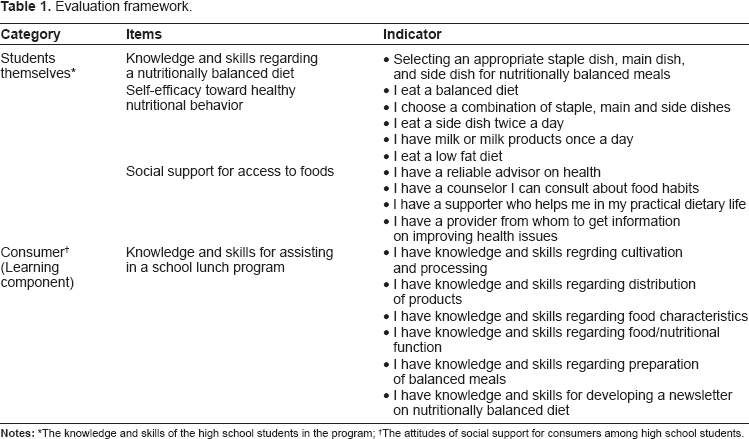
The knowledge and skills of the high school students in the program;
The attitudes of social support for consumers among high school students.
Informed consent was obtained from students participating in the questionnaire survey by disclosing at the start of the survey its meaning and purpose, including the fact that it was not a test, that the results would be calculated in aggregate form, and that private information would be protected. Homeroom teachers distributed and collected the forms in classrooms at the agricultural high schools. The Nayoro City University Ethics Committee in Japan reviewed and approved the survey.
Statistical analyses
To confirm the reliability of the criteria (the internal consistency of the subscale), Cronbach's a coefficient was calculated. The pre- and post-intervention ratios of indicators were compared and the relationships between these scores were investigated. For the pre- and post-intervention comparison of the measurement criteria and the relevancy between criteria, a Wilcoxon t-test and Mann-Whitney U-test were used. SPSS ver.16.0 for Windows was used for aggregate data analysis (SPSS Inc, Chicago, 2008), and the significance level of the statistical examination was 5%.
Results
The students at Hokkaido N Agricultural High School included 69 boys and 23 girls, with 47 enrolled in the production course and 45 enrolled in the dairy course. The reliability values of the subscales of Cronbach's a coefficients were 0.811 for the knowledge and skills of program students and 0.881 for the attitudes towards social support for consumers, with a high internal consistency across the board. We proceeded with the analysis upon this confirmation of reliability. A change in the knowledge and attitudes of students was observed when the pre- and post-intervention survey scores were compared.
Table 2 shows the pre- and post-intervention ratios of indicators, which compared the knowledge and skills of program of students and attitudes towards social support for consumers. There was a significant increase in knowledge and skills involved in preparing newsletters about produce for consumers in the Hokkaido N Agricultural High School, compared to those of the control agricultural high school.
Transition of knowledge and attitude of students themselves and consumer support through intervention.

Table 3 shows the relationship between the knowledge and skills used for preparing educational materials to inform consumers about produce and the students' attitudes towards social support for consumers. Responses to survey questions “I want to work with consumers on health matters,” “I want to provide advice regarding consumers' health concerns,” and “I want to be a reliable food producer” showed a significant positive correlation to producing educational materials about produce for consumers. The students' food knowledge and food production skills showed a significant positive correlation with their attitudes towards assisting in the school lunch program.
Peason partial correlation coefficients for knowledge and attitudes of themselves and consumer.

P < 0.05;
P < 0.01.
Discussion
This study concluded that knowledge and skills related to producing educational materials on produce of the experimental group improved significantly, compared with those of the control group. The knowledge and skills related to assisting in the school lunch program were associated with the knowledge, skills, and attitudes towards social support of the students. Thus, including a school lunch program in the curriculum of agricultural high schools might facilitate their understanding of a nutritionally balanced diet.
According to social cognitive theory (SCT), social support emerges as a strong predictor of students' adoption of a healthy, active lifestyle because of its influence on psychosocial variables such as self-regulation. 10 In this program, the students who demonstrated improved knowledge and skills may identify and incorporate supporting children's diets. One of the educational goals in agricultural high schools is the awareness of social support for consumers on the part of producers. In this program, the agricultural students, in their role as food producers, came to think about the health of elementary and middle school pupils. Robinson-O' Brien et al. reported that this is an opportune time to investigate whether adolescent attitudes about food production practice are associated with healthy eating. 11 In fact, Monge-Rojas et al. identified that the practice is consistently associated with positive behaviors, but only adolescents with the required skills and abilities can become members of such a program. 12 In the case of the agricultural high schools in this study, it was found that those who participated in the program exhibited an increase in nutritional knowledge and skills with regard to both themselves and their customers.12,13
Previous studies have reported that two main psychological factors affect adolescent students. One involves social activities and the acquisition of knowledge and skills that influence self-concept, which tends to be weak during this period.14,15 Therefore, the program should take an approach that nurtures self-acceptance—an approach that achieves this goal by allowing increased opportunities for sharing with others. 16 Successful interventions have been underpinned by the behavior change theory, with an emphasis on curriculum activities that incorporated experiential learning, role modeling, knowledge and skill acquisition, and motivational strategies to change attitudes and behavior. 14 Our program did include experiential learning, knowledge and skill acquisition, and motivational strategies.
Our study has both weaknesses and strengths. One weakness is the relatively limited scope of the study, since only 92 students were surveyed. This was largely a factor of the relatively small size of Japanese agricultural schools. To remedy this, we plan to increase the number of schools and participants in a similar study in the near future. A second weakness is that agricultural students and teachers were busy cultivating produce to deliver to the school lunch center for several weeks. To remedy this, the schedule of the program might be modified. It is believed that we, together with other concerned individuals and organizations (such as agricultural cooperatives, supermarkets, and convenience stores) 17 must provide additional opportunities for students to study 18 and carefully consider the nature of their own dietary habits as well as their roles in social behavior. 19
Regarding the strengths of this study, we demonstrated the possibility of the practical and effective application of this program in many small high schools at the same time. We will replicate our study with people of various occupations in the future.
Author Contributions
Conceived and designed the experiments: Ishikawa, Kubota, Kudoh, Ota. Analysed the data: Ishikawa, Kubota, Umezawa. Wrote the first draft of the manuscript: Ishikawa. Contributed to the writing of the manuscript: Meadows. Agree with manuscript results and conclusions: all authors. Jointly developed the structure and arguments for the paper: Hokkaido Nayoro agricultural high school, Nayoro School lunch center. Made critical revisions and approved final version: all authors. All authors reviewed and approved of the final manuscript.
Competing Interests
The authors have no competing interests to declare.
Disclosures and Ethics
As a requirement of publication author(s) have provided to the publisher signed confirmation of compliance with legal and ethical obligations including but not limited to the following: authorship and contributorship, conflicts of interest, privacy and confidentiality and (where applicable) protection of human and animal research subjects. The authors have read and confirmed their agreement with the ICMJE authorship and conflict of interest criteria. The authors have also confirmed that this article is unique and not under consideration or published in any other publication, and that they have permission from rights holders to reproduce any copyrighted material. Any disclosures are made in this section. The external blind peer reviewers report no conflicts of interest.
Footnotes
Acknowledgements
This research study was funded by Nayoro City University in Japan. The author sincerely thanks the individuals and institutions who graciously cooperated with this program, including the principal and teachers of the Hokkaido Nayoro Agricultural High School, the city's Superintendent of education, the head and employees of Nayoro's School Lunch Center, and the food preparation personnel.