






Abstract
Background
Many health service sectors produce leaflets for health education, but specific issues such as their overall content and design (layout, graphics, illustrations) are seldom discussed. Important features contributing to the effectiveness of any leaflet is the extent to which it is read by its target audience. The purpose of this study was to examine the acceptability of two different leaflets on abstinence from alcohol during pregnancy.
Methods
Four semistructured group discussions were conducted among 33 pregnant women. They were asked if they would take, read, and save the leaflets, and to give a reason for their decision. The reasons were discussed according to the components of the leaflet, including its front cover, content, and illustrations.
Results
The design of a leaflet's front cover plays a key role in attracting pregnant women, and, in the event that readers are interested in the topic, they prefer a leaflet with detailed content, and a real-life example, eg, a photograph of a child with fetal alcohol syndrome.
Conclusion
Positive key characteristics should be incorporated into educational leaflets to enhance the attention given to the material by pregnant women, as well as to facilitate retention of the information.
Keywords
Introduction
Many organizations, such as public health centers, medical associations, hospitals, and nonprofit organizations, produce leaflets for health education. These leaflets are used as educational materials in classes, placed with a “please take one” sign, distributed with a maternity record book, or as part of a medical checkup. With increasingly hectic schedules, health care providers struggle to provide one-on-one health education, and distribution of a leaflet is one way of substituting for what time does not allow. 1
Previous research has shown that even a single distribution of a leaflet without any explanation of the content has significant educational effects. 2 However, a person who receives a leaflet does not necessarily read it. Approximately 15% and 7% of recipients have reported that they “hardly read it” and “did not read it at all”, respectively. 2 The most important issue for any educational leaflet is that it successfully reaches its target audience. Obviously, a message not heeded would have little or no effect, so it should be no surprise that the aim of an educational leaflet is simply to increase awareness. 3 This study investigated the features of a leaflet that would encourage it to be taken away and read.
Methods
Participants
To avoid sampling bias, two recruitment methods were used. The National Institute of Public Health Institutional Review Board approved the study procedures (NIPH-IBRA#09032 for convenience sampling and NIPH-IBRA#10006 for recruitment via a research company).
Convenience sampling
In Japan, municipal health centers run maternity classes to provide health education to female residents who are pregnant for the first time. Most maternity classes consist of four sessions, with each session being held on the same day of the week over a one-month period. The frequency of the maternity classes depends on the population administered by the center; some small towns, for example, hold only three courses of maternity classes each year, while some health centers in Tokyo's 23 wards run maternity classes once a month.
The investigator recruited pregnant women participating in maternity classes held at three municipal health centers in Saitama Prefecture (town A and city B) and Tokyo (C ward) in Japan. To recruit participants, fliers were distributed at the first session to advertise that a group interview would be held on the same day as the last session, to call for 10, nine, 10, and nine participants at the sites of town A, city B, and ward C, respectively. However, on the day of the group interview, three and two applicants did not appear at the city B and ward C sites, respectively. In return for participation in the group interview, each participant received an honorarium, a receipt for which was collected in lieu of written informed consent.
Recruitment by a research company
Another sample of pregnant women comprised members of a national Internet panel maintained by Yahoo Value Insight Japan (hereafter simply referred to as Yahoo), a custom research company located in Tokyo. At the time of recruitment, the Internet panel consisted of 5890 pregnant women in Japan. Inclusion criteria were based on residence (ie, living in Tokyo or the neighboring prefectures [Saitama, Kanagawa, or Chiba]), being in months 5–8 of a first pregnancy, and not being engaged in a medical profession. To avoid selection bias, the detailed themes of the intended group discussion were not mentioned at the time of recruitment; rather, participants were simply informed that they would be interviewed about their lifestyle. A group interview was held at the National Institute of Public Health in Saitama Prefecture. In return for participating in the group interview, each participant received monetary compensation from Yahoo. On the author's behalf, Yahoo obtained written informed consent from each participant.
Group interview procedure
The participants were told that group interviews were being carried out to obtain their thoughts about educational leaflets. A diversity of opinions was anticipated, so the participants were asked to respond candidly to each question. They were informed that all information shared would be strictly confidential and that they would not be identified by name because their seat number was substituted for their name during the interview.
The investigator conducted all interviews, with each interview lasting approximately 90 minutes. Notes were taken by two assistants at all interviews. All interviews were audiotaped with the permission of the participants, and the audiotapes were later professionally transcribed.
Leaflet
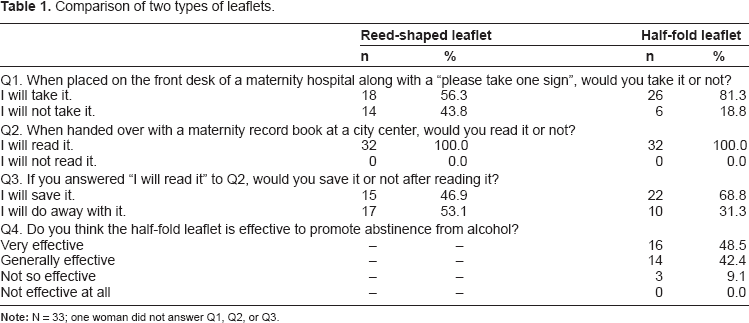
During the group interviews, the participants were asked four questions (Table 1) and to give reasons for their answers regarding two different leaflets about alcohol consumption targeting pregnant women. A reed-shaped leaflet was made by a nonprofit organization (National Citizens' Association for Alcohol and Drug Problems) which consults on alcohol problems (Fig. 1). A half-fold leaflet was newly developed for this study (Fig. 2).
Comparison of two types of leaflets.

A reed-shaped leaflet.

A half-fold leaflet.
Results
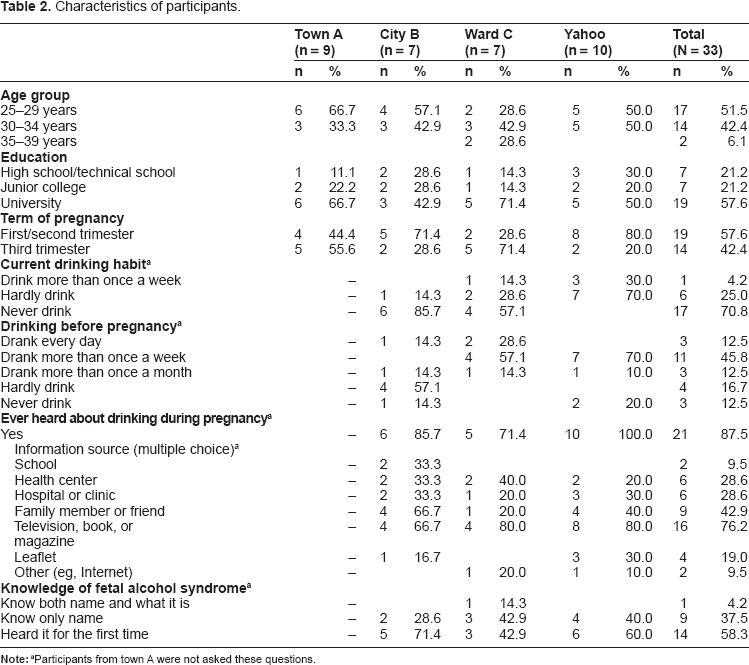
A total of 33 women participated in the interviews (Table 2). Each woman was in her first pregnancy. Table 1 shows their answers to the questions asked during the interviews.
Characteristics of participants.
Question 1: Take or not take
Reed-shaped leaflet
If placed on the front desk of a maternity hospital along with a “please take one sign”, 56% of the women said they would pick up the reed-shaped leaflet. The main reason to take it was its clear title of “Pregnancy and alcohol”.
I' m aware that it is bad, but I don' t know the specific details so the title of “Pregnancy and alcohol” aroused my curiosity and made me interested in reading the leaflet.
I don' t drink alcohol, but the words “pregnancy” makes me want to take a copy.
It seems I never get a clear answer when asking people whether alcohol is good or bad, so I would take a copy because it seems like it would have the answer.
I can determine the contents from the title of “Pregnancy and alcohol”. On the other hand, this title also became an inhibitor because it did not attract women who do not drink or those who felt they were already aware of the problem.
Half-fold leaflet
The importance of the title was also highlighted in the comments on the half-fold leaflet. The ambiguous title, “What a mom can do for her baby to be born” attracted many women. The copy appealed to a mother's love, along with the photograph of a pretty baby.
The title “What a mom can do for her baby to be born” left an impression, so I think I would definitely take a copy; I think the title would make me want to take a copy regardless of what was actually written inside.
Looking at the title makes me wonder what type of good things I do right now, and makes me want to read the leaflet.
The title makes me wonder what the leaflet is about.
In addition to the title, other components and the overall design of the front cover were important.
The “What a mom can do” part of the title made me want to read the leaflet, and the picture of the baby was cute which made me interested.
First the title made me interested in the content of the leaflet, then the gentle colors and the design made me want to find out what the leaflet was about.
The design was stylish, the photo of the baby was cute, and it seemed easy to understand, so I think there is a high chance I would take a copy with me.
Meanwhile, the ambiguous title worked negatively for three women.
I wouldn' t take it after just glancing at it, because I can' t see what the content is.
If it said “alcohol” on the cover I think I would take a copy. If I opened it I think I would take a copy.
Looking at just the cover the content was vague and I didn' t know what it was about. I think I would take a copy if the content was also noted.
Question 2: Read or not read
All the women said they would read both types of leaflets if they were handed over directly (Table 1).
Question 3: Save or not save
The percentage of women who said they would save the leaflet after reading it was smaller for the reed-shaped leaflet (47%) compared with the half-fold one (69%).
Reed-shaped leaflet
The main reason to save the reed-shaped leaflet was not related to its content. The women just made it a rule to save whatever they received until the delivery.
If I received it together with the maternity record book, I would keep it until the birth.
On the other hand, the main reason not to save the reed-shaped leaflet was its simple content. They said that they need not to save this because if they read once, they could understand it and remember what it said.
Basically, this just says it's better not to drink alcohol, so I think I would probably throw it away after understanding that.
Half-fold leaflet
In contrast, many women said they would save the half-fold leaflet because of its detailed contents.
There were a lot of things I didn' t know in the content so I would keep it.
It's very easy to read, has a picture and was detailed.
Presentation of a bar graph had a great impact on the women. More than 90% of the women liked its inclusion in the leaflet (data not shown in Table).
The graph is very persuasive.
The graph showing weekly organ development was interesting.
The photograph of a child with fetal alcohol syndrome (FAS) in the leaflet had shock value for two women.
The photo of the boy with FAS was very shocking, and the advice that we must be careful serves as a warning.
The right page on the two-page spread was shocking, and what would actually happen when a disorder occurs left a strong impression, so I think I would keep it.
Some women said they would save it to pass on the information to others.
It makes me think about giving a copy to friends who are pregnant yet still drinking alcohol.
I would keep it because I thought the contents were something I' d want to show to my husband.
It can be used as advice when offered alcohol, as in “this is why I don' t want to be offered alcohol”.
Question 4: evaluation of the half-fold leaflet
More than 90% of women said the half-fold leaflet was “very effective” (49%) or “generally effective” (42%, Table 1). The photograph of a child with FAS was highly rated as an image that made the leaflet effective.
I thought it was effective because it had a photo of an actual example and it was the first time I had seen such a photo.
I think it was very convincing with the graph and the photo of an actual child alive now.
The graph and photo were good; seeing this leaflet for just a few seconds made me think maybe I should quit drinking.
The photo and graph make it clear that alcohol while pregnant is bad.
The photo and graph made the content easily understandable.
The photo of the child with FAS had a strong impact.
In addition, the women appreciated the information in the leaflet because it was clearly written and provided answers to what they wanted to know.
In books and such, they don' t say “
I think this is the first time I have seen so much information condensed so well.
Discussion
Leaflets as an educational tool
Educational leaflets can be disseminated in settings where time, educator preparation, cost, recipient attention span, and generally limited resources are constraints. Dissemination of information leaflets is a brief educational approach that is low in complexity and cost, and is not designed to be demanding of clients and the staff who implement it.
Many studies have been conducted to evaluate the effectiveness of educational leaflets.4–8 However, the most important contributor to the effectiveness of any leaflet is the extent to which it is read. In fact, 14% of young women admitted to not reading such a leaflet in an intervention study. 9
The process of educational material development has been widely reported in the literature,10–13 whereby participants were asked for feedback on the usefulness, credibility, and readability of information.12,13 Unlike previous studies, the discussion groups in this study focused on whether women would actually take and/or read the leaflets, because taking and reading is the first crucial step in educating people using leaflets. The reasons provided by the participants were analyzed according to individual components, including the front cover and illustrative material. The findings of this research could be used as a practical guide for those wishing to develop similar written material.
Background of participants
Although 88% of the women had already heard about drinking during pregnancy, only two women (10%) said that they had learned about it at school. According to a national survey in Japan, alcohol education was considered least important in health education in schools. 14 Although some schools provide alcohol education to their students, it usually focuses on prevention of underage drinking, and drinking during pregnancy is hardly mentioned. 15 Because few individuals receive education on alcohol during pregnancy in the course of their formal schooling, it is necessary to provide relevant information to young adults on an ad hoc basis. Dissemination of information leaflets at a maternity class can accomplish this.
In general, the media is the main source of health care information for the public. In this study, 76% of the women had heard about drinking during pregnancy through television, books, or magazines. However, some women had not been satisfied with the vague descriptions contained in these media. They appreciated that the clear messages in the half-fold leaflet helped them to make a decision not to drink. Messages that have an explicit conclusion or recommendation are more effective than are those that do not, and even with a highly motivated and intelligent target audience, explicit conclusions work better. 16
Audience segmentation
Audience segmentation has been proposed as a promising strategy to reach people for health education. 17 For example, demographic segmentation may focus on a particular race, gender, and/or educational level. 18 Different segments show different levels of acceptance of health education material. For instance, African American men have been reported to prefer print materials that are brief, use graphics of real African-American men, and provide a telephone number they can call for additional information on, eg, prostate and colorectal cancer. 19 African American women in the southeastern US have been reported to like high-quality materials that are brief, avoid jargon, and use simple language, bright colors, and photographs, and provide useful information that acknowledges the content of their lives, including their family role, in physical activity, and diet. 20 In contrast, the participants in this study preferred the half-fold leaflet containing more detailed information than the brief reed-shaped leaflet. None of the women showed resistance to jargon, eg, FAS or the academic presentation of fetal development in a bar graph. Their interest was sufficiently stimulated that they requested more information, and this might be one of the defining characteristics of pregnant women.
The target population in this study lived in the same geographic area. They were pregnant for the first time, and 94% were 34 years of age or younger. On account of these criteria, they had already been segmented into a small and homogenous group. The tailoring of educational materials using focus group data is a good approach to making them effective among such groups.
Front cover
Other Japanese research suggests that direct distribution of a leaflet is more effective than the placement method. 21 All the participants in this study said that they would read both types of leaflet if they were handed over to them directly. However, most advertising activities by Japanese public health sectors involve placement of printed materials in public facilities.
In the situation of placement, the first impression made by the front cover was a determining factor in whether the women would take it or not. The importance of the leaflet design was also confirmed by other focus group study on nutrition education. 22 It could be concluded that, in a half-fold leaflet, design of the front cover is crucial. On the other hand, an intriguing front cover could attract women, even those who declined to take and read the reed-shaped leaflet on the basis that they do not drink or are already aware of pregnancy and alcohol.
Content
Printed educational materials have two advantages. One is that they can deliver information wherever they are distributed. Another is that they continue to deliver information as long as they are kept. In fact, some participants said they would save the half-fold leaflet to pass on the information to others.
Content of the leaflet had a great impact on the decision to save it or not. Graphic presentation using a bar graph was rated as convincing and informative. By comparing the responses to the two leaflets, it was shown that the women wanted to save the leaflet containing more detailed information, and that this was related to the characteristics of the study population. Participants were clearly interested in the information and saw it as a way in which to improve the health of their baby by acquiring knowledge that would benefit them and their child.
Elaboration likelihood model
According to the elaboration likelihood model, messages can be processed by two routes, ie, centrally, by thoughtful consideration and evaluation of the information given, and peripherally, by simply using heuristics or peripheral cues like attractiveness or an expert source. 23 A person's motivation and ability to process a given message determines the level of elaboration likelihood, ie, how much effort one puts into processing the message. Both motivation and ability are necessary for systematic processing or taking the central route to persuasion. Conversely, when a person's motivation or ability to process a given message is low, the communication effect is more likely to be influenced by heuristic cues. 24
Regarding the problem of dioxin-contaminated breast milk, mothers' attitudes towards breast feeding were adopted centrally by absorbing a full understanding of the information given, because they were highly motivated to consider the risk to their baby's health. 25 For mothers-to-be and mothers of babies who are conscious of their children's health, it is important to support information-processing via the central route. Because they are already motivated to learn the information, content quality might be more important than peripheral cues.
Based on the elaboration likelihood model, Drossaert et al made two versions of the tailored leaflet, ie, a simple version and an extended version with added peripheral cues, ie, use of glossy paper, colors, and colored pictures. 26 The results revealed that there were no differences in reparticipation rate in breast cancer screening programs between the two leaflet groups. The investigators speculated that this might be due to the fact that the women could all be regarded as highly involved because they had already participated in the first round of the screening program.
In addition, the elaboration likelihood model suggests that prior knowledge may affect one's information processing. 23 Almost 90% of the participants had previously heard about drinking during pregnancy from a variety of information sources. It is possible that they had a greater ability to process the message because they had prior knowledge about the topic.
Real-life examples
The photograph of a child with FAS was rated highly as an image that made the leaflet effective. It was considered as a kind of real-life example. It is known that narratives and anecdotes can be very persuasive. 27 Walker et al showed that participants perceived information as being more credible when testimonials were included. 28 The vividness of real-life examples affects decision-making by increasing the emotional interest, proximity, and/or concreteness of the information. 29
Persuasion through the experiential pathway depends on two interrelated processes, ie, self-referencing and emotional responding. 30 Self-referencing refers to the process of relating the message to aspects of oneself and one's life, and has been demonstrated to have many positive persuasive effects. The impact of emotional responses to persuasive messages has been considered in depth in the literature in terms of shock value, with a recent meta-analysis confirming the impact of message-stimulated fear as a driver of behavior and intentions. 31 The photograph of a child with FAS was met with fear by some participants. Both self- referencing and emotional responding were found to be associated with feelings of personal risk that were subsequently related to intentions to change. 30
Conclusion
This study investigated the features of leaflets that attract pregnant women by comparing two types of leaflets. The main findings were that the design of a leaflet's front cover plays an instrumental role in attracting women, and, if readers are interested in the topic, they prefer a leaflet with detailed content, and a convincing real-life example, in this case a photograph of a child with FAS. With regard to generalizability, the findings and recommendations from this study may not be applicable to other areas, eg, some of the rural areas in Japan.
Disclosure
This manuscript has been read and approved by the author. This paper is unique and is not under consideration by any other publication and has not been published elsewhere. The author and peer reviewers of this paper report no conflicts of interest. The author confirms that they have permission to reproduce any copyrighted material. This paper is a part of study. Another part of the same study has been published in Clinical Medicine Insights: Women's Health 2011; 4:17–33.
Footnotes
Acknowledgments
The author would like to thank the women who participated in this study, which was supported by a grant from the Ministry of Education, Culture, Sports, Science and Technology, Japan.